

The Great White Heron and Great Egret are tall, completely white wading birds that can appear nearly identical from a distance. However, they are not the same bird. The Great White Heron is a white form of the Great Blue Heron, while the Great Egret is a separate species. Size, leg color, bill shape, head plumes, habitat, and geographic range provide the most reliable identification clues. This guide explains how to distinguish these elegant birds in the field.
Great White Heron vs Great Egret: Quick Comparison
The easiest way to separate these birds is to examine their legs. A Great Egret normally has black legs, while a Great White Heron has pale gray, yellowish, or flesh-colored legs. The Great White Heron is also heavier, taller, and equipped with a thicker bill.
| Feature | Great White Heron | Great Egret |
| Scientific identity | White form of Ardea herodias | Ardea alba |
| Size | Very large and heavy | Large but slimmer |
| Bill | Heavy, thick and yellow | Slender, pointed and yellow-orange |
| Legs | Pale gray or yellowish | Black |
| Feet | Pale | Black or dark |
| Head plumes | Usually present | No long head plumes |
| Neck | Thick and powerful | Long and slender |
| Main habitat | Coastal saltwater wetlands | Freshwater and saltwater wetlands |
| Primary range | Southern Florida and Caribbean | Widespread worldwide |
Are the Great White Heron and Great Egret the Same?
No. Although both belong to the heron family, they have different biological identities.
Great White Heron
The Great White Heron is generally treated as the white form or subspecies of the Great Blue Heron. It has the large body, strong neck, heavy bill, and overall proportions of a Great Blue Heron, but its plumage is entirely white.
This bird is associated mainly with southern Florida, particularly Florida Bay and the Florida Keys, as well as parts of the Caribbean. It is uncommon outside that region, although wandering individuals occasionally appear elsewhere.
Great Egret
The Great Egret is a separate species named Ardea alba. It is widely distributed across North America, South America, Europe, Africa, Asia, and Australia.
Great Egrets occupy freshwater and coastal wetlands, including marshes, lakes, rivers, estuaries, mangroves, ponds, and flooded fields. They are much more widespread than Great White Herons.
Physical Differences
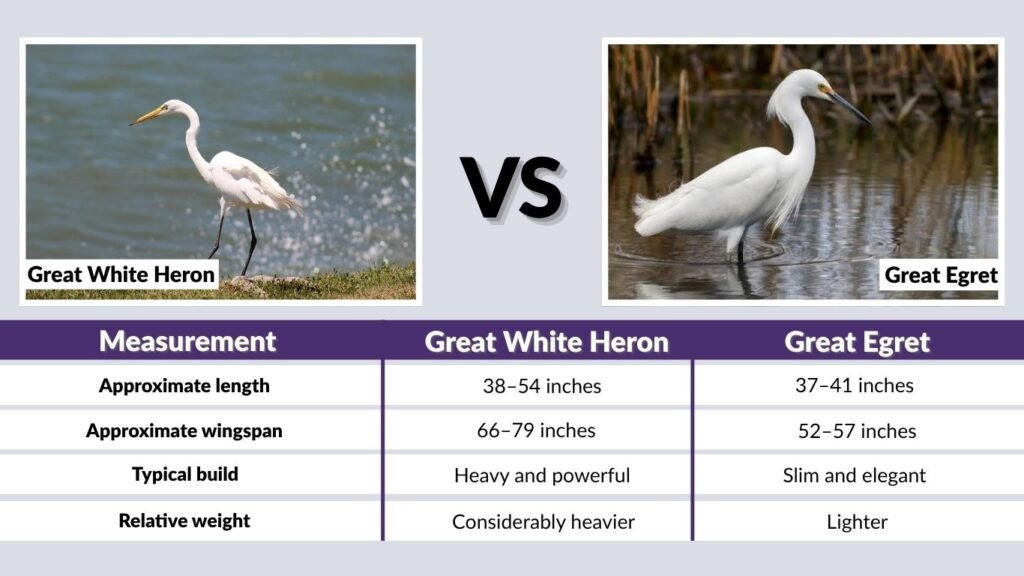
Both birds have white feathers, long necks, yellowish bills, and long legs. Close observation reveals noticeable differences in size and body structure.
Size and Weight
The Great White Heron is generally larger and much heavier. As a form of the Great Blue Heron, it may measure approximately 38 to 54 inches long, with a wingspan approaching 80 inches. Great Blue Herons commonly weigh more than twice as much as Great Egrets.
A Great Egret normally measures about 37 to 41 inches long and has a wingspan of approximately 52 to 57 inches. Its body is slender and graceful rather than heavy.
| Measurement | Great White Heron | Great Egret |
| Approximate length | 38–54 inches | 37–41 inches |
| Approximate wingspan | 66–79 inches | 52–57 inches |
| Typical build | Heavy and powerful | Slim and elegant |
| Relative weight | Considerably heavier | Lighter |
Measurements overlap because individuals vary, so size should be combined with leg and bill characteristics.
Leg and Foot Color
Leg color is usually the most dependable field mark.
The Great White Heron has pale legs that may appear grayish, dull yellow, greenish-yellow, or flesh-colored depending on age, lighting, and breeding condition. Its feet are also relatively pale.
The Great Egret has distinctly black legs and dark feet. When enough of the bird is visible, this feature often provides an immediate identification.
Bill Shape
Both birds have yellow or yellow-orange bills, but the shapes are different.
A Great White Heron has a long, deep, heavy bill that appears thick from base to tip. Its bill gives the head a powerful, spear-like appearance.
The Great Egret has a narrower and more sharply pointed bill. It remains an effective hunting tool but looks noticeably slimmer when the two birds are viewed together.
Head and Neck
The Great White Heron has a larger head and thicker neck. It may also display noticeable head plumes extending from the back of the crown, a feature inherited from the Great Blue Heron.
The Great Egret has a smaller head and a long, slender S-shaped neck. During the breeding season, it develops beautiful ornamental feathers across its back, but it lacks the long head plumes associated with Great Blue Herons.
Breeding Plumage Differences
Breeding season can make identification slightly more complicated because both birds develop brighter facial colors and decorative feathers.
Great Egret Breeding Appearance
A breeding Great Egret develops long, delicate plumes called aigrettes across its back. The bare skin between its eyes and bill becomes bright green, while its yellow-orange bill may temporarily darken in some regional populations.
Both males and females can develop ornamental breeding feathers. The plumes are displayed during elaborate courtship movements involving neck stretching, bowing, and feather raising.
Great White Heron Breeding Appearance
A Great White Heron can develop longer head, chest, and back plumes during the breeding season. Its bill may become brighter, and the legs can appear pinkish or more intensely colored.
Its heavier head, thicker bill, pale legs, and larger body remain useful identification features throughout the year.
Habitat and Range Differences

Habitat can offer another important clue, especially in Florida.
| Category | Great White Heron | Great Egret |
| Preferred water type | Mostly saltwater | Freshwater and saltwater |
| Common locations | Mangroves, tidal flats, coastal ponds | Marshes, ponds, rivers, lakes, estuaries |
| Geographic distribution | Southern Florida and Caribbean | Worldwide distribution |
| Social behavior | Frequently solitary | Solitary while feeding but colonial when nesting |
| Likelihood away from Florida | Very uncommon | Common across many regions |
Where Great White Herons Live
Great White Herons are strongly associated with shallow coastal environments. They are especially characteristic of mangrove islands, tidal flats, lagoons, saltwater ponds, and seagrass shallows in southern Florida.
The Great White Heron National Wildlife Refuge protects extensive mangrove islands and shallow marine habitats in the Lower Florida Keys.
Where Great Egrets Live
Great Egrets use a broader range of habitats. They can be found around freshwater marshes, farm ponds, rivers, reservoirs, flooded fields, coastal bays, mudflats, mangroves, and estuaries.
Therefore, a large white bird beside an inland lake is much more likely to be a Great Egret than a Great White Heron.
Feeding Behavior and Diet

Both birds are carnivorous hunters that use their long bills to capture aquatic prey. Their diets include fish, frogs, crustaceans, aquatic insects, reptiles, and other small animals.
Great White Heron Hunting Style
Great White Herons frequently hunt alone. They walk slowly through coastal shallows or remain motionless while waiting for fish to move within striking distance. Their heavy bills can handle relatively large prey.
Great Egret Hunting Style
Great Egrets also stalk slowly or stand still in shallow water. When prey comes close, they rapidly extend their necks and strike with their pointed bills. They mainly eat fish but also capture amphibians, crustaceans, insects, snakes, and small mammals.
Differences in Flight
Both birds fly with their necks folded into an S-shape and their legs trailing behind the tail. The Great White Heron, however, appears broader, heavier, and more powerful in flight.
The Great Egret has a lighter appearance, with a slimmer neck, narrower head, and more delicate proportions. Its black legs can sometimes be visible even at a moderate distance.
Best Identification Clues in Flight
Look for the following:
- Overall size: Great White Heron is larger.
- Wing shape: Great White Heron has broader-looking wings.
- Leg color: Great Egret has black trailing legs.
- Bill thickness: Great White Heron has a heavier bill.
- Head shape: Great White Heron often appears more massive.
Great White Heron vs Snowy Egret

A Snowy Egret is much smaller than either the Great White Heron or Great Egret. It has a thin black bill, black legs, and bright yellow feet.
The Great White Heron is several times heavier and has a thick yellow bill with pale legs. The Great Egret is also significantly larger than a Snowy Egret and has a yellow bill, black legs, and dark feet.
Which Identification Feature Is Most Reliable?
Leg color is the best place to begin:
- Black legs: Great Egret
- Pale gray or yellowish legs: Great White Heron
Next, evaluate the bird’s build. A massive white bird with a thick neck and heavy bill is probably a Great White Heron. A slimmer bird with a narrow neck and elegant proportions is more likely a Great Egret.
Location provides additional support. In most places outside southern Florida and the Caribbean, a large white heron with a yellow bill is almost certainly a Great Egret.
FAQs
Is a Great White Heron simply a white Great Blue Heron?
Yes. The Great White Heron is generally classified as a white form or regional subspecies of the Great Blue Heron. It has the same large proportions and heavy bill but entirely white plumage. It occurs mainly in southern Florida and parts of the Caribbean.
What is the easiest way to distinguish them?
Examine the legs first. A Great Egret normally has completely black legs and dark feet. A Great White Heron has pale gray, yellowish, greenish, or flesh-colored legs. Size and bill thickness provide additional confirmation when the legs are hidden by water or vegetation.
Which bird is larger?
The Great White Heron is larger and substantially heavier than the Great Egret. It has broader wings, a thicker neck, a larger head, and a more powerful bill. The Great Egret remains a large bird but has a noticeably slimmer and more delicate overall appearance.
Can Great White Herons and Great Egrets live together?
Yes. Their ranges overlap in southern Florida, where both may feed in coastal wetlands, mangroves, lagoons, and tidal shallows. They may appear near each other, although Great White Herons tend to favor saltwater habitats while Great Egrets use both freshwater and coastal environments.
Are Great White Herons rare?
Great White Herons have a restricted distribution and are uncommon compared with Great Egrets. Most live in southern Florida and the Caribbean, with Florida Bay supporting an important population. Sightings far outside this region are unusual and often attract considerable attention from birdwatchers.
