
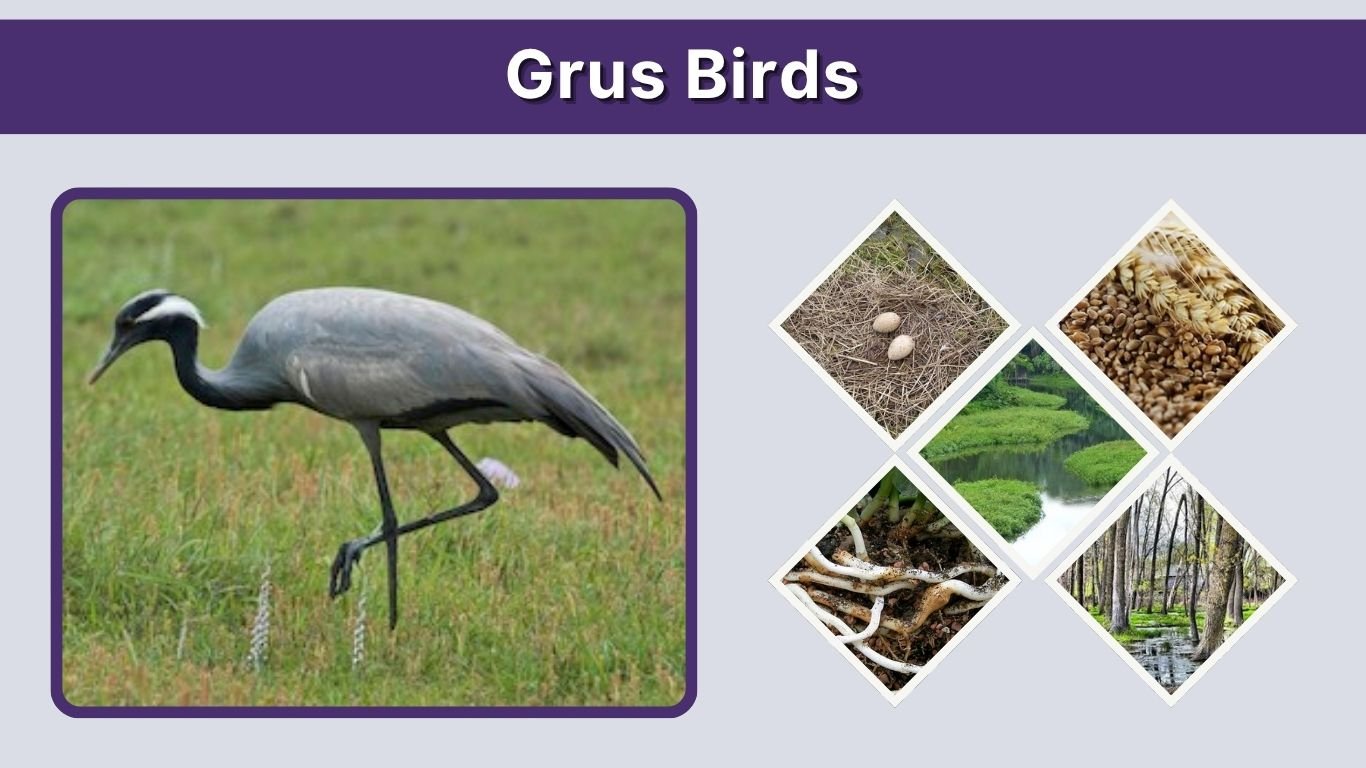
Grus is a genus of large, long-legged birds belonging to the crane family, Gruidae. Its members include some of the world’s most recognizable cranes, such as the Common Crane, Whooping Crane, and Red-crowned Crane. These elegant birds are known for their trumpeting calls, complex dances, lifelong or long-lasting pair bonds, and impressive migrations. Most Grus cranes depend on wetlands for nesting but also visit grasslands, agricultural fields, high plateaus, and open countryside to find food.
Grus Scientific Classification
The word Grus comes from Latin and means “crane.” The genus was formally established by French zoologist Mathurin Jacques Brisson during the 18th century.
| Classification | Name |
|---|---|
| Kingdom | Animalia |
| Phylum | Chordata |
| Class | Aves |
| Order | Gruiformes |
| Family | Gruidae |
| Genus | Grus |
Taxonomic authorities do not all define the genus in exactly the same way. A broad classification places eight living species in Grus. Other major bird checklists move the Wattled Crane to Bugeranus and the Blue and Demoiselle Cranes to Anthropoides, leaving five species in Grus.
Species in the Grus Genus
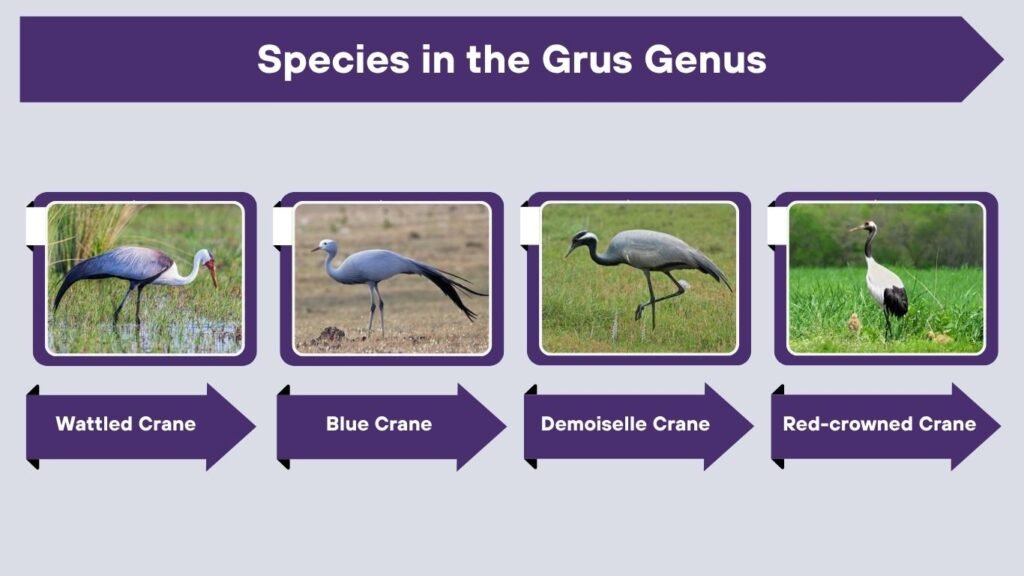
Under the broader classification, the genus contains eight living species. They occur across Europe, Asia, Africa, and North America.
| Common Name | Scientific Name | Main Distribution |
|---|---|---|
| Wattled Crane | Grus carunculata | Eastern and southern Africa |
| Blue Crane | Grus paradisea | Southern Africa |
| Demoiselle Crane | Grus virgo | Europe, Central Asia, and northern Africa |
| Red-crowned Crane | Grus japonensis | Northeastern Asia |
| Whooping Crane | Grus americana | North America |
| Common Crane | Grus grus | Europe, Asia, and northern Africa |
| Hooded Crane | Grus monacha | Eastern Asia |
| Black-necked Crane | Grus nigricollis | Tibetan Plateau and surrounding regions |
1. Wattled Crane
The Wattled Crane is a tall African species identified by its white neck, dark body, red facial skin, and white wattles hanging beneath its throat. It depends heavily on shallow wetlands with soft aquatic vegetation.
These cranes live mainly in parts of southern and eastern Africa. Important populations occur in Zambia, Botswana, Ethiopia, and several neighboring countries. Wetland drainage, altered flooding patterns, and disturbance threaten many populations.
2. Blue Crane
The Blue Crane is a relatively small, elegant crane native to southern Africa. It has pale blue-grey plumage, a rounded head, and long dark feathers that hang behind the wings.
It is strongly associated with South Africa, where it is the national bird. Blue Cranes use grasslands, agricultural areas, and shallow wetlands. Unlike many cranes, they often forage in relatively dry environments.
3. Demoiselle Crane
The Demoiselle Crane is the smallest crane species. It has a grey body, black neck and chest, red eyes, and long white feathers extending behind each eye.
Its breeding range stretches across open landscapes from parts of eastern Europe through Central Asia to Mongolia and northern China. Many populations migrate south to Africa or the Indian subcontinent during winter.
4. Red-Crowned Crane
The Red-crowned Crane is a large white crane with black secondary feathers, a black neck, and a patch of bare red skin on its crown. It is an important cultural symbol of longevity, loyalty, and good fortune in East Asia.
Migratory populations breed in northeastern China and eastern Russia before wintering in China and on the Korean Peninsula. A largely nonmigratory population lives in Hokkaido, Japan.
5. Whooping Crane
The Whooping Crane is one of North America’s tallest birds. Adults are white with black wing tips, long dark legs, and red and black markings on the head.
The species experienced a dramatic population decline because of hunting and wetland destruction. Intensive habitat protection, captive breeding, monitoring, and reintroduction programs have helped it recover, but it remains vulnerable.
6. Common Crane
The Common Crane, also called the Eurasian Crane, has a slate-grey body, black-and-white neck, and bare red crown. It breeds across northern Europe and Asia.
Many populations migrate south for winter, traveling in V-shaped flocks. European cranes commonly winter in France, Spain, Portugal, and northern Africa, while Asian populations travel toward the Middle East, India, or China.
7. Hooded Crane
The Hooded Crane is one of the smaller members of the genus. It has a dark grey body, white head and upper neck, black face, and a small patch of red skin on its crown.
It breeds in remote wetlands of eastern Russia and possibly neighboring parts of Asia. A large percentage of the global population gathers at a limited number of wintering sites in Japan, making the species vulnerable to disease and habitat disturbance.
8. Black-Necked Crane
The Black-necked Crane is a high-altitude Asian species with a pale grey body, black head and neck, white area behind the eye, and red crown.
It breeds on the Tibetan Plateau and in surrounding parts of China and India. Some populations move to lower valleys in Bhutan, China, and India during winter. The bird has important cultural and spiritual significance in several Himalayan communities.
Size and Appearance of Grus Birds
Members of Grus are medium-to-large cranes with long legs, long necks, broad wings, and relatively short tails. Their height and weight vary considerably by species.
Smaller species, such as the Demoiselle Crane, stand around 85–100 centimeters tall and weigh approximately 2–3 kilograms. Larger species, including the Red-crowned and Whooping Cranes, may stand 140–160 centimeters tall and weigh more than 7 kilograms.
Common Physical Features
Most Grus cranes share several characteristics:
- Long legs adapted for walking through wetlands
- Long neck used to reach food and produce displays
- Straight, pointed bill
- Broad wings suitable for soaring and migration
- Long inner wing feathers that hang over the tail
- Grey, white, or bluish plumage
- Bare red skin on the head in several species
- Loud, resonant calls
Males and females usually have similar plumage. Males are generally larger, but determining sex from appearance alone can be difficult.
Juveniles tend to have browner, duller feathers and lack the bright facial patterns and bare red crowns of mature birds.
Habitat and Distribution

Grus cranes occupy a wide range of habitats, but wetlands are particularly important during nesting. Different species have adapted to environments ranging from African floodplains to the cold, high-altitude wetlands of the Tibetan Plateau.
Breeding Habitats
Common breeding habitats include:
- Freshwater marshes
- Shallow lakes
- Forested swamps
- Peat bogs
- Flooded grasslands
- Wet meadows
- Reed beds
- River valleys
- High-altitude wetlands
Cranes usually select isolated nesting sites with shallow water. Water surrounding the nest can make it more difficult for land predators to approach unnoticed.
Feeding and Winter Habitats
Outside the breeding season, cranes may move into much drier areas. They regularly feed in grasslands, pastures, rice fields, harvested farmland, mudflats, and open plains.
Many species return to shallow wetlands at night, where they gather in communal roosts. Standing in water offers some protection from predators.
What Do Grus Birds Eat?
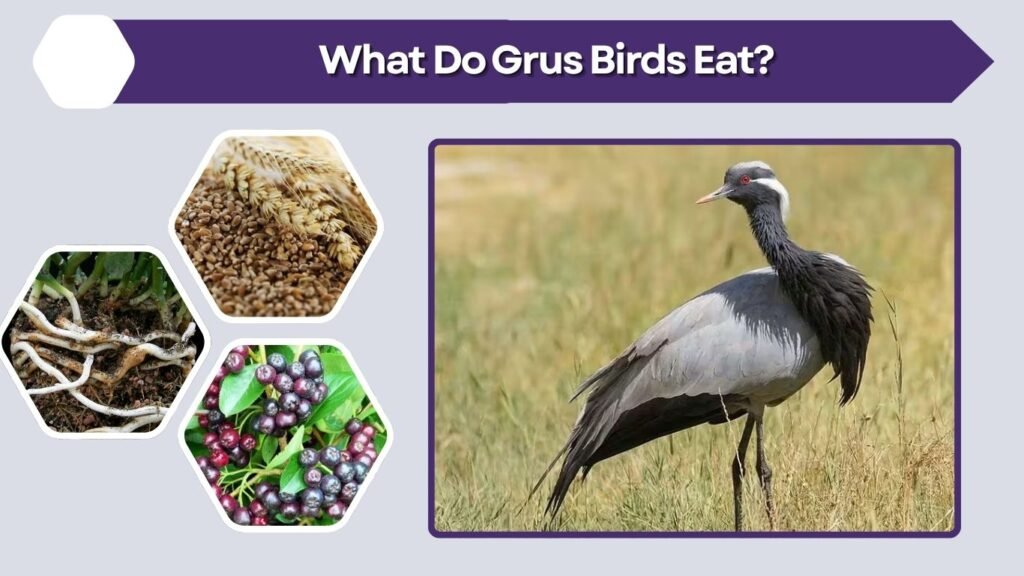
Cranes in the genus Grus are generally omnivorous. Their diet changes according to habitat, season, and food availability.
Plant Foods
Common plant foods include:
- Seeds and grains
- Corn, wheat, barley, and rice
- Roots and rhizomes
- Tubers
- Acorns
- Berries
- Young shoots
- Aquatic plants
Spilled grain in harvested fields is an important food source for many migrating and wintering cranes.
Animal Foods
Animal prey may include:
- Insects and insect larvae
- Earthworms
- Snails and other mollusks
- Frogs and tadpoles
- Small fish
- Crustaceans
- Lizards and snakes
- Rodents
- Bird eggs and small chicks
Cranes normally forage by walking slowly and picking food from the ground. They also probe soil, mud, and shallow water with their bills.
Calls and Dancing Behavior
Grus cranes are famous for their powerful calls. Their long windpipes help create resonant trumpeting sounds that can travel several kilometers.
Pairs frequently perform coordinated unison calls. This behavior strengthens the pair bond, advertises the pair’s territory, and warns other cranes to remain away.
Crane dances include jumping, bowing, running, wing flapping, and tossing vegetation into the air. Dancing is associated with courtship, but juveniles and nonbreeding adults also participate. It may support social bonding, coordination, and physical development.
Migration and Social Behavior
Several Grus species are long-distance migrants. Common, Demoiselle, Hooded, Red-crowned, and Whooping Cranes may travel hundreds or thousands of kilometers between breeding and wintering areas.
Migrating cranes frequently fly in V-shaped or diagonal formations. This arrangement allows birds behind the leader to benefit from favorable air movement created by the wings of the bird ahead.
Outside the breeding season, cranes become highly social. Hundreds or thousands may gather at traditional staging areas to rest and feed. Breeding pairs, in contrast, usually defend large territories and keep other cranes away from their nests.
Grus Life Cycle and Reproduction
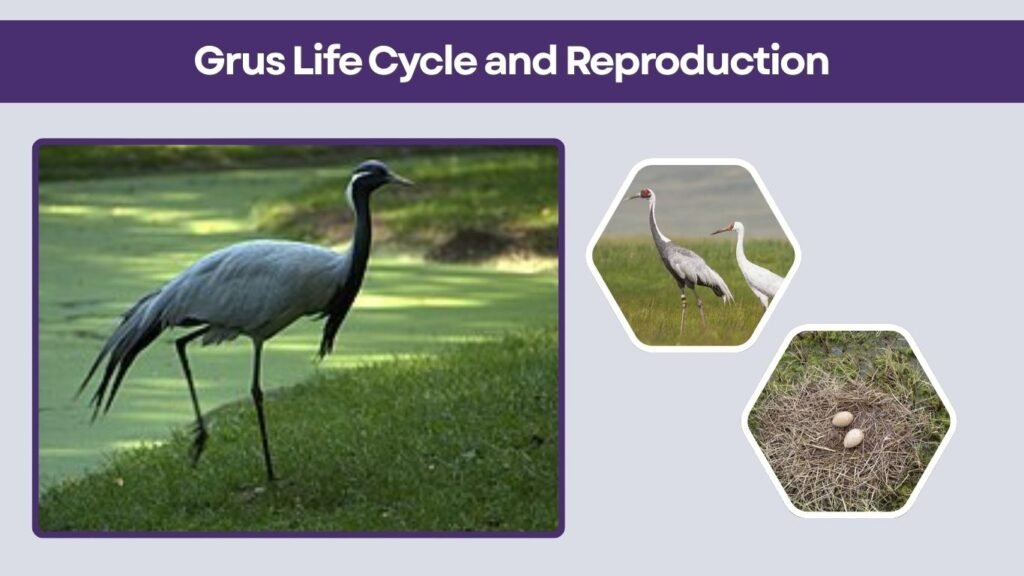
Cranes generally form long-lasting monogamous pair bonds. Some pairs remain together for life, although a surviving bird may find another mate if its partner dies.
Nesting and Eggs
Most species build large platform nests on the ground using reeds, grass, sedges, and other vegetation. Nests are usually positioned in shallow water or dense wetland vegetation.
A female commonly lays two eggs, although one-egg clutches occur in some species. Both parents may incubate, but the female usually performs a larger share of the work. Incubation generally lasts around 28–35 days.
Chicks and Parental Care
Crane chicks are precocial. They hatch covered in down, with open eyes and the ability to walk within hours. The family soon leaves the nest and travels through the surrounding wetland.
Both parents guard and feed the chicks. Young cranes begin picking up insects and plant material themselves but continue receiving food from their parents.
The chicks usually learn to fly between two and three months after hatching. Migratory young travel with their parents and often remain with them through winter. They normally leave the family before the next breeding season.
Most cranes do not begin breeding until they are several years old. Depending on the species, maturity may occur between three and seven years of age.
Lifespan and Predators
Wild cranes can live for several decades, although many chicks and juveniles do not survive their early years. Larger species may reach 20–30 years under favorable conditions.
Eggs and chicks are vulnerable to foxes, wild boar, raccoons, crows, ravens, and birds of prey. Adults have fewer predators because of their size and defensive abilities. They can strike with their sharp bills and kick powerfully with their legs.
Conservation of Grus Cranes
Many Grus cranes face serious conservation challenges. Major threats include wetland drainage, agricultural expansion, collisions with power lines, poisoning, hunting, disturbance, and loss of migration stopovers.
Species with small populations or limited wintering areas face especially high risks. Protecting breeding wetlands alone is insufficient; cranes also need safe migration routes, undisturbed roosts, and reliable winter feeding grounds.
FAQs
Is Grus a single bird species?
No. Grus is a scientific genus containing several crane species. Depending on the taxonomic system, it may include five or eight living species. The Common Crane, Grus grus, is one individual species within this genus.
Why do some sources list different Grus species?
Bird classification changes as scientists study anatomy, behavior, and DNA. Some authorities place the Wattled, Blue, and Demoiselle Cranes in separate genera, while others include them within the broader genus Grus.
Do Grus cranes mate for life?
Many cranes form long-lasting monogamous relationships that can continue for numerous breeding seasons. However, the death or disappearance of one bird may cause the surviving crane to form a new partnership.
Can Grus cranes fly?
Yes. Despite their large bodies, cranes are powerful fliers. Migratory species travel long distances using steady wingbeats, gliding, and rising columns of warm air. They often migrate in V-shaped formations.
Are Grus birds endangered?
Conservation status differs by species. Some have relatively large populations, while others remain threatened or vulnerable. Wetland loss, hunting, poisoning, power-line collisions, and concentration at a few nesting or wintering sites create continuing risks.
