
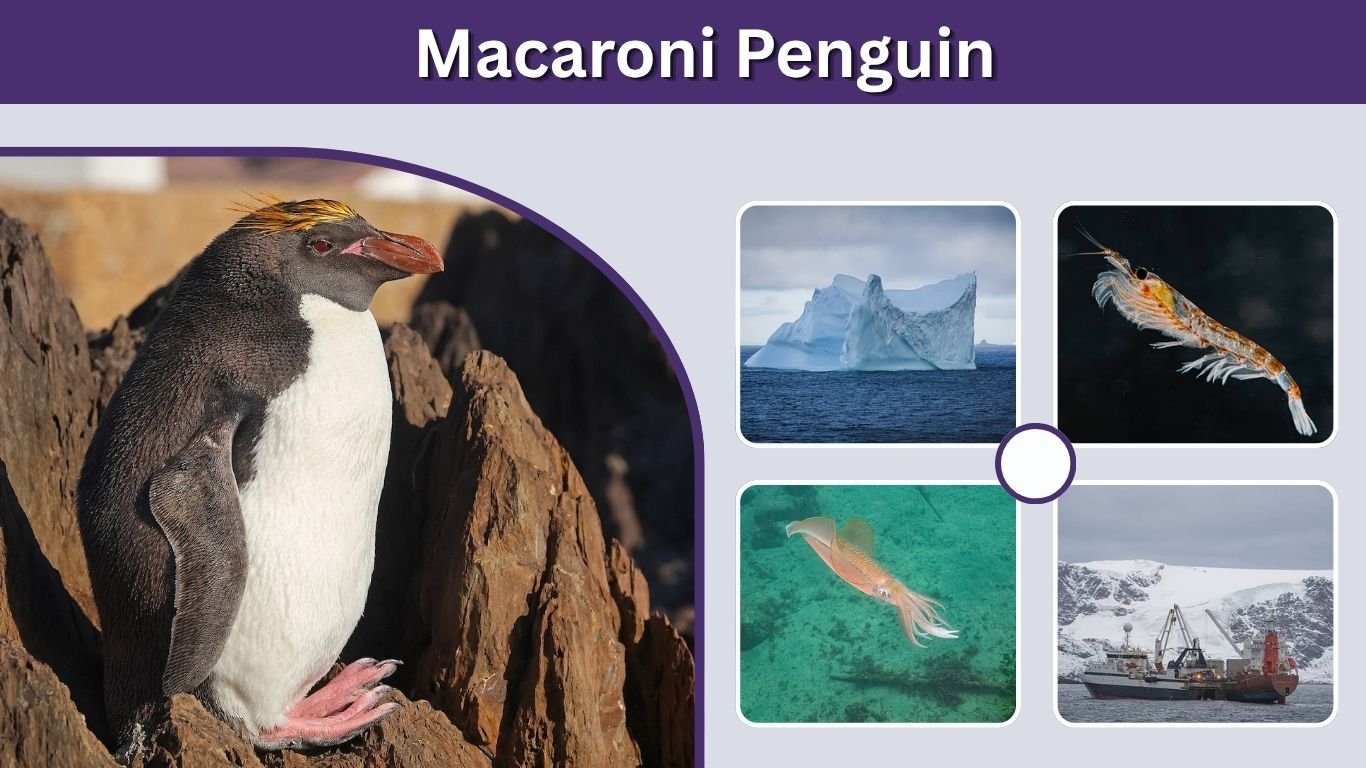
The macaroni penguin (Eudyptes chrysolophus) is one of the most recognizable penguins, thanks to the bright golden-orange feathers sweeping across its forehead. These social seabirds live mainly on sub-Antarctic islands, where they gather in enormous breeding colonies and spend much of their lives hunting at sea. From their unusual two-egg breeding strategy to their impressive diving ability, macaroni penguins have several fascinating adaptations. This guide covers their appearance, habitat, diet, behavior, chicks, lifespan, predators, and differences from rockhopper penguins.
What Is a Macaroni Penguin?
Macaroni penguins are medium-sized crested penguins belonging to the family Spheniscidae. Their scientific name, Eudyptes chrysolophus, refers to their diving ability and distinctive golden crest. Although their black-and-white body resembles many other penguins, the long yellow-orange feathers above the eyes make adults easy to recognize. Males and females look very similar, although males are generally slightly larger.
Macaroni Penguin Facts
Some useful facts about the species include:
- Scientific name: Eudyptes chrysolophus
- Family: Spheniscidae
- Height: Approximately 70 cm
- Weight: Around 4–7 kg
- Diet: Krill, fish and other marine animals
- Estimated lifespan: 20 years or more
- Conservation status: Vulnerable
- Main range: Sub-Antarctic islands and parts of the Antarctic Peninsula
Their weight changes during the year, particularly around breeding and moulting periods.
What Does a Macaroni Penguin Look Like?
An adult has a black head and back contrasting sharply with a white belly. Its most noticeable characteristic is the golden-yellow to orange crest beginning near the forehead and extending outward above the eyes.
Macaroni penguins also have a strong reddish-brown or orange-red bill. Their wings have evolved into rigid flippers that help propel their streamlined bodies through water.
The unusual crest is also connected with their common name. The term “macaroni” was associated with an extravagant style of dress and hairstyle fashionable among some young British men during the 18th century, and the penguin’s elaborate head feathers reminded people of that fashion.
Macaroni Penguin Habitat and Distribution
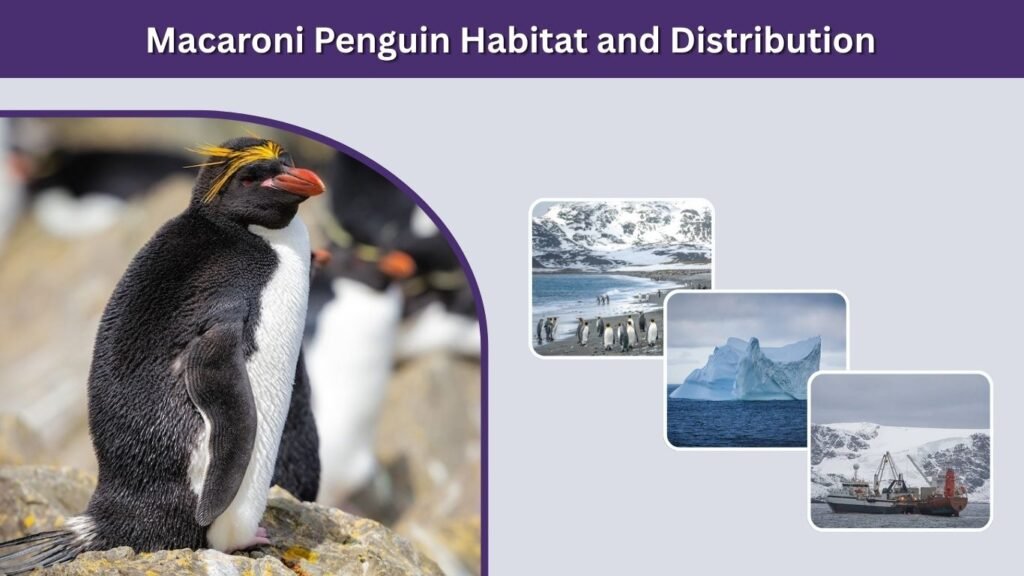
Macaroni penguins have a broad circumpolar distribution, but most do not live permanently on the Antarctic continent. Instead, breeding populations are concentrated on remote sub-Antarctic islands. They generally need access to productive ocean feeding areas along with rocky, open land where large colonies can establish nests during the breeding season.
Where Does the Macaroni Penguin Live?
Important breeding areas include:
- South Georgia
- South Sandwich Islands
- South Orkney Islands
- South Shetland Islands
- Crozet Islands
- Kerguelen Islands
- Prince Edward and Marion Islands
- Heard and McDonald Islands
- Bouvet Island
- Parts of southern Chile
- Northern Antarctic Peninsula
One particularly large colony occurs on Heard Island. Macaroni penguins can nest on surprisingly steep slopes and rocky coastal terrain.
Life at Sea and on Land
These penguins spend much of their lives in the ocean. Land becomes particularly important for breeding and moulting.
During the breeding season, thousands or even hundreds of thousands of birds may crowd together in noisy colonies. Birds use calls and displays while interacting with partners and defending nesting space. Once breeding and moulting are complete, they can disperse widely across the Southern Ocean.
What Do Macaroni Penguins Eat?
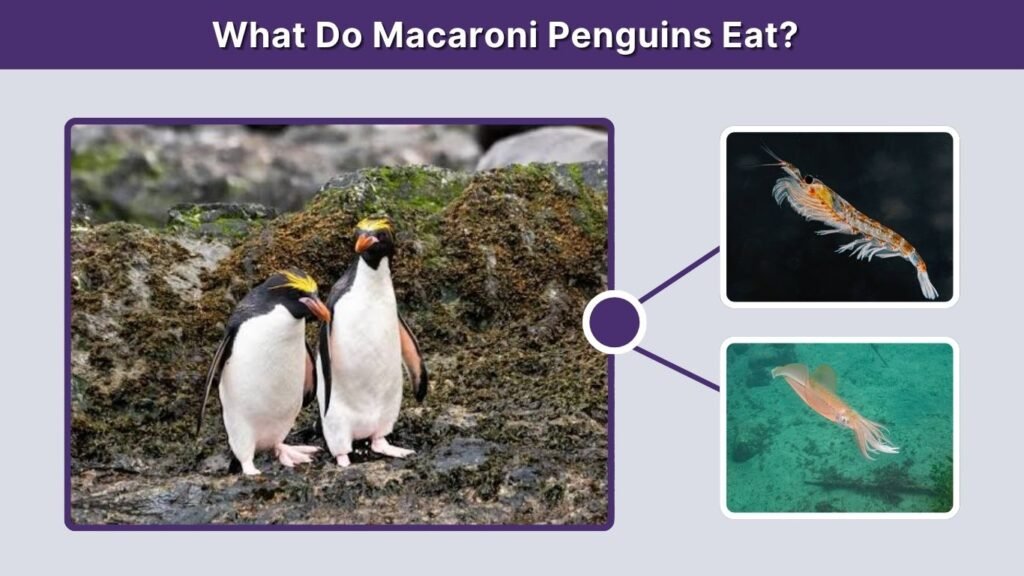
The macaroni penguin is a marine predator whose diet changes somewhat according to location and available prey. Antarctic krill can be especially important, but these birds are flexible enough to consume several types of ocean animals. Their strong flippers and streamlined bodies allow them to pursue prey underwater rather than feeding only at the surface.
Macaroni Penguin Diet
Common foods include:
- Antarctic krill
- Other small crustaceans
- Small fish
- Squid and other cephalopods
Krill can form a major part of the diet in some locations. What an individual eats depends on season, colony location and which prey species are available nearby.
Diving and Feeding Behavior
Macaroni penguins are powerful pursuit divers. Although many feeding dives occur between roughly 15 and 50 meters, they are capable of diving deeper than 220 meters. Their foraging journeys also vary dramatically with breeding stage and food availability.
Trips recorded by the Australian Antarctic Program can range from about a day to several weeks, with birds sometimes covering very long distances while searching for food.
Macaroni Penguin Breeding and Life Cycle
Macaroni penguins return to crowded colonies for their annual breeding cycle. The timing varies between locations, but breeding activities are highly synchronized within individual colonies. One of the most unusual features of their reproductive biology is the production of two noticeably different-sized eggs, even though normally only one chick is successfully raised.
Eggs and Macaroni Penguin Chicks
Their breeding cycle includes several unusual features:
- A female normally lays two eggs.
- The first egg is considerably smaller.
- The larger second egg is usually the successful one.
- Parents participate in incubation and chick care.
- A young penguin eventually joins other chicks before becoming independent.
- Fledging generally occurs within about two months of hatching.
The Australian Antarctic Program reports that females generally begin breeding at around five years old, while males commonly begin at about six.
Macaroni Penguin Lifespan
The exact longevity of wild macaroni penguins is difficult to establish because individuals spend enormous amounts of time at sea and can be challenging to monitor throughout life.
Current estimates suggest that they may live 20 years or more. Surviving that long requires coping with predators, harsh weather, food fluctuations and the physical demands of migration, breeding and annual moulting.
Adaptations, Predators, and Conservation
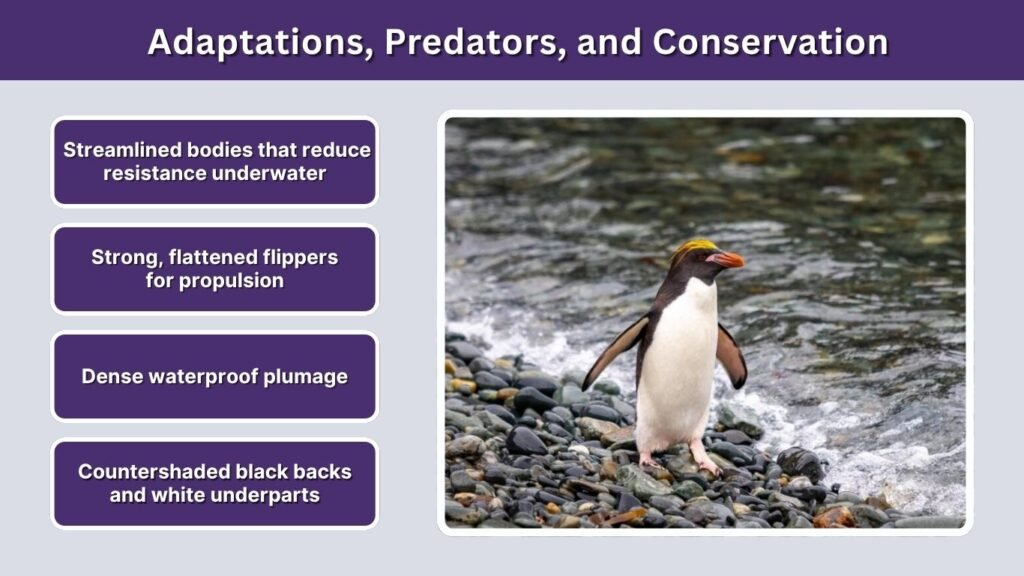
Living between cold ocean waters and exposed breeding colonies requires specialized adaptations. Macaroni penguins are superb swimmers, but they must also survive predators and changing marine conditions. Their global conservation status remains important because substantial declines have occurred in some populations, despite the species maintaining large breeding colonies across its geographic range.
Macaroni Penguin Adaptations
Important adaptations include:
- Streamlined bodies that reduce resistance underwater
- Strong, flattened flippers for propulsion
- Dense waterproof plumage
- Countershaded black backs and white underparts
- Strong feet for moving across rough coastal terrain
- Powerful diving ability for reaching underwater prey
- Colonial breeding behavior that brings large numbers of birds together
Like other penguins, their wings function as flippers rather than structures for flight.
Macaroni Penguin Predators
Adult macaroni penguins can be attacked by leopard seals and fur seals, particularly around the ocean and breeding areas.
Eggs and chicks face a different group of predators. Skuas, sheathbills and giant petrels may prey upon vulnerable young birds or eggs. As a result, the period between egg laying and fledging is a particularly challenging stage of the penguin’s life.
Conservation Status
The macaroni penguin is currently listed as Vulnerable in BirdLife’s penguin species information. Population declines have been documented, including significant changes at some major colonies. Scientists continue monitoring breeding populations to understand how ocean conditions, food availability and other environmental pressures influence their numbers.
Macaroni Penguin vs Rockhopper Penguin
Macaroni and rockhopper penguins can look confusingly similar because both belong to the genus Eudyptes and possess colorful crests. Looking at their overall size and crest pattern usually makes identification easier. Their geographical ranges also overlap in parts of the Southern Ocean, so knowing the physical differences is particularly useful.
Key Differences
- Size: Macaroni penguins are generally larger.
- Macaroni crest: Golden-orange feathers meet prominently across the forehead.
- Rockhopper crest: Yellow eyebrow-like feathers extend outward above the eyes.
- Macaroni weight: Approximately 4–7 kg.
- Southern rockhopper weight: Roughly 2–3.8 kg.
- Scientific names: Macaroni is Eudyptes chrysolophus; southern rockhopper is Eudyptes chrysocome.
Both are excellent swimmers and breed in colonies, but their crest arrangement provides one of the quickest visual clues for distinguishing them.
FAQs
Questions about macaroni penguins commonly focus on their unusual name, yellow head feathers, food and Antarctic distribution. Although frequently associated with Antarctica, these birds are especially characteristic of sub-Antarctic islands. Understanding these basic details helps explain how the species has adapted to a lifestyle divided between crowded breeding colonies and long periods at sea.
1. Why is it called a macaroni penguin?
The name is linked to the flamboyant “macaroni” fashion associated with some 18th-century British men. The penguin’s striking crest was compared with their extravagant hairstyles.
2. How tall is a macaroni penguin?
An adult macaroni penguin stands approximately 70 cm tall, although individual body size and weight vary according to sex and breeding stage.
3. What does a macaroni penguin eat?
Macaroni penguins primarily consume krill and other crustaceans, along with fish and cephalopods such as squid. The proportions vary according to their location and available food.
4. Do macaroni penguins live in Antarctica?
Some do occur around the Antarctic Peninsula, but most breeding colonies are located on sub-Antarctic islands distributed across the Southern Ocean.
5. How long does a macaroni penguin live?
Their longevity is not known precisely, but the Australian Antarctic Program estimates that macaroni penguins can live for 20 years or more.