
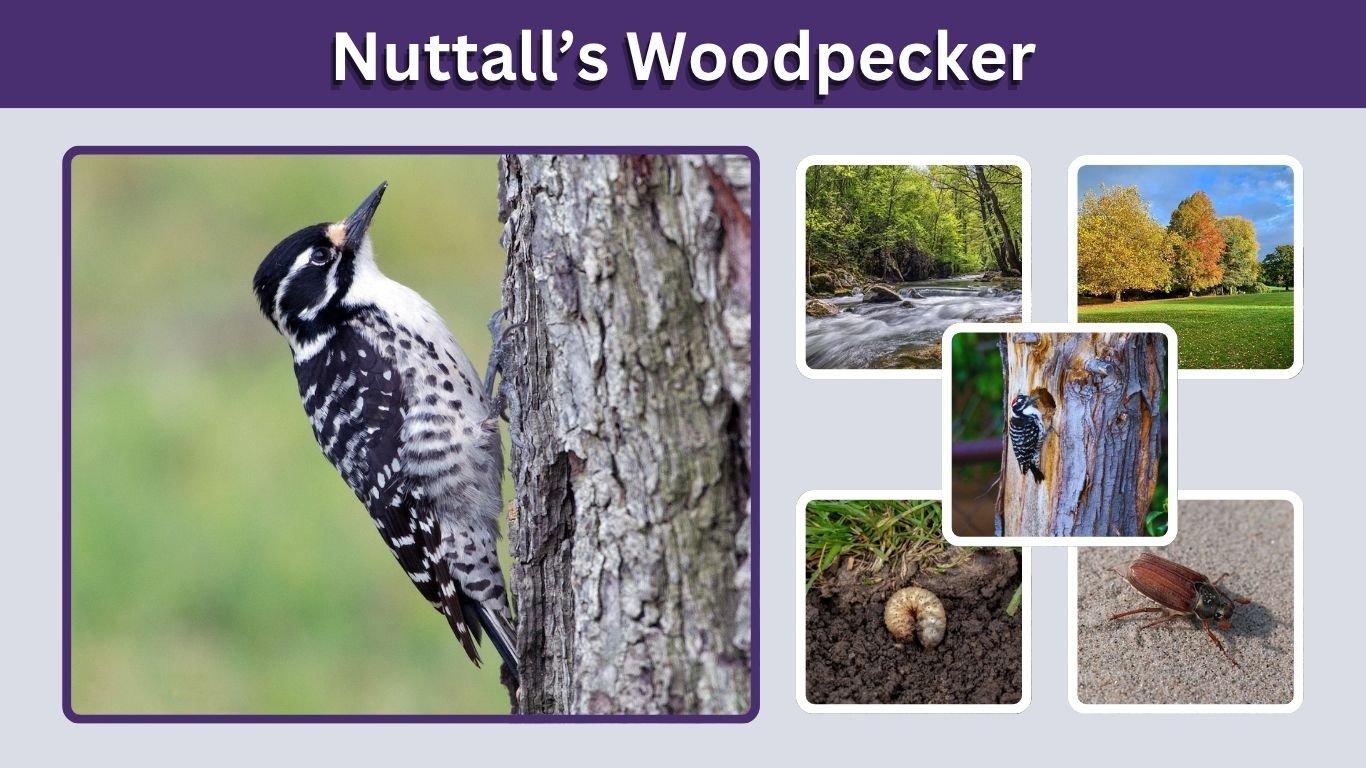
Nuttall’s woodpecker is a small, black-and-white bird closely associated with California’s oak woodlands. Its striped back, sharp calls, and energetic movements make it a rewarding species to watch, although it can disappear surprisingly quickly among leafy branches. Males and females look similar, while juveniles have markings that sometimes confuse identification. Learning a few reliable features helps separate this bird from downy, ladder-backed, and acorn woodpeckers. This guide explores its appearance, range, habitat, diet, nesting behavior, and the details that make it distinctive among North American woodpeckers.
Nuttall’s Woodpecker Identification
The scientific name of Nuttall’s woodpecker is Dryobates nuttallii. Older references may use Picoides nuttallii. This compact bird has a rounded head, a pointed bill, and a stiff tail that helps support it against tree trunks.
Main Identification Features
- Length: Approximately 6.3–7.1 inches, or 16–18 centimeters.
- Weight: Around 30–45 grams.
- Wingspan: Approximately 13–16.1 inches, or 33–41 centimeters.
- Back: Narrow black-and-white horizontal bars.
- Upper back: A solid black area immediately below the neck.
- Face: Black with narrow white stripes.
- Underparts: Whitish, with dark spotting and barring along the sides.
Male vs. Female Nuttall’s Woodpecker
Adult males have a red patch toward the back of the head. Adult females lack this patch but share the male’s striped back and facial pattern.
Check the head from several angles. A male’s red feathers can be hidden when it faces away or presses close to a branch.
Juvenile Nuttall’s Woodpecker
Juveniles often have grayer or buffier underparts than adults. Importantly, young birds of both sexes can show red on the crown. The adult rule that red indicates a male therefore cannot be applied reliably to juveniles.
Nuttall’s Woodpecker vs. Similar Species
Several woodpeckers share black-and-white plumage, making a quick glimpse misleading. Start with the back pattern, then examine the face and head. Location helps narrow the possibilities, but it should support visible identification features rather than replace them.
Downy vs. Nuttall’s Woodpecker
The back provides the clearest distinction. A downy woodpecker has a broad white stripe running vertically down its back. Nuttall’s woodpecker has horizontal black-and-white bars instead.
Downy woodpeckers also have a noticeably short bill. Nuttall’s are slightly larger overall, but apparent size changes with distance and posture. When choosing between a downy or Nuttall’s woodpecker, prioritize the back pattern over an uncertain size estimate.
Nuttall’s vs. Ladder-Backed Woodpecker
These species are particularly similar because both have barred backs. Look for three useful differences:
- Upper back: Nuttall’s has a solid black patch; ladder-backed barring extends farther upward.
- Facial stripes: Nuttall’s generally has narrower white stripes.
- Adult male’s crown: The ladder-backed woodpecker’s red extends farther forward.
Use these features together. A partially hidden upper back or an immature bird can make a single marking unreliable.
Nuttall’s vs. Acorn Woodpecker
Acorn woodpeckers are larger and have a bold, pale face contrasting with black around the bill. Their backs are predominantly black rather than finely barred.
In flight, acorn woodpeckers show conspicuous white wing patches and a white rump. They also commonly gather in social groups and store acorns in holes. These differences help distinguish them even when both species occupy the same oak woodland.
Nuttall’s Woodpecker Range and Habitat
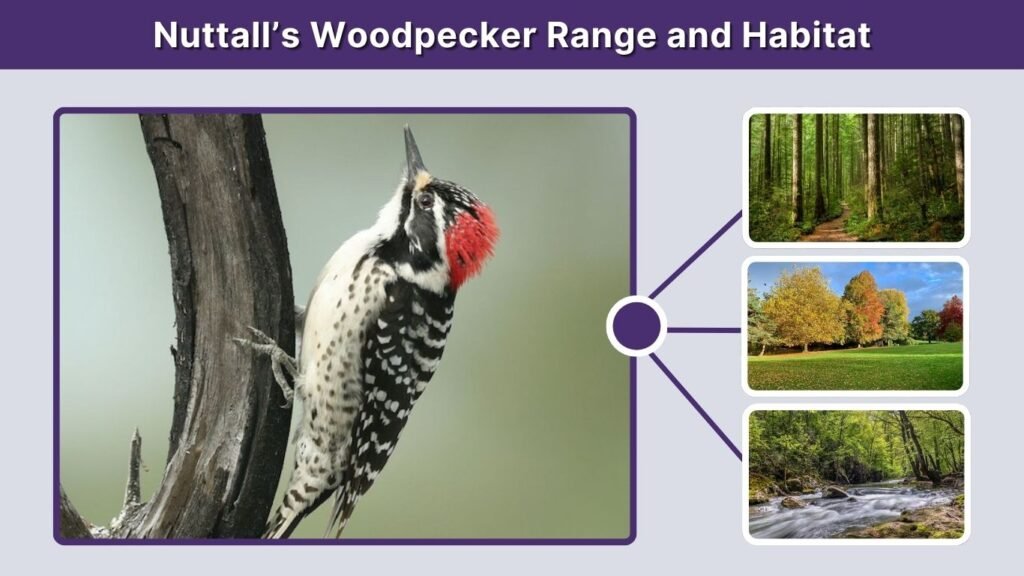
Nuttall’s woodpecker has a much smaller geographic range than many familiar North American woodpeckers. California is its stronghold, with its regular distribution extending into northwestern Baja California, Mexico. It is primarily a resident species, not a long-distance migrant.
Where Does It Live in California?
Suitable areas include the Central Valley, Coast Ranges, Sierra Nevada foothills, and parts of southern California. Distribution follows appropriate woodland rather than covering every part of the state equally.
Low-elevation wooded landscapes are particularly important. A county may contain suitable habitat along a river or foothill while nearby open farmland or desert offers few opportunities.
Preferred Habitats
- Oak woodland and wooded foothills.
- Streamside forests containing willows and cottonwoods.
- Sycamore-lined canyons.
- Mixed woodland with mature trees.
- Wooded neighborhoods adjoining suitable natural habitat.
In southern California, birds also occupy streamside woodland where oaks are scarce. Trees provide feeding surfaces, shelter, and potential nest sites, making habitat structure as important as the presence of one particular tree species.
What Does Nuttall’s Woodpecker Eat?
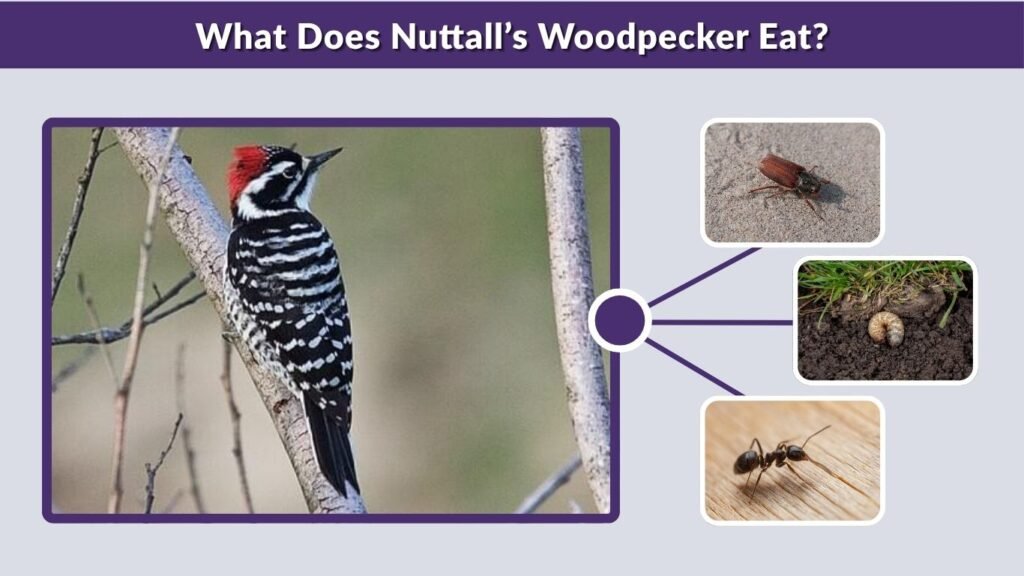
Nuttall’s woodpecker feeds mainly on insects and other small arthropods. Although strongly associated with oak trees, it is not an acorn-storage specialist like the acorn woodpecker. Oaks are valuable largely because they provide abundant places to search for prey.
Insects and Other Foods
Foods include beetles, beetle larvae, ants, termites, and caterpillars. Birds also occasionally eat fruits and berries.
Descriptions differ about whether acorns are eaten at all or only rarely. The useful distinction is that acorns are not a major dietary staple, and these birds do not maintain the conspicuous granaries associated with acorn woodpeckers.
How It Finds Food
A feeding bird probes bark cracks, picks prey from surfaces, and searches branches and twigs. It may circle a branch or perch across a thin stem, using its wings for balance. Watching these smaller branches can reveal birds that would be missed by scanning trunks alone.
Nuttall’s Woodpecker Calls and Drumming
Sound often reveals this woodpecker before its markings become visible. Its calls are sharp and compact rather than musical. Learning the difference between a vocal call and mechanical drumming also helps explain what the bird is doing.
What Does the Call Sound Like?
Both sexes give a high-pitched “pit” and a doubled note often written as “pit-it.” A rapid series of similar notes produces a dry, metallic rattle.
During courtship, birds may also give a harsher, shrieking call. Written descriptions are only approximations, so rhythm and repetition are useful alongside the overall sound.
Do Females Drum?
Yes. Both males and females drum by rapidly striking a surface with their bills. Their drum is fast and relatively even, typically lasting about one second. Hearing drumming therefore does not establish that the bird is male.
Nuttall’s Woodpecker Nesting and Life Cycle
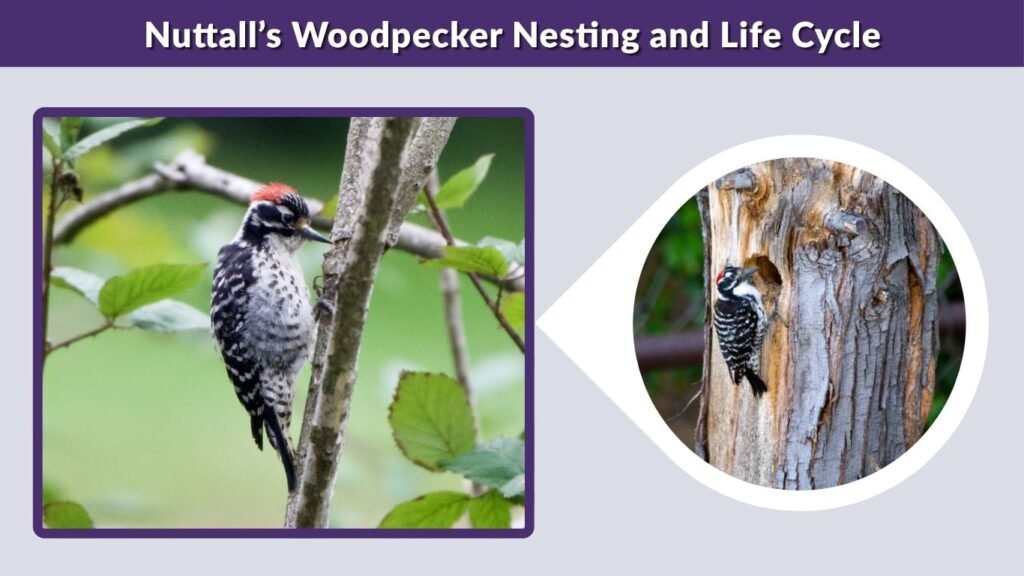
Nuttall’s woodpeckers are cavity nesters, raising their young inside excavated tree holes. Suitable dead wood is an important resource, even in otherwise healthy woodland. Birds need material soft enough to excavate while still providing a sheltered nesting chamber.
Nest Construction
The male performs most of the excavation. Nest sites commonly occur in dead trunks or limbs of willows, cottonwoods, sycamores, and other trees.
Pairs generally create a new cavity each year. The entrance leads into an enclosed chamber rather than an exposed nest supported by branches.
Eggs and Young
Clutches contain approximately three to six white eggs. Both parents incubate, with the male taking the nighttime shift. Incubation lasts about two weeks.
Both adults feed the chicks. Young birds typically leave the cavity around four weeks after hatching, although parental care continues afterward. Leaving the nest is therefore a transition toward independence, not the immediate end of family contact.
Conservation and Backyard Habitat
Nuttall’s woodpecker is globally categorized as Least Concern, but its restricted range makes suitable woodland important. Retaining a variety of native trees and appropriate dead wood supports the resources these birds need throughout the year.
How to Make a Yard More Suitable
- Plant locally appropriate native trees and shrubs.
- Retain safe dead limbs and cavity-bearing trees where practical.
- Preserve mature trees rather than relying entirely on young ornamental planting.
- Consider a suet feeder if you already live within suitable habitat.
- Watch nesting birds from a distance without blocking their entrance.
A feeder may encourage occasional visits, but it cannot replace feeding and nesting habitat. Cornell recommends native planting and notes that suet can attract the species in California oak woodland.
FAQs
These answers address common uncertainties about Nuttall’s woodpeckers, especially their identification, distribution, and relationship with people.
Why Is It Called Nuttall’s Woodpecker?
William Gambel named the species in 1843 after Thomas Nuttall, an English botanist and ornithologist. Its name recognizes Nuttall’s contributions to natural history.
Do Nuttall’s Woodpeckers Live in Utah?
Utah is outside the species’ normal range. A suspected sighting there needs careful documentation and comparison with other local woodpeckers rather than identification from color alone.
Does a Red Crown Always Mean Male?
No. Although adult males have red on the head and adult females lack it, juveniles of both sexes can show red crown feathers.
Do Nuttall’s Woodpeckers Migrate?
They generally remain within their range throughout the year. Local movements can occur, but they do not undertake a regular long-distance seasonal migration.
Will Nuttall’s Woodpeckers Use a Birdhouse?
Their normal nesting behavior is to excavate a tree cavity. A generic birdhouse should not be assumed to meet their needs or attract a nesting pair. Suitable natural nesting wood is the more dependable habitat resource.
