
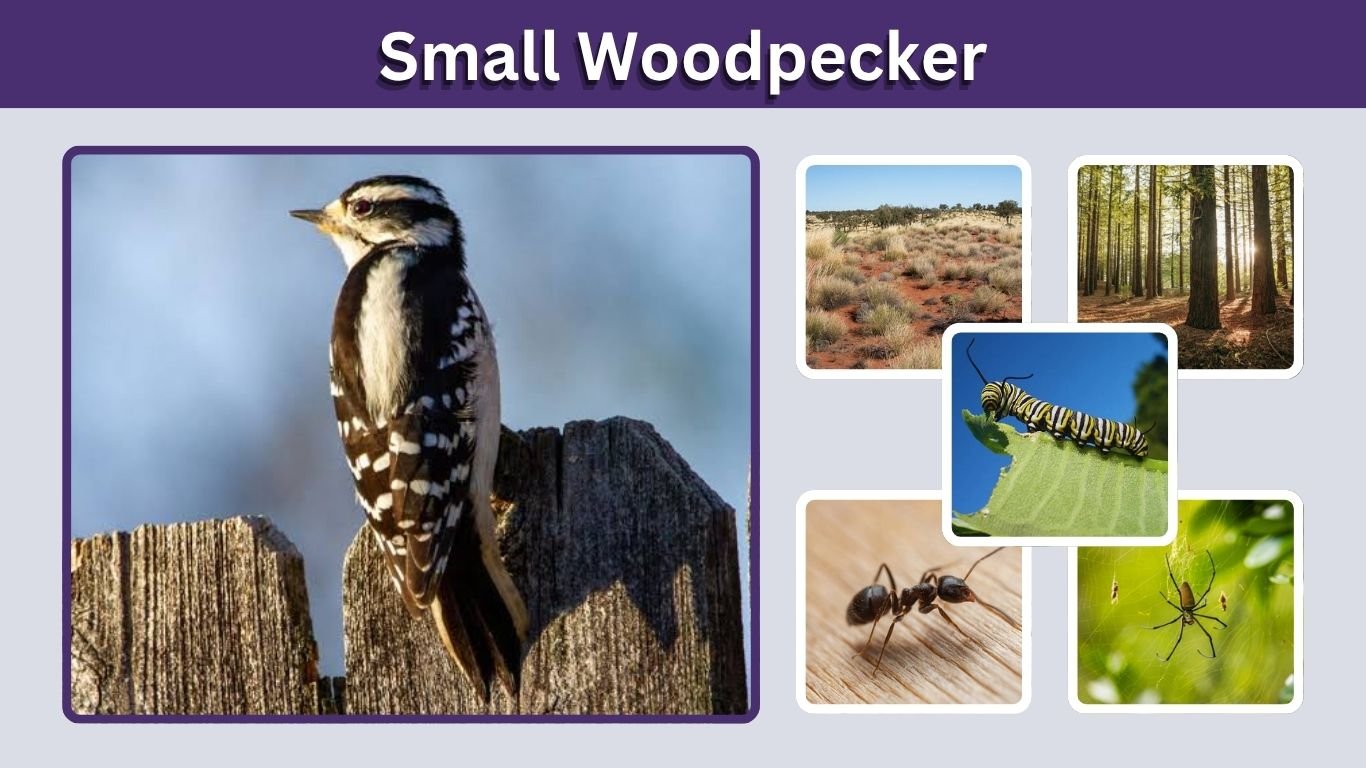
A small black-and-white woodpecker climbing a backyard tree is often a Downy Woodpecker, especially across much of the United States and Canada. Males have a small red patch on the back of the head, while adult females have no red. However, several other small woodpeckers—including Ladder-backed and Nuttall’s Woodpeckers—can look surprisingly similar. Location, back pattern, bill size, and head markings are the easiest clues for telling them apart. In the UK, the sparrow-sized Lesser Spotted Woodpecker fills a similar small-woodpecker niche.
What Is the Small Black-and-White Woodpecker?
“Small woodpecker” is not the official name of one species. In North America, the bird most people are describing is the Downy Woodpecker (Dryobates pubescens). It is compact, black and white, short-billed, and commonly visits yards and feeders. Adults measure only about 5.5–6.7 inches long with a wingspan of 9.8–11.8 inches.
Small Woodpecker Identification
Look for these features:
- Sparrow-sized body
- Black-and-white plumage
- White stripe down the center of the back
- White spots on black wings
- White underparts
- Short, straight bill
- Black-and-white striped face
- Male with a small red patch behind the head
- Adult female without red
Downy Woodpeckers are considerably smaller and shorter-billed than Hairy Woodpeckers.
Small Woodpecker With a Red Head
If the bird is tiny, black and white, and has only a small red spot on the back of its head, it is probably a male Downy Woodpecker.
The red marking is actually on the nape rather than covering the entire head.
Juvenile Downy Woodpeckers complicate identification because young birds can have red feathering on the top of the crown.
Small Woodpecker With No Red on Its Head
A tiny black-and-white woodpecker without any red may simply be a female Downy Woodpecker. Females have essentially the same body pattern as males but completely lack the male’s red nape patch. Similar sexual differences occur in several other small woodpecker species.
Female Downy Woodpecker
Female Downies show:
- Black crown
- No red nape
- White facial stripes
- White back patch
- Black wings with white spots
- Short bill
- Pale underparts
Along the Pacific coast, Downy Woodpeckers may appear somewhat dingier or brownish-gray underneath, but females still lack the red nape.
5 Common Small Woodpecker Species
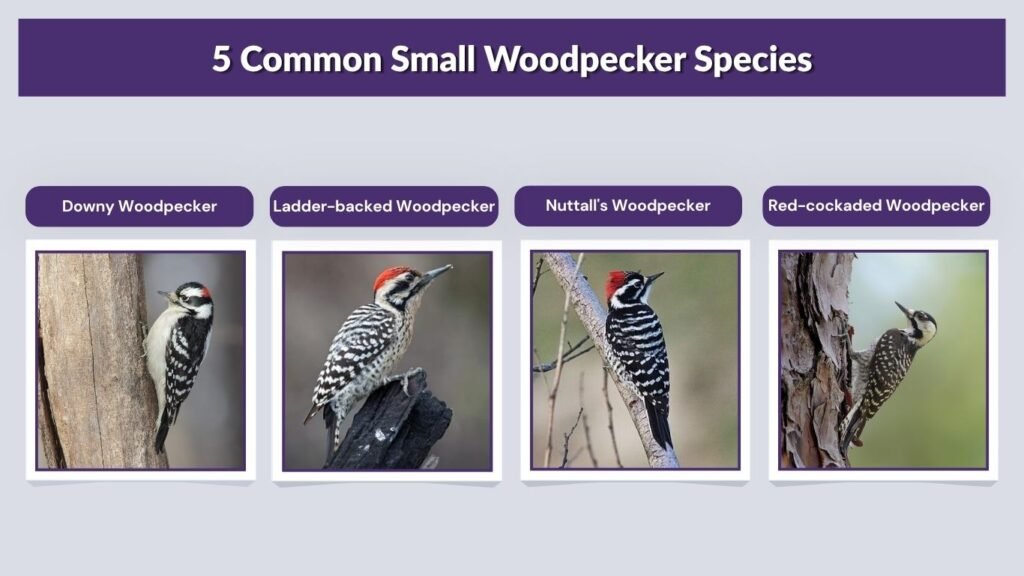
Several North American woodpeckers fit the general description of a small black-and-white bird. Geographic location can narrow identification quickly. A barred desert bird in Arizona may be Ladder-backed, whereas a tiny feeder visitor in Pennsylvania is much more likely a Downy.
1. Downy Woodpecker
The Downy is the classic small North American woodpecker.
Adults are only about 5.5–6.7 inches long. They have a broad white patch running vertically down the back, black wings covered with white spots, and a very short bill.
Male Downies have a small red nape patch; females do not.
2. Ladder-backed Woodpecker
Ladder-backed Woodpeckers are slightly larger, reaching about 6.3–7.1 inches.
Instead of a large white patch down the back, they have numerous narrow black-and-white bars that resemble the rungs of a ladder.
They favor desert scrub and thorny vegetation in the southwestern United States. Males have red on the crown, while females lack it.
3. Nuttall’s Woodpecker
Nuttall’s Woodpeckers are small black-and-white birds found primarily in California.
They measure about 6.3–7.1 inches and have strongly barred backs. Males have a red patch on the back of the head, while both sexes show narrow white facial stripes.
They are particularly associated with California oak woodland.
4. Red-cockaded Woodpecker
The Red-cockaded Woodpecker is another relatively small black-and-white species, but it has a specialized association with mature southern pine forests.
Despite its name, the male’s red “cockade” is tiny and often difficult to see in the field.
It should not be confused with the much more conspicuously colored Red-headed Woodpecker.
5. Lesser Spotted Woodpecker
In the UK, the best match for “very small woodpecker” is the Lesser Spotted Woodpecker (Dryobates minor).
It is roughly sparrow-sized and black and white. Adult males have red on the crown.
However, it is now scarce in Britain. BTO reports that the species is restricted mainly to England and Wales and has declined substantially since the 1980s.
Small Woodpeckers by Location
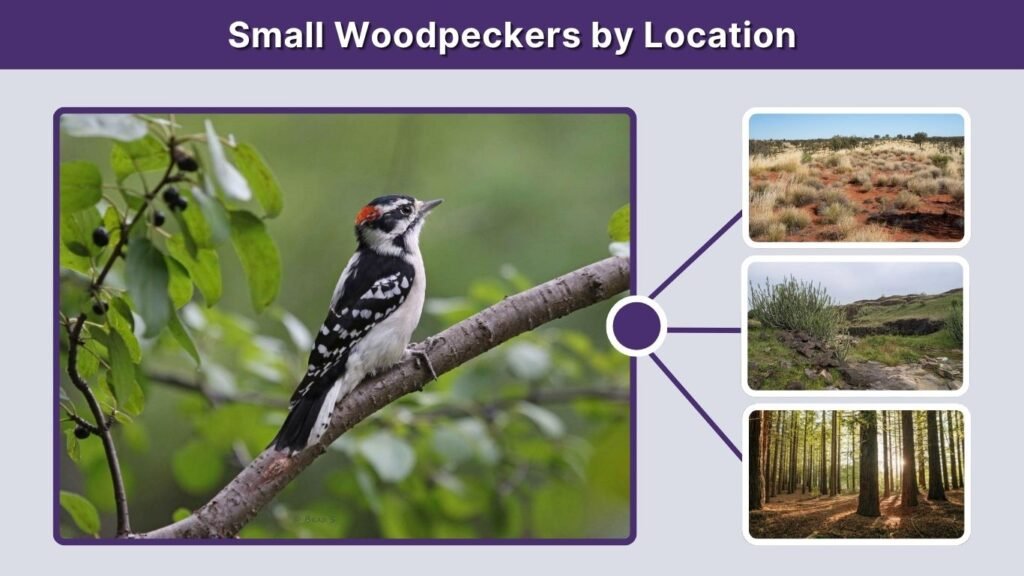
Location is one of the best identification tools because not every small woodpecker occurs across the entire continent. Downy Woodpeckers dominate many eastern and northern searches, while Ladder-backed and Nuttall’s become more relevant in the Southwest and California.
Eastern and Midwestern United States
In states such as:
- Florida
- Georgia
- South Carolina
- North Carolina
- Virginia
- Maryland
- Pennsylvania
- New Jersey
- Ohio
- Indiana
- Illinois
- Michigan
- Wisconsin
- Minnesota
- Maine
- Massachusetts
A very small black-and-white backyard woodpecker is often a Downy Woodpecker.
Look for the large white back patch and very short bill.
Arizona, Texas, New Mexico and Colorado
In dry southwestern habitats, consider the Ladder-backed Woodpecker.
It inhabits desert scrub, thorn forest, pinyon-juniper woodland, and vegetation containing mesquite, cholla, yucca, and similar plants. It even reaches pinyon-juniper habitat in southeastern Colorado.
Downy Woodpeckers can still occur in suitable wooded habitats, so habitat and markings should both be checked.
California and Pacific Coast
California supports both Downy and Nuttall’s Woodpeckers.
A small woodpecker with dense horizontal barring on its back in oak woodland strongly suggests Nuttall’s. The species is primarily a California resident and commonly feeds among oaks, willows, and cottonwoods.
Downy Woodpeckers also occur along the Pacific coast and may look somewhat darker or dingier underneath than eastern birds.
Downy vs Small Hairy Woodpecker
Downy and Hairy Woodpeckers have extremely similar black-and-white patterns, but the Hairy is substantially larger.
A Downy is roughly sparrow-sized, whereas a Hairy Woodpecker is closer to robin-sized.
Key Differences
| Feature | Downy Woodpecker | Hairy Woodpecker |
| Length | 5.5–6.7 in | 7.1–10.2 in |
| Bill | Short | Long, nearly head-length |
| Overall size | Sparrow-like | Robin-like |
| Back | White central stripe | White central stripe |
| Male | Red nape | Red nape |
| Female | No red | No red |
The bill is often the easiest clue: the Downy’s looks unusually short and delicate, while the Hairy’s is much longer and heavier.
Small Woodpecker-Looking Birds
Not every tiny bird climbing a tree trunk is a woodpecker. Nuthatches and Brown Creepers are frequently mistaken for small woodpeckers because they forage directly on bark.
White-breasted Nuthatch
A White-breasted Nuthatch has a blue-gray back, white face and belly, and black cap.
Unlike woodpeckers, nuthatches frequently climb headfirst down tree trunks.
If you saw what looked like a tiny gray-blue woodpecker crawling downward, a nuthatch is a strong possibility.
Brown Creeper
The Brown Creeper is small, brown and heavily camouflaged.
It typically starts near the bottom of a tree and creeps upward while searching for insects before flying to the bottom of another trunk.
Its thin, curved bill is very different from a woodpecker’s straight chisel-like bill.
What Do Small Woodpeckers Eat?
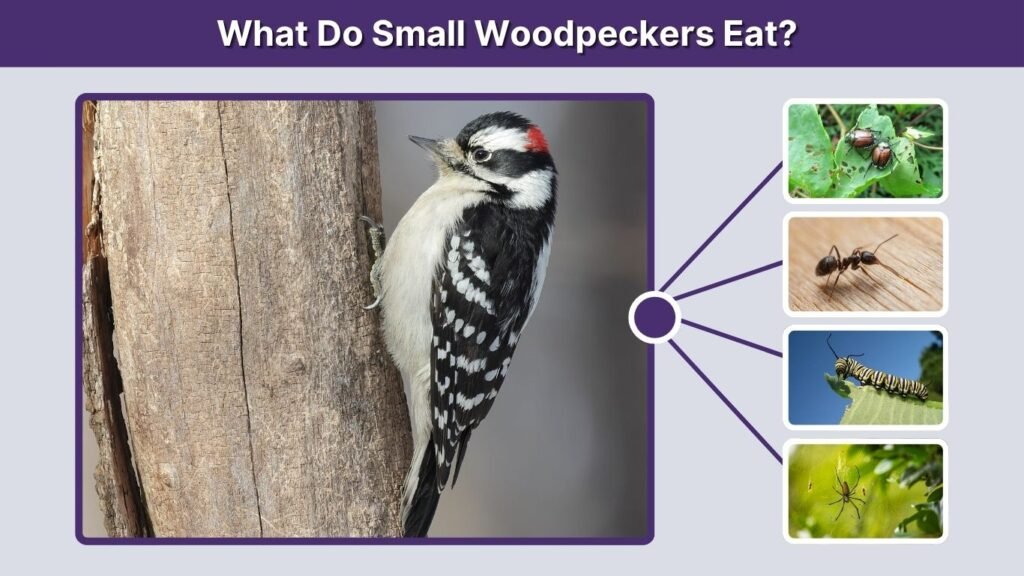
Small woodpeckers primarily search bark, branches, and stems for insects. Their small size allows them to use thin branches and weeds that heavier woodpeckers cannot exploit as easily.
Common Foods
Depending on species, foods may include:
- Beetles
- Beetle larvae
- Ants
- Caterpillars
- Insect eggs
- Spiders
- Seeds
- Berries
- Suet at feeders
Nuttall’s Woodpeckers, for example, eat beetles, larvae, ants, termites, and other invertebrates, occasionally supplementing their diet with fruit.
Where Do Small Woodpeckers Nest?
Most small woodpeckers are cavity nesters. They excavate holes in dead trees, dead limbs, or wood softened by decay rather than constructing open nests from grass and twigs.
Nesting Habits
Typical nesting behavior includes:
- Excavating a cavity
- Choosing dead or softened wood
- Laying white eggs
- Both parents helping care for chicks
- Using wood chips at the cavity bottom instead of building a conventional nest
Woodpecker feet and stiff tail feathers are specialized for clinging to vertical surfaces, while their bills are adapted for excavating wood.
FAQs
1. What is the smallest woodpecker in North America?
The Downy Woodpecker is North America’s smallest widely recognized woodpecker, measuring about 5.5–6.7 inches long.
2. What small black-and-white woodpecker has a red spot?
A male Downy Woodpecker is a common match. It has a small red patch on the back of its head.
3. Which small woodpecker has no red?
Adult female Downy Woodpeckers have no red. Female Ladder-backed and Nuttall’s Woodpeckers also lack the males’ red head markings.
4. What small woodpecker lives in the UK?
The Lesser Spotted Woodpecker is Britain’s smallest woodpecker, but it is now scarce and primarily occurs in England and Wales.
5. How can I identify a small woodpecker?
Check size, bill length, back pattern, red head markings, geographic location, and habitat. For many backyard sightings across North America, a tiny black-and-white bird with a short bill is most likely a Downy Woodpecker.
