
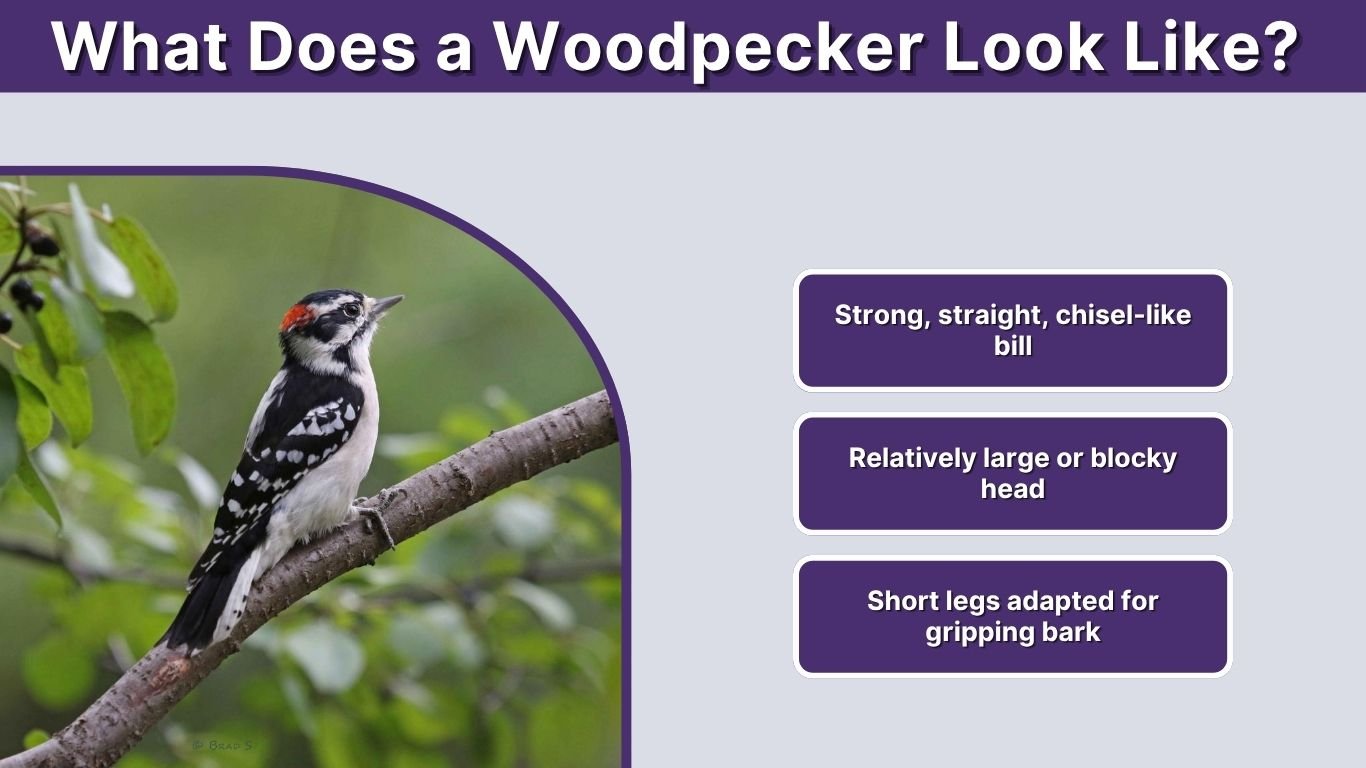
A woodpecker typically has a strong chisel-shaped bill, a blocky head, short legs, gripping feet, and stiff tail feathers that support its body against tree trunks. Plumage varies dramatically by species, but black, white, brown, green, and red are common colors. Many males have red markings that females lack, though this is not universal. From tiny Downy Woodpeckers to crow-sized Pileated Woodpeckers, identifying one becomes easier when you compare its size, bill, head markings, back pattern, and behavior.
What Does a Woodpecker Look Like?
Woodpeckers belong to the family Picidae and are specially adapted for climbing and feeding on trees. Most have sturdy bodies, straight bills, and stiff tails. Their feet grip bark while the tail braces the bird against the trunk. Although the classic image is a black-and-white bird with red on its head, some species are brown, green, yellow, or almost entirely black.
Common Identification Features
Look for these characteristics:
- Strong, straight, chisel-like bill
- Relatively large or blocky head
- Short legs adapted for gripping bark
- Stiff, pointed tail feathers
- Upright posture on tree trunks
- Black, white, brown, green, or red plumage
- Red crown or nape on many species
- Undulating or bouncing flight
- Drumming or tapping behavior
A Downy Woodpecker demonstrates the classic body plan particularly well: a blocky head, straight bill, wide shoulders, and upright posture supported by stiff tail feathers.
How Big Are Woodpeckers?
Woodpeckers vary enormously in size.
A Downy Woodpecker is only about 5.5–6.7 inches long, while a Pileated Woodpecker can approach crow size.
Size is therefore one of the quickest identification clues.
What Does a Female Woodpecker Look Like?
There is no single appearance for a female woodpecker because differences between males and females vary by species. In many North American species, the sexes have almost identical body patterns but males possess additional red markings on the head.
Male vs Female Woodpeckers
Examples include:
- Downy Woodpecker: Male has a small red patch on the nape; female has none.
- Pileated Woodpecker: Male has a red moustache stripe and more red toward the forehead; female lacks the red moustache.
- Red-bellied Woodpecker: Male has red from crown to nape; female has red mainly on the nape.
- Red-headed Woodpecker: Adult males and females look essentially alike.
Female Downy Woodpeckers are particularly easy to recognize because they have the same black-and-white pattern as males but lack the red nape patch.
What Does a Red-headed Woodpecker Look Like?
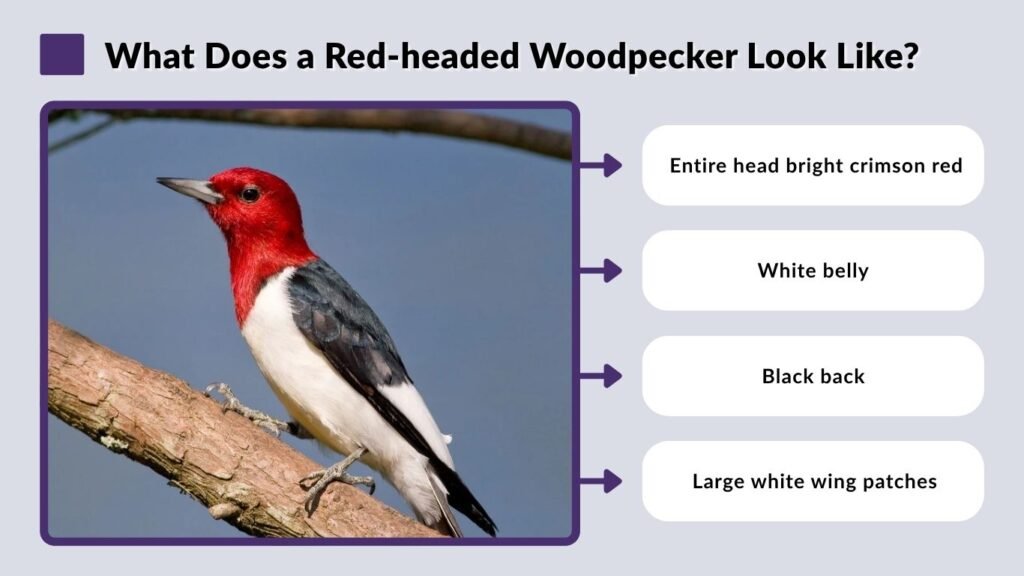
The Red-headed Woodpecker (Melanerpes erythrocephalus) is one of the easiest woodpeckers to identify. Adults have a completely red head, snow-white underparts, and a black back and wings interrupted by large white wing patches.
Red-headed Woodpecker Identification
Adults have:
- Entire head bright crimson red
- White belly
- Black back
- Large white wing patches
- Powerful pale-gray bill
- Medium-sized body
Males and females look alike, so a female Red-headed Woodpecker also has a completely red head.
Young Red-headed Woodpecker
Juveniles look dramatically different.
Young birds have brownish or gray-brown heads rather than red ones. Their backs are brownish-black, and the white wing patches show dark bars.
As they mature, the head gradually turns red and the wing pattern becomes cleaner.
What Does a Downy Woodpecker Look Like?
The Downy Woodpecker (Dryobates pubescens) is a tiny black-and-white woodpecker commonly seen in North America. Its short bill is one of its most useful identification characteristics.
Downy Woodpecker Identification
Look for:
- Sparrow-sized body
- Short, delicate bill
- White belly
- Black wings covered in white spots
- Large white stripe down the back
- Black-and-white striped face
- Red patch on male’s nape
- No red on adult female
Juveniles can show red feathering on the top of the crown, which sometimes causes confusion with adults.
What Does a Pileated Woodpecker Look Like?
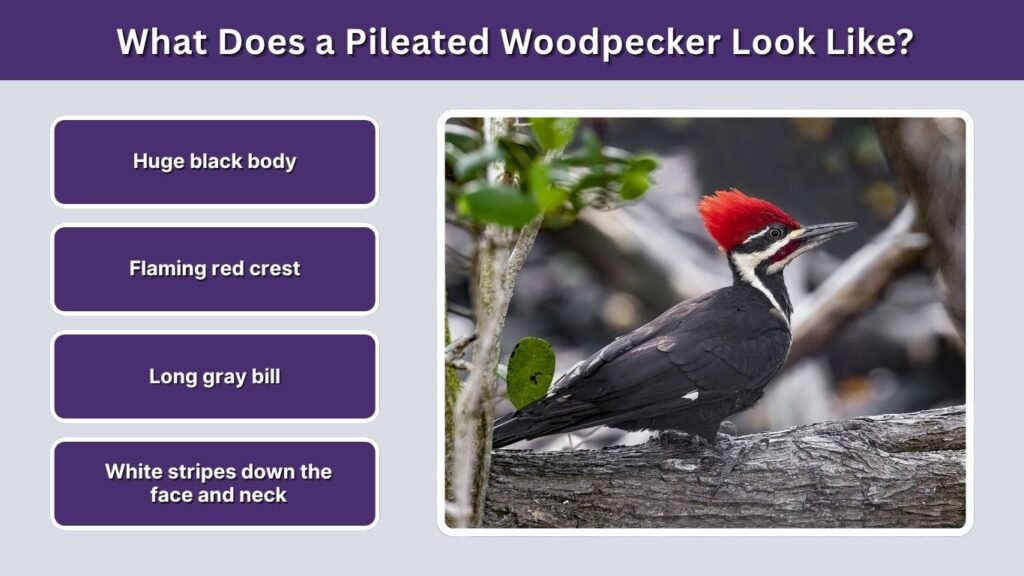
The Pileated Woodpecker (Dryocopus pileatus) is almost impossible to mistake for a Downy or Hairy Woodpecker because it is dramatically larger.
It is nearly crow-sized and predominantly black, with bold white facial stripes and a tall red crest.
Pileated Woodpecker Identification
A typical adult has:
- Huge black body
- Flaming red crest
- Long gray bill
- White stripes down the face and neck
- Extensive white underwings visible in flight
- Long neck
- Powerful feet and tail
The male has a red moustache stripe, while the female has a dark moustache and gray-black forecrown.
Pileated Woodpecker in Flight
Watch for broad black wings with conspicuous white patches underneath.
The combination of large size, red crest, and white wing flashes separates it from crows and most other forest birds.
What Does a Red-bellied Woodpecker Look Like?
The Red-bellied Woodpecker has one of the most misleading bird names because its pale reddish belly is often difficult to see.
Instead, most people first notice the striking red head markings and zebra-like black-and-white back.
Identification
Adults have:
- Black-and-white barred back
- Pale grayish belly
- Red head markings
- Long, slightly curved-looking bill
- White patches in the wings
Males have a red crown and nape, whereas females have a red nape but lack the fully red crown.
Immature birds can appear much grayer and may have little or no obvious red on the head.
What Does a Hairy Woodpecker Look Like?
Hairy Woodpeckers strongly resemble Downy Woodpeckers, but they are noticeably larger and have much longer bills.
Both typically have black-and-white bodies, a white back patch, and white-spotted wings.
Downy vs Hairy Woodpecker
The easiest distinction is the bill.
A Downy’s bill looks short compared with its head, while a Hairy Woodpecker’s bill is substantially longer and heavier. Cornell specifically recommends bill size as one of the most useful features for separating these otherwise similar species.
Male Hairy Woodpeckers also have red on the back of the head, while females lack it.
What Does a Flicker Woodpecker Look Like?
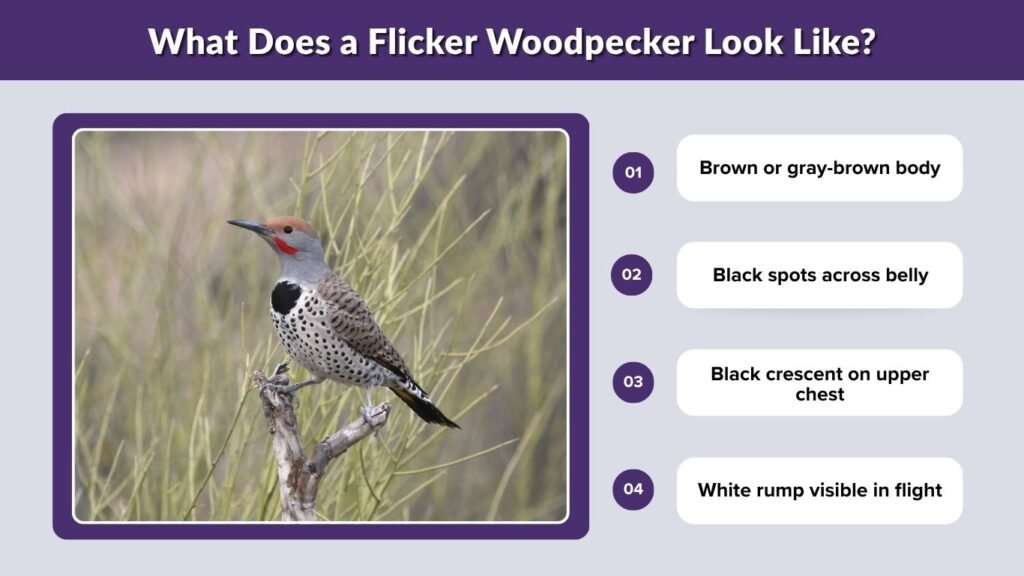
The Northern Flicker looks unusually brown compared with many classic black-and-white woodpeckers.
It is a fairly large bird with a spotted belly, barred back, black chest crescent, and conspicuous white rump.
Northern Flicker Identification
Look for:
- Brown or gray-brown body
- Black spots across belly
- Black crescent on upper chest
- White rump visible in flight
- Slightly curved bill
- Yellow or red underneath wings depending on region
Eastern Yellow-shafted males have a black moustache, while western Red-shafted males have a red moustache.
Northern Flickers are also unusual because they frequently feed on the ground while searching for ants.
What Does a Baby Woodpecker Look Like?
Newly hatched woodpeckers look nothing like the feathered adults. They hatch helpless inside their tree cavities and initially have little or no feather covering.
As nestlings grow, pin feathers develop and eventually open into juvenile plumage.
Juvenile Woodpecker Identification
Young woodpeckers may have:
- Softer-looking plumage
- Less distinct adult markings
- Different head coloration
- Shorter-looking bills
- Noticeable begging behavior
- Fluffy or loosely arranged feathers
Some juveniles actually show more red on the crown than their parents. Young Downy Woodpeckers and Great Spotted Woodpeckers are examples.
What Does a Woodpecker Nest Look Like?
Most woodpeckers are cavity nesters. Rather than constructing a cup-shaped nest from twigs, they excavate a chamber inside dead or softened wood.
From outside, you may see only a round or oval entrance.
Inside a Woodpecker Nest
The cavity usually:
- Extends downward inside the tree
- Widens below the entrance
- Contains no conventional twig nest
- Has loose wood chips at the bottom
- Holds plain white eggs
For example, a Downy Woodpecker entrance is roughly 1–1.5 inches across, leading to a cavity approximately 6–12 inches deep. The bottom is lined only with wood chips left from excavation.
Pileated Woodpeckers make much larger cavities, with entrances that are typically oblong rather than perfectly round.
What Does a Woodpecker Hole Look Like?
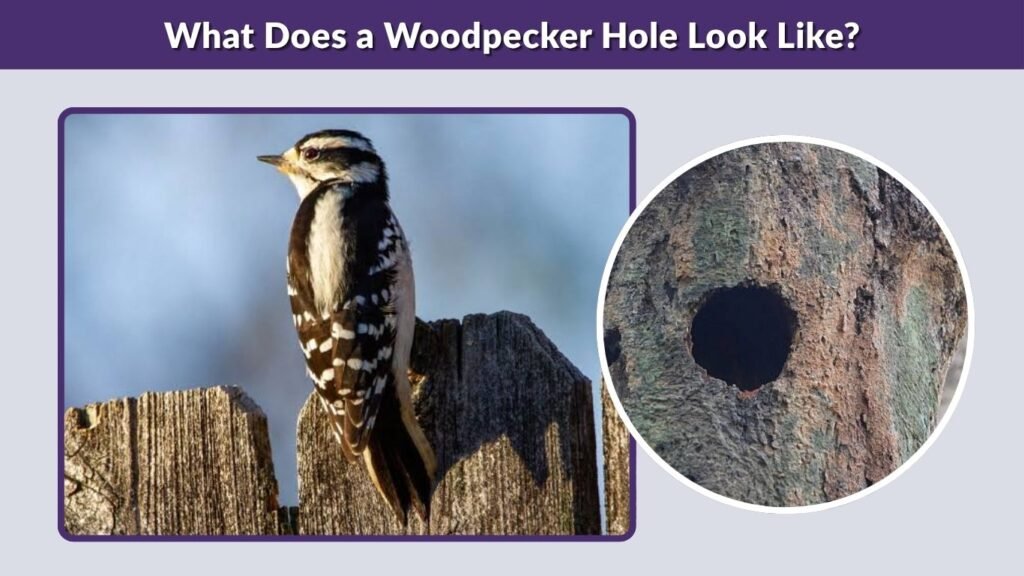
Not every hole made by a woodpecker is a nest. Woodpeckers also create feeding holes while searching for insects or sap.
Common Woodpecker Hole Patterns
Round or oval cavity: May be used for nesting or roosting.
Large rectangular excavation: Strong clue of a Pileated Woodpecker searching for carpenter ants or other insects.
Neat horizontal rows of small holes: Often created by sapsuckers to obtain tree sap. Yellow-bellied Sapsuckers characteristically drill organized rows of shallow sap wells.
Small irregular holes: May result from ordinary insect foraging.
Seeing holes alone therefore does not identify the exact species.
What Does a Woodpecker Look Like in the UK?
Britain’s common woodpeckers look quite different from one another.
The Great Spotted Woodpecker is predominantly black and white with red beneath the tail; adult males also have a red patch behind the head. Juveniles have a red crown.
The European Green Woodpecker is much larger and has green upperparts, a pale belly, bright yellow rump, and red crown. Male Green Woodpeckers have red inside the black moustache stripe.
FAQs
1. What color is a woodpecker?
There is no single color. Many species are black and white with red markings, but others can be green, brown, yellow, or predominantly black.
2. What does a female woodpecker look like?
It depends on the species. Females often resemble males but have less red on the head. Female Downy Woodpeckers, for example, completely lack the male’s red nape patch.
3. What woodpecker has an entirely red head?
The adult Red-headed Woodpecker has an entirely crimson head with a black back and white belly. Both adult sexes share this pattern.
4. What does a woodpecker nest look like inside?
It is typically a vertical tree cavity that widens below the entrance. Most species do not build a conventional nest; eggs rest on wood chips left from excavation.
5. How can I identify a woodpecker?
Check its size, bill length, back pattern, head color, red markings, habitat, and hole pattern. These clues together are much more reliable than using one feature alone.
