
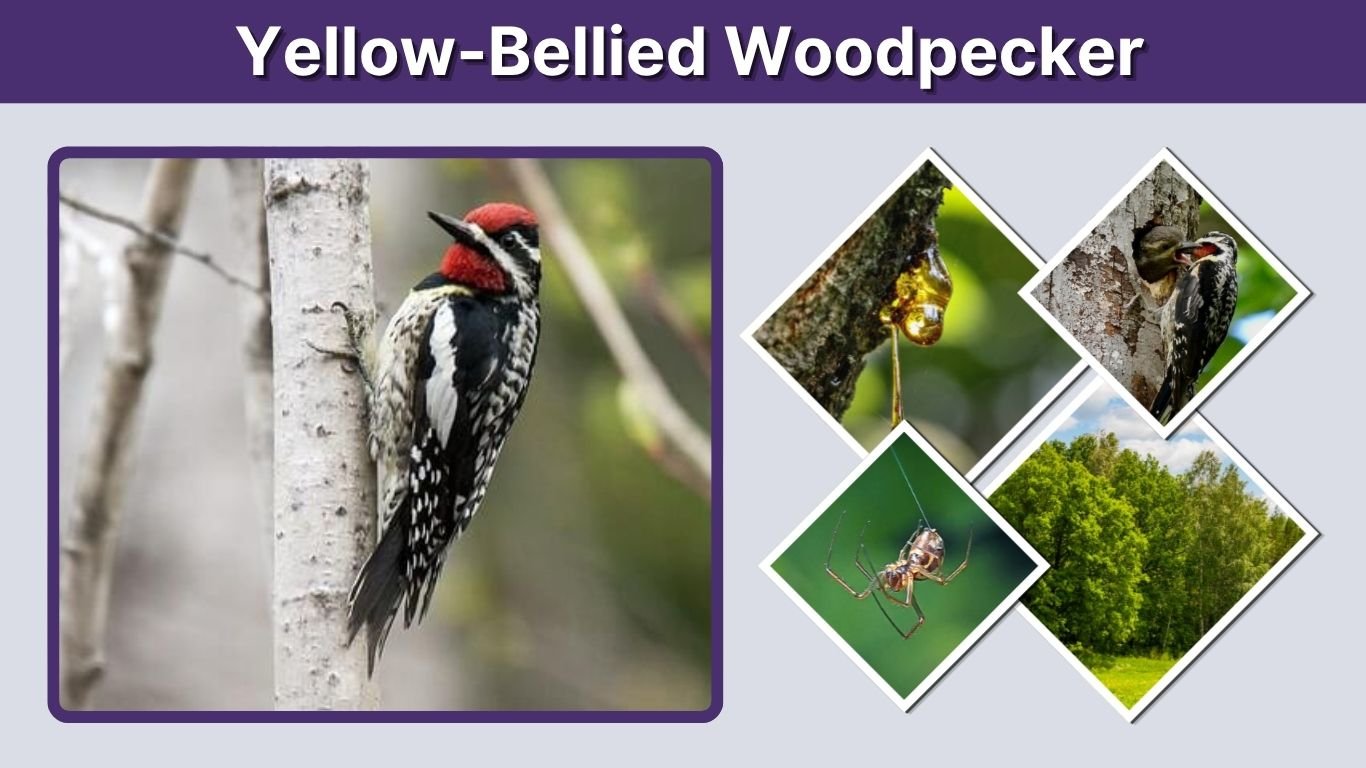
The Yellow-bellied Sapsucker (Sphyrapicus varius), sometimes called a yellow-bellied woodpecker, is a medium-small woodpecker native to North America. It is best known for drilling orderly rows of shallow holes in trees and returning to drink the flowing sap. Its striking black-and-white plumage, red forehead, pale yellow belly, and bold white wing patch make it distinctive. Males and females look similar, although their throat colors differ. The species is also unusually migratory for a North American woodpecker.
What Is a Yellow-Bellied Woodpecker?
The correct common name is Yellow-bellied Sapsucker. It belongs to the woodpecker family Picidae, so yes, a Yellow-bellied Sapsucker really is a woodpecker.
Unlike species that primarily excavate insects from dead wood, this bird specializes in creating sap wells in living trees. It drinks the sap and also captures insects attracted to the sticky liquid.
Yellow-Bellied Sapsucker Identification
Look for these characteristics:
- Black-and-white patterned body
- Bright red forehead
- Large white patch on the folded wing
- Black chest or bib
- Whitish to pale-yellow belly
- Straight, stout bill
- Bold black-and-white facial stripes
- Red throat on adult males
- White throat on adult females
- Stiff tail feathers used while climbing trees
Juveniles are more brownish and mottled than adults but still show the characteristic white wing patch.
Yellow-Bellied Woodpecker Size
Yellow-bellied Sapsuckers are larger than Downy Woodpeckers but slightly smaller than Hairy Woodpeckers.
Adults generally measure:
- Length: 7.1–8.7 inches (18–22 cm)
- Weight: 1.5–1.9 ounces (43–55 g)
- Wingspan: 13.4–15.8 inches (34–40 cm)
Their overall size is roughly comparable to a robin, although their body shape is more compact and adapted for climbing.
Male vs Female Yellow-Bellied Woodpecker
Male and female Yellow-bellied Sapsuckers share most of the same markings. Both normally have a red forehead, black-and-white face, prominent white wing patch, dark chest markings, and yellowish underparts.
The throat is the easiest place to look when determining sex.
Female Yellow-Bellied Woodpecker
An adult female typically has:
- Red forehead
- White throat
- Black border around the throat
- Black-and-white wings
- Large white wing stripe
- Pale-yellow belly
- Black chest markings
The female’s white throat is the simplest feature separating her from an adult male.
Male Yellow-Bellied Woodpecker
Adult males have a red throat as well as a red forehead.
Therefore:
Male = red forehead + red throat
Female = red forehead + white throat
Both sexes may show varying amounts of yellow on the belly, so belly color should not be used to determine sex.
What Do Yellow-Bellied Woodpeckers Eat?
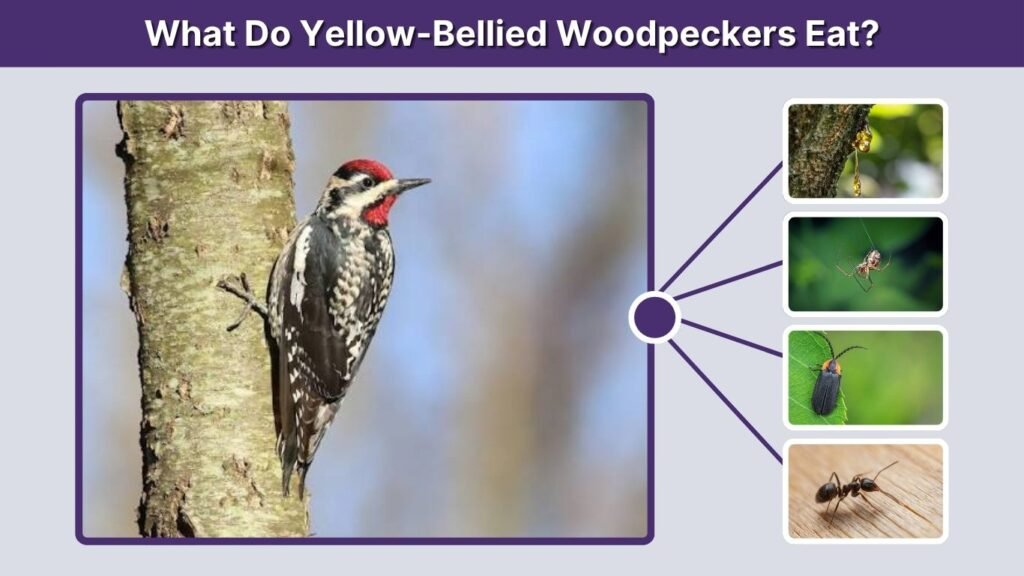
Tree sap is an unusually important part of the Yellow-bellied Sapsucker’s diet. The bird drills carefully organized holes into selected trees and repeatedly returns to maintain them.
Yellow-Bellied Sapsucker Diet
Common foods include:
- Tree sap
- Ants
- Beetles
- Other insects
- Spiders
- Tree cambium
- Berries
- Fruits
Birches and maples are particularly important sap-producing trees, although Yellow-bellied Sapsuckers have been recorded using a remarkably wide variety of woody plants.
How Do Sapsuckers Drink Sap?
The bird creates rows of small holes known as sap wells.
It produces deeper circular wells to reach xylem sap during early spring and later makes shallower rectangular holes that access phloem sap. These holes must be revisited and maintained to keep sap flowing.
A specialized brush-tipped tongue helps the bird collect the liquid.
Sap wells also provide food for other wildlife, including hummingbirds and insects.
Yellow-Bellied Woodpecker Habitat and Range
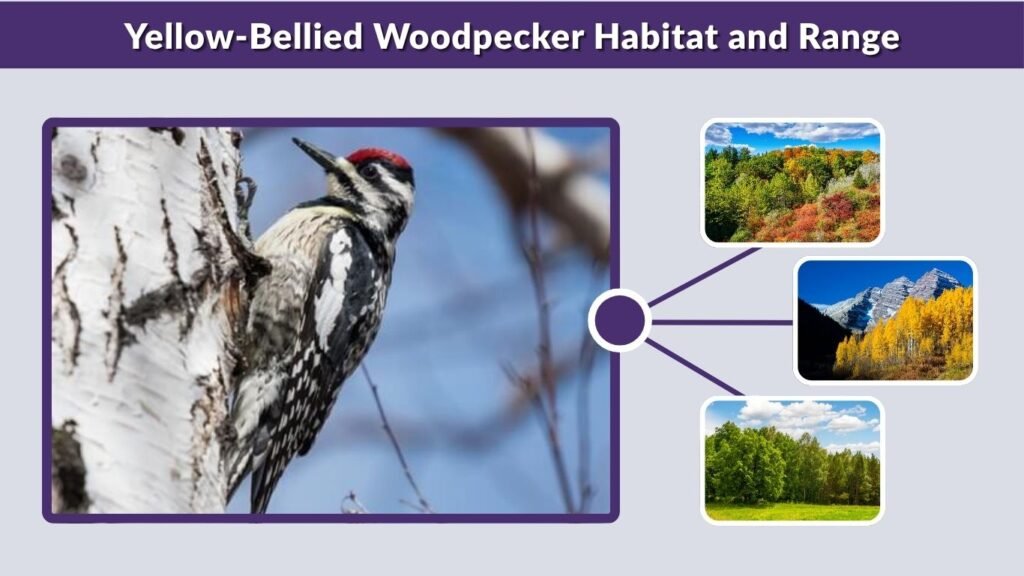
Yellow-bellied Sapsuckers occupy forests containing suitable trees for feeding and cavity nesting. Their preferred habitat changes somewhat between summer breeding areas and wintering grounds.
Where Do Yellow-Bellied Woodpeckers Live?
During the breeding season they favor:
- Young deciduous forests
- Mixed forests
- Aspen groves
- Birch stands
- Forest edges
- Regenerating woodland
Their breeding range extends primarily across Canada, the northeastern United States, and parts of the Great Lakes region.
During migration and winter, they occur much farther south, including parts of the southeastern United States, Mexico, the Caribbean, and Central America.
Are They Migratory?
Yes. The Yellow-bellied Sapsucker is unusually migratory compared with many other North American woodpeckers.
Most birds leave northern breeding territories during September and early October and return north during spring. Some travel as far south as Central America.
Females tend to winter farther south than males.
That explains why the species may be a winter visitor in states such as Florida, Georgia, Tennessee, and parts of Texas while being a breeding bird farther north.
Yellow-Bellied Woodpecker Call and Sound
Yellow-bellied Sapsuckers produce calls that are quite different from the sharp notes of many familiar woodpeckers.
What Does a Yellow-Bellied Sapsucker Sound Like?
Its signature call is a nasal, somewhat cat-like mewing sound.
Other sounds include:
- Repeated squealing calls
- Territorial notes
- Alarm calls
- Irregular drumming
Their drumming is especially distinctive. Instead of maintaining an evenly spaced rapid rhythm, a Yellow-bellied Sapsucker produces a broken, stuttering sequence sometimes compared with Morse code.
Yellow-Bellied Sapsucker Nest and Young
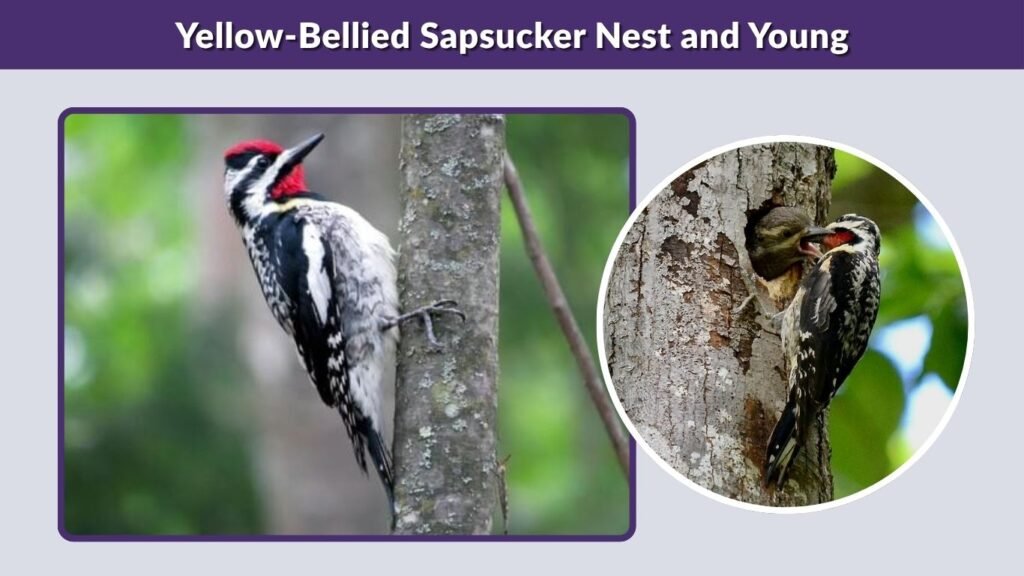
Yellow-bellied Sapsuckers are cavity nesters. They excavate holes in trees rather than constructing open nests from twigs and grass.
Trees with softened or decayed interior wood are particularly useful because they are easier to excavate while still providing a sturdy outer trunk.
Nesting Facts
Typical nesting behavior includes:
- Nesting in tree cavities
- Preference for aspen, birch, poplar and similar trees
- Both sexes helping excavate
- Usually one brood per year
- Both parents feeding the nestlings
- Young remaining in the nest roughly 25–29 days
Parents may continue feeding fledglings briefly after they leave the nest.
Yellow-Bellied Sapsucker vs Downy Woodpecker
These two species can occur in the same areas, but several features make them easy to separate once you know what to examine.
Main Differences
Yellow-bellied Sapsucker:
- Larger
- Prominent vertical white wing patch
- Red forehead in both adult sexes
- Pale-yellow belly
- Black chest patch
- Drills rows of sap wells
Downy Woodpecker:
- Smaller
- Broad white patch down the center of the back
- Adult female has no red
- Adult male has a small red patch behind the crown
- Belly usually white
- Primarily searches bark for insects
The conspicuous white wing stripe and sap-well behavior are particularly useful clues for identifying a sapsucker.
Red-Bellied vs Yellow-Bellied Woodpecker
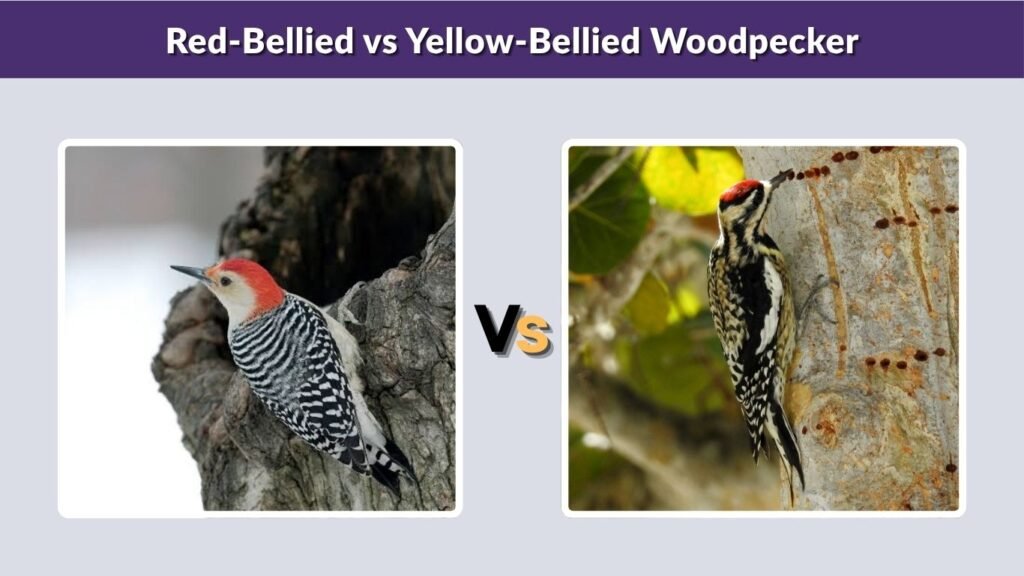
Despite their names, these birds are quite different.
A Red-bellied Woodpecker has a strongly barred black-and-white back, a prominent red head or nape, and only a subtle reddish wash on the belly.
A Yellow-bellied Sapsucker has a prominent white wing patch, black chest markings, patterned face, and a yellowish belly.
Their feeding methods also differ. Red-bellied Woodpeckers eat insects, nuts, seeds, and fruit, while Yellow-bellied Sapsuckers are highly specialized for exploiting tree sap.
Yellow-Bellied Sapsucker vs Hairy Woodpecker
Hairy Woodpeckers have similar black-and-white coloration but lack the sapsucker’s red forehead, yellow belly, and large white wing patch.
Hairy Woodpeckers are also slightly larger and possess a noticeably long, heavy bill.
If the bird is drilling organized horizontal rows of small holes, it is much more likely to be a sapsucker than a Hairy Woodpecker.
Do Yellow-Bellied Sapsuckers Damage Trees?
Sap wells usually do not seriously harm healthy trees, especially when damage is limited. However, individual sapsuckers sometimes repeatedly drill the same ornamental or landscape tree.
Heavy girdling around a trunk or branch can weaken parts of a tree, particularly if the tree is already stressed.
Before attempting deterrence, confirm that the holes actually come from sapsuckers. Their holes characteristically appear in neat horizontal or vertical rows rather than as random excavation marks.
FAQs
Is a Yellow-bellied Sapsucker a woodpecker?
Yes. The Yellow-bellied Sapsucker belongs to the woodpecker family Picidae and is a specialized sap-feeding woodpecker.
What does a female Yellow-bellied Woodpecker look like?
An adult female has a red forehead, white throat, black-and-white plumage, a large white wing patch, and pale yellowish underparts.
What does a Yellow-bellied Sapsucker eat?
It eats tree sap, insects, spiders, cambium, berries, and fruit. Sap is particularly important to its feeding strategy.
Where do Yellow-bellied Woodpeckers live?
They breed primarily across northern and northeastern North America and migrate south for winter, with some traveling into Mexico, the Caribbean, and Central America.
What does a Yellow-bellied Woodpecker sound like?
Its best-known call is a nasal, cat-like mew. Its drumming has an irregular, stuttering rhythm rather than the steady roll produced by many other woodpeckers.
