
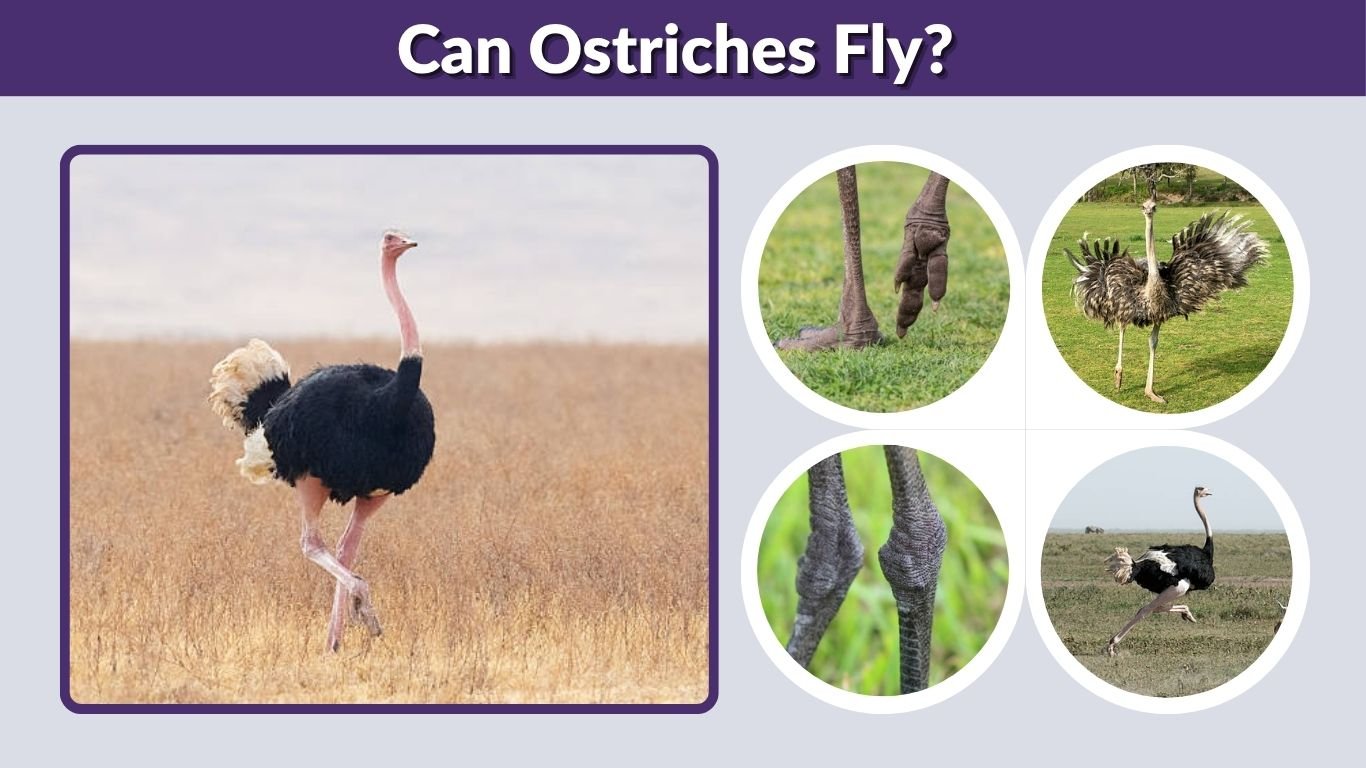
Ostriches are the largest living birds, with powerful legs, long necks, and surprisingly large wings. But can ostriches fly? No, ostriches cannot fly, even for short distances. Their heavy bodies, flat breastbones, small flight muscles, and specialized feathers make powered flight impossible. Instead, ostriches have evolved into exceptional runners that can move rapidly across open landscapes. Their wings are still valuable, helping with balance, courtship, communication, and protecting their young.
Can Ostriches Fly?
Ostriches are completely flightless birds. Unlike chickens, turkeys, and some other heavy birds that can briefly leave the ground, an ostrich cannot use its wings to become airborne. Millions of years of evolution have shaped its body for running rather than flying, making its powerful legs far more important for survival than flight-capable wings.
Can an Ostrich Fly at All?
No, an ostrich cannot fly at all. It cannot perform sustained flight, glide through the air, or make short powered flights.
Several physical characteristics prevent flight:
- Ostriches can weigh more than 200 pounds.
- Their wings are too small to lift their large bodies.
- Their flight muscles are not developed enough for powered flight.
- Their breastbone lacks the large keel found in flying birds.
- Their feathers are designed differently from typical flight feathers.
Even when an ostrich runs at full speed and stretches out its wings, it remains on the ground.
Can Ostriches Fly Short Distances?
Ostriches cannot fly short distances either. Some people assume they might be able to jump into the air and flap their wings for several feet, but their anatomy does not allow this.
An ostrich may jump, especially while running or defending itself, but this should not be confused with flight. Its wings cannot produce enough lift to support its body.
Can Baby Ostriches Fly?
Baby ostriches are also unable to fly. Chicks have small wings that develop as they grow, but they never become functional flight wings.
Young ostriches quickly develop strong legs instead. Running helps them stay close to adults and escape potential predators.
Why Can’t Ostriches Fly?
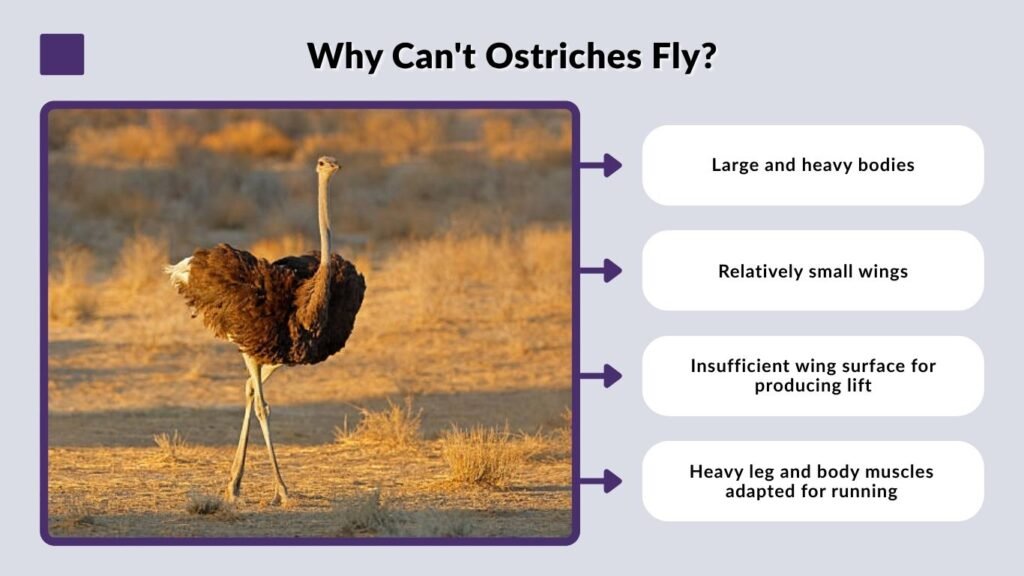
Ostriches belong to a group of birds commonly described as flightless birds. Their ancestors changed over long periods as survival became increasingly dependent on moving efficiently across the ground. Consequently, several anatomical features associated with flight became reduced, while their legs, feet, and running abilities became exceptionally well developed.
Their Bodies Are Too Heavy
One of the major obstacles to ostrich flight is body weight.
Their flight limitations include:
- Large and heavy bodies
- Relatively small wings
- Insufficient wing surface for producing lift
- Heavy leg and body muscles adapted for running
- A body structure designed primarily for terrestrial movement
Producing enough lift to carry such a large bird would require much larger wings and considerably stronger flight muscles.
Ostriches Lack a Keel-Shaped Breastbone
Most strong flying birds have a prominent ridge called a keel on the sternum or breastbone. Large flight muscles attach to this structure and provide the power needed to flap the wings.
Ostriches have a much flatter sternum. Without a prominent keel and massive flight muscles, they cannot generate the powerful wingbeats required to become airborne.
Their Feathers Are Not Designed for Flight
Flight feathers usually have a firm structure that helps create a smooth aerodynamic surface.
Ostrich feathers are different. They are relatively soft and loose, making them excellent for insulation and display but unsuitable for producing the aerodynamic forces required for flight.
Why Do Ostriches Have Wings If They Can’t Fly?
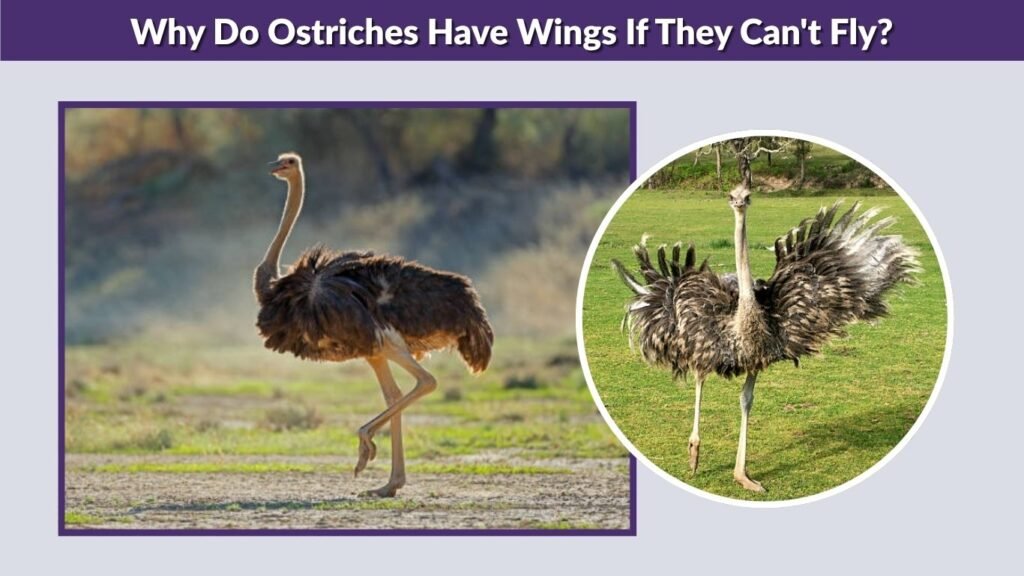
Although ostrich wings cannot carry the birds through the air, they are far from useless. Wings have been retained because they provide several advantages in everyday life. Ostriches use them while running, interacting with other birds, breeding, and caring for offspring, demonstrating that wings can evolve important functions unrelated to actual flight.
Wings Help With Balance
When an ostrich runs and changes direction quickly, it may spread or move its wings.
Its wings can help with:
- Maintaining balance at high speeds
- Making rapid turns
- Stabilizing the body
- Changing direction while running
- Controlling body position during sudden movements
The wings essentially work as stabilizers rather than flight structures.
Wings Are Used During Courtship
Male ostriches use their feathers and wings extensively during breeding displays. A male may spread, shake, or move his wings while performing movements designed to attract a female.
Their striking black-and-white plumage makes these displays particularly noticeable.
Wings Help With Communication and Protection
Ostriches can also use wing movements to communicate. Different postures may be involved in social interactions, displays, or defensive behavior.
Adults may additionally spread their wings while protecting chicks, helping keep the young together or providing some shelter from environmental conditions.
How Ostriches Survive Without Flying
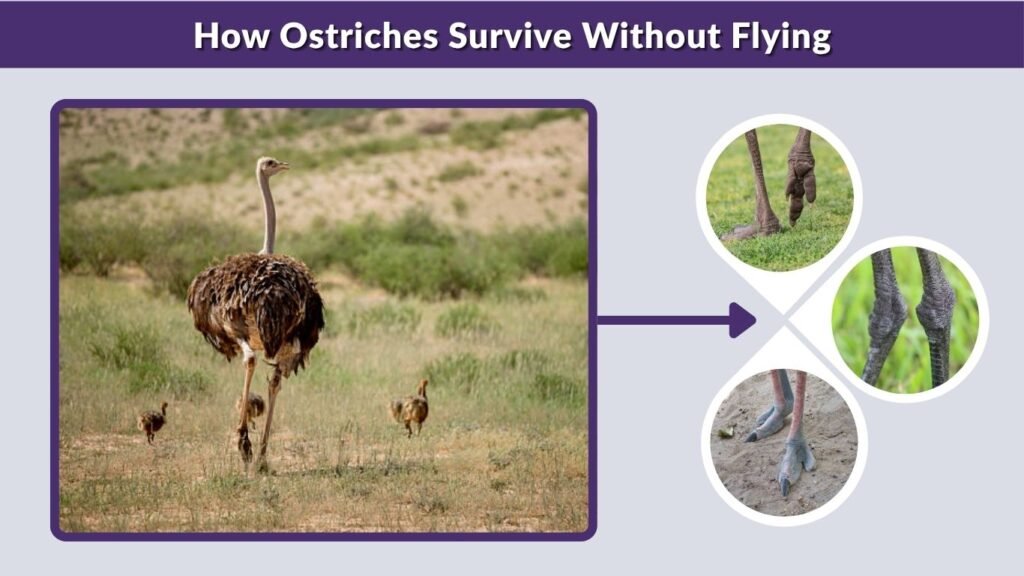
Flight helps many birds escape danger, search for food, and travel long distances. Ostriches solve these challenges differently. Their entire body is specialized for life on the ground. Powerful legs, impressive running speed, sharp eyesight, and defensive kicks allow them to survive in open African habitats without ever needing to take flight.
Ostriches Are Extremely Fast Runners
Running is the ostrich’s main method of escaping danger. Their long legs allow them to cover considerable distance with each stride, while their body remains balanced during rapid movement.
Their running adaptations include:
- Long, muscular legs
- Flexible leg joints
- Powerful leg tendons
- Only two toes on each foot
- A large inner toe that supports efficient movement
Rather than flying away from predators, an ostrich will usually rely on speed and endurance.
Powerful Legs Provide Defense
Running is not their only defense. Ostriches can deliver powerful forward kicks when threatened.
Their strong legs and large claws can potentially cause serious injuries to predators. Therefore, maintaining a safe distance from a defensive ostrich is important.
Excellent Eyesight Helps Detect Danger
An ostrich’s height gives it an excellent view across open grasslands and semi-arid environments. Its large eyes help it notice approaching animals from considerable distances.
Early detection gives an ostrich more time to run instead of relying on last-second escape through flight.
Ostriches Compared With Other Flightless Birds
Ostriches are not the only birds that have lost the ability to fly. Several unrelated bird groups developed flightlessness independently as they adapted to specific environments and lifestyles. However, their solutions differ considerably. Ostriches became highly specialized runners, while some other flightless species developed strong swimming abilities or adapted to forests and other terrestrial habitats.
Ostrich vs. Emu
Ostriches and emus are both large flightless birds, but they belong to different groups and live naturally on different continents.
Neither can fly. Both rely heavily on strong legs for movement and defense. Ostriches, however, are larger and generally capable of reaching greater running speeds.
Ostrich vs. Penguin
Penguins cannot fly through the air either, but their wings followed a completely different evolutionary path.
Penguin wings became stiff flippers designed for swimming. They essentially use their wings to propel themselves through water rather than air. Ostrich wings remain useful for displays, balance, and communication.
Ostrich vs. Turkey
Turkeys provide an interesting comparison because many people assume every large bird is flightless.
Wild turkeys can perform short bursts of flight and may fly into trees. Ostriches cannot. Therefore, if someone asks whether a turkey can fly higher than an ostrich, the answer is yes because any true flight is already higher than an ostrich can achieve through its wings.
How Fast Can an Ostrich Run?
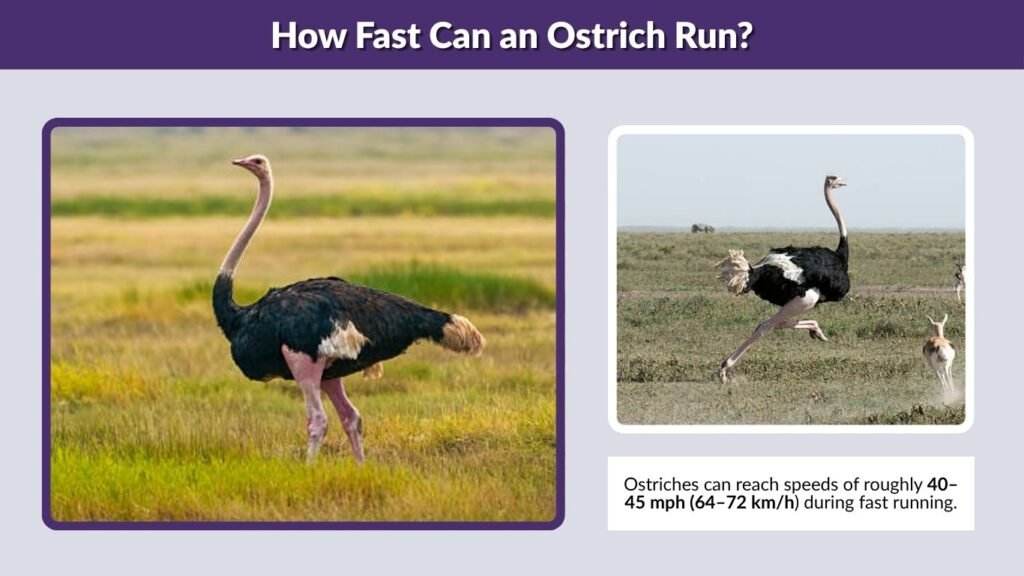
The ostrich’s inability to fly is compensated for by impressive ground movement. It is widely recognized as the fastest living bird on land. Its long stride, powerful muscles, and specialized feet allow it to travel efficiently across open terrain while conserving energy better than many animals of comparable size.
Running Instead of Flying
Ostriches can reach speeds of roughly 40–45 mph (64–72 km/h) during fast running. They can also maintain substantial speeds over longer distances.
When running rapidly, their wings may spread outward to help stabilize turns. This can sometimes create the visual impression that the bird is attempting to fly, but the wings never generate enough lift to carry it into the air.
FAQs
Can an Ostrich Fly Yes or No?
No. Ostriches cannot fly. Their heavy bodies, relatively small wings, flat breastbones, reduced flight muscles, and specialized feathers prevent powered flight. They are instead highly adapted for running and use their wings mainly for balance, communication, courtship, and other ground-based behaviors.
How Far Can an Ostrich Fly?
An ostrich cannot fly any distance. It may jump while running, but jumping does not count as true flight. Unlike some heavy birds capable of short flights, ostriches cannot generate enough lift with their wings to support their bodies in the air.
How High Can an Ostrich Fly?
An ostrich cannot fly above the ground using its wings. It may briefly leave the ground while jumping or running over uneven terrain, but this is produced by its legs rather than powered wing movement. Its wing structure is unsuitable for lifting its body.
Why Did Ostriches Lose the Ability to Fly?
Over evolutionary time, ostriches became increasingly specialized for terrestrial life. Their bodies developed powerful legs and adaptations for efficient running while flight-related anatomy became reduced. Modern ostriches therefore depend on speed, awareness, and strong defensive kicks rather than flying to escape threats.
Can Ostriches Fly If They Try Hard Enough?
No. Flying is not a matter of effort for an ostrich. Its anatomy simply cannot produce the lift and wing power necessary for flight. Even an ostrich running at maximum speed and flapping its wings cannot take off because its body is structurally adapted for running rather than flying.