
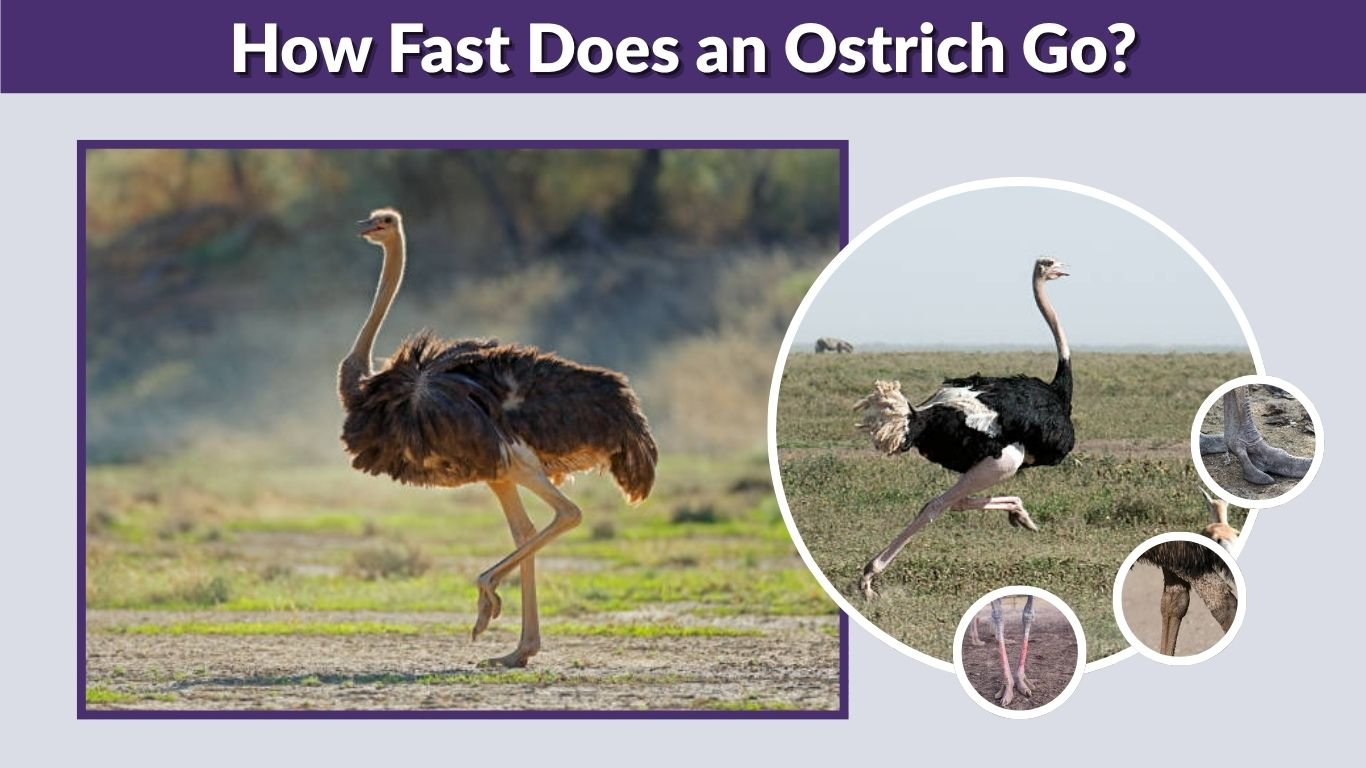
Ostriches are famous for being the fastest birds on land, but exactly how fast does an ostrich go? A healthy adult ostrich can reach a top running speed of around 40–45 mph (64–72 km/h) during short bursts. It can also maintain impressive speeds over longer distances thanks to its powerful legs, long stride, and energy-efficient movement. Although ostriches cannot fly, their remarkable running ability helps them escape predators and travel quickly across open African landscapes.
How Fast Can an Ostrich Run?
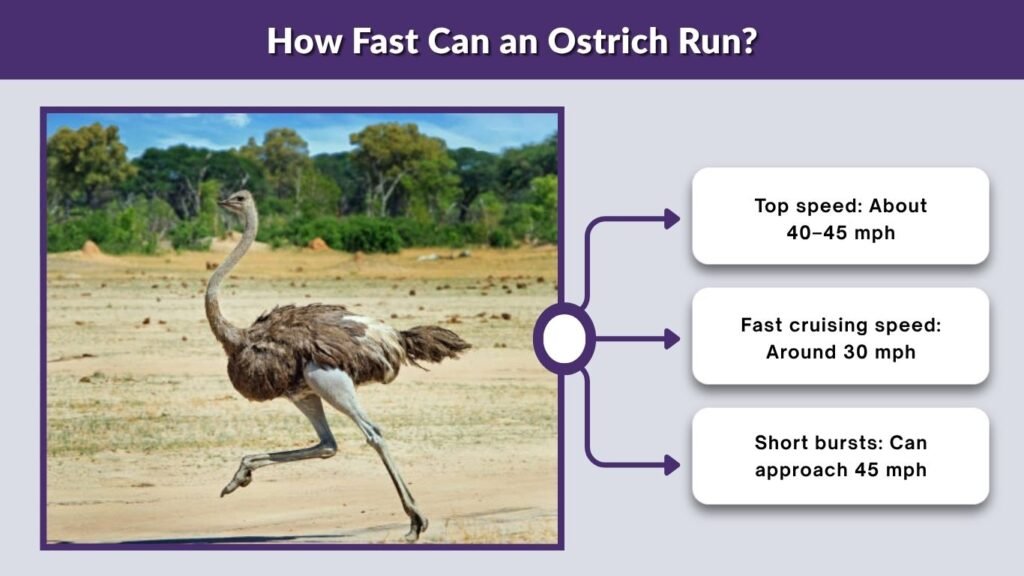
An ostrich is built for speed. Its long legs, lightweight lower limbs, powerful muscles, and specialized two-toed feet allow it to run faster than any other living bird. While exact speed varies depending on the individual and conditions, healthy adults can accelerate quickly and maintain surprisingly high speeds across open terrain.
Ostrich Top Speed
At maximum effort, an ostrich can run approximately 40–45 mph (64–72 km/h).
Important speed facts include:
- Top speed: About 40–45 mph
- Fast cruising speed: Around 30 mph
- Short bursts: Can approach 45 mph
- Stride length: Can exceed 10 feet during rapid running
- Fastest bird on land: Ostriches hold this distinction among living birds
These speeds allow an ostrich to outrun many animals over open ground.
How Long Can an Ostrich Run Fast?
An ostrich is not limited to very short sprints. It has excellent endurance and can maintain speeds of around 30 mph for relatively long periods.
This combination of speed and stamina makes the ostrich particularly difficult for predators to catch. Instead of relying entirely on sudden acceleration, it can continue moving quickly until the threat falls behind.
How Quickly Can an Ostrich Accelerate?
Ostriches can accelerate rapidly when they detect danger. Their strong leg muscles generate powerful forward movement, while their flexible joints help produce long, efficient strides.
They also use their wings to help stabilize their bodies when making sharp turns at high speeds.
Why Can Ostriches Run So Fast?
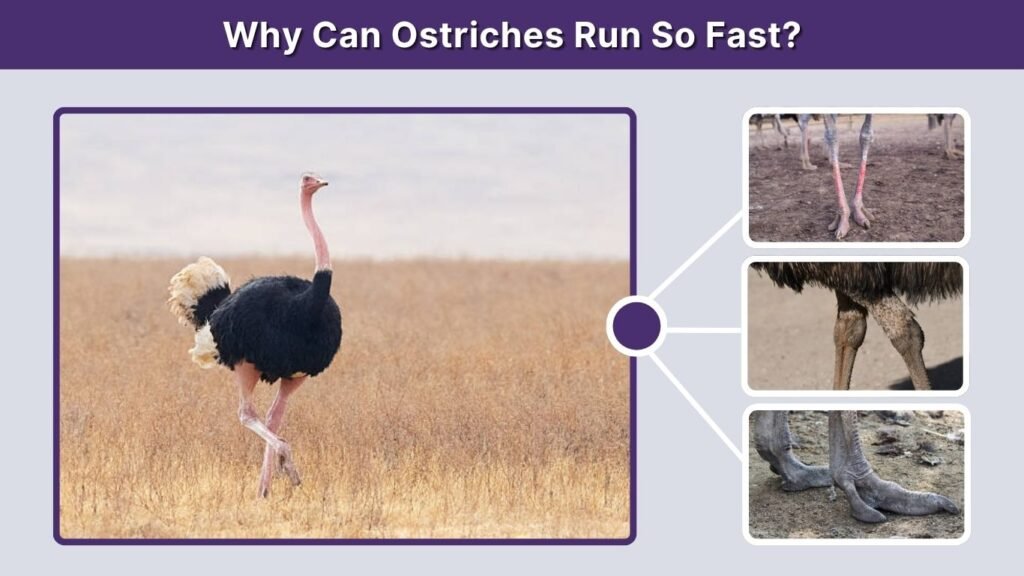
The ostrich’s body has evolved specifically for efficient terrestrial movement. Unlike flying birds that devote much of their anatomy to flight muscles and wings, ostriches concentrate tremendous power in their legs. Their skeletal structure, muscles, tendons, and feet work together to produce both exceptional speed and endurance.
Long and Powerful Legs
An ostrich’s legs are responsible for most of its impressive running performance.
Their adaptations include:
- Long leg bones that increase stride length
- Large upper-leg muscles
- Strong elastic tendons
- Lightweight lower legs
- Flexible joints that support rapid movement
These features allow an ostrich to cover considerable ground with relatively few steps.
Two-Toed Feet Improve Efficiency
Most birds have three or four toes, but ostriches have only two on each foot.
The larger inner toe bears much of the bird’s weight and has a large nail. This unusual foot structure reduces unnecessary weight at the end of the legs and helps the ostrich push efficiently against the ground while running.
Elastic Tendons Save Energy
Ostrich tendons act somewhat like springs. They store energy when the foot hits the ground and release some of it during the next stride.
This reduces the amount of muscular effort required during sustained running, helping explain why ostriches can maintain high speeds better than many other animals.
How Fast Is an Ostrich Compared With Other Animals?
Although ostriches are exceptionally fast, several land mammals can reach greater maximum speeds. What makes an ostrich unusual is the combination of speed, endurance, body size, and efficient movement. Compared with other birds and many familiar animals, an ostrich is an extremely impressive runner.
Ostrich vs. Human
A typical human cannot come close to matching an ostrich’s maximum speed.
The difference can be summarized as:
- Ostrich: Up to about 40–45 mph
- Elite human sprinter: Around the high 20-mph range at peak speed
- Average person: Considerably slower
- Ostrich advantage: Longer strides and highly specialized running anatomy
Trying to outrun an ostrich on foot would therefore be unrealistic.
Ostrich vs. Horse
A fast horse can reach speeds of roughly 40 mph or more, depending on breed and conditions.
This means an ostrich can approach the speed of a galloping horse during maximum-effort running. However, performance varies significantly between individual animals.
Ostrich vs. Cheetah
A cheetah is considerably faster than an ostrich over a short sprint and can exceed 60 mph.
However, cheetahs cannot maintain their maximum speed for very long. Ostriches rely more heavily on a combination of quick acceleration, sustained speed, maneuverability, and endurance to escape predators.
How Do Ostriches Run?
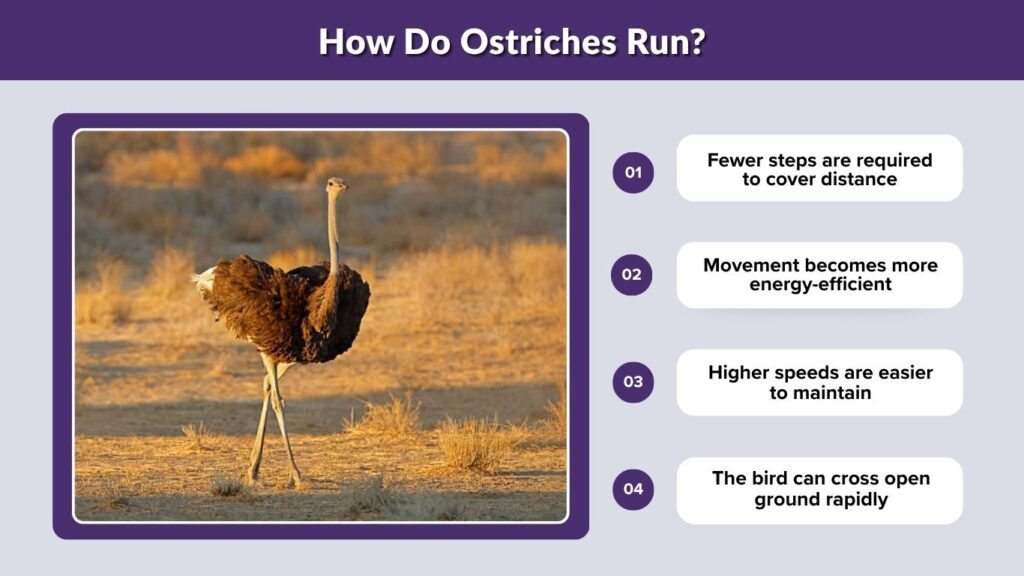
Watching an ostrich run reveals how specialized its body is for ground movement. Rather than taking many short steps, it uses long, spring-like strides. Its body remains relatively stable while the powerful legs extend underneath it, helping the bird move efficiently across grasslands, savannas, and other open environments.
Their Strides Are Extremely Long
At high speed, an ostrich may cover more than 10 feet with a single stride.
Long strides provide several advantages:
- Fewer steps are required to cover distance
- Movement becomes more energy-efficient
- Higher speeds are easier to maintain
- The bird can cross open ground rapidly
- Longer legs help increase forward momentum
This is one reason ostriches can move so quickly despite their large size.
Wings Help With Balance
Although ostriches cannot fly, their wings still serve an important purpose while running.
When making rapid turns, an ostrich may extend or move its wings to stabilize its body. The wings essentially act as balancing structures, allowing the bird to change direction more effectively without losing control.
The Body Remains Stable
During running, an ostrich’s torso and head remain relatively controlled while its legs perform much of the movement.
This efficient running posture limits unnecessary motion and helps conserve energy during longer periods of travel.
Why Do Ostriches Need So Much Speed?
Ostriches naturally live in open environments where hiding from predators can be difficult. Because they cannot fly into trees or escape through the air, running has become their primary defense. Speed allows them to create distance quickly while endurance helps them remain ahead of predators during prolonged pursuits.
Escaping Predators
Running helps ostriches escape animals such as large African predators.
Their survival advantages include:
- Excellent long-distance vision
- Rapid acceleration
- High maximum speed
- Strong endurance
- Ability to change direction while running
- Powerful defensive kicks if escape fails
An ostrich will usually prefer to move away from danger rather than fight whenever possible.
Traveling Across Open Habitat
Speed is also useful when ostriches move through large territories searching for food and water.
Their efficient legs make covering long distances less demanding than it would be for a bird with shorter, less specialized limbs.
Protecting Chicks
Adult ostriches may use movement and distraction behaviors when predators threaten their young. Their speed allows them to draw attention away from vulnerable chicks while remaining difficult for many predators to catch.
Can an Ostrich Outrun a Person?
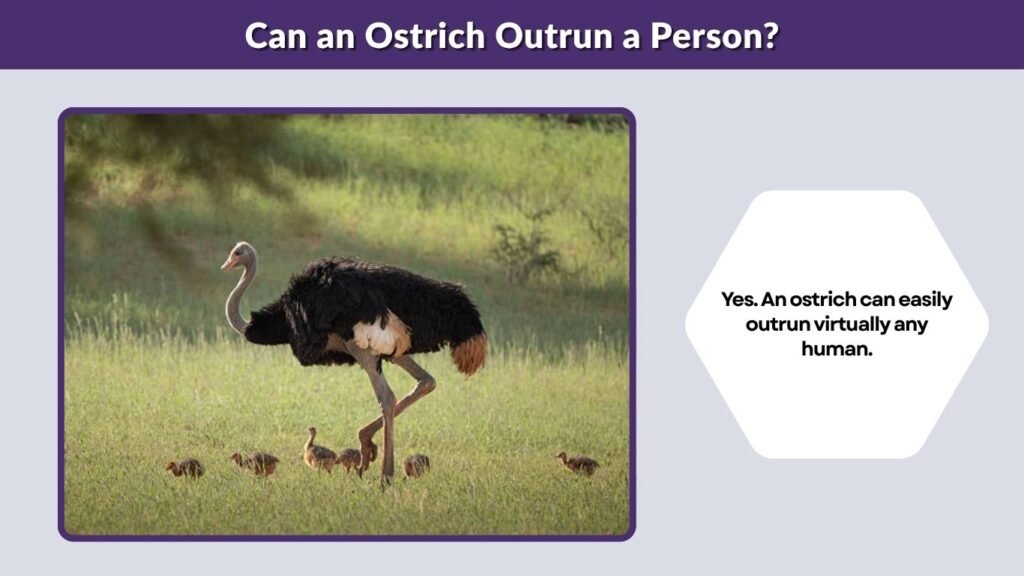
Yes. An ostrich can easily outrun virtually any human. Even elite sprinters cannot maintain speeds approaching an ostrich’s maximum for meaningful distances. The bird’s long legs and specialized running system give it a major advantage, especially across open ground where there are few obstacles.
Why Humans Cannot Keep Up
Humans are efficient endurance runners, but our bodies are not specialized for the same combination of stride length and high speed.
An ostrich’s legs can produce extremely long strides while its elastic tendons recycle energy efficiently. Humans have much shorter legs relative to an ostrich and cannot maintain comparable speeds.
If encountering an ostrich, especially a defensive one, trying to race it is not a practical safety strategy.
FAQs
How Fast Does an Ostrich Go in MPH?
An ostrich can reach approximately 40–45 mph during maximum-effort running. It can also maintain speeds around 30 mph for longer periods. This impressive combination of speed and endurance makes the ostrich the fastest living bird when traveling on land.
How Fast Can an Ostrich Run in KM/H?
An ostrich can reach approximately 64–72 km/h at its highest running speed. Its long legs, powerful muscles, elastic tendons, and two-toed feet help it move efficiently while maintaining good balance across open terrain.
Can an Ostrich Run 60 MPH?
No. Reliable estimates generally place an ostrich’s maximum speed closer to 40–45 mph rather than 60 mph. Speeds around 60 mph are more characteristic of extremely fast mammals such as cheetahs during short sprints.
Can an Ostrich Outrun a Human?
Yes. Ostriches are considerably faster than humans. While the fastest human sprinters can briefly reach speeds in the high 20-mph range, an ostrich can approach 45 mph and can sustain high running speeds much longer.
Is an Ostrich Faster Than a Horse?
An ostrich can reach speeds comparable to some galloping horses, although fast horses may match or exceed it depending on the breed and conditions. Ostriches are particularly impressive because their lightweight legs and specialized feet allow both rapid acceleration and efficient sustained running.
