
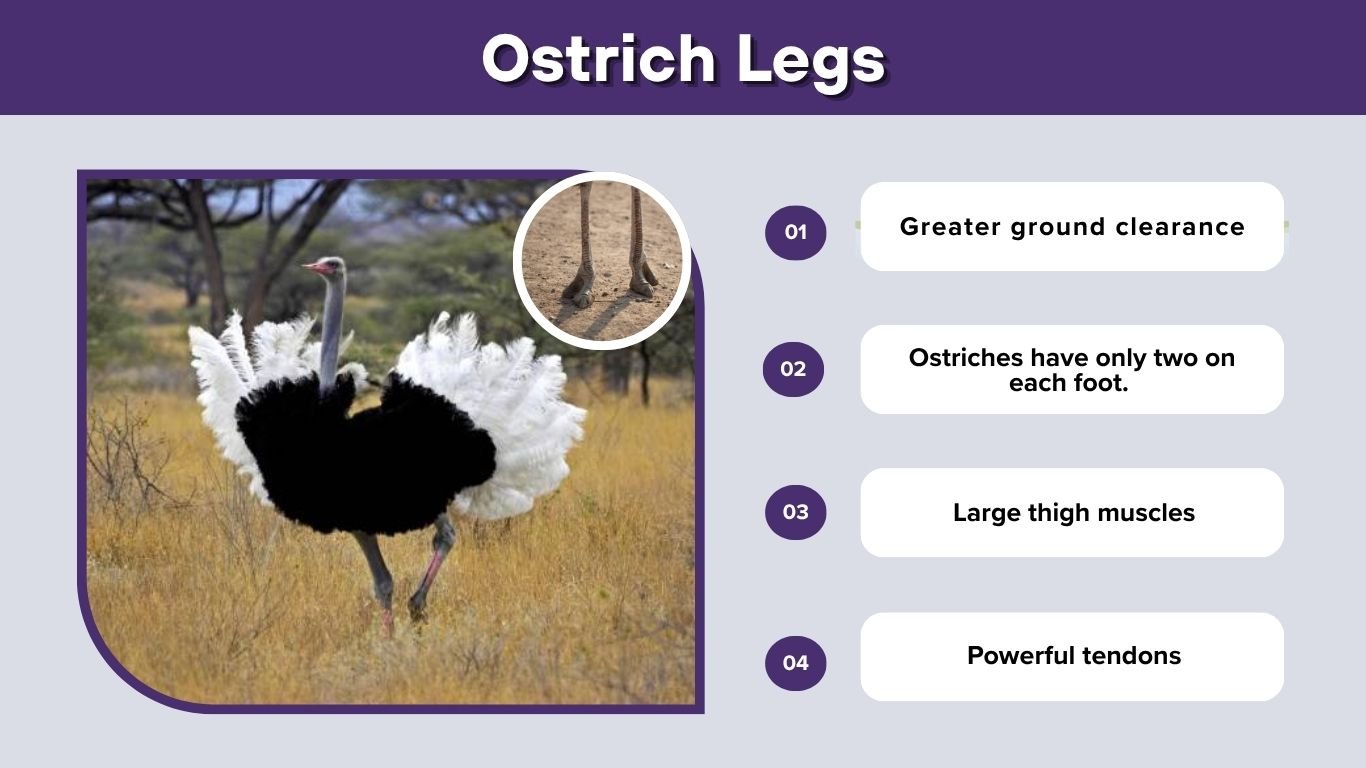
Ostrich legs are among the most remarkable adaptations of any living bird. Long, muscular, and built for speed, they allow ostriches to run across open ground at impressive speeds while covering large distances efficiently. Each foot has only two toes, including one large weight-bearing toe that improves stability and traction. These powerful legs also serve as an important defense against predators. From their unusual anatomy and incredible strength to their running ability, feet, bones, and kicking power, ostrich legs are perfectly suited to life on the ground.
Ostrich Leg Anatomy
An ostrich may look as though most of its leg begins at the visible backward-bending joint, but bird leg anatomy is more complicated. Much of the upper leg is hidden beneath the feathers. The long exposed section includes elongated lower-leg and foot bones that help produce long, efficient strides while keeping the limb relatively lightweight.
Main Parts of an Ostrich Leg
Important structures include:
- Femur: Upper leg bone largely hidden beneath body feathers
- Tibiotarsus: Long, powerful lower-leg bone
- Tarsometatarsus: Extended bone contributing much of the visible leg length
- Knee: Positioned relatively high and partly hidden by feathers
- Ankle: The prominent backward-looking joint people sometimes mistake for a knee
- Muscles and tendons: Produce force while helping conserve energy during running
- Feet: Specialized for fast movement over firm and sandy ground
This combination creates a long but surprisingly efficient running limb.
Ostrich Leg Bones
Ostrich leg bones need to support a very heavy flightless bird while withstanding repeated impacts during fast running.
Their leg structure combines strength with relatively low weight. Powerful muscles are concentrated closer to the body, while the lower portions of the legs are dominated by bones and tendons.
This arrangement reduces the amount of heavy tissue that must swing forward and backward during each stride, helping the bird move efficiently.
How Long Are Ostrich Legs?
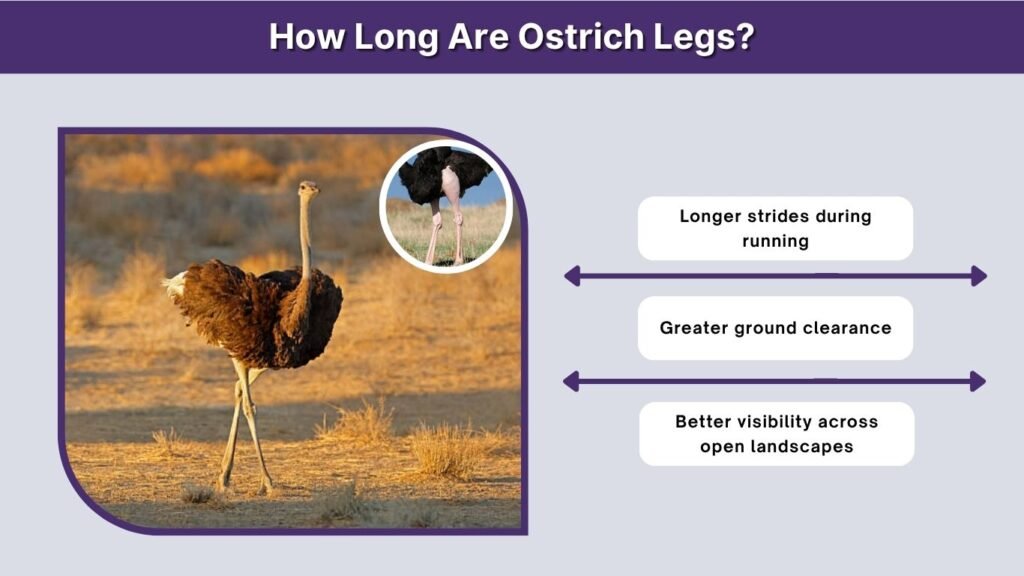
Ostriches are the tallest living birds, and their exceptionally long legs contribute greatly to that height. Exact leg length differs according to the bird’s sex, age, and body size. Adult males are generally taller and heavier than females, although both sexes have long legs designed for running rather than perching or climbing.
Why Are Ostrich Legs So Long?
Long legs provide several advantages:
- Longer strides during running
- Greater ground clearance
- Better visibility across open landscapes
- Efficient movement over long distances
- Powerful leverage when kicking
- Rapid acceleration when escaping danger
Their long stride means they can cover considerable ground with relatively few steps compared with much smaller animals.
How Many Legs Does an Ostrich Have?
Like other birds, an ostrich has two legs.
What makes those legs unusual is their size and specialization. Ostriches cannot fly, so natural selection has favored exceptionally strong terrestrial locomotion.
Their wings still have roles in balance, display, and maneuvering, but the legs provide virtually all of the power needed for traveling and escaping predators.
Ostrich Feet Have Only Two Toes
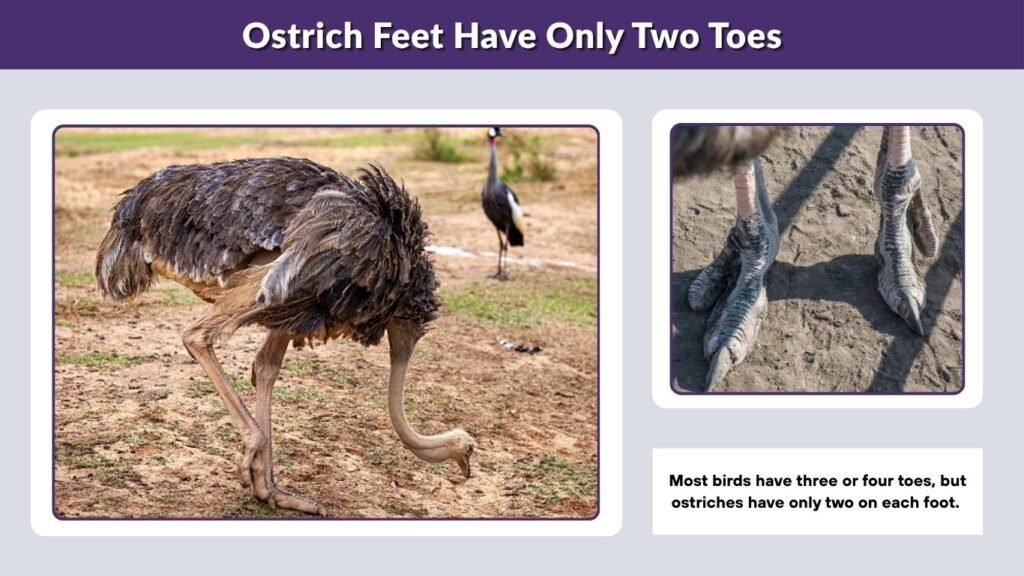
One of the most unusual features of ostrich legs is found at the feet. Most birds have three or four toes, but ostriches have only two on each foot. This reduction in toe number is associated with their highly specialized running lifestyle.
Ostrich Legs and Feet
The two toes have different roles:
- Large inner toe: Bears much of the bird’s weight and has a strong nail
- Smaller outer toe: Helps with balance and stability
- Broad foot pad: Helps absorb impacts while running
- Reduced toe number: Keeps the foot relatively lightweight
- Long foot structure: Contributes to an efficient stride
Their feet work somewhat like highly specialized running equipment, providing traction while reducing unnecessary weight at the end of the leg.
Why Do Ostriches Have Two Toes?
Having fewer toes reduces the mass at the end of each leg. This matters because moving a lighter foot requires less energy during rapid running.
The large inner toe also provides strong contact with the ground and contributes to forward propulsion.
Ostriches are unique among living birds in having only two toes on each foot.
How Strong Are Ostrich Legs?
Ostrich legs are extremely muscular because they must support the body, power rapid running, and provide defense. An adult ostrich is far too large to rely solely on flight or hiding when threatened, so speed is its first defense. If escape is impossible, those same legs can deliver forceful kicks.
What Makes Ostrich Legs Powerful?
Several features contribute to their strength:
- Large thigh muscles
- Strong bones
- Long leverage-producing limbs
- Powerful tendons
- Large weight-bearing toes
- Strong claws
- Excellent balance
- Fast leg extension during kicking
The combination of muscle and leverage means an ostrich can produce a powerful forward kick.
How Powerful Is an Ostrich Kick?
An ostrich can kick hard enough to seriously injure a person or predator. The large claw on the main toe can make the strike particularly dangerous.
Ostriches usually prefer running away from threats, but cornered or defensive birds may kick.
For this reason, wild or captive ostriches should always be treated with caution and given plenty of space.
Ostrich Legs and Running Speed
Ostriches are the fastest birds on land. Their long legs, lightweight lower limbs, powerful muscles, and spring-like tendons work together to make sustained running remarkably efficient. Unlike many animals that can sprint only briefly, ostriches can maintain relatively high speeds while traveling across open terrain.
How Fast Can Ostrich Legs Carry Them?
Ostriches can reach running speeds of roughly 70 km/h (43 mph) for short periods.
Their running adaptations include:
- Long strides
- Strong leg muscles
- Lightweight lower legs
- Elastic tendons
- Two-toed feet
- Good balance
- Wings that assist with steering and stability
At slower running speeds, the elastic properties of their legs help conserve energy from one stride to the next.
How Ostriches Turn While Running
Their wings may look unnecessary because ostriches cannot fly, but they are useful during fast movement.
An ostrich can extend or move its wings while turning, helping shift balance during rapid changes in direction.
Meanwhile, the long legs continue generating forward power. This combination helps the bird maneuver while escaping predators rather than simply running in a straight line.
Do Ostriches Stand on One Leg?
Ostriches may occasionally rest with one leg positioned differently from the other, but they are not famous for prolonged one-legged standing in the way flamingos are. Their normal posture relies on both legs to support their substantial body weight.
How Ostriches Rest Their Legs
When resting deeply, an ostrich may lower its body toward the ground rather than remaining upright continuously.
The bird can bend its long legs beneath its body while sitting. During ordinary standing and walking, however, both legs provide the primary support necessary for balance and movement.
Can Ostrich Legs Get Injured?
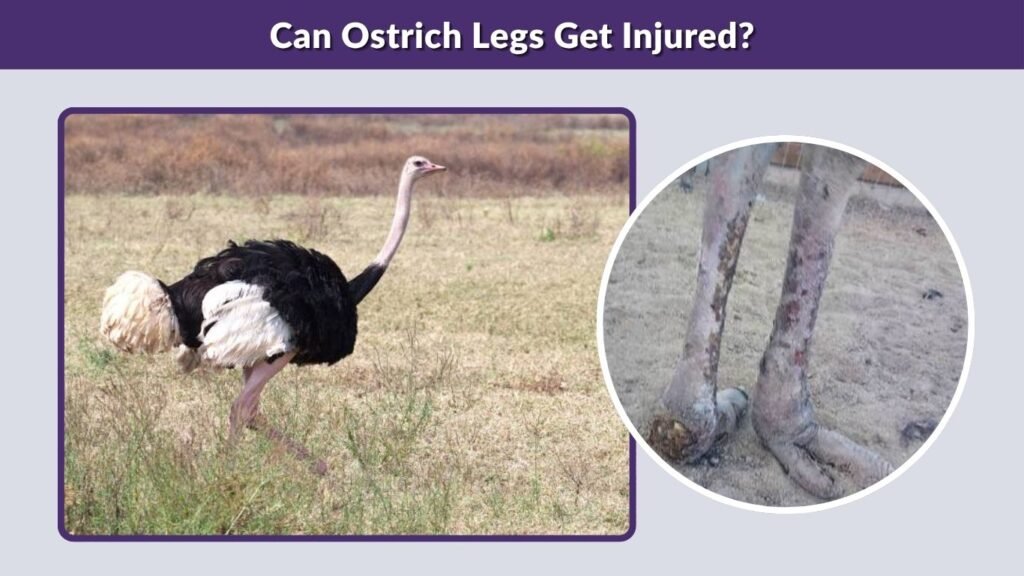
Because ostriches depend almost entirely on their legs for mobility, leg injuries can be serious. Problems may result from accidents, poor footing, inappropriate enclosure surfaces, nutritional issues, or collisions. Young birds can be particularly vulnerable while their bones and muscles are developing.
Common Leg Problems
Possible concerns include:
- Fractures
- Joint injuries
- Tendon problems
- Foot injuries
- Abnormal leg development
- Slipping injuries
- Cuts around the feet or lower legs
A captive ostrich showing severe limping, inability to stand, swelling, or an abnormal leg position requires evaluation by a veterinarian experienced with large birds.
Interesting Facts About Ostrich Legs
Ostrich legs combine several unusual adaptations that are rarely found together in other birds. Their specialized feet, long bones, strong muscles, and energy-saving tendons allow one structure to perform multiple jobs: walking, running, balancing, escaping predators, and defending the bird when necessary.
Quick Ostrich Leg Facts
- Ostriches have two legs.
- Each foot has only two toes.
- They are the only living birds with two-toed feet.
- The large inner toe carries much of the bird’s weight.
- Their lower legs are relatively lightweight.
- Powerful muscles are concentrated higher on the leg.
- Their legs allow very long running strides.
- Ostriches can run around 43 mph at top speed.
- Their legs can deliver dangerous defensive kicks.
- Wings help with balance and turning while running.
FAQs
Ostrich legs attract attention because they look very different from those of most familiar birds. Their extreme length, unusual two-toed feet, and enormous power are all closely connected with the ostrich’s flightless lifestyle.
How many legs does an ostrich have?
An ostrich has two legs, just like other birds. However, its legs are exceptionally long and muscular because running is its primary means of transportation and escape. Each leg ends in a specialized foot containing only two toes.
How strong are ostrich legs?
Ostrich legs are extremely powerful. They support a heavy bird, propel it at high running speeds, and can deliver strong defensive kicks. The combination of large muscles, long bones, tendons, and a large clawed toe makes a kick potentially dangerous.
Why are ostrich legs so long?
Long legs allow ostriches to take enormous strides and travel efficiently across open habitats. They also provide leverage for fast acceleration and defensive kicking. Their height additionally gives them a better view of their surroundings.
How fast can an ostrich run?
An ostrich can reach approximately 70 km/h, or about 43 mph, during fast running. Its two-toed feet, long stride, strong muscles, and energy-efficient tendons make it the fastest living bird on land.
Do ostriches have knees?
Yes. Ostriches have knees, but the actual knee joint is positioned high on the leg and is partly hidden by the bird’s body feathers. The prominent joint visible farther down the leg that bends backward is mainly the ankle region, not the knee.
