
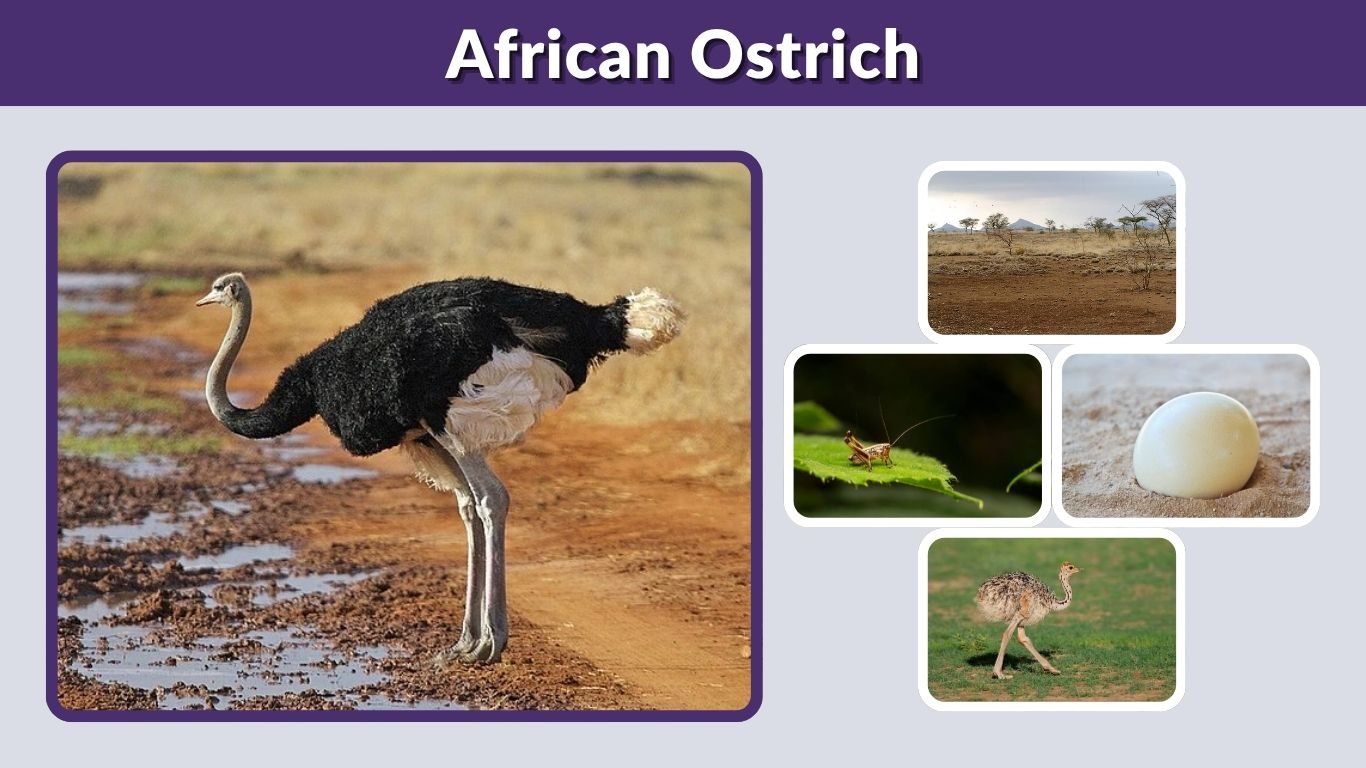
The African ostrich is the world’s largest living bird and one of the most recognizable animals of Africa’s open landscapes. Native to the continent, ostriches are flightless but exceptionally fast runners, using powerful legs to escape predators across savannas and semi-arid regions. Africa is home to different ostrich populations, including the North African and South African ostrich. These remarkable birds are also known for enormous eggs, long necks, strong feet, and impressive adaptations to heat. Here is a closer look at African ostriches, their habitat, diet, behavior, and life cycle.
What Is an African Ostrich?
The common ostrich (Struthio camelus) is a large flightless bird native to Africa. It belongs to a group of birds called ratites, which also includes emus, rheas, cassowaries, and kiwis. Ostriches cannot fly, but they compensate with extraordinary running ability, excellent eyesight, and strong legs adapted for moving across open terrain.
African Ostrich Identification
African ostriches have several unmistakable characteristics:
- Extremely long legs
- Long, mostly bare neck
- Small head relative to body size
- Large rounded body
- Two toes on each foot
- Powerful muscular legs
- Large eyes with long eyelashes
- Soft, loose feathers rather than rigid flight feathers
- Adult males commonly have black-and-white plumage
- Females are usually grayish-brown
Males can stand more than 8 feet tall, making ostriches taller than any other living bird.
Are Ostriches Native to Africa?
Yes. Ostriches are naturally associated with Africa and historically occupied a much larger range across the continent and parts of the Middle East.
Today, wild common ostriches occur mainly in suitable open habitats across portions of eastern, southern, and parts of northern Africa.
The Somali ostrich, found mainly in the Horn of Africa, is now generally treated as a separate ostrich species rather than simply another common ostrich subspecies.
Where Do African Ostriches Live?
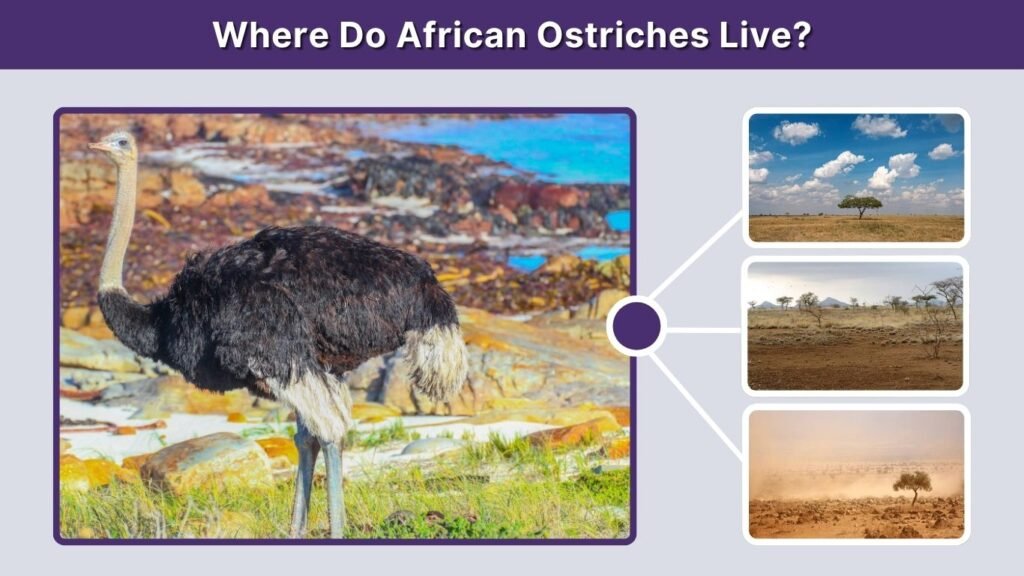
African ostriches are built for open environments. Their long legs allow them to travel considerable distances, while their excellent eyesight helps them detect predators before danger gets close. They generally avoid dense forests, preferring habitats where visibility is high and running provides an effective means of escape.
African Ostrich Habitat
Common habitats include:
- Savannas
- Semi-deserts
- Dry grasslands
- Open scrubland
- Bushveld
- Arid plains
- Agricultural areas in some regions
- Open woodland edges
Ostriches tolerate hot, dry conditions remarkably well. They can obtain substantial moisture from the vegetation they eat and may travel to find better food when local conditions become dry.
Do Ostriches Live Only in Africa?
Wild native populations are primarily African, although ostriches have been introduced or farmed in many other parts of the world.
Commercial ostrich farming occurs in countries outside Africa because ostriches can be raised for meat, leather, feathers, eggs, and tourism.
However, Africa remains the natural home of wild ostriches and the center of their evolutionary history.
North African Ostrich
The North African ostrich, also called the red-necked ostrich, is a subspecies of the common ostrich. Its scientific designation is Struthio camelus camelus. Historically, it occupied extensive portions of northern and western Africa, but its distribution has become much more fragmented.
What Does the North African Ostrich Look Like?
North African ostriches are extremely large and may be distinguished partly by the reddish or pink coloration of the neck and legs, especially in adult males during breeding periods.
Typical characteristics include:
- Very large body size
- Long reddish neck
- Pink to reddish legs in males
- Black body feathers in adult males
- White wing and tail feathers
- Gray-brown coloration in females
Like other ostriches, they are unable to fly but are powerful runners.
North African Ostrich Diet
North African ostriches primarily consume plant material, although their diet is flexible.
They may eat:
- Grasses
- Leaves
- Seeds
- Flowers
- Fruits
- Shrubs
- Succulent vegetation
- Occasionally insects and other small animals
Their broad diet helps them survive in dry habitats where food availability changes dramatically between seasons.
North African Ostrich Predators
Adult ostriches are large enough to discourage many predators, but they still face threats from large carnivores.
Potential predators can include lions, leopards, cheetahs, hyenas, and African wild dogs, depending on region.
Eggs and chicks are more vulnerable. Jackals, birds of prey, hyenas, and other animals may raid nests or capture young birds.
Adults rely heavily on running and strong defensive kicks when threatened.
South African Ostrich
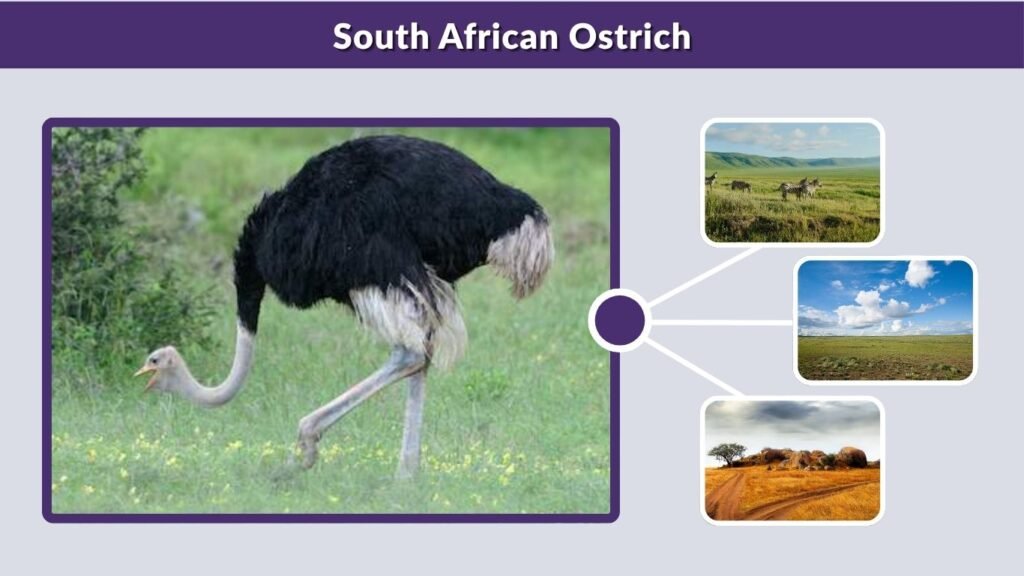
The South African ostrich (Struthio camelus australis) occurs naturally in southern Africa. It has also played an important role in the development of commercial ostrich farming, particularly in South Africa.
Where Do South African Ostriches Live?
They occur in countries and regions with suitable open, dry habitats in southern Africa.
Typical environments include:
- Grasslands
- Semi-arid plains
- Savannas
- Shrublands
- Dry open country
South Africa has a particularly long history of ostrich farming, with the Oudtshoorn region becoming internationally associated with commercial ostrich production.
South African Ostrich Appearance
Adult males have predominantly black body feathers with conspicuous white feathers on the wings and tail.
Females are generally gray to brown, providing better camouflage when sitting near nests.
Their long bare legs are extremely powerful, and the two-toed feet distinguish ostriches from nearly every other large bird.
African Black Ostrich
The African Black ostrich is best understood as a domesticated or selectively bred type rather than a separate wild ostrich species. It became particularly important within the South African ostrich-farming industry.
Why African Black Ostriches Are Farmed
Selective breeding has emphasized traits useful for commercial production, including manageable temperament and desirable feathers, skin, meat, and reproductive characteristics.
Ostriches may be farmed for:
- Meat
- Leather
- Feathers
- Eggs
- Breeding stock
- Tourism
Ostrich leather is particularly recognizable because of its distinctive follicle pattern.
What Do African Ostriches Eat?
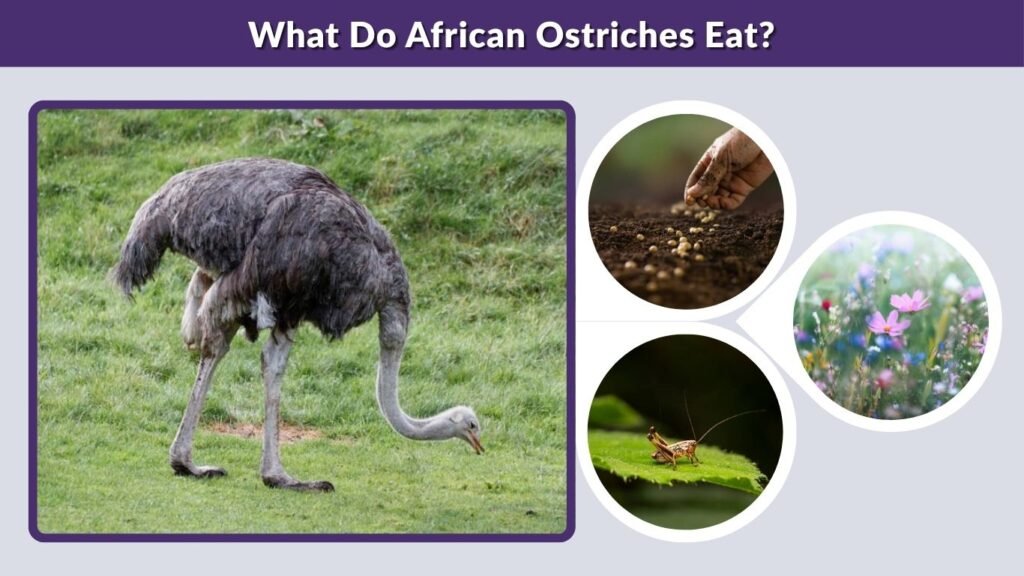
African ostriches are mainly herbivorous but opportunistic. Much of their diet consists of plant material, although they can consume insects and small animals when available.
Common African Ostrich Foods
Their diet can include:
- Grasses
- Seeds
- Leaves
- Flowers
- Fruits
- Roots
- Shrubs
- Succulent plants
- Insects
- Small vertebrates occasionally
Because ostriches lack teeth, they swallow small stones and grit. These materials remain in the muscular stomach and help grind food during digestion.
What Do Ostriches Drink?
Ostriches drink water when it is available, but they are well adapted to dry environments.
They obtain part of their water requirements directly from fresh vegetation. This allows them to survive periods when standing water is limited.
They may still drink substantial amounts when they encounter a reliable water source.
How Fast Can an African Ostrich Run?
Speed is one of the ostrich’s greatest defenses. Although it cannot fly, an adult ostrich can outrun many predators over open ground.
African Ostrich Speed
An ostrich can reach speeds of roughly 70 km/h (43 mph) for short periods and can maintain impressive running speeds over longer distances.
Its running ability comes from:
- Extremely long legs
- Powerful thigh muscles
- Lightweight skeletal adaptations
- Two-toed feet
- Long strides
- Flexible balance while running
A running ostrich may cover several meters with a single stride at high speed.
African Ostrich Feet and Legs
Ostrich feet are unusual among birds because each foot has only two toes. The larger inner toe carries a substantial claw and helps support the bird while running.
Can an Ostrich Kick Be Dangerous?
Yes. An ostrich has extremely strong legs and can deliver powerful defensive kicks.
When threatened and unable to escape, an adult may kick forward with considerable force.
This is one reason wild or captive ostriches should be treated as large, potentially dangerous animals rather than approached casually.
Their legs are primarily designed for running, but they also provide an effective defense against predators.
African Ostrich Eggs
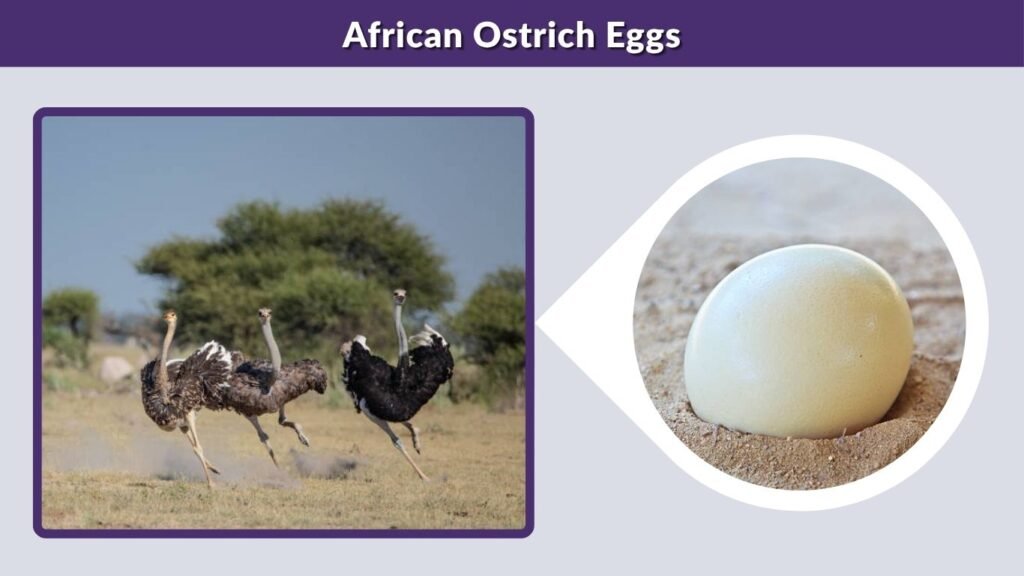
Ostriches produce the largest eggs of any living bird. Although enormous compared with chicken eggs, an ostrich egg is relatively small when compared with the size of the adult female.
How Big Is an African Ostrich Egg?
A typical ostrich egg can weigh around 1.2–1.8 kg, although individual size varies.
The shell is thick, hard, and cream-colored.
Ostrich eggs are notable for:
- Large size
- Thick shells
- High food content
- Shared incubation by adults
- Use in decorative art and crafts
The strong shell helps protect the developing chick but must eventually be broken from inside during hatching.
Painted African Ostrich Eggs
Decorated ostrich eggs have a long history as art and craft objects.
The thick shells can be:
- Painted
- Carved
- Engraved
- Turned into lamps
- Displayed as ornaments
- Used in jewelry or decorative pieces
Painted and carved ostrich eggs are particularly associated with African art and tourist markets, including those in southern Africa.
African Ostrich Reproduction and Chicks
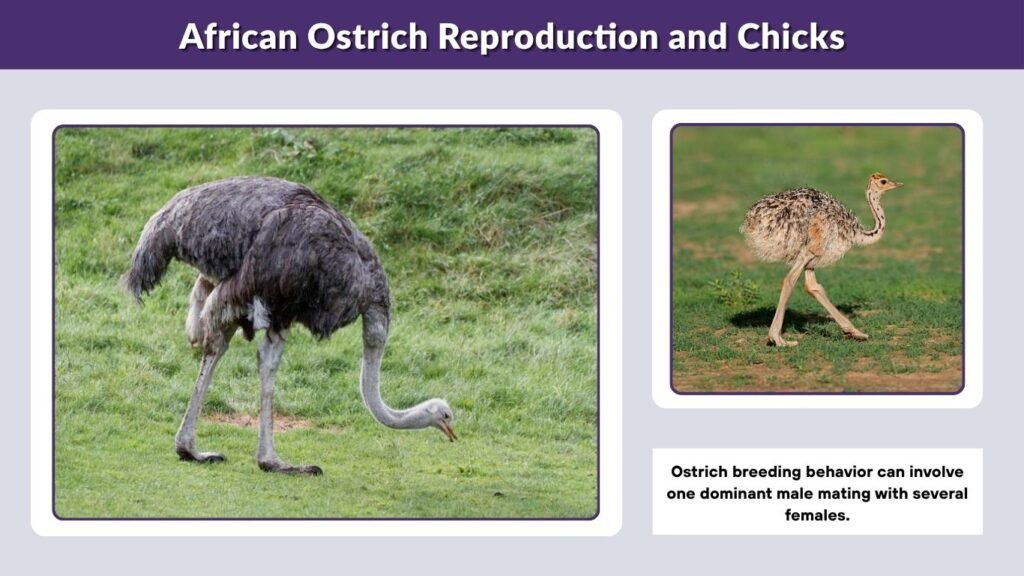
Ostrich breeding behavior can involve one dominant male mating with several females. Multiple females may place eggs into a shared nest scraped into the ground.
Incubation and Hatching
The dominant female often incubates during daylight, while the male commonly takes a major role at night.
Their different plumage may help with camouflage: the female’s brown coloring blends with the daytime landscape, while the male’s dark feathers are less conspicuous at night.
After hatching, chicks can walk and move with adults relatively quickly, although they remain vulnerable to predators during their early life.
African Ostrich Facts
Ostriches have several extraordinary adaptations that distinguish them from other birds.
Interesting Facts
- Ostriches are the tallest living birds.
- They are also the heaviest living birds.
- They cannot fly.
- They can run around 70 km/h in short bursts.
- Each foot has only two toes.
- Their eggs are the largest produced by living birds.
- Males are generally black and white.
- Females are usually gray-brown.
- Ostriches have very large eyes.
- They swallow stones to help grind food.
- They can survive in dry environments.
- Strong legs provide both speed and defense.
- Wild ostriches are native to Africa.
- Several distinct ostrich populations occur across the continent.
FAQs
Are there ostriches in Africa?
Yes. Ostriches are native to Africa and continue to live wild in several regions of the continent. They are especially associated with savannas, grasslands, semi-arid areas, and open scrub. Different populations occur in eastern, southern, and parts of northern Africa.
What is a North African ostrich?
The North African ostrich is the red-necked subspecies Struthio camelus camelus. It is a very large ostrich historically distributed across northern and western Africa. Populations have declined substantially in many areas, making conservation and reintroduction efforts important.
What is the difference between a North and South African ostrich?
The North African ostrich is S. c. camelus, while the South African ostrich is S. c. australis. They differ in geographic distribution and some physical characteristics, including skin coloration. Both are forms of the common ostrich and share similar diets and behavior.
How fast can an African ostrich run?
African ostriches can reach roughly 70 km/h, or about 43 mph, during short high-speed runs. Their long legs, two-toed feet, powerful muscles, and enormous stride allow them to escape many predators without relying on flight.
Are African ostriches dangerous?
Ostriches generally prefer running away from danger, but adults can be dangerous when cornered, threatened, or protecting nests and chicks. Their muscular legs can deliver powerful kicks. Wild and captive ostriches should therefore be observed from a safe distance and handled only by experienced people.
