
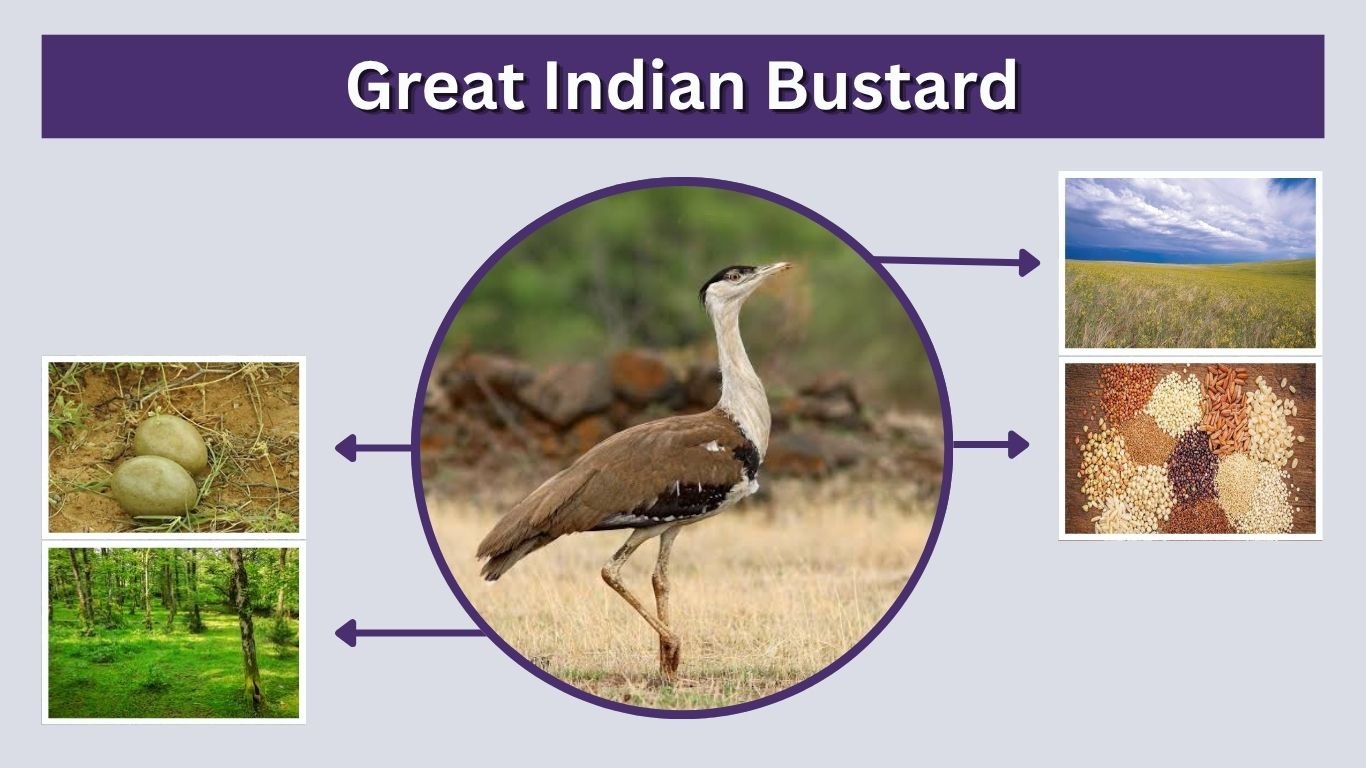
The Great Indian Bustard (Ardeotis nigriceps) is one of India’s rarest birds and among the heaviest capable of flight. Known as the Godawan, it has a black crown, pale neck, sandy-brown body, and long legs. This grassland bird once occurred widely across the Indian subcontinent, but most survivors now live in Rajasthan’s Thar Desert. With a tiny wild population remaining, its future depends on protecting open habitats, preventing power-line collisions, and rebuilding populations through conservation programs.
What Is the Great Indian Bustard?
The Great Indian Bustard belongs to the family Otididae, whose members generally inhabit open country. Its scientific name, Ardeotis nigriceps, refers to its black head. Although it mostly walks, it can fly strongly.
It is Rajasthan’s state bird, widely known as Godawan. Other names include Maldhok in Marathi and Ghorad in Gujarati. These refer to the same species.
How to Identify a Great Indian Bustard
This bird is tall and heavily built, with a horizontal body, long neck, and strong bare legs. Its sandy coloring blends into dry grassland, making it harder to spot than its size suggests. The black crown and white neck are especially useful identification features when observing one from a distance.
Size, Weight, and Wingspan
Males reach about 100–122 cm tall and weigh 8–14.5 kg. Females are smaller, around 76–92 cm and 3.5–6.75 kg. Large birds may have a wingspan of roughly 2–2.5 meters and fly with broad, steady wingbeats.
Male vs. Female Appearance
Both sexes are brown above and pale below, but males are larger, with a whiter neck and stronger black crown and breast markings. Females often show a less distinct breast band, while young birds appear duller.
Where Does the Great Indian Bustard Live?
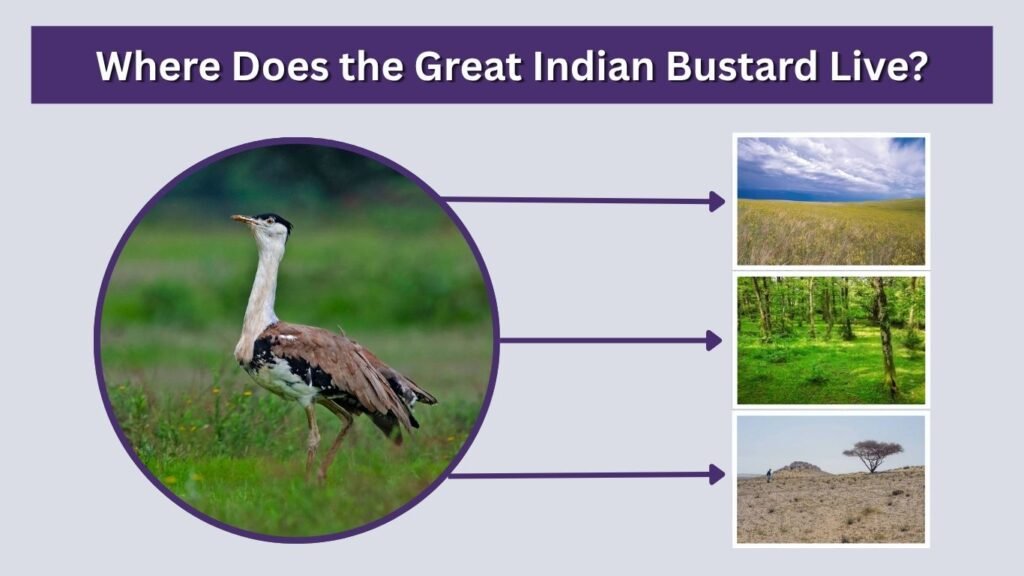
The Great Indian Bustard depends on extensive, open landscapes rather than dense forest. It uses short grasslands, semi-desert plains, sparse scrub, and lightly cultivated areas. It needs enough vegetation for cover and feeding, yet also requires broad visibility to detect predators and move freely.
Rajasthan and Desert National Park
Rajasthan holds the main surviving population. Desert National Park and surrounding grasslands in Jaisalmer form its strongest refuge. Protection focuses on breeding sites, habitat quality, and dangerous infrastructure.
Even here, sightings are never guaranteed because the bird is extremely rare.
Great Indian Bustards in Other States
Historically, it occupied grasslands across several Indian states and Pakistan. Today, only tiny populations remain outside Rajasthan, particularly around Gujarat’s Kachchh region, with scattered records elsewhere. Maharashtra’s Nannaj area is historically important, but its former sanctuary status does not imply a healthy population today.
What Does the Great Indian Bustard Eat?
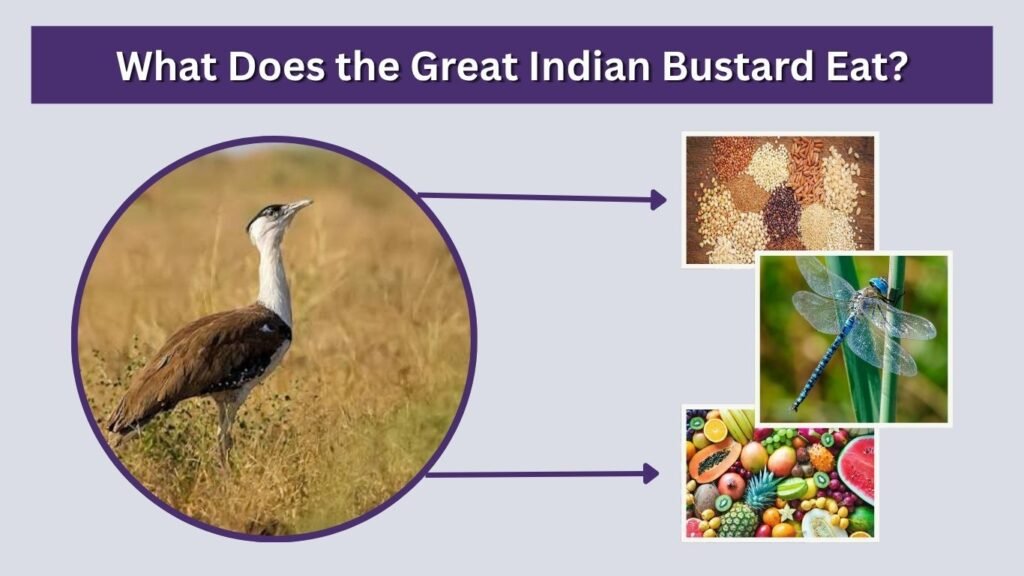
The Great Indian Bustard is an omnivore, feeding on both plants and animals. Its diet changes with season and local conditions. It usually walks slowly through open ground, looking for visible food among grasses, crops, and low vegetation.
Common food sources include:
- Insects: Grasshoppers, locusts, beetles, and other large insects.
- Plant material: Seeds, shoots, and seasonal fruits.
- Agricultural foods: Groundnuts, millets, and other available crops.
- Small animals: Occasional lizards, rodents, and other small prey.
Its varied diet helps it use grasslands and traditional farmland, but food cannot compensate for unsafe habitat.
Great Indian Bustard Calls, Dance, and Flight
These birds are generally quiet, but breeding males become conspicuous during courtship. Their displays combine posture, movement, and low vocal sounds. Although they spend much of the day on the ground, their wings remain important for moving between feeding and breeding areas.
Courtship Dance and Sound
During courtship, a male lifts his head, adjusts his feathers, and inflates a large throat pouch. He produces deep booming or bellowing calls. The so-called mating dance involves deliberate postures and walking rather than elaborate jumping.
Can Great Indian Bustards Fly?
Yes. Broad wings carry these heavy birds across grasslands, but sudden turns can be difficult. Overhead transmission wires are therefore dangerous obstacles when birds fail to see them in time.
Great Indian Bustard Eggs and Chicks
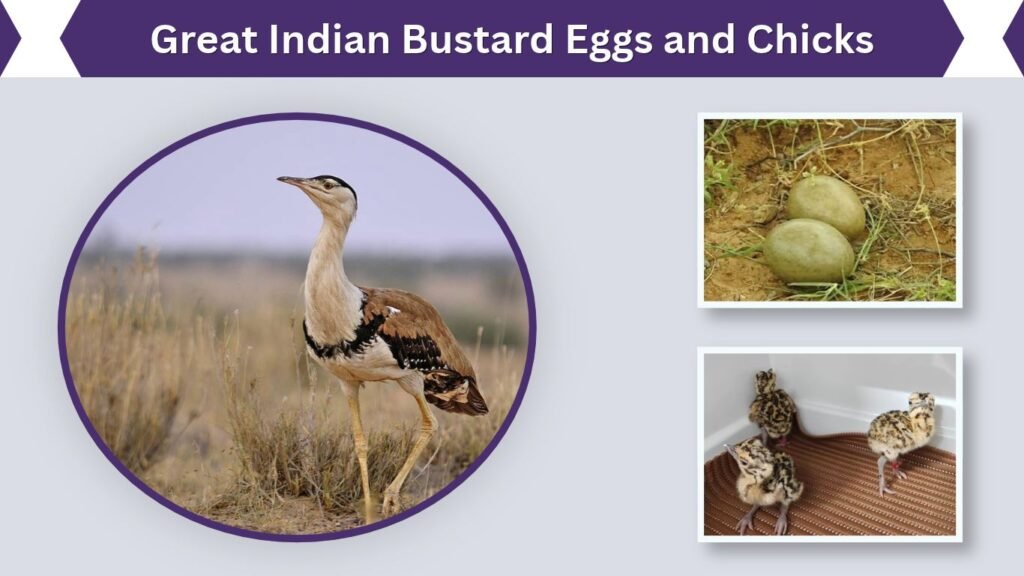
Great Indian Bustards nest directly on the ground, usually in a shallow depression rather than a constructed nest. The female generally lays one egg, rarely two. Incubation lasts about 27 days, and the female alone cares for the developing chick.
Chicks move soon after hatching but depend on their mothers. Because reproduction is slow and breeding may not succeed every year, losing even a few birds or eggs matters.
How Many Great Indian Bustards Are Left in 2026?
The species remains exceptionally rare. A Wildlife Institute of India survey from 2024–25, released in 2026, estimated 130 wild birds in Rajasthan, with a margin of error of ±21. Including small populations elsewhere, the global wild total is often estimated around 140–150, not an exact count.
| Conservation measure | Reported position |
| IUCN Red List category | Critically Endangered |
| Rajasthan wild estimate | 130 ±21 birds, from 2024–25 survey |
| Approximate total wild population | Around 140–150 birds |
| Conservation breeding | Active at facilities in Sam and Ramdevra |
| Main wild stronghold | Jaisalmer region of Rajasthan |
Captive birds are not part of the wild population estimate. In October 2026, the government reported 97 birds at breeding facilities, including captive-bred birds and individuals from wild-collected eggs. This does not yet mean wild populations have recovered.
Why Is the Great Indian Bustard Critically Endangered?
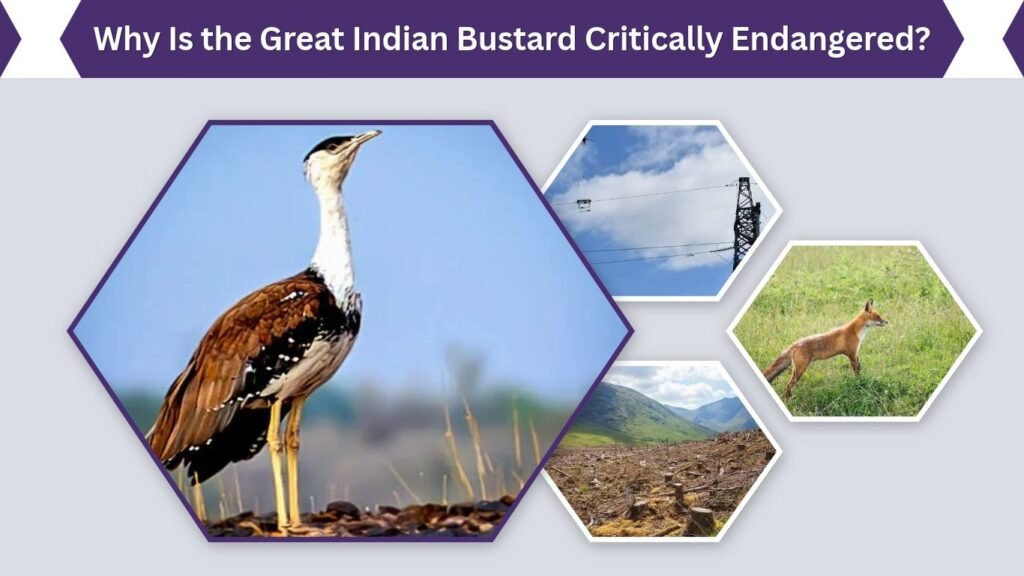
The bird has declined because its open habitat has been lost, fragmented, and made increasingly dangerous. Its slow breeding rate makes recovery difficult even when adult losses are reduced. Several threats often occur in the same landscape.
- Power-line collisions: Large birds can strike poorly visible overhead cables.
- Habitat conversion: Farming expansion, infrastructure, and other land-use changes reduce suitable grassland.
- Disturbance and predation: Ground nests and chicks are vulnerable, particularly where disturbance or free-ranging animals increase risk.
- Historical hunting: Hunting and egg collection contributed to earlier population declines.
Grasslands are sometimes treated as empty land, but they are functioning ecosystems. Protecting them also benefits other species adapted to India’s dry, open landscapes.
Project Great Indian Bustard and Captive Breeding
Project Great Indian Bustard combines habitat protection, research, and conservation breeding. Rajasthan launched its initiative in 2013, alongside national recovery work led by conservation agencies.
At Jaisalmer breeding facilities, specialists have incubated eggs and bred birds in captivity. Pilot releases began in 2026, with monitoring essential because captive-raised birds must adapt to natural hazards.
Long-term success will depend on restoring connected grasslands, making power infrastructure safer, protecting nesting areas, and ensuring that released birds survive and reproduce naturally.
FAQs
Is the Great Indian Bustard extinct?
No. The Great Indian Bustard is not extinct, but it is classified as Critically Endangered. A very small number still live in the wild, mostly in Rajasthan. Conservation breeding has produced additional birds, although protecting and rebuilding a self-sustaining wild population remains the central challenge.
Is the Great Indian Bustard India’s national bird?
No. India’s national bird is the Indian peafowl, commonly called the peacock. The Great Indian Bustard is the state bird of Rajasthan. It was once discussed as a possible national bird, which sometimes causes confusion, but it never replaced the peafowl as India’s official national bird.
What is the Great Indian Bustard called in Hindi?
It is commonly known as Godawan (गोडावण), especially in Rajasthan. Other regional names include Maldhok in Marathi and Ghorad in Gujarati. Names can differ by language and locality, so a long list of supposed synonyms should not be treated as scientifically distinct birds.
How many eggs does a Great Indian Bustard lay?
A female usually lays one egg in a shallow ground nest, although two are occasionally reported. She incubates the egg and raises the chick without routine help from the male. Because breeding is slow, disturbance and egg or chick losses can significantly affect population recovery.
Why are power lines dangerous to Great Indian Bustards?
Great Indian Bustards are heavy flying birds with limited ability to avoid unexpected obstacles at the last moment. Overhead wires can be difficult for them to detect, leading to fatal collisions. Conservation responses include marking dangerous lines, rerouting infrastructure, and undergrounding selected lines where practical.