
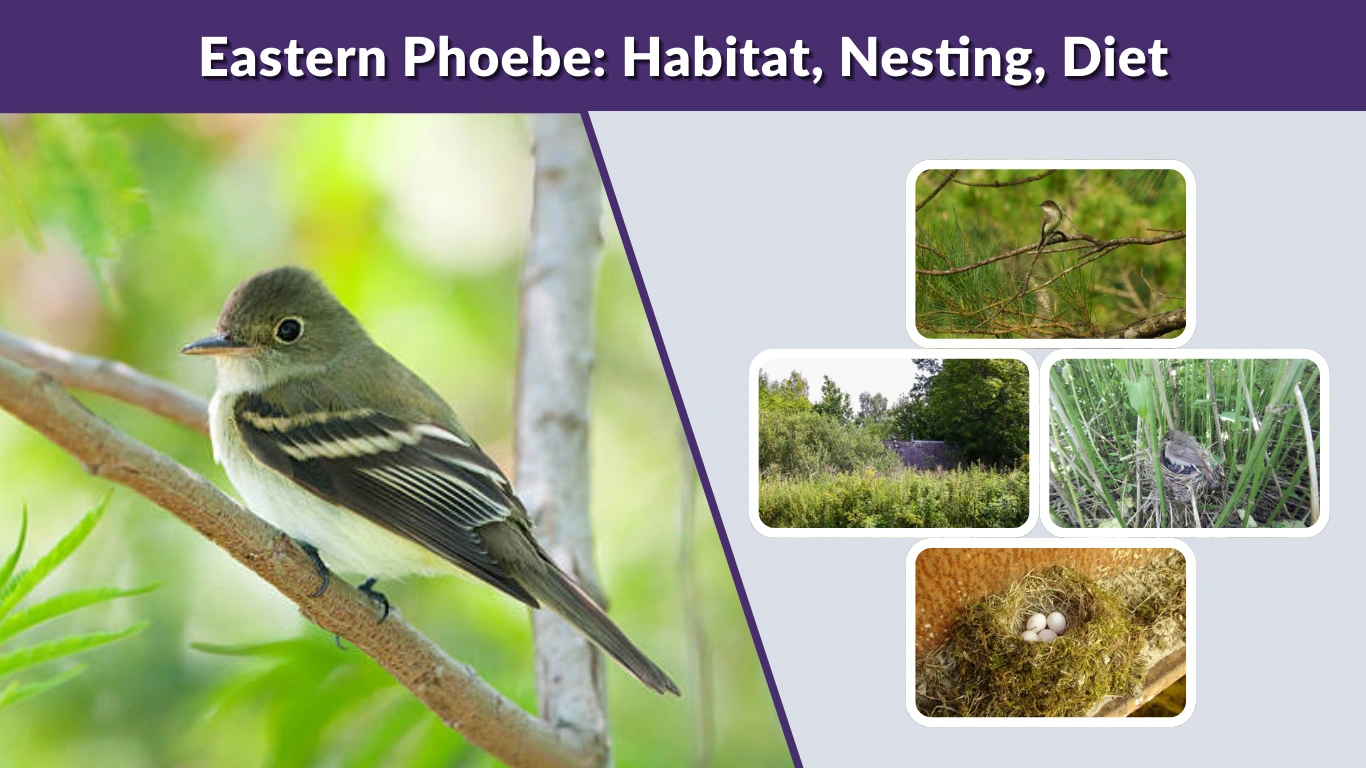
The eastern phoebe is one of the earliest returning songbirds of spring, often arriving before trees have fully leafed out. Recognized by its soft gray-brown plumage and distinctive “fee-bee” call, this small flycatcher is a familiar sight across much of eastern North America. Unlike many shy woodland birds, the eastern phoebe frequently nests on buildings and bridges, making it easy to observe. In this guide, we’ll explore the eastern phoebe’s habitat, diet, nesting habits, eggs, and key identification features to help you better understand this adaptable species.
Eastern Phoebe Overview
Identification and Physical Characteristics
The eastern phoebe is a medium-sized flycatcher measuring about 6 to 7 inches long, with a wingspan of roughly 10 to 11 inches. It has a slender build, a fairly large head, and a thin, straight bill designed for catching insects.
Its coloring is subtle but distinctive once you know what to look for. The upperparts are gray-brown or olive-gray, while the underparts are pale gray to off-white. The head appears darker than the body, but unlike many other flycatchers, the eastern phoebe lacks bold markings. There is no strong eye ring, no wing bars, and no bright coloration. This plain appearance is one of its key identification features.
One behavior that makes identification easier is its constant tail wagging or tail pumping. When perched, the bird frequently dips its tail downward in a steady rhythm, a habit rarely seen in similar species.
Signature Call and Behavior
The eastern phoebe gets its name from its clear, whistled song that sounds like “fee-bee.” Males repeat this two-note call throughout early spring as they establish territories and attract mates.
In addition to its song, the phoebe makes sharp chip notes used for communication and alarm. Its vocal activity is especially noticeable in March and April, when many other birds have not yet begun singing.
Behaviorally, eastern phoebes use a classic flycatcher hunting style known as the perch-and-sally technique. The bird waits quietly on a low branch, fence, or building edge, then suddenly flies out to snatch an insect in mid-air before returning to the same perch. This repeated pattern makes them fascinating to watch.
Migration and Range
Eastern phoebes breed across the eastern and central United States and into southern Canada. They prefer temperate climates and return north earlier than most insect-eating birds, sometimes while snow is still on the ground.
During winter, they migrate to the southeastern United States, including states like Florida and Texas, as well as parts of eastern Mexico. Some individuals remain in the southernmost parts of their range year-round if food remains available.
Their early arrival in spring is possible because they can survive on limited insect supplies and occasionally supplement their diet with berries.
Eastern Phoebe Habitat
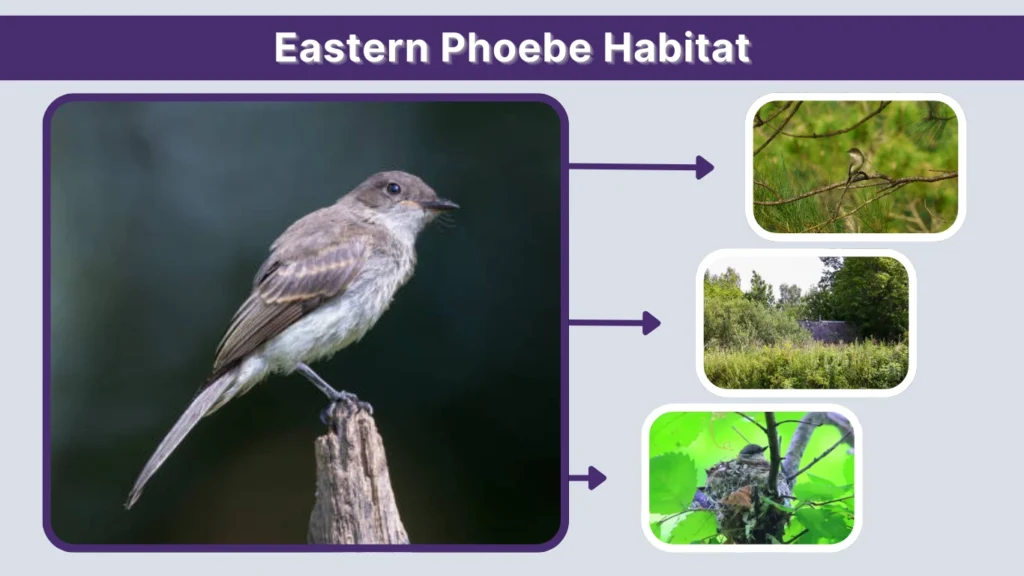
Preferred Breeding Habitat
The eastern phoebe habitat typically includes open woodlands, forest edges, farmland, and areas near water such as streams or ponds. They favor semi-open landscapes that provide both perching spots for hunting and sheltered areas for nesting.
Unlike deep-forest specialists, phoebes thrive in transitional habitats where trees meet open fields. These environments offer abundant flying insects and suitable nesting ledges.
Water sources are particularly attractive, as insect populations tend to be higher near streams and wetlands.
Winter Habitat
In winter, eastern phoebes move south to milder climates. Their winter habitat often includes:
- Open forests
- Shrubby fields
- Woodland edges
- Suburban parks
Even during colder months, they remain close to wooded areas where they can find shelter and occasional insects.
Adaptation to Human Environments
One of the reasons eastern phoebes are so widespread is their ability to adapt to human structures. Historically, they nested on natural rock ledges or cliff faces. Today, they commonly build nests under:
- Bridges
- Barn rafters
- Porch ceilings
- Sheds and garages
These man-made structures mimic natural ledges and provide protection from rain and predators. Because of this adaptability, eastern phoebes are often seen near homes and farms.
Eastern Phoebe Diet
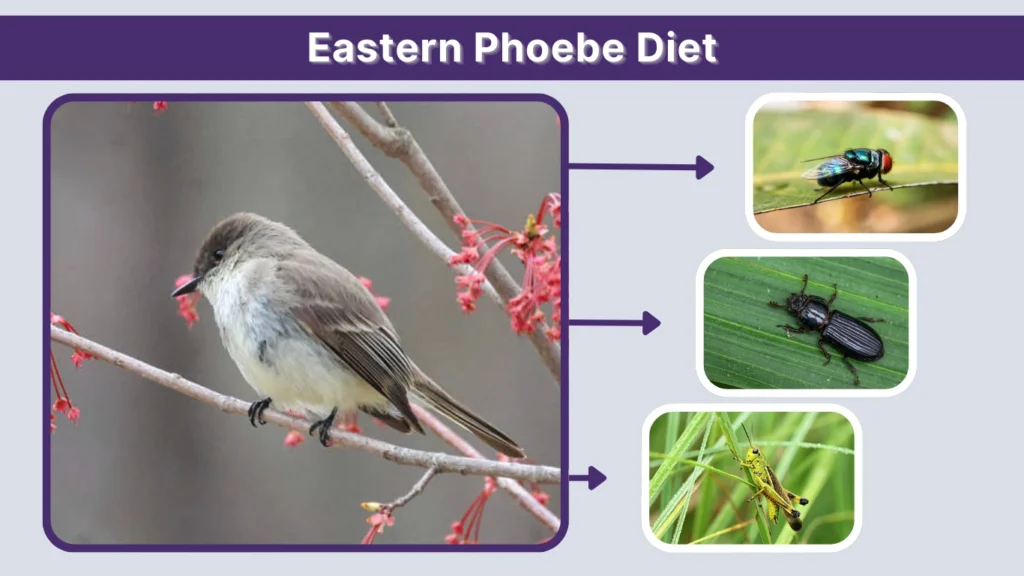
Primary Food Sources
The eastern phoebe diet consists mainly of insects and other small invertebrates. As a true flycatcher, it specializes in capturing flying insects.
Common prey items include:
- Flies
- Beetles
- Wasps
- Grasshoppers
- Spiders
Their thin bills and agile flight make them highly effective aerial hunters.
Hunting Technique
Eastern phoebes typically hunt from low perches. They sit quietly while scanning for movement, then launch into short, quick flights to capture prey in mid-air. After catching an insect, they usually return to the same perch.
This repeated behavior is a helpful identification clue for birdwatchers. Their feeding flights are direct and purposeful rather than long, wandering chases.
Seasonal Diet Changes
During the breeding season, insects form nearly the entire diet, providing the protein necessary for egg production and feeding nestlings. However, in late fall and winter—especially in southern parts of their range—eastern phoebes may supplement their diet with small berries.
This flexibility helps them survive when flying insects are scarce.
Eastern Phoebe Nesting Habits
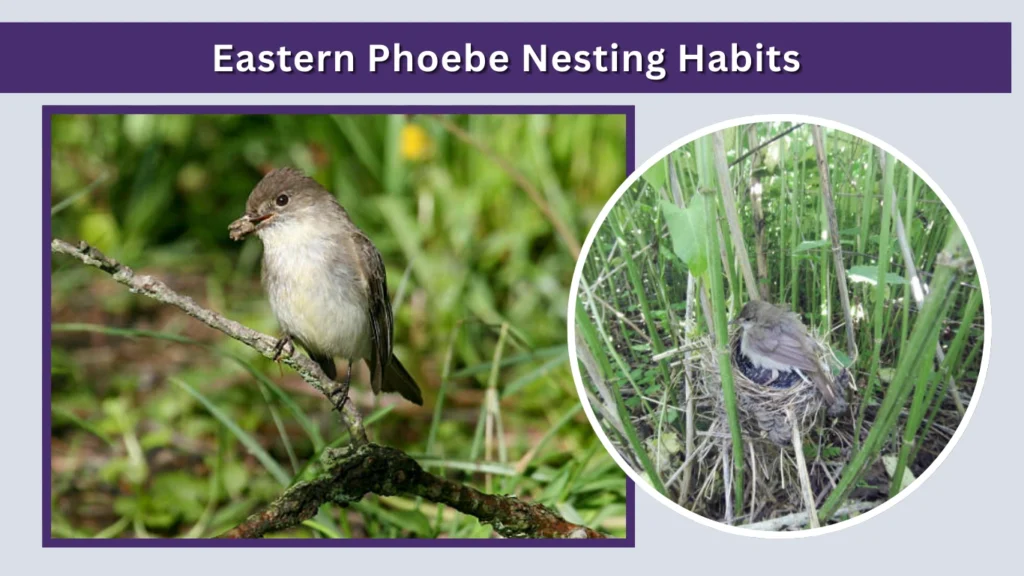
Eastern Phoebe Nest Location
Eastern phoebe nesting begins early in spring, often shortly after the birds return from migration. One of their most distinctive traits is their choice of nesting sites. Unlike many woodland songbirds that hide nests deep in shrubs or trees, phoebes prefer sheltered ledges.
Common nest locations include:
- Under bridges
- On barn rafters
- Beneath porch ceilings
- Inside sheds or garages
- Natural rock overhangs
These sites provide protection from rain and direct sunlight. The overhead cover is essential, as phoebe nests are open cups and not enclosed structures.
Phoebes are also known for strong site fidelity, meaning they often return to the same nesting spot year after year. In some cases, they even build a new nest on top of an old one.
Nest Construction
The female builds the eastern phoebe nest, though the male may remain nearby to guard the area. Nest construction usually takes several days.
The nest has a sturdy, cup-shaped design with a base made primarily of mud. This mud foundation helps anchor the nest securely to a vertical surface. Once the base is formed, the female adds:
- Grass
- Moss
- Plant fibers
- Animal hair
The interior lining is soft and insulated, providing comfort for eggs and chicks. Because mud is essential to construction, nesting often begins after spring rains when mud is readily available.
Nesting Season and Broods
Eastern phoebes typically raise one to two broods per year. In warmer regions, a third brood is sometimes possible.
Breeding begins in early spring, often earlier than many other insect-eating birds. After the first brood fledges, the pair may quickly begin a second nesting attempt.
Both parents feed the young once they hatch, bringing insects back to the nest repeatedly throughout the day.
Eastern Phoebe Eggs
Egg Appearance
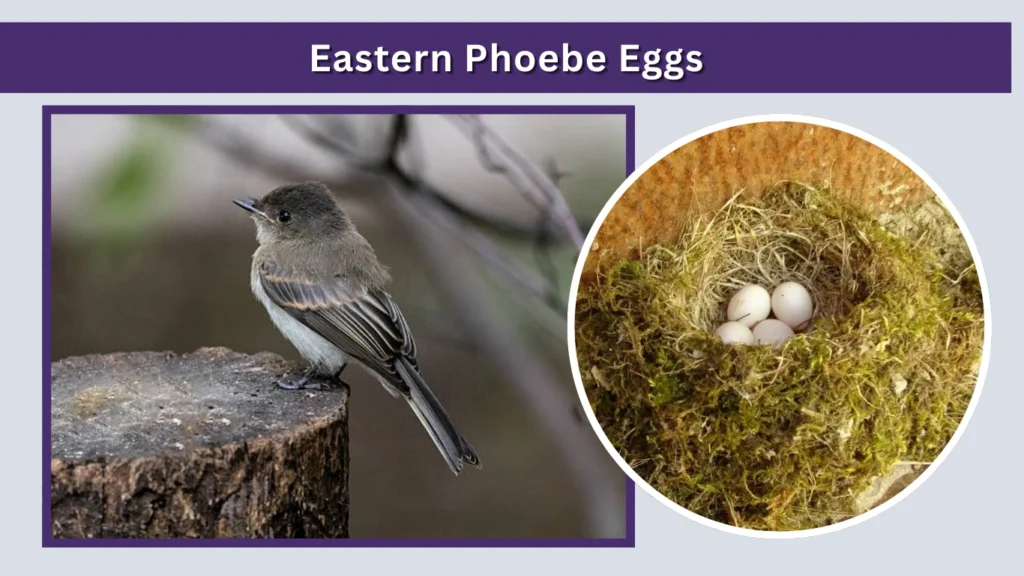
Eastern phoebe eggs are smooth, small, and usually plain white. Unlike many songbirds whose eggs are speckled, phoebe eggs often lack noticeable markings. Occasionally, faint speckling may appear, but most clutches are uniformly white.
The simplicity of the egg coloration is partly offset by the sheltered nesting location, which reduces visibility to predators.
Clutch Size
A typical clutch contains 3 to 5 eggs, with four being most common. The female lays one egg per day until the clutch is complete.
Because nesting begins early in the season, phoebes may experience cooler temperatures during incubation compared to later-breeding species.
Incubation and Fledging
Incubation lasts approximately 15 to 17 days, and the female performs nearly all incubation duties. During this time, the male may bring food or guard the nesting territory.
After hatching, nestlings remain in the nest for about 15 to 18 days. Both parents work tirelessly to provide insects to the growing chicks. Once fledged, the young birds stay nearby for a short period while learning to hunt on their own.
Eastern Phoebe vs Flycatcher
Is the Eastern Phoebe a Flycatcher?
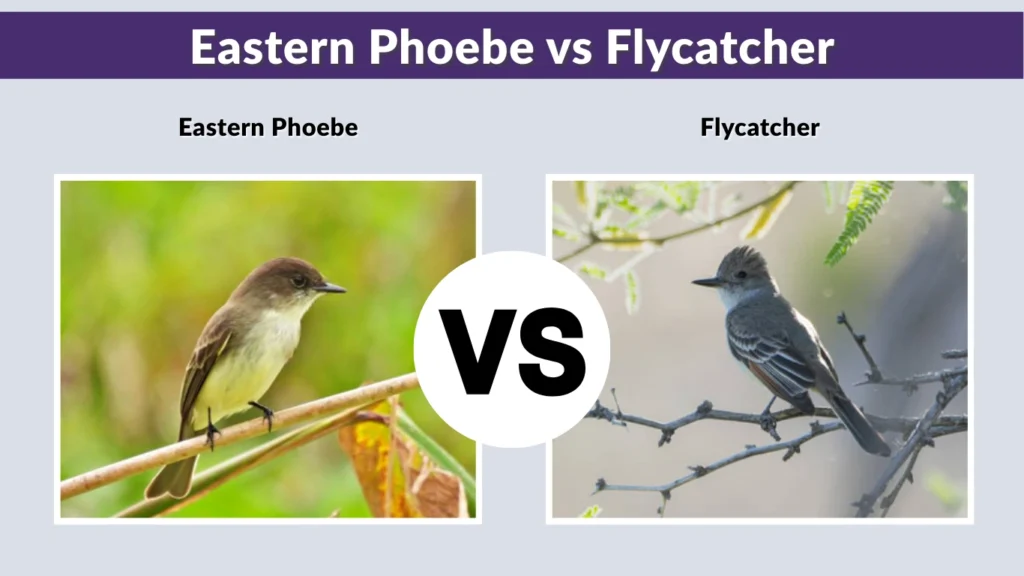
Yes, the eastern phoebe is a member of the Tyrannidae family, commonly known as tyrant flycatchers. This large family includes many species across North and South America that specialize in catching insects in flight.
Among eastern North American flycatchers, the phoebe is one of the most familiar and easiest to identify.
How to Distinguish It from Other Flycatchers
Many flycatchers look similar, often with muted gray or olive coloring. However, several features help separate the eastern phoebe from other species:
- No bold eye ring
- No strong wing bars
- Subtle gray-brown coloring
- Frequent tail pumping
- Early spring arrival
These traits make it stand out from species like the Eastern Wood-Pewee or Empidonax flycatchers, which often show clearer eye rings or wing bars.
Comparison with Similar Species
- Eastern Wood-Pewee: Has more distinct wing bars and a clearer eye ring; typically arrives later in spring.
- Great Crested Flycatcher: Larger, with bright yellow underparts and a louder call.
- Eastern Kingbird: Bold black-and-white pattern and more aggressive behavior.
The phoebe’s plain appearance and tail-wagging habit are often the most reliable field marks.
Interesting Eastern Phoebe Facts
Historical Significance
The eastern phoebe holds a unique place in ornithological history. It was the first bird ever banded in North America. In 1804, John James Audubon tied silver thread around the legs of phoebe nestlings to see if they would return the following year—and they did.
Behavior Traits
Phoebes are known for their tolerance of human activity. Many will nest near homes without abandoning the site. Their calm demeanor and repetitive hunting behavior make them enjoyable to observe.
They also frequently reuse nesting sites, sometimes building directly on top of previous nests.
Ecological Role
As insect specialists, eastern phoebes play an important role in natural pest control. By consuming large quantities of flies, beetles, and other insects, they help maintain ecological balance in woodland edges and rural areas.
Conclusion
The eastern phoebe is a resilient and adaptable flycatcher that thrives in a variety of habitats, from woodland edges to backyard barns. Its early spring arrival, simple “fee-bee” song, and steady tail wagging make it easy to recognize. Understanding the eastern phoebe’s habitat, diet, nesting behavior, eggs, and differences from other flycatchers adds depth to every sighting. Whether perched beneath a bridge or calling from a fence post, this modest gray bird remains a dependable sign of the changing seasons.