
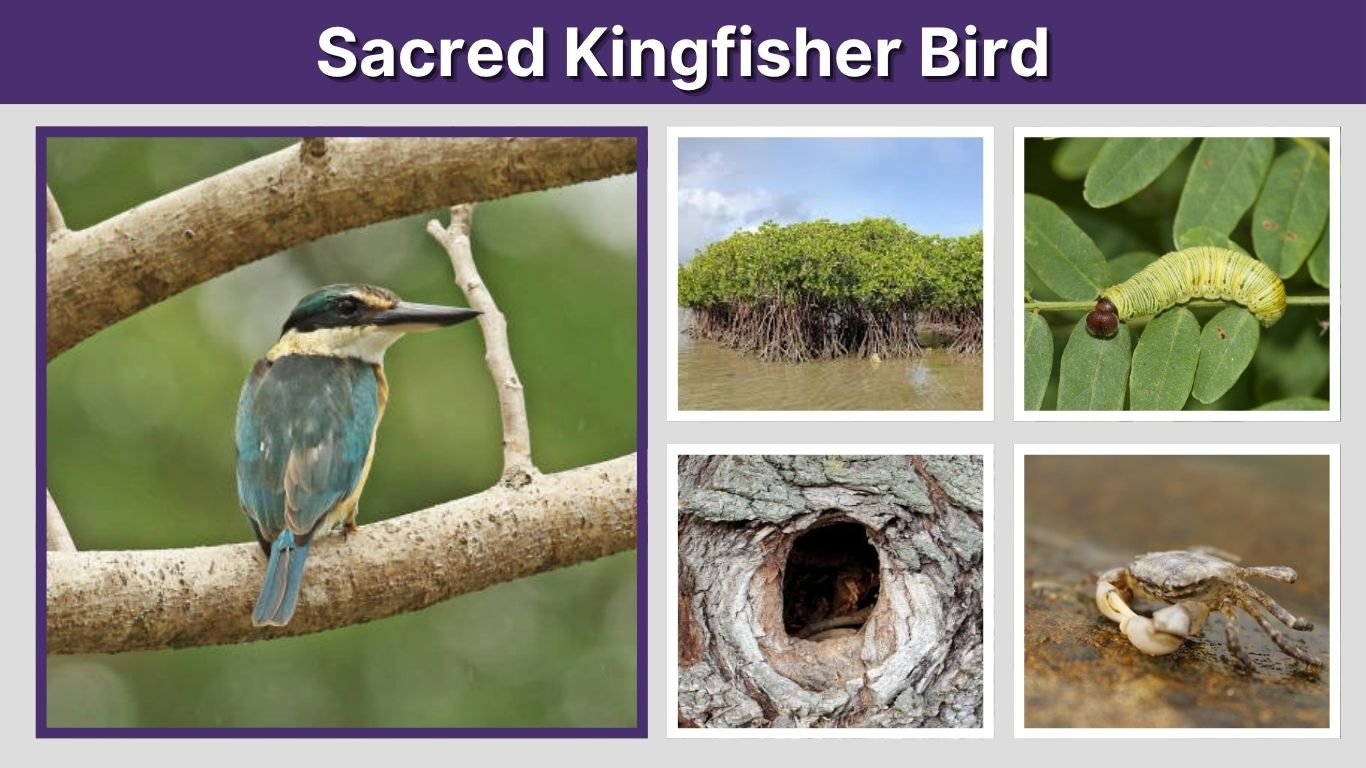
The Sacred Kingfisher is a colorful woodland kingfisher known for its blue-green wings, pale underparts, dark eye stripe, and sharp hunting style. Found across Australia, New Zealand, and parts of the western Pacific, this bird is often seen perched on branches, wires, mangroves, and forest edges. Although called a kingfisher, it often hunts on land as well as near water.
What Is a Sacred Kingfisher?
The Sacred Kingfisher is a small to medium-sized kingfisher with the scientific name Todiramphus sanctus. It belongs to the kingfisher family, but it does not depend only on catching fish. Unlike some water kingfishers that spend most of their time diving into rivers, the Sacred Kingfisher often hunts insects, lizards, small frogs, crustaceans, and other small animals from a perch.
This bird is admired for its bright colors and alert posture. It has a strong bill, compact body, short legs, and a square-looking head. Its upperparts are usually turquoise, blue-green, or greenish-blue, while the underparts are pale or buff-white. A dark eye stripe gives the bird a masked look.
The Sacred Kingfisher is especially familiar in Australia and New Zealand, where it may be seen around open woodland, mangroves, coastal flats, gardens, forest edges, wetlands, and river valleys.
Sacred Kingfisher Identification
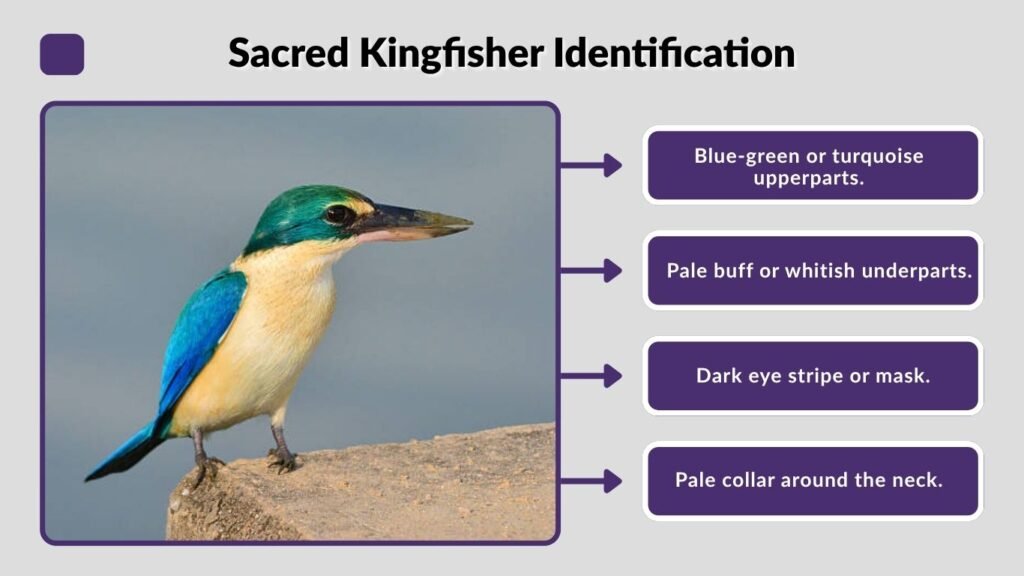
The Sacred Kingfisher is not very large, but its shape and color make it stand out. It often sits upright on a visible perch while watching for prey. From a distance, it may appear as a small blue-green bird with a pale underside and a dark line through the eye.
Key Field Marks
Look for these features when identifying a Sacred Kingfisher:
- Blue-green or turquoise upperparts
- Pale buff or whitish underparts
- Dark eye stripe or mask
- Pale collar around the neck
- Strong, straight bill
- Compact body and short tail
- Upright perch-hunting posture
The bird’s color can change slightly depending on light. In bright sunlight, the back and wings may look vivid blue or turquoise. In shade, they may appear greener or duller.
Sacred Kingfisher Size and Appearance
The Sacred Kingfisher is smaller than a kookaburra but larger and sturdier than many small garden birds. It has the typical kingfisher shape: a large head, strong bill, short neck, and compact body.
| Feature | Sacred Kingfisher Details |
|---|---|
| Scientific name | Todiramphus sanctus |
| Bird family | Kingfisher family, Alcedinidae |
| Main colors | Blue-green upperparts, pale underparts, dark eye stripe |
| Common habitats | Woodlands, mangroves, forests, wetlands, coasts, river valleys |
| Main diet | Insects, reptiles, crustaceans, frogs, and occasional fish |
| Nest type | Hollow, bank, termite mound, or tree cavity |
| Global status | Least Concern |
The Sacred Kingfisher is usually seen alone or in pairs. Its bright colors can make it look tropical, but it is also found in cooler southern regions during the breeding season.
Female Sacred Kingfisher vs Male
Male and female Sacred Kingfishers look very similar. Unlike Belted Kingfishers, where the female has a very obvious extra chestnut band, Sacred Kingfishers do not show such a dramatic difference between the sexes.
Male Sacred Kingfisher
The male usually has brighter blue-green upperparts and may look slightly cleaner or richer in color. He has the same general shape as the female: strong bill, compact body, pale underparts, and dark eye stripe.
Female Sacred Kingfisher
The female is often a little duller or greener than the male. Her underparts may look less strongly colored, and the overall contrast may be softer. However, these differences can be subtle, especially in poor light.
Best Way to Tell Them Apart
For most casual birdwatchers, it is difficult to separate male and female Sacred Kingfishers with certainty. Light, age, feather wear, and viewing angle can affect appearance. Unless the bird is seen clearly or compared with a mate, it is safer to identify it simply as a Sacred Kingfisher rather than confidently calling it male or female.
Juvenile Sacred Kingfisher
A juvenile Sacred Kingfisher looks similar to an adult but usually appears duller. Young birds may have mottled or buff-edged feathers, especially around the underparts, collar, and wings. Their colors may not look as clean or bright as those of adults.
Juvenile Identification Clues
A juvenile may show:
- Duller blue-green upperparts
- Buff or brownish feather edges
- Less crisp facial markings
- Softer-looking plumage
- A less polished overall appearance
Juveniles still have the same basic kingfisher shape, including a strong bill and large head. As they mature, their plumage becomes brighter and more adult-like.
Sacred Kingfisher Habitat
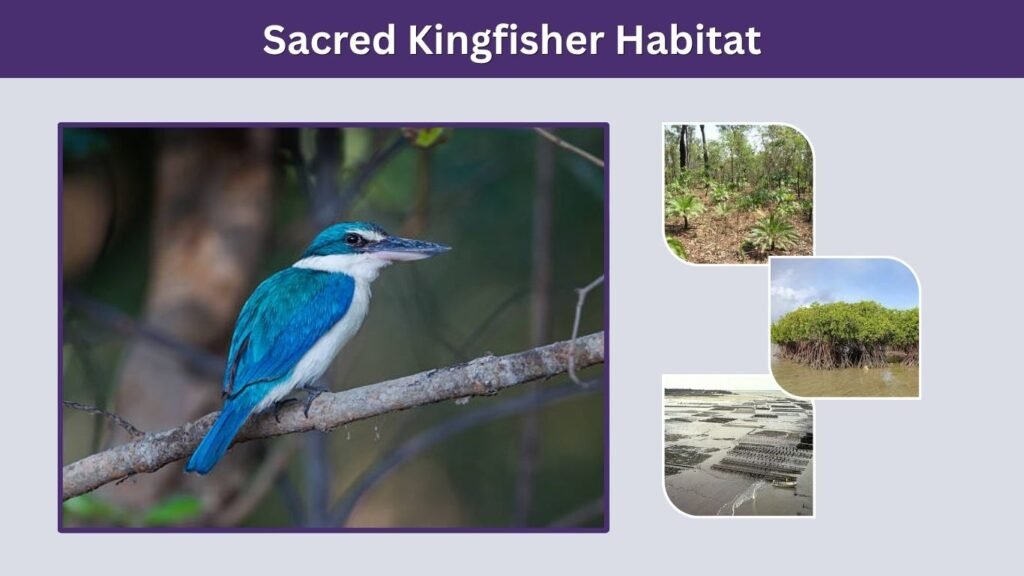
The Sacred Kingfisher uses a wider variety of habitats than many people expect. It is often associated with water, but it is not limited to rivers or lakes. It can live in open forests, woodland edges, mangroves, coastal flats, paperbark swamps, farms, parks, and gardens.
Common Habitat Types
You may find Sacred Kingfishers in:
- Eucalypt woodland
- Mangrove forests
- River valleys
- Wetlands and swamps
- Coastal mudflats
- Forest edges
- Parks and gardens
- Open farmland with trees
In Australia, Sacred Kingfishers are often seen in woodland and coastal habitats. In New Zealand, the bird, commonly known as kōtare, is found in both coastal and inland habitats. It often perches on powerlines, branches, posts, or exposed lookouts before dropping down onto prey.
Sacred Kingfisher in Australia
The Sacred Kingfisher is widely known in Australia. It occurs in many regions, especially where there are suitable trees, open hunting areas, and seasonal breeding sites. It can be found in states such as Queensland, New South Wales, Victoria, South Australia, Western Australia, and Tasmania, though its presence may vary by season and habitat.
Sacred Kingfisher in Australian Landscapes
In Australia, this bird may appear in:
- Open eucalypt forest
- Melaleuca and paperbark woodland
- Mangrove creeks
- River corridors
- Coastal reserves
- Bushland edges
- Rural properties
- Urban parks with mature trees
Many Australian Sacred Kingfishers move seasonally. Birds from southern areas often spend the cooler months farther north and return south in spring for breeding.
Sacred Kingfisher in New Zealand
In New Zealand, the Sacred Kingfisher is also called kōtare. It is a familiar native bird in coastal and freshwater habitats. Many people notice it perched on fences, wires, branches, and posts while scanning the ground or water below.
The New Zealand Sacred Kingfisher is strongly connected with estuaries, mudflats, streams, farmland, forest edges, and gardens. It may hunt crabs and small coastal animals near shorelines, but it also feeds on insects, lizards, and small prey away from water.
Sacred Kingfisher NZ Behavior
In New Zealand, kōtare may be seen:
- Waiting on powerlines above open ground
- Perching near estuaries and mudflats
- Hunting from branches near streams
- Nesting in banks, holes, or tree cavities
- Calling with sharp repeated notes
This bird is often easy to recognize because of its hunched posture and sudden direct flight from a perch.
Sacred Kingfisher Diet
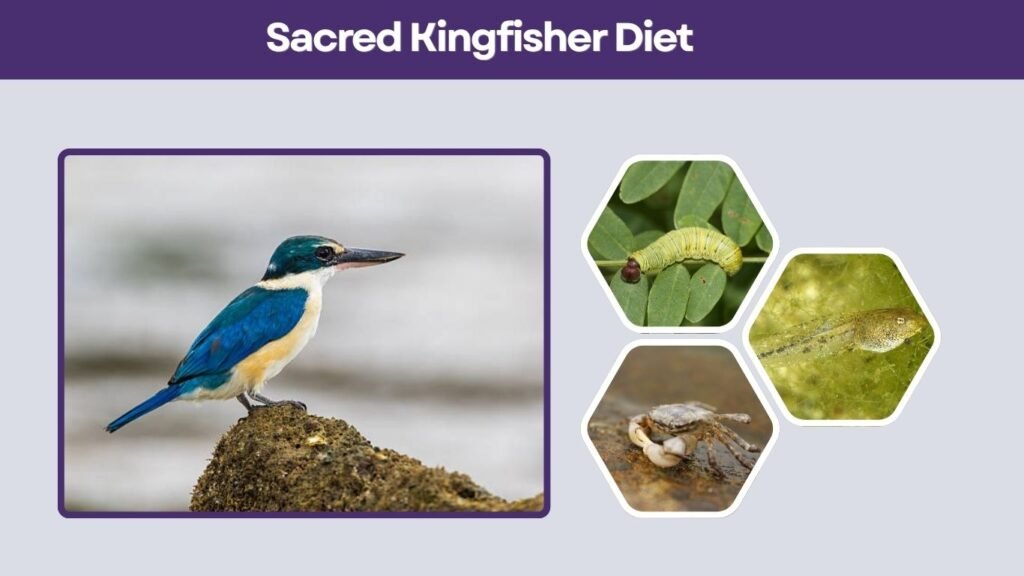
Despite its name, the Sacred Kingfisher does not eat only fish. In fact, it often forages mainly on land. It watches from a perch and then swoops down to catch prey on the ground, in vegetation, or near water.
What Do Sacred Kingfishers Eat?
The diet may include:
- Insects and insect larvae
- Beetles, grasshoppers, and cicadas
- Small lizards and skinks
- Frogs and tadpoles
- Crustaceans such as small crabs
- Spiders and other invertebrates
- Occasionally small fish
After catching prey, the bird usually returns to a perch. It may beat larger prey against the perch before swallowing it. This behavior helps subdue prey and make it easier to eat.
Sacred Kingfisher Call and Sound
The Sacred Kingfisher call is sharp, repeated, and often described as a loud “kek-kek-kek” or “ek-ek-ek” sound. It can be heard during territorial activity and breeding season. The call is not musical like a songbird’s voice; instead, it is clear, bright, and somewhat harsh.
When Does It Call?
Sacred Kingfishers may call when:
- Defending territory
- Communicating with a mate
- Moving through breeding habitat
- Reacting to disturbance
- Perching near a nest site
The call is one of the easiest ways to detect the bird. Even when the kingfisher is hidden among trees or mangroves, its repeated notes can reveal its location.
Sacred Kingfisher Nest and Breeding
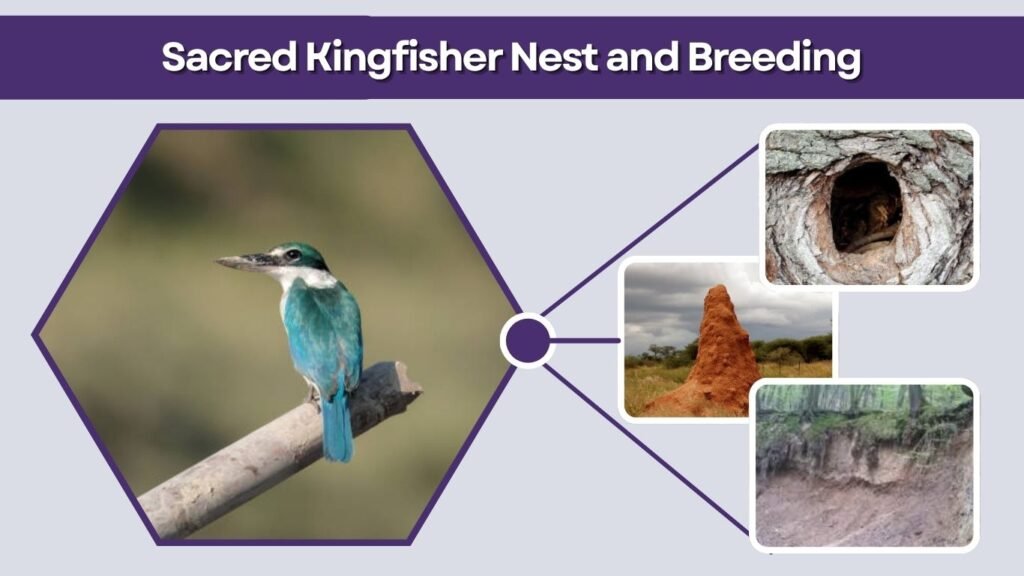
The Sacred Kingfisher nests in enclosed spaces rather than building an open cup nest. It may use a tree hollow, a burrow in a bank, a hole in a termite mound, or a cavity in soft wood or soil.
Both members of the pair may help prepare the nesting site. The nest chamber is usually simple and may not be lined with much material. The female lays glossy white eggs, and both parents help with nesting duties.
Common Nest Sites
Sacred Kingfishers may nest in:
- Tree hollows
- Termite mounds
- Riverbanks
- Earth banks
- Rotten branches
- Cliff-like soil faces
Nest sites are important because the bird needs a safe cavity for eggs and chicks. Habitat loss, removal of old trees, and disturbance around nesting areas can reduce breeding opportunities.
Sacred Kingfisher Migration
Sacred Kingfisher migration depends on the region. In parts of Australia, many birds move north after breeding and return south in spring. This seasonal movement helps them follow warmer conditions and food availability.
In New Zealand, movements may be more local. Some birds shift between inland and coastal areas, especially after breeding. They may move from higher or forested places toward open country, estuaries, or coastal habitats.
Where Do Sacred Kingfishers Migrate To?
In Australia, southern birds may move toward northern Australia, New Guinea, Indonesia, or nearby western Pacific regions outside the breeding season. They return south when conditions become suitable for breeding again.
Migration is one reason Sacred Kingfishers may seem common in one area during one season and scarce during another.
Sacred Kingfisher Predators and Threats
Sacred Kingfishers are alert birds, but eggs, chicks, and adults can still face threats. Nest cavities may be vulnerable to snakes, monitor lizards, rats, cats, or other predators, depending on location. Adults may also be taken by larger birds of prey.
Main Threats
Potential threats include:
- Loss of nesting hollows
- Clearing of woodland and mangroves
- Predation by introduced mammals
- Disturbance near nest sites
- Reduction of insect and reptile prey
- Coastal habitat damage
The species is not globally endangered, but local habitat protection still matters. Keeping mature trees, natural banks, mangroves, and healthy insect populations helps support Sacred Kingfishers.
Sacred Kingfisher vs Collared Kingfisher

The Sacred Kingfisher is sometimes confused with the Collared Kingfisher because both species can show blue-green upperparts, pale underparts, and a strong bill. They also belong to the same broader group of tree kingfishers.
The Collared Kingfisher is generally more strongly associated with coastal and mangrove habitats in many areas and often has a larger-looking bill and brighter white collar. The Sacred Kingfisher can be more widespread in woodland, inland, and seasonal habitats.
Simple Comparison Tips
To separate them, look at:
- Location and habitat
- Size and bill shape
- Shade of blue-green upperparts
- Strength of white collar
- Local field guide range maps
Because these birds can be similar, a clear photo, call, and location are useful for accurate identification.
Sacred Kingfisher Symbolism and Spiritual Meaning
Some people search for Sacred Kingfisher spiritual meaning, symbolism, or Māori meaning. In New Zealand, the bird is known as kōtare, and it is a familiar native species in both coastal and inland settings. In broader symbolism, kingfishers are often associated with patience, precision, peace, clear vision, and successful hunting.
The word “sacred” in the bird’s name is linked to older cultural associations in parts of the Pacific, where some kingfishers were treated with respect or spiritual significance. However, meanings can differ between cultures, so it is best not to apply one single interpretation everywhere.
Sacred Kingfisher Facts
Here are quick facts for readers:
- Scientific name: Todiramphus sanctus
- Also called kōtare in New Zealand
- Found in Australia, New Zealand, and parts of the western Pacific
- Often hunts from exposed perches
- Eats insects, reptiles, crustaceans, frogs, and occasional fish
- Nests in tree hollows, banks, or termite mounds
- Has a sharp repeated call
- Many Australian birds migrate seasonally
- Juveniles look duller than adults
- Global conservation status is Least Concern
The Sacred Kingfisher is a strong example of a bird whose common name can be misleading. It is a kingfisher, but it often hunts away from water and eats many land-based animals.
FAQs
What does a Sacred Kingfisher eat?
A Sacred Kingfisher eats insects, insect larvae, small reptiles, frogs, crustaceans, spiders, and occasionally fish. It often hunts from a perch, swooping down to catch prey on the ground, in vegetation, or near water before returning to the perch to eat.
Where does the Sacred Kingfisher live?
The Sacred Kingfisher lives in Australia, New Zealand, and parts of the western Pacific. It uses woodlands, mangroves, forests, river valleys, wetlands, coastal areas, parks, and gardens. It is often seen perched on wires, branches, posts, or exposed lookout points.
What does a Sacred Kingfisher sound like?
A Sacred Kingfisher makes a sharp repeated call often described as “kek-kek-kek” or “ek-ek-ek.” The sound is clear, harsh, and repeated, especially during the breeding season or when the bird is defending territory.
Do Sacred Kingfishers migrate?
Yes, many Sacred Kingfishers migrate or move seasonally, especially in Australia. Southern birds often move north after breeding and return south in spring. In New Zealand, some movements may be more local, such as shifting between inland and coastal habitats.
How can you identify a juvenile Sacred Kingfisher?
A juvenile Sacred Kingfisher usually looks duller than an adult. It may show buff or brownish feather edges, softer markings, and less vivid blue-green color. The strong bill, compact body, and kingfisher shape are still useful clues for identification.