

The Ringed Kingfisher is one of the most impressive kingfishers in the Americas. With its large body, shaggy crest, powerful bill, and loud rattling call, this bird is hard to miss near rivers, lakes, wetlands, and coastal waterways. Birdwatchers often compare it with the Belted Kingfisher, but the Ringed Kingfisher is larger, bolder, and strongly tied to tropical and subtropical waters.
What Is a Ringed Kingfisher?
The Ringed Kingfisher is a large water-loving bird known scientifically as Megaceryle torquata. It belongs to the kingfisher family, a group of birds famous for hunting fish by diving from perches above water.
This species is especially noticeable because of its size and voice. It often sits in the open on branches, wires, posts, or bridge rails while watching the water below. When it spots prey, it dives quickly, grabs it with its strong bill, and returns to a perch to swallow or handle the catch.
Key Ringed Kingfisher Facts
The Ringed Kingfisher is often described as a super-sized version of the Belted Kingfisher. It has a big head, thick neck, shaggy crest, and long dagger-like bill. Its upperparts are mostly bluish gray, while the underparts are rich chestnut with a bold white collar.
Important facts include:
- Scientific name: Megaceryle torquata
- Bird family: Alcedinidae
- Main food: Fish, with some crustaceans and aquatic prey
- Common habitat: Rivers, lakes, canals, ponds, wetlands, and mangroves
- Range: Southern Texas through Central America and much of South America
- Conservation status: Least Concern
Ringed Kingfisher Size and Appearance
The Ringed Kingfisher is one of the largest kingfishers found in the Americas. Its heavy body and oversized bill make it look powerful compared with smaller kingfishers.
Male Ringed Kingfisher
The male Ringed Kingfisher has bluish gray upperparts, a white collar, and a broad chestnut belly. From a distance, the rich rusty underside is one of the easiest features to notice. The male usually looks cleaner below than the female because it lacks the extra bluish-gray breast band that females show.
Female Ringed Kingfisher
The female Ringed Kingfisher is similar in size and shape but has more banding across the chest. She usually shows a bluish-gray band above the chestnut lower underparts. This extra band is one of the best ways to separate females from males in the field.
Juvenile Ringed Kingfisher
A juvenile Ringed Kingfisher can look duller and less sharply marked than an adult. Young birds may show less clean contrast in the plumage, but they still have the large bill, shaggy crest, and strong kingfisher shape. Observers should look at body size, perch behavior, and habitat to help confirm identification.
Ringed Kingfisher Range and Where It Lives
The Ringed Kingfisher has a broad range across the Americas. It is common through much of Latin America and reaches the United States mainly in southern Texas.
Range by Region
| Region | Ringed Kingfisher Presence | Notes |
|---|---|---|
| Southern Texas | Local but established | Most often found around the lower Rio Grande Valley |
| Mexico and Central America | Common in suitable habitat | Seen near rivers, lakes, wetlands, and coastal waters |
| Costa Rica | Widespread near water | A strong birding destination for this species |
| South America | Broadly distributed | Found through many lowland aquatic habitats |
| Arizona | Rare or accidental | Not part of the normal core range |
Ringed Kingfisher in Texas
In the United States, the Ringed Kingfisher is most strongly associated with southern Texas, especially the lower Rio Grande Valley. Birders may search along rivers, canals, reservoirs, and other open water areas. It was once much rarer north of Mexico, but it is now more regular in parts of southern Texas.
Ringed Kingfisher in Arizona
Searches for “Ringed Kingfisher Arizona” usually come from birders wondering whether the species occurs there. Arizona is not part of its regular range. Any possible sighting would be unusual and should be carefully documented with photos, location details, and comparison notes.
Ringed Kingfisher in Costa Rica
Costa Rica is one of the better places to see Ringed Kingfishers. The bird occurs near rivers, lakes, wetlands, lagoons, and mangrove edges. Because it often perches openly and calls loudly, it can be easier to find than some smaller, quieter kingfishers.
Ringed Kingfisher Habitat
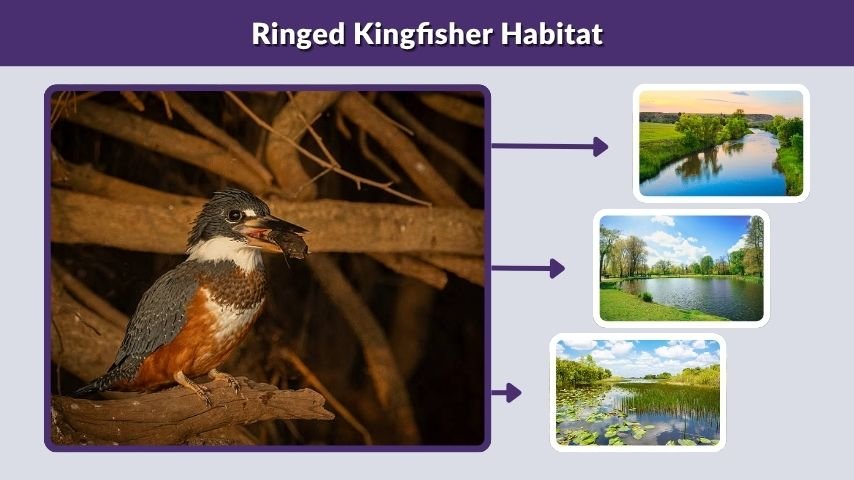
Ringed Kingfishers live near water because they rely heavily on fish and aquatic prey. They prefer places where they can perch with a clear view of the surface.
Typical habitats include:
- Rivers and streams
- Lakes and ponds
- Wetlands and marshes
- Irrigation canals
- Estuaries and mangroves
- Reservoirs and open waterways
The best habitat usually includes open water, fish availability, and suitable perches. During breeding, earthen banks may also be important because many kingfishers nest in tunnels or burrows dug into banks.
Ringed Kingfisher Call and Behavior
The Ringed Kingfisher call is loud, harsh, and rattling. It often gives away the bird before it is seen. Around rivers or wetlands, birders may hear a strong rolling call coming from a high branch, wire, or exposed perch.
Hunting Behavior
Ringed Kingfishers hunt mainly by watching from a perch. They scan the water below, then dive after fish. After catching prey, they often return to a perch to beat, position, and swallow it.
Common behaviors include:
- Sitting upright on exposed perches
- Calling loudly while flying along waterways
- Diving directly into water after prey
- Carrying fish back to a branch or post
- Moving along river corridors and open aquatic edges
This bird is not usually shy. Its size, voice, and exposed perching habits make it a favorite species for bird photographers and wildlife watchers.
Ringed Kingfisher Diet
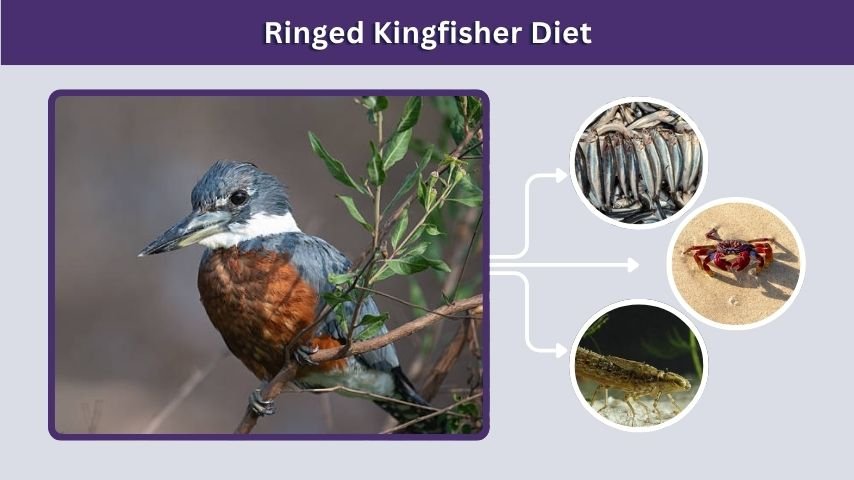
Fish make up most of the Ringed Kingfisher’s diet. Its large bill is built for grabbing slippery aquatic prey. However, it may also eat crustaceans and other small animals found near water.
Its diet can include:
- Small to medium-sized fish
- Crabs and other crustaceans
- Aquatic insects
- Small amphibians or similar prey when available
Because it depends on aquatic food, clean and productive waterways are important for supporting healthy kingfisher populations.
Ringed Kingfisher vs Belted Kingfisher
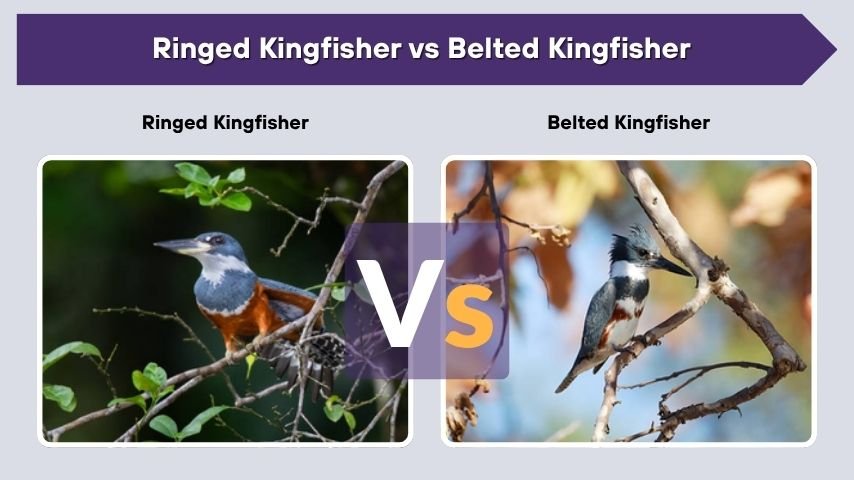
Many birders search for “Ringed Kingfisher vs Belted Kingfisher” because the two species look similar at first glance. Both have shaggy crests, bluish upperparts, and strong bills, but the Ringed Kingfisher is much larger and usually has richer chestnut underparts.
The Belted Kingfisher is more widespread across North America, while the Ringed Kingfisher is mostly tropical and subtropical. In areas where both occur, size is often the first clue. The Ringed Kingfisher looks bulkier, heavier, and more crow-like than the Belted Kingfisher.
Quick Identification Tips
To identify a Ringed Kingfisher, look for these features:
- Very large kingfisher shape
- Massive dagger-like bill
- Shaggy crest
- Bluish gray back and wings
- White collar
- Rich chestnut underparts
- Loud, rattling call
- Open perch above water
If the bird looks smaller, slimmer, and more common across North America, it may be a Belted Kingfisher instead.
Male vs Female Ringed Kingfisher
Male and female Ringed Kingfishers are similar, but their chest pattern helps with identification. Males usually show a broad chestnut underside with a bold white collar. Females have an additional bluish-gray band across the breast, giving them a more strongly “ringed” or banded look.
When watching from a distance, lighting can make colors harder to judge. In that case, focus on pattern rather than brightness. A clear breast band usually points to a female.
Ringed Kingfisher Photos and Images
Ringed Kingfisher images are popular because the bird is colorful, large, and often visible in open areas. Photographers usually find the best chances near quiet river edges, wetlands, bridges, and canals where the bird uses regular hunting perches.
For better photos, watch from a respectful distance and avoid disturbing the bird. A perched kingfisher may stay in place for several minutes if it does not feel threatened. Early morning and late afternoon light can bring out the blue-gray back, white collar, and chestnut belly beautifully.
Conservation Status

The Ringed Kingfisher is not currently considered globally threatened. It has a very large range and remains common in many suitable habitats. Still, local populations can be affected by pollution, wetland loss, riverbank disturbance, and changes to fish populations.
Protecting rivers, wetlands, mangroves, and natural banks benefits Ringed Kingfishers and many other water-dependent birds. Even common species need healthy habitats to remain stable over time.
FAQs
Where do Ringed Kingfishers live?
Ringed Kingfishers live near rivers, lakes, wetlands, canals, mangroves, and other water bodies. Their range extends from southern Texas through Mexico, Central America, and much of South America. They are most common in tropical and subtropical regions where fish-rich water and open perches are available.
What does a Ringed Kingfisher eat?
A Ringed Kingfisher mainly eats fish. It hunts by perching above water, watching for movement, and diving quickly to catch prey with its strong bill. It may also eat crustaceans, aquatic insects, and other small water-based animals when available.
Is the Ringed Kingfisher found in Texas?
Yes, the Ringed Kingfisher is found in Texas, especially in the lower Rio Grande Valley and nearby southern areas. It is much more limited in the United States than the Belted Kingfisher, so birders usually look for it in specific waterways and suitable habitats in southern Texas.
How can you tell male and female Ringed Kingfishers apart?
Male and female Ringed Kingfishers look similar, but the female usually has an extra bluish-gray band across the breast. Males tend to show a cleaner chestnut underside below the white collar. Good light and a side or front view make the difference easier to see.
What is the difference between a Ringed Kingfisher and a Belted Kingfisher?
The Ringed Kingfisher is larger, heavier, and more tropical than the Belted Kingfisher. It has richer chestnut underparts and a massive bill. The Belted Kingfisher is smaller and more widespread across North America. Where both occur, size and underpart pattern are the best clues.
