
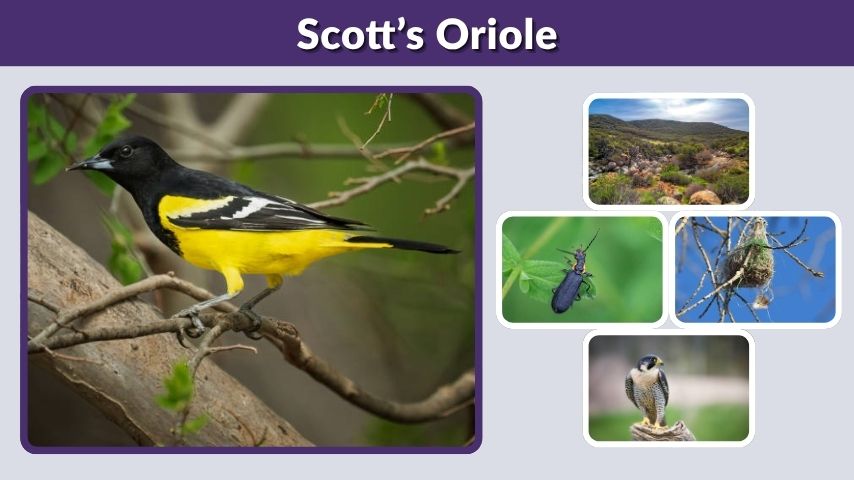
Scott’s Oriole is one of the most striking yellow-and-black birds of the American Southwest. Often seen around yuccas, desert slopes, canyons, and open woodland edges, this oriole is admired for its bright plumage and rich song. Birders search for it in places like Arizona, New Mexico, Nevada, California, Utah, Texas, and parts of Mexico, especially during the breeding season.
What Is a Scott’s Oriole?
Scott’s Oriole is a medium-sized songbird in the blackbird and oriole family. Its scientific name is Icterus parisorum. It is best known for the male’s sharp black-and-yellow coloring, its strong connection to yucca plants, and its clear, musical song.
This bird is not usually as familiar to casual backyard birders as the Baltimore Oriole or Bullock’s Oriole, but it is a memorable species for anyone birding in dry western landscapes.
Quick Scott’s Oriole Facts
| Feature | Details |
|---|---|
| Common name | Scott’s Oriole |
| Scientific name | Icterus parisorum |
| Bird family | Icteridae |
| Main colors | Yellow, black, olive, gray |
| Typical habitat | Arid slopes, yucca areas, canyons, open woodland |
| Diet | Insects, nectar, fruit, spiders, and other small invertebrates |
| Nest style | Hanging woven cup or pouch |
| Best-known plant association | Yucca |
| U.S. range | Southwestern and western interior states |
| Winter range | Mainly Mexico, with some birds wintering near the U.S. border |
How to Identify a Scott’s Oriole
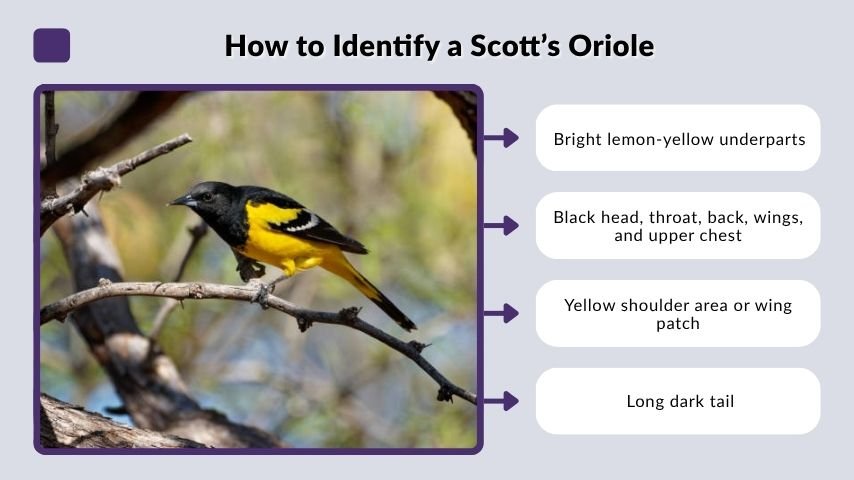
Scott’s Oriole has a slim body, pointed bill, and fairly long tail. Like many orioles, it often moves actively through shrubs, yuccas, and trees instead of sitting still for long. Identification becomes easier when you know the differences between males, females, and young birds.
Male Scott’s Oriole
The adult male is the easiest to identify. Look for:
- Bright lemon-yellow underparts
- Black head, throat, back, wings, and upper chest
- Yellow shoulder area or wing patch
- Long dark tail
- Slim, slightly curved bill
- Bold contrast between black upperparts and yellow belly
In good light, the male looks extremely vivid against desert vegetation. The yellow can appear especially bright when the bird perches near yucca flowers, agaves, or pale canyon rock.
Female Scott’s Oriole
A female Scott’s Oriole is more subtle than the male but still attractive. She is usually yellowish below, olive or grayish above, and less sharply marked. Her wings may show pale edging, and her head does not have the male’s solid black hood.
Female identification can be tricky because several western orioles have yellowish females. Habitat is a helpful clue. A yellowish oriole in a dry yucca-rich canyon or desert-slope area may be a Scott’s Oriole, especially if a singing male is nearby.
Juvenile and Immature Scott’s Oriole
Juvenile and immature Scott’s Orioles are duller than adults. Young birds may look washed-out yellow, grayish, or olive, and immature males can show partial black markings as they develop adult plumage.
When identifying a juvenile Scott’s Oriole, focus on:
- Location and habitat
- Slim oriole shape
- Yellowish underparts
- Association with adult Scott’s Orioles
- Behavior around yuccas, trees, or flowering plants
Scott’s Oriole Range and Range Map Overview
Scott’s Oriole is mainly a bird of the southwestern United States and Mexico. During the breeding season, it can be found in parts of southern California, Nevada, Utah, Arizona, New Mexico, western Texas, and nearby areas. It is also found in Mexico, where many birds spend the winter.
A Scott’s Oriole range map usually shows three broad zones: breeding range in the southwestern U.S. and northern Mexico, year-round range in parts of Mexico, and wintering areas farther south. Exact presence can vary by season, elevation, food supply, and local habitat.
Scott’s Oriole in Arizona, Tucson, and New Mexico
Arizona and New Mexico are two of the best U.S. states for seeing Scott’s Oriole. In Arizona, birders may find it around desert foothills, canyons, and areas with yucca or agave. Around Tucson, the right habitat in nearby canyons and desert slopes can be productive during the warmer months.
In New Mexico, Scott’s Oriole often appears in dry, open habitats with yuccas, pinyon-juniper woodland, canyon edges, and desert foothills. Listening for the song can be more effective than scanning silently.
Scott’s Oriole in Las Vegas and the Mojave Desert
Scott’s Oriole can occur in and around suitable habitat near Las Vegas and the Mojave Desert region. It is not a bird of empty sand flats; it is more likely where there are yuccas, Joshua trees, canyons, slopes, or desert-edge vegetation.
For birders in the Mojave Desert, the best approach is to search areas with flowering yuccas, desert washes, and rocky slopes during the breeding season.
Scott’s Oriole Habitat
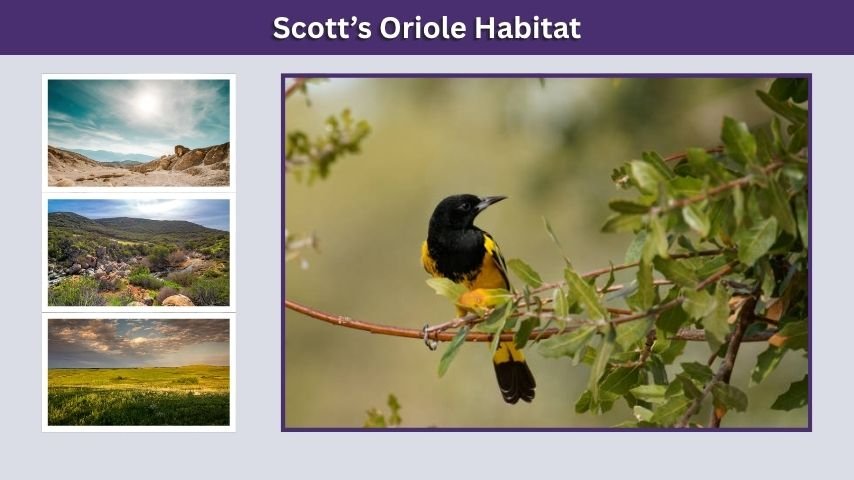
Scott’s Oriole is strongly associated with arid and semi-arid landscapes. It favors high desert, canyon slopes, foothills, open oak woodland, pinyon-juniper areas, and grasslands with scattered yucca.
Yuccas are especially important because they provide several resources. Scott’s Orioles may forage in yucca flowers for nectar and insects, use the plant as a nesting site, and gather fibers for nest construction.
Common Habitat Features
Good Scott’s Oriole habitat often includes:
- Yucca, agave, Joshua tree, or similar desert plants
- Open slopes and canyons
- Sparse woodland or shrubland
- Flowering plants with nectar
- Insects and spiders for feeding young
- Scattered trees for singing perches
Because this bird can be uncommon and somewhat local, finding the right habitat matters more than simply visiting any desert area.
Scott’s Oriole Song and Call
Scott’s Oriole is a strong singer. The song is usually a rich, whistled series of clear notes. It can sound fluid, musical, and slightly bubbling. Males often sing from exposed perches, especially during the breeding season.
The call is different from the song. Calls may be sharper, shorter, or harsher, often used for contact or alarm. If you are trying to locate the bird, learn both the musical song and the shorter call notes.
How to Find One by Sound
To improve your chances:
- Visit suitable habitat early in the morning
- Stop near yucca-rich slopes or canyon edges
- Listen for clear whistled phrases
- Watch the tops of yuccas, shrubs, and small trees
- Follow the sound slowly without pushing too close
The song often gives away the bird before its colors do.
Scott’s Oriole Nest and Breeding Behavior
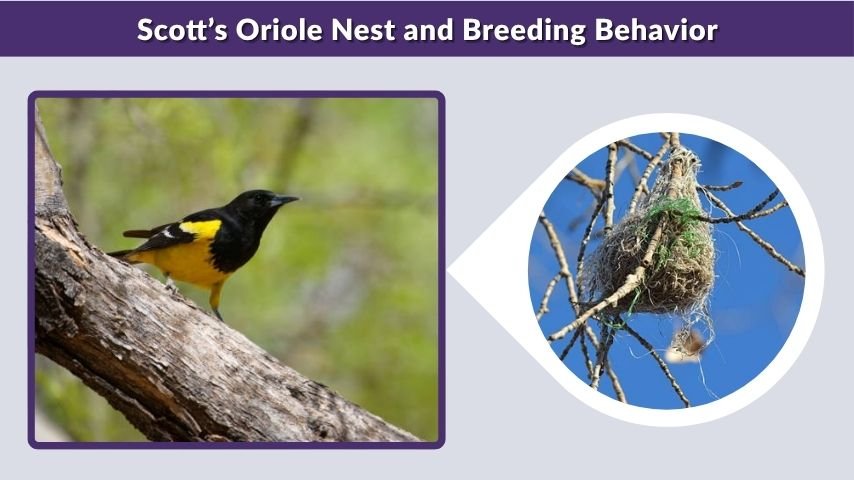
Scott’s Oriole builds a hanging nest, often placed in yucca, trees, Joshua trees, or similar vegetation. The nest is usually woven from plant fibers, grasses, and other flexible materials. Yucca fibers are especially useful because they are strong and easy to weave.
The female does much of the nest building and incubation, while both parents may help feed the young after hatching. Insects and other protein-rich foods are especially important during the nesting season because young birds need more than nectar or fruit to grow well.
Nesting Clues to Watch For
During breeding season, you may notice:
- Adults carrying fibers or grasses
- Repeated visits to one yucca or tree
- Adults bringing insects to a hidden spot
- Alarm calls when a predator gets too close
- A woven hanging nest partly concealed in vegetation
Avoid disturbing active nests. Watch from a distance and keep photography brief.
What Does Scott’s Oriole Eat?
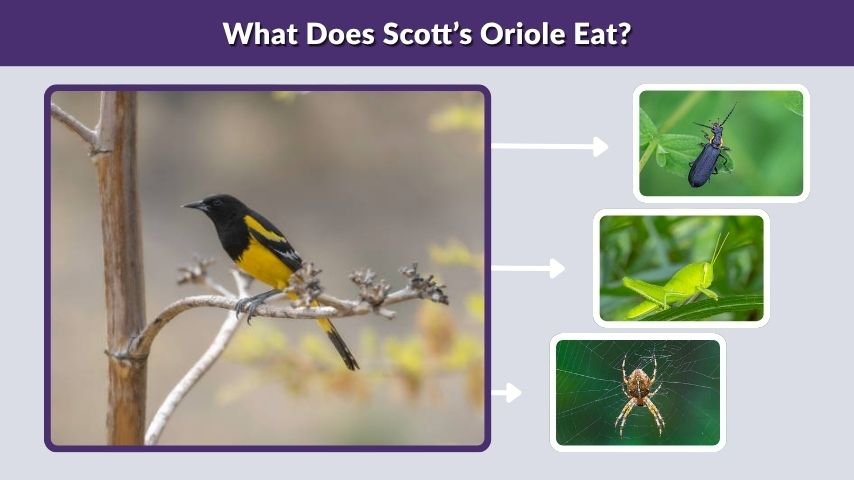
Scott’s Oriole has a varied diet. It eats insects, spiders, nectar, and fruit. Like other orioles, it may visit flowers and occasionally come to feeders, especially when nectar, oranges, jelly, or fruit are available in suitable regions.
However, in natural habitat, this bird is not just a nectar feeder. It actively searches plants for insects and other small prey. This is especially important during the breeding season.
Natural Foods
Scott’s Oriole may feed on:
- Caterpillars
- Beetles
- Grasshoppers
- Spiders
- Nectar from yucca and other flowers
- Soft fruits and berries
- Insects hidden in leaves, flowers, or bark
A yard near proper habitat may attract orioles with native plants, flowering shrubs, and safe nectar sources.
Scott’s Oriole Migration and Winter Range
Many Scott’s Orioles are migratory. Birds that breed in the United States often move south after the breeding season, with much of the winter range in Mexico. Some individuals may remain near the southern edge of the U.S. range in mild areas, but many leave northern breeding sites before winter.
Migration timing can vary by region. In general, birders in the U.S. Southwest are most likely to find them from spring through late summer or early fall, depending on location.
Where Does Scott’s Oriole Migrate?
Scott’s Oriole generally migrates between breeding areas in the southwestern U.S. and wintering areas mainly in Mexico. Some populations in Mexico may be resident or less strongly migratory. Local weather, food supply, and elevation can affect when birds move.
Scott’s Oriole vs Baltimore Oriole
Scott’s Oriole and Baltimore Oriole are both colorful members of the oriole group, but they live in different regions and look different.
Baltimore Oriole is mainly an eastern and central North American bird, often associated with leafy deciduous trees, parks, and woodland edges. Male Baltimore Orioles are orange and black, while male Scott’s Orioles are yellow and black.
Key differences:
- Scott’s Oriole is more southwestern and desert-associated.
- Baltimore Oriole is more eastern and woodland-associated.
- Male Scott’s Oriole is lemon-yellow and black.
- Male Baltimore Oriole is orange and black.
- Scott’s Oriole is closely tied to yucca-rich habitats.
- Baltimore Oriole often nests in tall deciduous trees.
Can Scott’s Oriole and Baltimore Oriole Mate?
Hybridization between different oriole species is possible in some groups, but Scott’s Oriole and Baltimore Oriole have different core ranges and habitats, so natural mating between them would be extremely unlikely. A confirmed hybrid would require careful expert documentation.
Scott’s Oriole vs Hooded Oriole
Scott’s Oriole and Hooded Oriole can overlap in the Southwest, so this comparison is more useful for western birders.
Male Hooded Oriole often appears more orange-yellow, with a black throat and face but not the same full black upperparts pattern as Scott’s Oriole. Hooded Orioles are also often associated with palms, neighborhoods, riparian areas, and ornamental plantings, while Scott’s Oriole is more strongly linked to arid slopes and yuccas.
Look at the whole bird, not just color. Habitat, song, face pattern, back color, and behavior all help separate them.
Predators and Threats
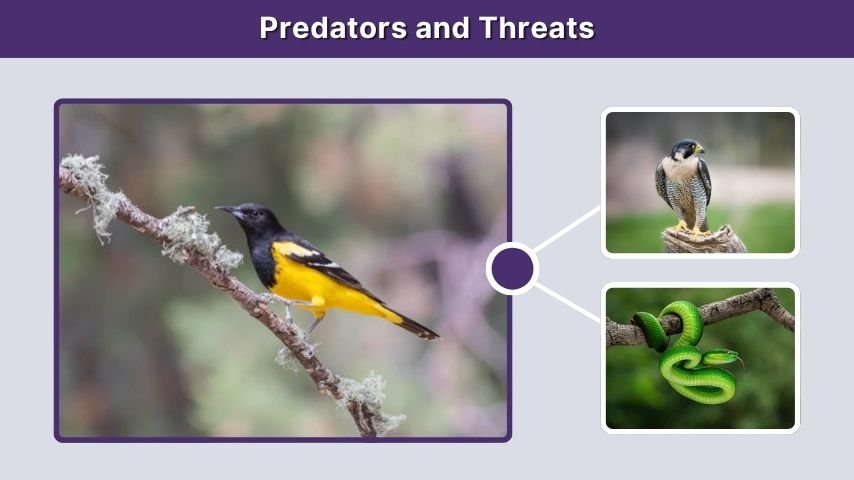
Scott’s Oriole faces many of the same natural risks as other small songbirds. Eggs, nestlings, and adults may be vulnerable to snakes, larger birds, mammals, and nest predators. Harsh weather, habitat loss, invasive plants, and reduced native vegetation can also affect local success.
Possible Predators
Potential predators may include:
- Snakes near nest sites
- Jays, crows, or other nest-raiding birds
- Hawks and falcons
- Small mammals
- Domestic or feral cats near human areas
Protecting native desert vegetation and keeping cats indoors can help many songbirds, including orioles.
Tips for Seeing Scott’s Oriole
Seeing Scott’s Oriole is easiest when you combine timing, habitat, and sound. This is not usually a bird you find by walking through random city parks. It rewards birders who search the right landscapes patiently.
Try these tips:
- Visit desert foothills, canyons, and yucca-rich areas.
- Go in spring or early summer during peak singing.
- Listen for clear whistled songs from exposed perches.
- Scan flowering yuccas and agaves.
- Watch for yellow flashes moving through shrubs and trees.
- Check eBird-style local sightings before your trip.
- Avoid disturbing nests or chasing birds too closely.
FAQs
What does a female Scott’s Oriole look like?
A female Scott’s Oriole is usually yellowish below with olive-gray or gray-brown upperparts. She lacks the adult male’s bold black head and back. Her softer coloring can make identification challenging, so use habitat, location, behavior, and nearby singing males as supporting clues when possible.
Where is Scott’s Oriole most commonly found?
Scott’s Oriole is mainly found in the southwestern United States and Mexico. In the U.S., it is associated with areas such as Arizona, New Mexico, southern California, Nevada, Utah, and western Texas. It prefers arid slopes, canyons, open woodland, and places where yuccas are common.
What does Scott’s Oriole sound like?
Scott’s Oriole has a clear, rich, whistled song that can sound musical and bubbling. Males often sing from visible perches during the breeding season. Its calls are shorter and harsher than the song, so learning both sounds can make field identification much easier.
Does Scott’s Oriole migrate?
Yes, many Scott’s Orioles migrate. Birds breeding in the United States often move south after the nesting season, spending winter mainly in Mexico. Some birds in parts of Mexico may remain year-round, and a few may winter near the southern edge of the U.S. range.
Is Scott’s Oriole rare?
Scott’s Oriole is not usually considered a common backyard bird, and it can be local or uncommon in many areas. However, it may be found regularly in the right southwestern habitats. Birders have the best chance in yucca-rich canyons, desert slopes, and open arid woodland during breeding season.
