
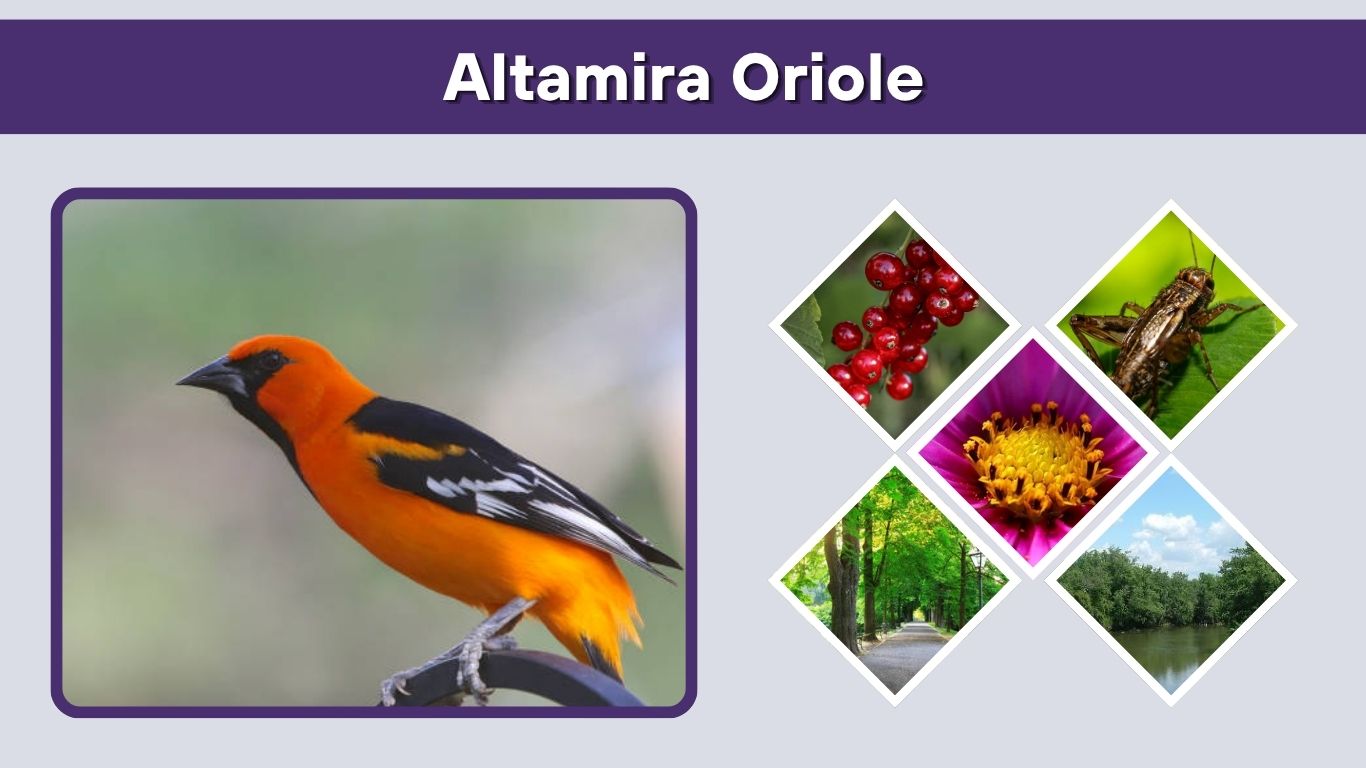
The Altamira Oriole is a striking orange-and-black bird best known for its tropical look, rich voice, and long hanging nest. In the United States, it is most strongly associated with far southern Texas, especially the Rio Grande Valley. Across Mexico and parts of Central America, it is more widespread in warm woodlands, edges, and semi-open habitats with trees.
What Is an Altamira Oriole?
The Altamira Oriole is a large New World oriole with the scientific name Icterus gularis. It belongs to the same broader family as blackbirds, meadowlarks, grackles, and other orioles. Among orioles seen in North America, it stands out because of its size, bright orange body, black throat, and bold wing pattern.
This bird is often searched by people who spot a bright orange bird in Texas, Mexico, Guatemala, or Central America and want to know what it is. Its vivid color makes it memorable, but it can still be confused with Hooded Orioles, Bullock’s Orioles, and other orange or yellow orioles.
Unlike some migratory orioles that appear only seasonally in many parts of the United States, Altamira Orioles are mostly resident in suitable warm habitats. Where they occur regularly, birdwatchers may find them throughout the year.
Altamira Oriole Identification
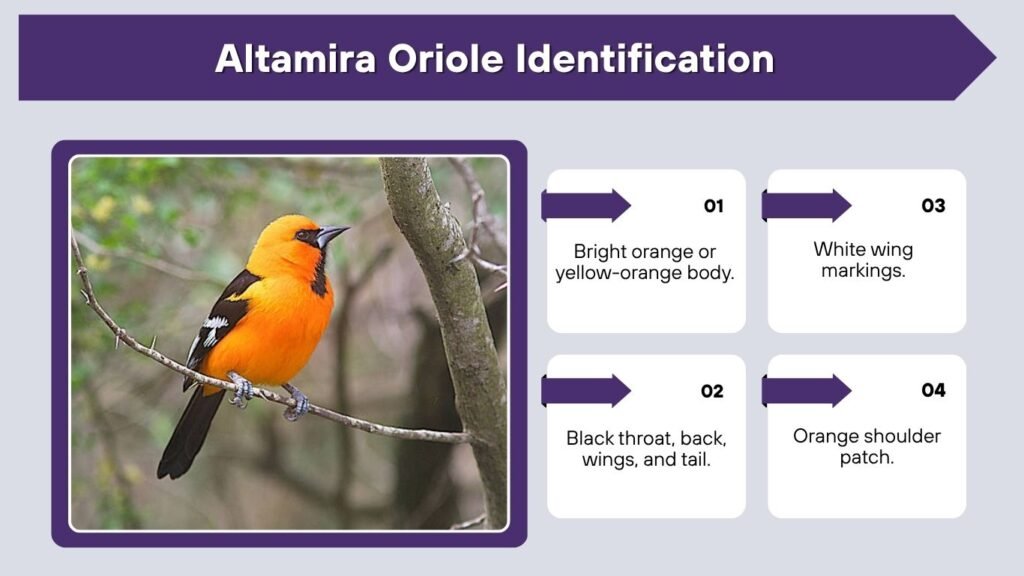
The Altamira Oriole has a bright orange to yellow-orange body, a black throat, black back, black wings, and a long black tail. White markings on the wings create a bold contrast when the bird is perched. Adults also show an orange shoulder patch that can help separate them from some similar orioles.
The bill is fairly thick, pointed, and dark. The bird’s overall shape is long and slim, but heavier and larger-looking than many smaller orioles. Its posture often looks upright when perched in trees.
Key Identification Signs
Look for these features when identifying an Altamira Oriole:
- Bright orange or yellow-orange body
- Black throat, back, wings, and tail
- White wing markings
- Orange shoulder patch
- Long tail and sturdy pointed bill
- Large size compared with many other orioles
- Warm habitat with scattered trees or woodland edges
The combination of orange body, black throat, black back, and white wing highlights is one of the best field clues. In good light, the bird can look almost glowing orange against green leaves.
Male and Female Altamira Oriole
Many bird species show strong differences between males and females, but Altamira Orioles are less dramatically different than some other orioles. Adult males and females are similar in overall pattern, with both showing bright orange and black plumage.
This can surprise birdwatchers who expect female orioles to be duller. In species such as the Hooded Oriole, females are much paler than males. In Altamira Orioles, adult females can look bright and bold too, although subtle differences may be hard to judge in the field.
Juvenile Altamira Orioles are easier to separate from adults. Young birds are usually duller, often with more olive or yellowish tones and less intense black on the back and throat. As they mature, they develop the stronger adult pattern.
Altamira Oriole Range
The Altamira Oriole is mostly a tropical and subtropical bird. Its range includes northeastern Mexico and extends through parts of Central America. In the United States, its regular range is limited mainly to the lower Rio Grande Valley of Texas.
Birders in Texas often look for this species in native woodland, parks, wildlife refuges, and brushy areas in the far south of the state. It is a special bird for many U.S. birdwatchers because it is not widely distributed across the country.
| Region | Status of Altamira Oriole |
|---|---|
| Far southern Texas | Local, year-round resident in suitable habitat |
| Northeastern Mexico | Common in many suitable areas |
| Guatemala and Central America | Present in parts of warm lowland habitat |
| California and Florida | Not regular; reports would be unusual |
| Northern U.S. states | Not expected under normal conditions |
When people search for Altamira Orioles in California, Florida, or northern states, they are often dealing with confusion, escaped birds, misidentification, or rare-vagrant questions. For normal birdwatching, Texas’s Rio Grande Valley is the main U.S. place to look.
Habitat and Behavior
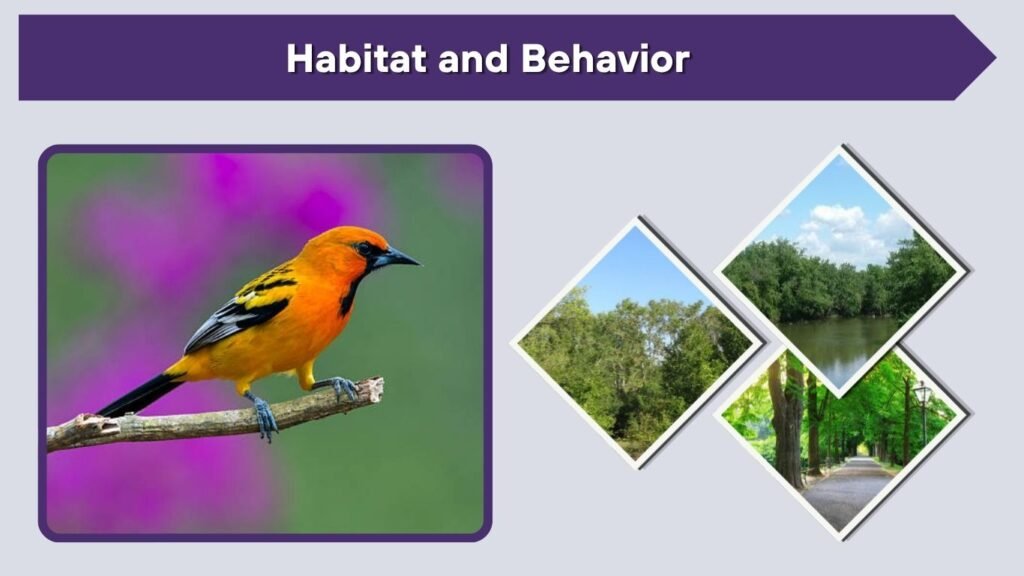
Altamira Orioles prefer warm, semi-open areas with trees. They can live in open woodland, thorn forest, riparian edges, brushy areas, parks, and large gardens. They often forage in trees, sometimes staying partly hidden among leaves.
They may be easier to hear than see. Even though the bird is brightly colored, it can disappear quickly into dense foliage. Its sharp calls and whistles often reveal its presence before a clear view is possible.
Common Places to See Them
Good places to look include:
- Native woodland in far southern Texas
- Rio Grande Valley wildlife areas
- Thorn forest and brushy edges
- Open woodland in Mexico and Central America
- Parks with mature trees
- Riparian corridors
- Areas with fruiting or flowering trees
They are not usually birds of deep, dark forest. They prefer areas where trees, open spaces, and food sources are mixed together.
What Do Altamira Orioles Eat?
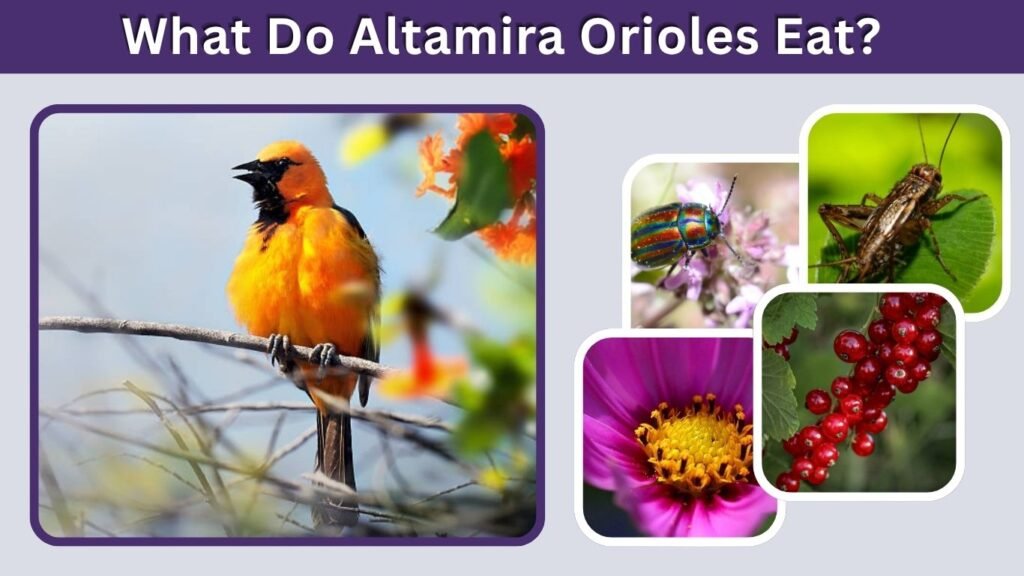
Altamira Orioles eat a mixed diet of insects, fruit, and nectar. Like other orioles, they forage among branches, leaves, flowers, and fruiting trees. They may search bark and foliage for insects or visit flowering plants for nectar.
Insects are important because they provide protein, especially during the breeding season. Fruit and nectar provide energy and are often easier to find in warm habitats.
Common Food Sources
Altamira Orioles may eat:
- Caterpillars and other insects
- Beetles, grasshoppers, and crickets
- Small fruits and berries
- Figs and other soft fruit
- Nectar from flowers
- Occasional feeder foods where offered
In yards within their range, fruiting trees, native plants, and insect-friendly landscaping may help attract them. Avoiding unnecessary pesticides is useful because orioles need insects as part of their diet.
Altamira Oriole Nest
The Altamira Oriole is famous for its nest. The female builds a long, woven hanging pouch, often suspended from a high branch. Cornell notes that these nests can be up to 26 inches long, making them especially noticeable compared with many other songbird nests.
The nest may hang from the end of a branch, where it is harder for some predators to reach. It is usually woven from plant fibers, grasses, strips of bark, and other flexible materials. The long pouch shape is one of the most distinctive parts of the bird’s breeding behavior.
Nesting Habits
Important nesting details include:
- The nest is a long hanging pouch
- It is usually placed high in a tree
- The female does most or all of the weaving
- The structure may hang from a branch tip
- Both parents may help care for young after hatching
The nest can be spotted even before the bird is seen. In areas where Altamira Orioles occur, a large hanging pouch in a tree may be an important clue.
Altamira Oriole Call and Song
The Altamira Oriole has a rich and varied voice. Its song includes clear whistles, sweet notes, clucks, and chatter. Cornell describes its song as rich whistles mixed with percussive clucks and chatters.
Its calls can also be harsh and attention-grabbing. Audubon notes that the bird may be noticed by its harsh fussing call notes even when it is hidden in dense trees. This makes sound an important identification tool.
A birder listening for Altamira Orioles should expect a mix of musical and rough sounds rather than one simple tune. The bird may sing from within trees, so patience is often needed to match the sound with a visual sighting.
Altamira Oriole vs Hooded Oriole
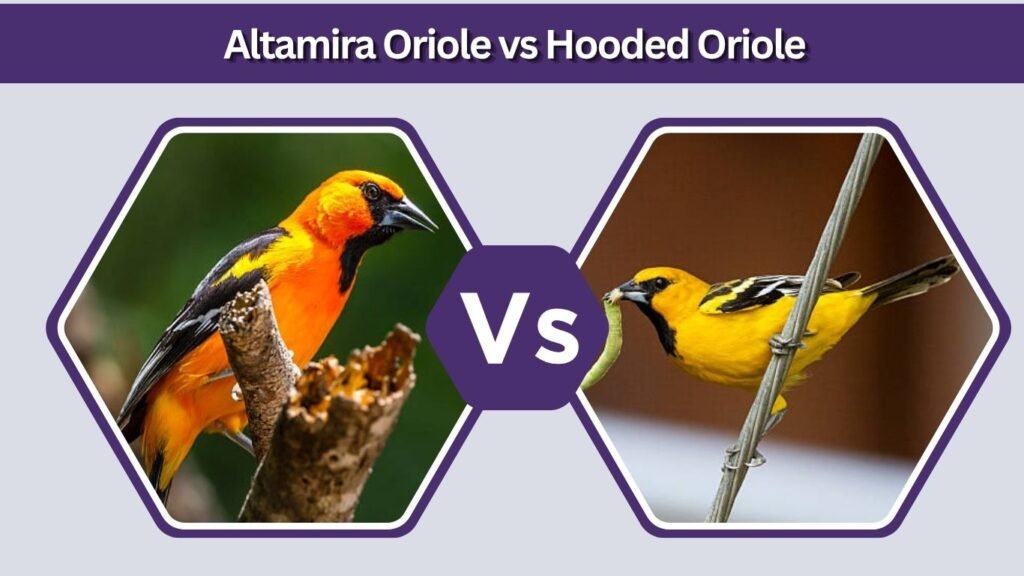
Altamira Orioles and Hooded Orioles can be confused because both may show orange or yellow-orange plumage and black markings. However, they differ in size, pattern, range, and sex differences.
Altamira Orioles are larger and usually show a bold black throat, black back, long black tail, white wing markings, and an orange shoulder patch. Adult males and females look fairly similar.
Hooded Orioles are slimmer and often more yellow-orange. Male Hooded Orioles have black on the throat and face, but females are much paler and less boldly marked. Hooded Orioles are also more widespread in parts of the southwestern United States, especially California, Arizona, and Texas.
Quick Difference Tips
Use these clues:
- Larger, heavier-looking oriole: likely Altamira
- Adult male and female both bright: likely Altamira
- Strong white wing marks and orange shoulder patch: likely Altamira
- Paler female with no bold black hood: likely Hooded Oriole
- Seen in California suburbs with palms: more likely Hooded Oriole
- Seen in far southern Texas native woods: could be Altamira
Range is often the easiest clue. In the U.S., Altamira Orioles are strongly tied to far southern Texas.
Are Altamira Orioles Rare?
Altamira Orioles are not rare across their full range, especially in parts of Mexico where suitable habitat is common. In the United States, however, they have a very limited range. That makes them special for U.S. birders.
A person in Texas’s Rio Grande Valley may have a reasonable chance of seeing one in the right habitat. A person in most other U.S. states is very unlikely to find one naturally. This difference is why the bird may be described as common in one region but rare or unexpected in another.
Habitat loss can affect local populations, especially where native woodland and thorn forest are removed. Protecting natural tree cover helps support orioles and many other birds.
How to Find Altamira Orioles
Finding an Altamira Oriole is easier when you search in the right region and habitat. In the United States, start with far southern Texas. Look in areas with native trees, woodland edges, and brushy habitat.
Listen carefully for whistles, clucks, and harsh chatter. Also scan high branches for the long hanging nest. Bright orange birds can still be hard to see when they stay inside leafy trees, so move slowly and watch for flashes of orange or black.
Early morning is often a good time for bird activity. A quiet approach and patient listening can make the difference between missing the bird and getting a clear view.
FAQs
What does an Altamira Oriole look like?
An Altamira Oriole is a bright orange-and-black bird with a black throat, black back, black wings, long black tail, and white wing markings. It also has an orange shoulder patch. Adults look bold and tropical, while juveniles are duller with more olive or yellowish tones before gaining adult plumage.
Where do Altamira Orioles live?
Altamira Orioles live mainly in northeastern Mexico and parts of Central America. In the United States, they are found mostly in far southern Texas, especially the Rio Grande Valley. They prefer warm open woodland, thorn forest, brushy edges, riparian areas, and parks with mature trees.
What do Altamira Orioles eat?
Altamira Orioles eat insects, fruit, and nectar. They search trees for caterpillars, beetles, grasshoppers, and other insects. They also feed on berries, figs, small fruits, and nectar from flowers. During nesting season, insects are especially important because they provide protein for growing young birds.
What is special about the Altamira Oriole nest?
The Altamira Oriole builds a long hanging pouch nest, often high in a tree and suspended from a branch. The nest can be very long compared with many songbird nests. Its woven structure helps protect eggs and young by placing them away from easy access by some predators.
Is the Altamira Oriole the same as a Hooded Oriole?
No, they are different species. Altamira Orioles are generally larger, with bold orange-and-black plumage, white wing markings, and similar-looking adult males and females. Hooded Orioles are slimmer, and females are much paler than males. In the United States, Altamira Orioles are mostly limited to far southern Texas.
