
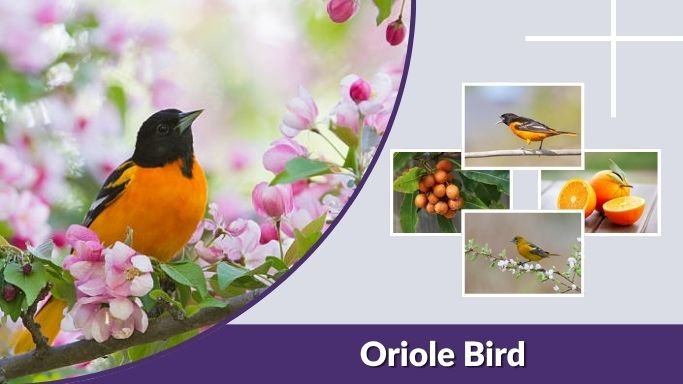
An oriole bird is usually recognized by its bright orange, yellow, black, or chestnut coloring, slender body, pointed bill, and musical whistle-like song. The Baltimore Oriole is the species many people picture first, especially in eastern North America. However, males, females, young birds, and similar species can look different, which is why a simple field guide helps.
Quick Oriole Identification Clues
Orioles are colorful songbirds in the blackbird family. They often stay high in trees, so many people notice the flash of orange or yellow before they see the full bird. Their shape is also important. Orioles have slim bodies, longish tails, pointed bills, and a graceful way of moving through branches.
Look for these common oriole features:
- Bright orange, yellow, black, or rusty plumage
- A slender body with a medium-length tail
- A straight, pointed bill used for fruit, nectar, and insects
- Strong white wing bars on many species
- A habit of perching high in trees
- A rich, whistling song in spring and early summer
The exact color pattern depends on the species, sex, and age of the bird. A male Baltimore Oriole looks bold and bright, while a female or young bird may look softer, yellowish, olive, or brownish.
What Does a Baltimore Oriole Bird Look Like?
The Baltimore Oriole is the classic orange-and-black oriole. Adult males are the easiest to identify because their colors are bold and clean. They have a black head, black upper back, black wings, and a brilliant orange body. Their wings show white bars, and the orange often glows in sunlight.
A male Baltimore Oriole may look almost flame-colored when it flies across a yard or sits in a flowering tree. The contrast between the black head and orange chest is the biggest clue. If you see a bright orange bird with a black head and black wings in the eastern or central United States, a male Baltimore Oriole is a strong possibility.
Females are not as dramatic. They are usually yellow-orange or golden below, with grayish-brown or olive tones on the back. Their wings are darker with pale wing bars. Some older females can become more orange, so color alone is not always enough.
Young Baltimore Orioles often resemble females. They may look yellowish, brownish, or olive, with softer markings and less contrast. Immature males gradually develop darker heads and brighter orange coloring as they mature.
| Oriole Type | Main Colors | Best ID Clue |
| Male Baltimore Oriole | Bright orange and black | Black head with vivid orange body |
| Female Baltimore Oriole | Yellow-orange, olive, gray-brown | Softer color with pale wing bars |
| Juvenile Baltimore Oriole | Dull yellow, brown, olive | Looks like a muted female |
| Male Orchard Oriole | Chestnut and black | Smaller, darker rusty body |
| Female Orchard Oriole | Yellow-green | Slim bird with soft yellow-green plumage |
What Does a Female Oriole Bird Look Like?
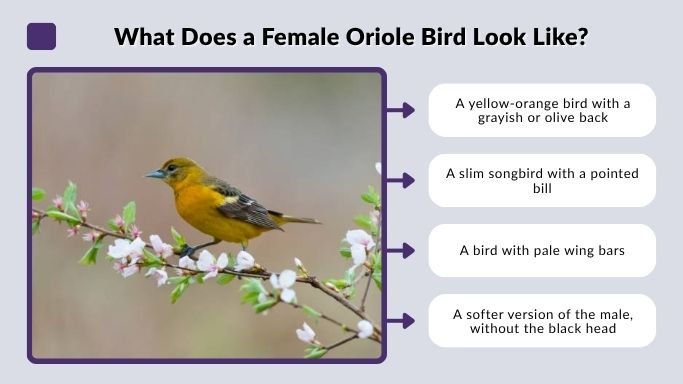
A female oriole is usually less colorful than a male, but she can still be beautiful. Female Baltimore Orioles often show warm yellow-orange on the breast and belly, with olive-brown or grayish tones on the back. Their wings are darker and usually marked with white or pale wing bars.
Because females are less bold, they are often confused with other yellow or orange birds. The best way to identify one is to look at the full combination of traits: body shape, pointed bill, wing bars, tree-top behavior, and soft orange-yellow coloring.
A female oriole may look like:
- A yellow-orange bird with a grayish or olive back
- A slim songbird with a pointed bill
- A bird with pale wing bars
- A softer version of the male, without the black head
- A bird feeding on oranges, jelly, nectar, or insects in trees
Female Orchard Orioles are different from female Baltimore Orioles. They are usually more yellow-green and smaller. They can look plain at first, but their slim shape and oriole-like behavior help separate them from warblers, tanagers, and finches.
What Do Baby and Juvenile Orioles Look Like?
Baby orioles in the nest do not look much like adults. Very young nestlings are small, weak, and mostly bare or covered with sparse down. As they grow, they develop feathers and begin to look more like dull versions of female orioles.
Juvenile orioles are often yellowish, olive, tan, or brownish. They usually lack the strong black-and-orange pattern of adult males. This is why many backyard birdwatchers see a young oriole and think it is a different species.
Fledgling orioles may look slightly fluffy, with shorter tails and less polished feathers. They may follow adults, beg for food, or move awkwardly through branches. If you see a dull yellow-orange bird near an adult oriole in summer, it may be a juvenile.
Young birds should not be handled unless they are clearly injured or in immediate danger. Many fledglings spend time outside the nest while their parents continue to feed them nearby.
Birds That Look Like Orioles
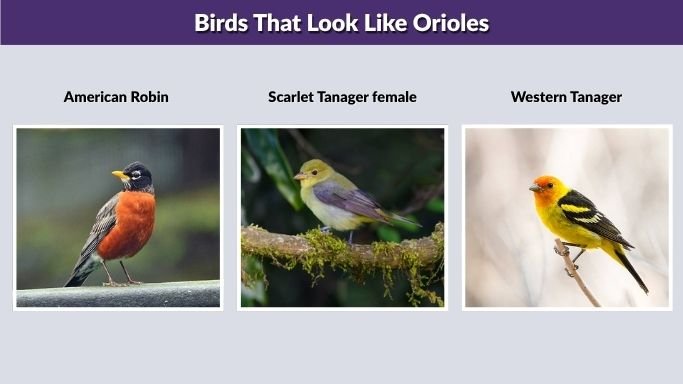
Many birds can be mistaken for orioles because they share orange, yellow, or black coloring. Some are close relatives, while others only look similar from a distance.
Common birds that look like orioles include:
- American Robin: Has an orange breast but is larger, rounder, and gray-brown above.
- Scarlet Tanager female: Yellowish-green and slender, but lacks the oriole’s strong wing-bar pattern.
- Western Tanager: Yellow and black with red or orange on the head, mostly in western regions.
- Bullock’s Oriole: Similar to Baltimore Oriole but found mainly in the West, with different facial markings.
- Orchard Oriole: Smaller than Baltimore Oriole; males are deep chestnut instead of bright orange.
- Hooded Oriole: Yellow-orange with a longer, slightly curved bill, common in parts of the Southwest.
- Blackburnian Warbler: Small, orange-throated bird, but much tinier and more delicate than an oriole.
- Eastern Towhee: Black and orange on the sides, but chunkier and usually found lower to the ground.
The fastest way to separate an oriole from lookalikes is to check size, bill shape, wing bars, and behavior. Orioles are slim, medium-sized songbirds that often feed high in trees and visit fruit or nectar feeders.
Birds That Look Like Baltimore Orioles but Aren’t
The phrase “bird that looks like a Baltimore Oriole” often comes from seeing an orange-and-black bird for just a second. In the East, the most common confusion is with robins, towhees, tanagers, or young/female orioles. In the West, Bullock’s Orioles and Hooded Orioles are more likely.
A robin has an orange breast, but it does not have the same black head and wing pattern as a male Baltimore Oriole. Robins are also heavier, with a rounder body and a more upright stance on lawns.
An Eastern Towhee can show black upperparts and orange sides, but it usually stays near shrubs or leaf litter. It is not as bright orange across the full body, and its shape is chunkier.
A Western Tanager may show yellow, black, and orange-red, but its color is arranged differently. It also lacks the classic black head and glowing orange body of a male Baltimore Oriole.
What Does an Oriole Bird Sound Like?
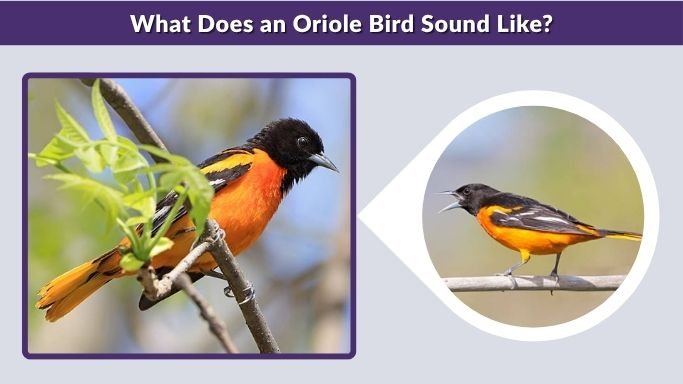
Orioles are known for clear, rich, whistling songs. A Baltimore Oriole’s song is often described as sweet, flutelike, and ringing from the treetops. The sound can vary from bird to bird, but it usually has a bright, whistled quality.
Orioles also make calls that are shorter and sharper than their songs. You may hear chattering, scolding, or single-note calls, especially when birds are near a nest, feeder, or another bird.
Listen for these sound clues:
- Clear whistles from high trees
- Short musical phrases with pauses
- Chattering or scolding notes near nesting areas
- A bright, ringing sound in spring
- Calls coming from leafy branches rather than open lawns
Because orioles often stay hidden among leaves, sound is one of the best ways to find them. In spring, look toward the top of tall trees after hearing a sweet whistle.
What Does an Oriole Nest Look Like?
An oriole nest is one of the most impressive nests in the bird world. Instead of building a simple cup on a branch, many orioles weave a hanging pouch. The nest often dangles from the end of a slender branch, where it is harder for predators to reach.
A Baltimore Oriole nest may look like a small hanging bag or woven sock. It is made from plant fibers, grasses, bark strips, hair, string-like material, and other flexible fibers. The female does most of the careful weaving.
You may see oriole nests in trees such as maples, elms, sycamores, cottonwoods, oaks, apples, or other tall deciduous trees. They can be hard to spot when leaves are full, but old nests are easier to see after leaves fall.
Never pull down or disturb an active nest. If you want to help orioles, create a bird-friendly yard with native trees, safe nesting material, and no loose plastic or long threads that could tangle birds.
What Do Oriole Birds Like to Eat?
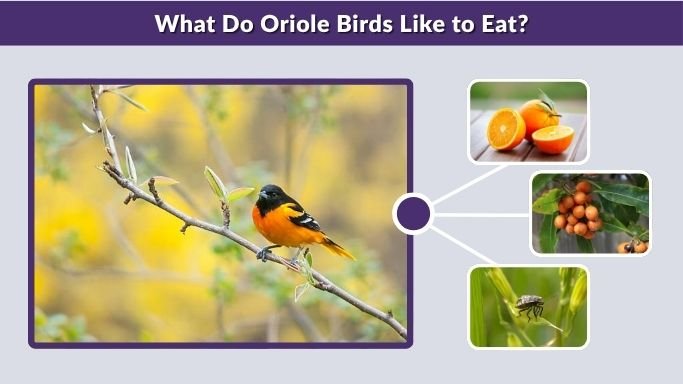
Orioles eat a mix of insects, fruit, and nectar. During nesting season, insects are especially important because they provide protein for growing young. Orioles may eat caterpillars, beetles, grasshoppers, and other small insects from leaves and branches.
In backyards, orioles are famous for visiting oranges, grape jelly, and nectar feeders. Many people first attract orioles by placing orange halves outside in spring. A small amount of grape jelly can also bring them in, but it should be offered carefully and kept fresh.
Good oriole foods include:
- Orange halves
- Small portions of grape jelly
- Nectar made for oriole feeders
- Native berries
- Flower nectar
- Insects from pesticide-free plants
Avoid giving orioles spoiled fruit, moldy jelly, or large open bowls of sticky food. Use small servings and clean feeders often. Natural food sources are best, so planting native trees, shrubs, and flowering plants can help orioles more than feeders alone.
What Does an Oriole Bird Feeder Look Like?
An oriole feeder is usually designed for fruit, nectar, or jelly. It may have orange-colored parts to attract attention, small cups for jelly, spikes or holders for orange halves, and nectar ports that fit an oriole’s bill.
Oriole feeders are often larger than hummingbird feeders because orioles are bigger birds. Some have perches so the bird can sit while feeding. A good feeder should be easy to clean, because sugar water and jelly can spoil quickly in warm weather.
Place the feeder near trees or shrubs, but not where cats can easily ambush birds. Orioles often feel safer when they can fly from a feeder to nearby branches. Put feeders out in early spring before orioles arrive in your area, because migrating birds may move on quickly if they do not find food.
Where Are You Most Likely to See Orioles?
Baltimore Orioles are common in much of the eastern and central United States during the breeding season. They often use open woods, parks, river edges, orchards, neighborhoods, and yards with tall trees.
They are migratory birds, so many people see them mainly in spring and summer. In fall, they travel south toward wintering areas. During migration, they may show up briefly at feeders, flowering trees, or fruiting plants.
Orchard Orioles also use open habitats with scattered trees, orchards, parks, and river edges. They are smaller and less flashy than Baltimore Orioles, so they can be easier to miss.
If you are searching for orioles, do not only look at feeders. Watch flowering trees, treetops, woodland edges, and areas with insects. A flash of orange or yellow high in the canopy may be your first clue.
FAQs
What does an oriole bird look like?
An oriole bird usually has a slim body, pointed bill, longish tail, and bright orange, yellow, black, or rusty coloring. Male Baltimore Orioles are vivid orange and black, while females and young birds are softer yellow-orange, olive, or brownish. Many orioles also show pale wing bars.
What does a Baltimore Oriole bird look like?
A male Baltimore Oriole has a black head, black wings, white wing bars, and a bright orange body. A female Baltimore Oriole is more muted, with yellow-orange underparts, grayish or olive-brown upperparts, and pale wing bars. Young birds often look similar to females.
What birds look like orioles?
Birds that may look like orioles include American Robins, Eastern Towhees, Western Tanagers, Scarlet Tanagers, Bullock’s Orioles, Hooded Orioles, Orchard Orioles, and Blackburnian Warblers. To tell them apart, compare body shape, bill shape, wing bars, behavior, range, and exact color pattern.
What does a female oriole bird look like?
A female oriole usually looks yellowish, orange-yellow, olive, or gray-brown rather than bright orange and black. Female Baltimore Orioles often have warm yellow-orange underparts and pale wing bars. Female Orchard Orioles are usually smaller and more yellow-green, with a slim, delicate appearance.
Do orioles like oranges and grape jelly?
Yes, orioles often visit oranges and grape jelly, especially during spring migration. Orange halves are a popular backyard food, and grape jelly can attract them when offered in small, clean portions. Orioles also need insects, nectar, berries, and native plants for a healthy diet.
