
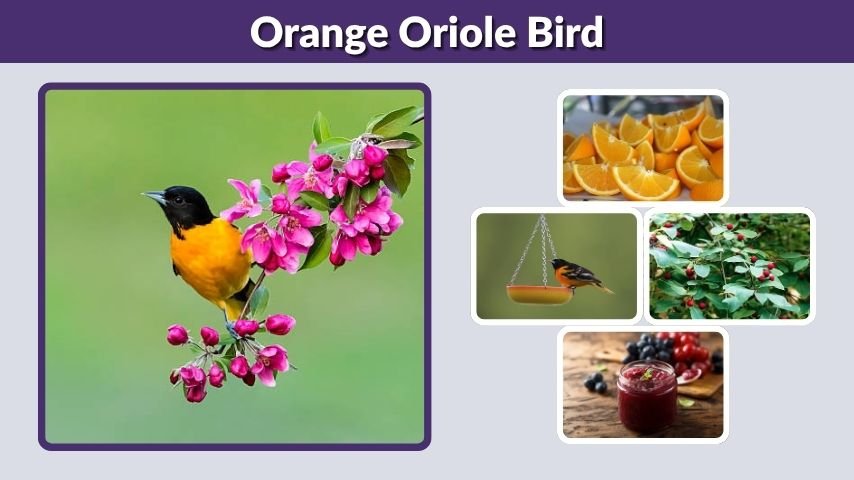
An orange oriole bird is usually a bright, slender songbird with a pointed bill, longish tail, and bold orange, black, yellow, or white markings. In eastern North America, the bird many people notice is the male Baltimore Oriole. In the West, orange orioles may include Bullock’s Orioles or Hooded Orioles. Orioles also love oranges, nectar, and fruit, which makes them exciting backyard visitors.
What Is an Orange Oriole Bird?
An orange oriole bird is not always one single species. The phrase usually describes any oriole with noticeable orange coloring. Some orioles are bright orange and black, while others are yellow-orange, flame-orange, or softly washed with orange.
The most familiar orange oriole in eastern and central North America is the Baltimore Oriole. Adult males are brilliant orange below with a black head, black wings, and white wing bars. They are often the bird people mean when they search for an orange and black oriole bird.
In western areas, a bright orange oriole may be a Bullock’s Oriole or Hooded Oriole. Bullock’s Orioles can show flame-orange coloring, a dark eye line, and a white wing patch. Hooded Orioles are often yellow-orange with black on the throat, face, wings, and tail.
Female and young orioles may look less vivid. They can appear yellow-orange, olive, grayish, or brownish. Because of this, some orange orioles are easy to identify, while others require a closer look at size, bill shape, wing bars, range, and behavior.
How to Identify an Orange Oriole
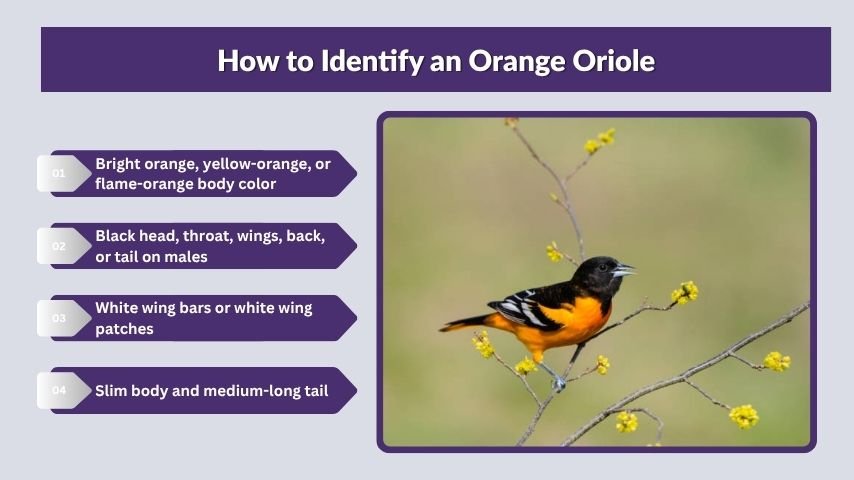
Orioles are medium-sized songbirds with slim bodies and pointed bills. They often stay high in trees, moving through leaves in search of insects, fruit, and nectar. A quick flash of orange may be your first clue.
Look for these field marks:
- Bright orange, yellow-orange, or flame-orange body color
- Black head, throat, wings, back, or tail on males
- White wing bars or white wing patches
- Slim body and medium-long tail
- Straight, pointed bill
- Treetop feeding behavior
- Visits to oranges, jelly, or nectar feeders
Color is helpful, but it should not be the only clue. A robin also has an orange breast, but it is larger and rounder than an oriole. A tanager may be orange-red or yellow, but it has a different bill and body shape. Orioles usually look sleeker and more delicate than many orange backyard birds.
Orange and Black Oriole Bird
An orange and black oriole bird is often a male Baltimore Oriole. This bird has one of the clearest color patterns among North American songbirds: a black head, black upperparts, black wings, and a glowing orange body. White wing bars add contrast.
The male Baltimore Oriole is especially noticeable in spring. It may sing from high branches, flash across open areas, or visit fruit feeders. Its orange plumage can look very bright in sunlight, which is why many people describe it as flame-colored.
A Bullock’s Oriole can also look orange and black, especially in the western United States. Adult males show orange on the face, breast, and underparts, with black markings and a noticeable white wing patch. They may be confused with Baltimore Orioles where ranges or migration overlap.
Hooded Orioles can also appear orange and black, although many look more yellow-orange than deep orange. Males have black markings on the throat and face, giving them a strong contrast against the bright body.
Orange-Breasted Bird With a Black Head
If you saw an orange-breasted bird with a black head, a male Baltimore Oriole is one of the best matches in eastern and central North America. The bird’s black head and orange underparts are its strongest identification clues.
However, not every orange-breasted bird with dark markings is an oriole. Some birds may look similar from a distance. American Robins have orange breasts, but they do not have a full black head like a male Baltimore Oriole. Eastern Towhees have black upperparts and orange sides, but they are chunkier and often stay low in shrubs or leaf litter.
The key is to notice the full pattern. A male Baltimore Oriole usually has a bright orange body, black head, black wings, and white wing bars. It is also slim and often found in trees rather than hopping across lawns.
If the bird has a very thick bill, consider a grosbeak. If it is round-bodied and feeding on the ground, consider a robin. If it is slim, bright, and moving through tree branches, an oriole becomes more likely.
Types of Orange Orioles
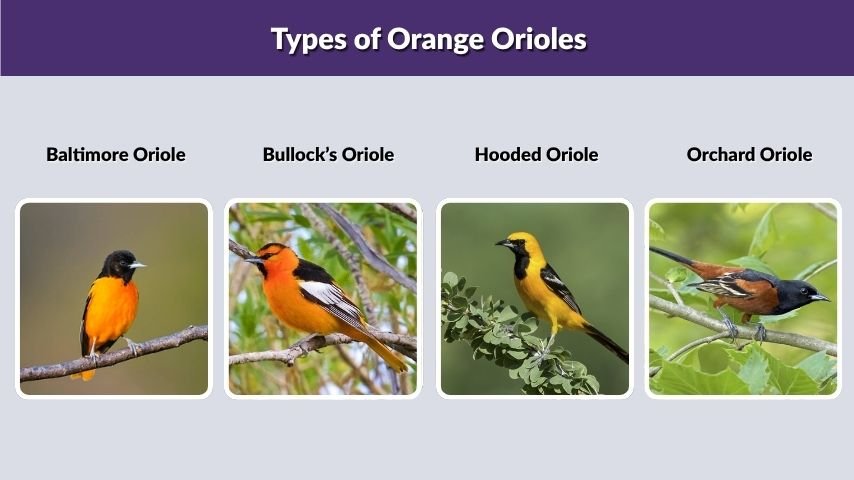
Several orioles may look orange, but their patterns and ranges differ. Knowing where you saw the bird is one of the fastest ways to identify it.
| Orange Oriole Type | Main Colors | Common Region | Best ID Clue |
| Baltimore Oriole | Bright orange and black | Eastern and central North America | Black head with vivid orange body |
| Bullock’s Oriole | Flame-orange, black, white | Western North America | Orange face with dark eye line and white wing patch |
| Hooded Oriole | Yellow-orange and black | Southwestern U.S. and Mexico | Black throat with yellow-orange body |
| Orchard Oriole | Chestnut-orange and black | Eastern and central North America | Smaller bird with darker rusty-orange male |
| Altamira Oriole | Orange, black, white | South Texas and Mexico | Large oriole with orange body and black back |
This table helps separate the most common possibilities, but local range is still important. A bright orange oriole in Pennsylvania is more likely to be a Baltimore Oriole, while one in California may be a Bullock’s or Hooded Oriole.
Do Oriole Birds Like Oranges?
Yes, orioles often like oranges. Many backyard birdwatchers attract orioles by offering fresh orange halves in spring. Orioles peck at the pulp and drink the juice, especially when they need energy during migration.
Oranges are popular because they are simple, visible, and easy for orioles to recognize. Their bright color may also help catch a bird’s attention. A cut orange placed on a branch, platform, or fruit feeder can bring orioles close enough for easy viewing.
To feed oranges safely:
- Cut a fresh orange in half
- Place it on a fruit spike, platform, or branch
- Keep it away from cats and heavy foot traffic
- Replace it when it dries out or becomes spoiled
- Clean any feeder surface regularly
- Avoid leaving rotten fruit outside
Orioles may visit oranges more often during migration and early nesting season. Later in summer, they may rely more on insects and natural foods, especially when feeding young.
Oriole Bird and Orange Slices
Orange slices can work, but orange halves are usually easier. A half orange gives the bird a stable surface and more pulp to peck. Thin slices may dry quickly, fall apart, or attract insects faster.
If you want to use slices, place them on a clean platform feeder or secure them firmly. Do not let sticky fruit pile up or rot. Spoiled fruit can attract pests and may be unhealthy for birds.
A good method is to place one orange half outside at a time. This keeps feeding simple and reduces waste. If several orioles visit your yard, you can add more halves, but still replace them often.
Oranges should be a treat, not the only food source. Orioles also need insects, berries, nectar, and natural habitat. A yard with native plants will support them better than fruit alone.
Orange Bird Feeders for Orioles
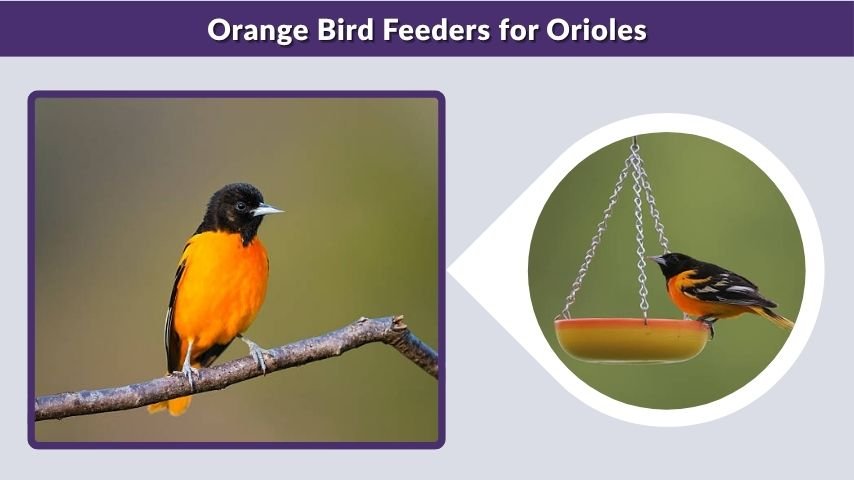
An orange bird feeder for orioles is usually designed to hold fruit, nectar, jelly, or a combination of these foods. Many oriole feeders are colored orange because orioles are often attracted to bright fruit-like colors.
Common oriole feeder features include:
- Spikes or posts for orange halves
- Small cups for grape jelly
- Nectar reservoirs with larger ports
- Perches for bigger birds
- Bright orange parts
- Easy-to-clean surfaces
- Hanging hooks or suction-cup designs
Oriole feeders are different from many seed feeders. Orioles do not usually visit regular seed feeders as often because they prefer fruit, nectar, and insects. A feeder designed for oranges and jelly is more likely to catch their attention.
Place the feeder near trees or shrubs so orioles feel safe. They often approach from cover, feed briefly, then return to branches. Avoid placing feeders where cats or other predators can hide nearby.
What Should You Put in an Oriole Feeder?
The best oriole feeder foods are fresh oranges, nectar, and small amounts of grape jelly. Some feeders hold all three. Others are designed only for nectar or fruit.
Good choices include:
- Orange halves
- Fresh fruit pieces
- Grape jelly in small amounts
- Sugar-water nectar
- Native berries nearby
- Clean water source
For nectar, many birdwatchers use a simple sugar-water mixture similar to hummingbird nectar. Do not use honey, artificial sweeteners, or red dye. The feeder color is enough to attract birds, and dyes are unnecessary.
Grape jelly should be offered carefully. Use a small portion, clean the cup often, and avoid letting it become sticky, moldy, or fermented. Too much jelly can be messy and may attract bees, ants, raccoons, or other unwanted visitors.
How Long Should You Leave Oranges Outside?
Leave oranges outside only while they are fresh. In cool weather, an orange half may last longer. In hot weather, it can dry out, ferment, or attract insects quickly. A good rule is to check oranges daily and replace them when they look dried, dirty, moldy, or spoiled.
If ants, bees, or wasps become a problem, remove the fruit, clean the feeder, and try again with smaller portions. You can also move the feeder to a different location or use an ant guard when appropriate.
Do not keep adding fresh fruit on top of old fruit. Clean the feeder surface first. This reduces disease risk and keeps the feeding area safer for birds.
Clean feeding stations are especially important during warm months. Fruit and sugar can spoil faster than seed, so oriole feeders need more attention than basic bird feeders.
Do Baltimore Orioles Prefer Oranges or Nectar?
Baltimore Orioles may visit both oranges and nectar. Their preference can change by season, location, and individual bird. During migration, oranges and nectar can provide quick energy. During nesting season, insects become very important because young birds need protein.
Some birdwatchers notice orioles first on orange halves, then later at nectar or jelly feeders. Others see them feeding mostly in trees and only occasionally at feeders.
The best approach is to offer a small variety:
- One fresh orange half
- A clean nectar feeder
- A small cup of grape jelly
- Native plants that support insects and berries
Natural foods should still be the foundation. Orioles feed on caterpillars, beetles, spiders, fruit, and flower nectar. A yard with fewer pesticides and more native plants can support birds long after the feeder is empty.
Orange Birds Besides Orioles
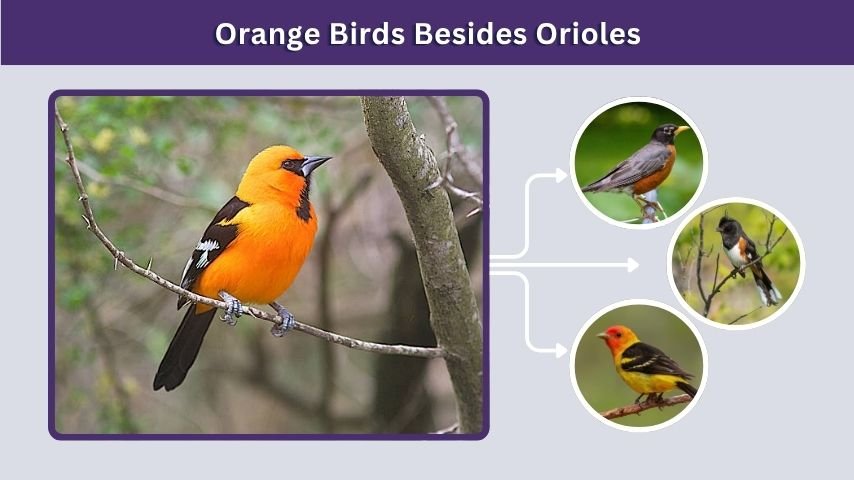
Not every orange bird is an oriole. Several birds have orange, reddish-orange, or warm yellow plumage. Some can look oriole-like at a quick glance.
Orange birds that may be confused with orioles include:
- American Robin
- Eastern Towhee
- Western Tanager
- Scarlet Tanager female or immature male
- Black-headed Grosbeak
- Varied Thrush
- Blackburnian Warbler
- Allen’s or Rufous Hummingbird
- Some female orioles and young orioles
The American Robin is one of the most common lookalikes. It has an orange breast, but it is larger, rounder, and more likely to be seen on lawns. A Baltimore Oriole is slimmer, brighter, and more tree-focused.
A Black-headed Grosbeak can also look orange and black, but it has a thick bill. Orioles have slimmer, sharper bills. This single feature can solve many confusing sightings.
Orange Oriole Bird Sounds
Orange orioles are often heard before they are seen. Baltimore Orioles sing clear, rich, whistling songs from treetops. Their song can sound bright, sweet, and flute-like. They also make shorter calls and chattering sounds.
Bullock’s Orioles also give whistling and chuckling sounds. Hooded Orioles are often noisy and may chatter from palms, yards, and open woodlands. Because orioles often stay hidden among leaves, learning their sounds can make identification easier.
When you hear a musical whistle from high in a tree, look carefully near the top branches. A flash of orange moving between leaves may reveal the bird.
Sound is especially useful in spring, when males sing to defend territories and attract mates. Later in the season, orioles may become quieter and harder to find.
How to Attract Orange Orioles to Your Yard
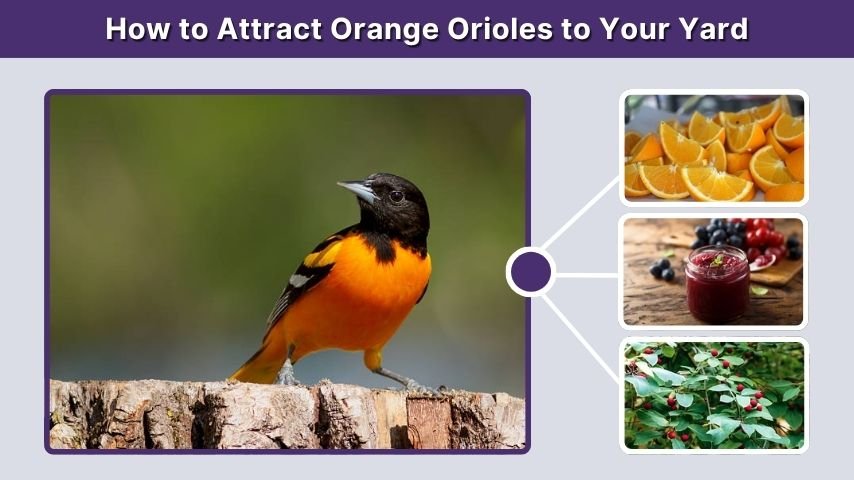
To attract orange orioles, offer the right food at the right time and create a safe habitat. Many people put feeders out too late. Orioles may pass through during migration and keep moving if they do not find food.
Try these tips:
- Put feeders out in early spring before orioles arrive
- Offer fresh orange halves
- Use a clean nectar feeder with perches
- Add a small amount of grape jelly
- Plant native fruiting shrubs and trees
- Avoid pesticides when possible
- Provide tall trees or nearby cover
- Keep feeders clean and fresh
Orioles are not guaranteed to stay just because food is available. They also need nesting areas, insects, and safe cover. A yard with trees, flowers, berries, and clean feeders is more attractive than a yard with only jelly.
FAQs
Is an oriole bird orange?
Many orioles have orange coloring, but not all are fully orange. Male Baltimore Orioles are bright orange and black, while females are more yellow-orange or olive. Bullock’s Orioles and Hooded Orioles can also show orange or yellow-orange plumage, especially adult males.
Do oriole birds like oranges?
Yes, orioles often like oranges. Fresh orange halves are one of the easiest foods to offer them in spring. Orioles peck at the pulp and drink the juice. Replace oranges when they dry out, become dirty, or start to spoil.
What orange bird looks like a Baltimore Oriole?
Birds that may look like a Baltimore Oriole include Bullock’s Oriole, Orchard Oriole, American Robin, Eastern Towhee, Western Tanager, and Black-headed Grosbeak. Check the bill, body shape, wing bars, head color, and location before deciding which bird you saw.
What does an orange oriole feeder look like?
An orange oriole feeder usually has places for orange halves, small cups for jelly, and sometimes a nectar reservoir. Many are bright orange to attract orioles. A good feeder should have perches, be easy to clean, and hold food securely.
How long can you leave oranges out for orioles?
Check oranges daily. Replace them when they become dry, dirty, moldy, or spoiled. In hot weather, oranges may need changing more often. Fresh fruit is safer and more attractive to orioles than fruit that has fermented or attracted too many insects.
