
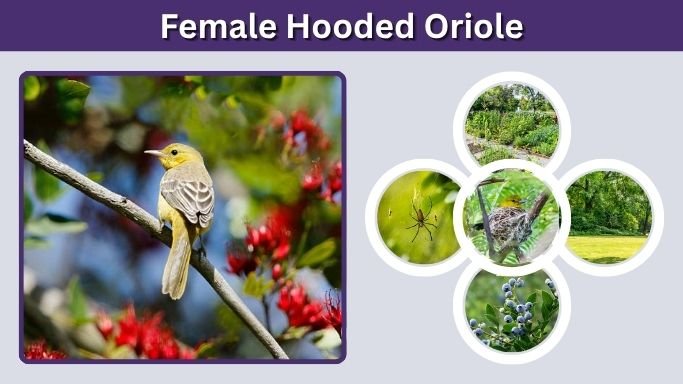
The female Hooded Oriole is a slim, graceful songbird with soft yellow coloring, a long pointed bill, and a warm tropical look. She is not as bright as the male, but her subtle colors make her beautiful in a different way. Birdwatchers often see her in palms, yards, orchards, and dry open habitats, especially across California and the southwestern United States.
What Does a Female Hooded Oriole Look Like?
Female Hooded Orioles are lighter and less dramatic than males, but they still have clear field marks. Their yellow body, grayish-olive upperparts, slender shape, and slightly curved bill help separate them from many other backyard and orchard birds. They may look plain at first, but careful observation shows several useful details.
Identification
A female Hooded Oriole usually has:
- Yellow to yellow-green underparts
- Olive-gray or grayish-green back
- Pale yellow face and throat
- Long, sharp, slightly curved bill
- Slim body and long tail
- Dark wings with faint pale edging
- Softer, duller color than the male
- No bold black throat patch like the adult male
The female often appears warm yellow below and gray-green above. Her bill is one of the most important clues because it looks long and pointed compared with warblers, finches, or tanagers. In strong sunlight, she may look brighter yellow, while in shade she can appear pale olive or grayish.
Size and Shape
The female Hooded Oriole is a medium-sized songbird with a narrow body and elegant posture. She is smaller and slimmer than many blackbirds but longer-bodied than most warblers. Her pointed bill is built for feeding on nectar, fruit, and insects.
Her tail often looks fairly long, especially when she perches upright. When moving through palm leaves or tree branches, she may appear quick, light, and slightly secretive. This slim shape is helpful when color is difficult to judge.
Color Pattern
The female does not have the strong orange-yellow and black pattern of the male. Instead, her colors are softer. The underparts are usually yellow, while the back and wings are more olive-gray. Some females may look brighter than others depending on age, season, and lighting.
Young females and immature birds can appear even duller. They may show more gray, olive, or washed yellow tones. This variation is one reason people often confuse female Hooded Orioles with female Orchard Orioles, female Bullock’s Orioles, or other yellowish birds.
Female Hooded Oriole vs Male Hooded Oriole
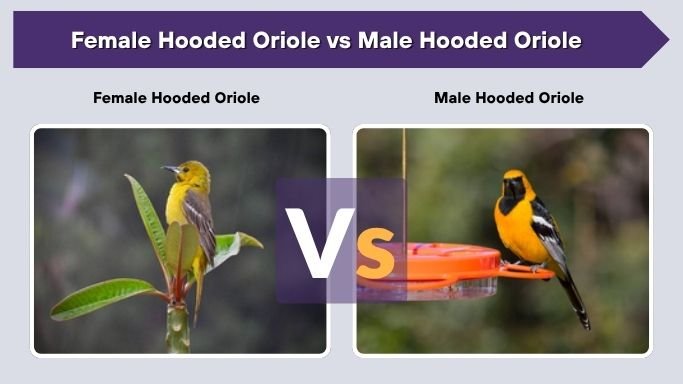
Male and female Hooded Orioles look noticeably different. The male is brighter, bolder, and easier to recognize. The female is softer in color and less strongly marked. Knowing this difference helps birdwatchers avoid confusing females with immature males or other oriole species.
Male Appearance
The adult male Hooded Oriole is usually bright yellow-orange with a black throat, black wings, and a black tail. In some areas, males may look more orange, while in others they appear more yellow. Their face and body color are much stronger than the female’s.
The male’s black throat patch is one of the clearest differences. Females do not show this bold black bib. Males are also more eye-catching when singing from palm trees, tall shrubs, or open branches.
Female Appearance
The female is more yellow-green and grayish. She has no strong black throat and lacks the intense orange glow of the male. Her wings are darker than her body, but the contrast is not as sharp as in the male.
This softer coloring helps her blend into leaves while nesting and foraging. If you see a yellowish oriole near palm trees but it lacks the male’s black throat, it may be a female Hooded Oriole.
Quick Male and Female Comparison
| Feature | Female Hooded Oriole | Male Hooded Oriole |
|---|---|---|
| Body color | Yellow to yellow-green | Bright yellow-orange |
| Throat | Pale, no black bib | Black throat patch |
| Back | Olive-gray or gray-green | Yellow-orange with dark wings |
| Wings | Dark with subtle edging | Black with stronger contrast |
| Overall look | Soft, slim, less bold | Bright, bold, tropical-looking |
| Nest role | Builds and cares for nest | Defends territory and sings |
Female Hooded Oriole in California
California is one of the best places to see Hooded Orioles. They are especially associated with palms, suburban neighborhoods, dry washes, parks, and gardens. In many areas, people first notice them when they visit nectar feeders or move through palm fronds during the breeding season.
Where She Lives
In California, female Hooded Orioles are often found in:
- Palm-lined neighborhoods
- Desert washes
- Parks and gardens
- Orchards
- Open woodlands
- Riparian areas
- Suburban yards with flowering plants
- Areas with tall palms or yucca-like plants
Palms are especially important in many urban and suburban areas. Female Hooded Orioles often use palm fibers to build their hanging nests. Because they move quietly through the fronds, they can be present even when they are not easy to see.
Seasonal Presence
Hooded Orioles are breeding-season visitors in many parts of California. They typically arrive in spring, nest during warmer months, and migrate south later in the season. During migration, females may appear in yards, gardens, and flowering trees.
A female may be seen visiting nectar feeders, sipping from flowers, or searching leaves for insects. If she appears repeatedly in the same yard during spring or early summer, there may be a nest nearby.
Backyard Behavior
Female Hooded Orioles may visit feeders with nectar, orange halves, or soft fruit. They are usually less bold than some other feeder birds and may approach carefully. They often perch briefly, feed quickly, and return to cover.
Planting flowering shrubs, keeping mature trees, and avoiding pesticide use can make a yard more attractive to orioles. In palm-heavy neighborhoods, they may nest surprisingly close to homes.
Female Hooded Oriole Call and Song
The female Hooded Oriole is not silent. Although males are more famous for singing, females also make calls and may produce short song-like sounds. Listening carefully can help confirm her presence when she is hidden among leaves or palm fronds.
Call Notes
The female’s calls are often sharp, quick, and somewhat nasal or chattering. She may call when moving through trees, communicating with a mate, or warning near a nest. These calls can sound less musical than the male’s song but are still useful for identification.
When disturbed near a nesting area, she may become more vocal. A repeated chatter from a palm or leafy tree can be a clue that a Hooded Oriole is nearby.
Song and Vocal Behavior
Male Hooded Orioles usually sing more often, especially during the breeding season. Their song can sound varied, scratchy, sweet, and musical. Females may give shorter vocalizations, but they are generally less obvious.
If you hear a bright, uneven oriole song from palms or open trees, look carefully for both birds. The male may be easier to spot first, while the female may stay lower or deeper in cover.
Female Hooded Oriole Nest
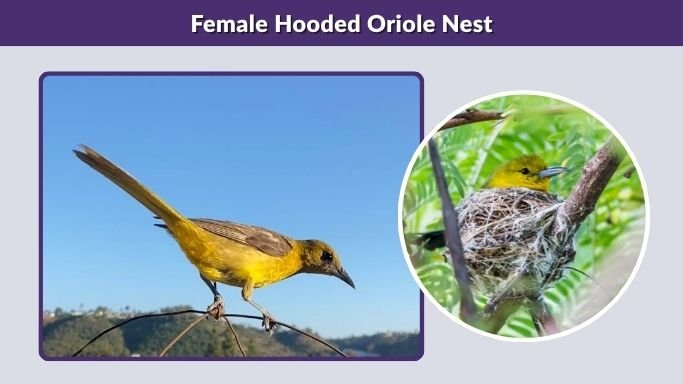
The female plays a major role in nesting. Hooded Orioles are known for their hanging nests, which are often woven into palm leaves. The nest is one of the best clues that a pair may be breeding nearby, although it can be difficult to see from the ground.
Nest Placement
Female Hooded Orioles commonly place nests in palm trees, especially under large palm fronds. They may also use other trees, but palms are strongly associated with this species in many western neighborhoods and dry habitats.
The nest often hangs like a small woven pouch. It may be attached to the underside of a palm leaf or woven into plant fibers. This hanging design helps protect eggs and nestlings from some predators.
Nest Building
The female usually does most of the nest construction. She uses plant fibers, grasses, palm fibers, and other thin materials to create a pouch-like structure. The nest must be strong enough to hold eggs and young birds while moving with wind and leaves.
Because the nest blends into palm fibers, it can be hard to find. Watching where the female repeatedly carries material is often the easiest way to locate the nesting area.
Eggs and Young
After the nest is ready, the female lays eggs and incubates them. Once the young hatch, both parents may help feed them. The young are fed insects and other soft foods that provide protein for growth.
Juvenile Hooded Orioles can look dull and yellowish, somewhat like females. This can create confusion when several young birds appear near a nesting site.
Juvenile and Immature Female Hooded Oriole
Juvenile and immature Hooded Orioles can be tricky to identify. They often lack the bright colors of adult males and may resemble females. Their soft yellow, olive, and gray tones make size, shape, bill structure, and behavior especially important.
Juvenile Appearance
A juvenile female Hooded Oriole may look pale yellow below and grayish or olive above. The wings may appear darker, but not strongly patterned. The bill still looks pointed and oriole-like, though young birds may appear less polished than adults.
Juveniles may also look slightly fluffy or loose-feathered after leaving the nest. They often stay near adults and may beg for food with fluttering wings or soft calls.
Immature Male Confusion
Immature males can look similar to females before they develop full adult plumage. They may show yellowish coloring without the bold black throat of an adult male. Over time, young males become brighter and develop stronger dark markings.
This is why not every plain yellow Hooded Oriole is female. Some may be young males. Behavior and timing can help, but exact age and sex may not always be easy to confirm in the field.
Female Hooded Oriole vs Similar Birds
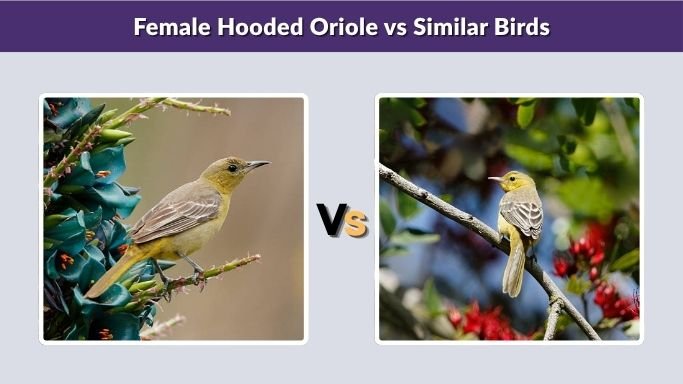
Female Hooded Orioles are often confused with other yellowish orioles and songbirds. The best identification method is to combine color, bill shape, habitat, size, and range. A long pointed bill and palm-loving behavior are especially helpful clues.
Female Orchard Oriole vs Female Hooded Oriole
Female Orchard Orioles are also yellow-green, but they are usually smaller and more compact. They often look more olive overall and have a shorter, finer shape. Hooded Orioles tend to look longer, brighter yellow below, and more associated with palms and dry western habitats.
Range is also important. Orchard Orioles are more common in the eastern and central United States, while Hooded Orioles are strongly linked with the southwestern United States, Mexico, and California.
Female Bullock’s Oriole vs Female Hooded Oriole
Female Bullock’s Orioles can look yellowish-orange and may overlap with Hooded Orioles in some western areas. Bullock’s females often show a different facial pattern, sometimes with a more noticeable pale eyebrow or contrast around the face.
Hooded Orioles usually look slimmer, with a longer curved bill and a cleaner yellow body. Habitat can also help, especially if the bird is feeding or nesting around palms.
Other Yellow Birds
Warblers, tanagers, and female orioles can all appear yellow. However, most warblers are smaller with thinner bills. Female tanagers may be stockier and lack the same long, pointed oriole bill. The Hooded Oriole’s shape, bill, and behavior are usually the strongest clues.
Diet and Feeding Behavior
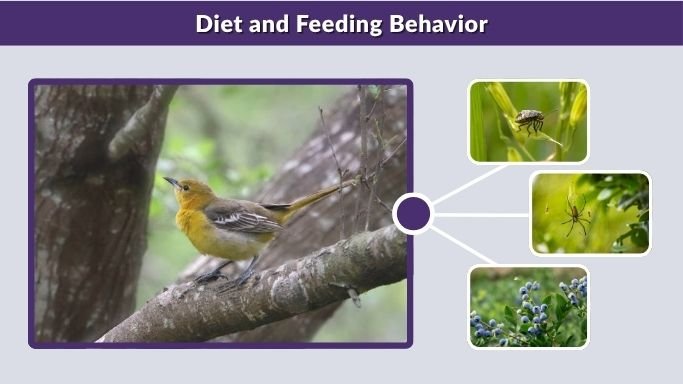
Female Hooded Orioles eat a mix of nectar, insects, fruit, and small arthropods. This varied diet helps them survive in dry habitats, gardens, orchards, and suburban areas. During nesting season, insects become especially important for feeding young birds.
Natural Food
In the wild, female Hooded Orioles feed on nectar from flowers, small insects, caterpillars, spiders, berries, and soft fruits. They search leaves, flowers, and branches for food, often moving quickly and carefully.
Their long bill helps them reach nectar and pick insects from tight spaces. In palms, they may inspect fronds and fibers for hidden prey.
Feeder Visits
Female Hooded Orioles may come to nectar feeders, especially in areas where they breed or migrate. They may also eat orange slices, jelly, or soft fruit. Clean feeders are important because spoiled nectar or dirty feeding stations can harm birds.
A safe feeder setup should be cleaned regularly and placed near natural cover. This gives orioles a place to retreat if they feel exposed.
FAQs
What color is a female Hooded Oriole?
A female Hooded Oriole is usually yellow to yellow-green below with olive-gray or gray-green upperparts. She does not have the bright orange-yellow body and black throat of the adult male. Her colors are softer, which helps her blend into leaves, palms, and nesting areas.
How can you tell a female Hooded Oriole from a male?
The male is brighter and has a black throat patch, black wings, and a stronger yellow-orange body. The female is paler, more olive-gray above, and lacks the bold black throat. If the bird looks soft yellow-green and does not show a black bib, it is likely female or immature.
Where are female Hooded Orioles found in California?
Female Hooded Orioles are often found in palm-lined neighborhoods, gardens, parks, orchards, desert washes, and riparian areas in California. They are strongly associated with palms in many places because females often weave their hanging nests into palm fronds during the breeding season.
What does a female Hooded Oriole nest look like?
The nest is a hanging pouch woven from plant fibers, grasses, and often palm material. It may hang beneath palm fronds or be hidden in other trees. The female does most of the nest building, creating a flexible but strong structure for eggs and young birds.
Is a juvenile female Hooded Oriole different from an adult female?
A juvenile female Hooded Oriole may look duller, softer, and less defined than an adult female. Young birds can appear pale yellow, olive, or grayish and may have a less polished look. Juveniles often stay near adults and may beg for food after leaving the nest.
