
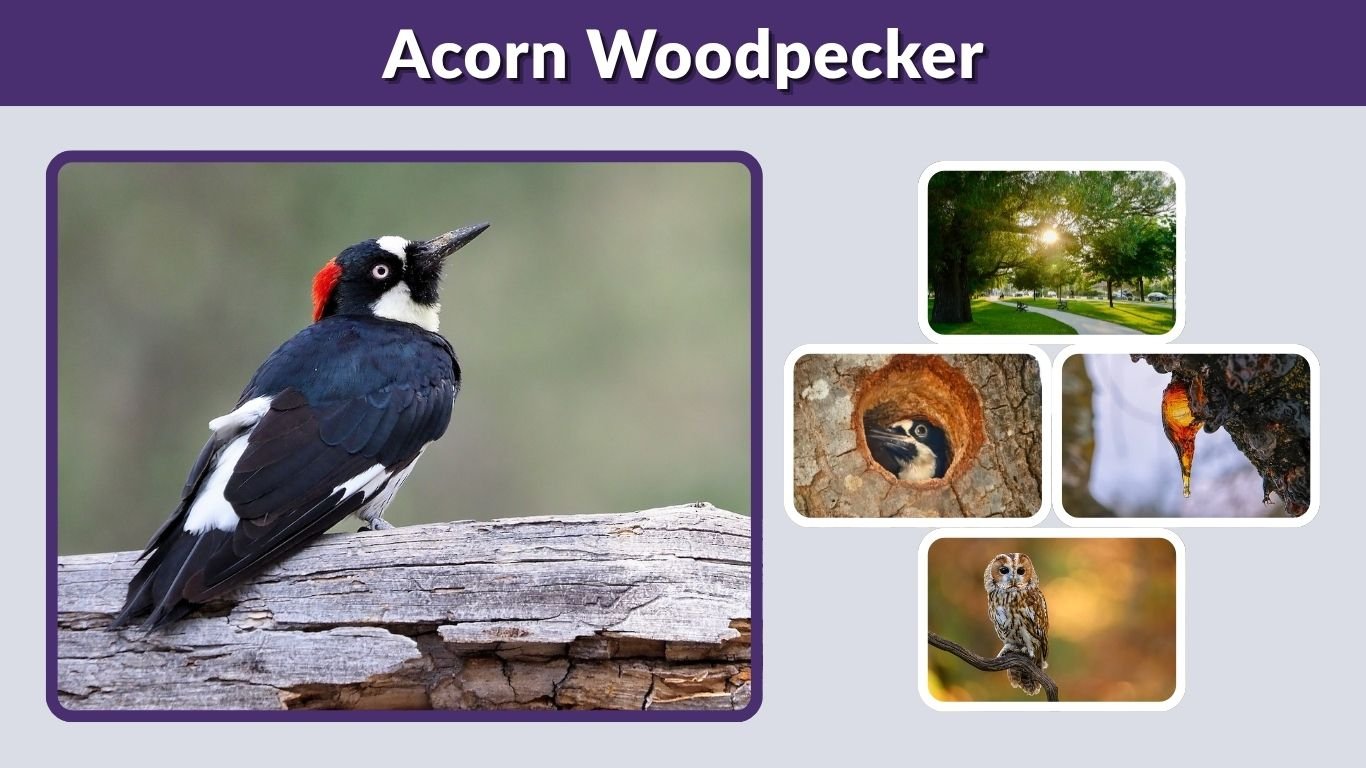
The acorn woodpecker is a colorful, highly social bird famous for storing thousands of acorns in specially drilled holes. Found mainly in oak woodlands of western North and Central America, these birds live in cooperative family groups and defend shared food stores. Their clownlike facial pattern, red crown, loud calls, and unusual granary trees make them easy to recognize. This guide explores the acorn woodpecker’s appearance, food, habitat, range, calls, nesting habits, adaptations, and potential damage to homes.
What Is an Acorn Woodpecker?
The acorn woodpecker (Melanerpes formicivorus) is a medium-sized woodpecker closely associated with oak forests. Unlike many solitary woodpeckers, it often lives in a complex family group whose members collect food, defend territory, and help raise young. Its dependence on stored acorns allows the group to remain in the same territory throughout much of the year.
Identification and Characteristics
Key features of an acorn woodpecker include:
- Length of approximately 7.5–9 inches
- Black back, wings, and chest
- White forehead, throat, belly, and rump
- Bright red crown on adults
- White wing patches visible during flight
- Pale or whitish eyes in adults
- Strong, pointed beak for drilling wood
- Undulating flight with alternating flaps and glides
Its dramatic black, white, and red pattern sometimes earns it the nickname “clown-faced woodpecker.” Juveniles resemble adults but generally have darker eyes and less clearly defined head markings.
Male vs. Female Acorn Woodpecker
Male and female acorn woodpeckers are similar in size and overall coloring. The easiest way to distinguish them is by examining the forehead and crown.
On a male, the red crown usually meets the pale forehead directly. On a female, a narrow black band separates the red crown from the pale forehead. Females have a slightly smaller red area, although this difference may be difficult to see when the bird is moving.
Acorn Woodpecker Call and Sound
The acorn woodpecker’s best-known call is a loud, nasal “waka-waka-waka” sound that resembles laughter. Groups can become extremely noisy when greeting one another, defending their granary, or warning of danger.
They also produce rattles, squeaks, alarm calls, and drumming sounds. Their calls are often the first indication that a group is present in an oak woodland.
Acorn Woodpecker Food and Diet

Despite its name, the acorn woodpecker does not survive entirely on acorns. It is an omnivorous and opportunistic feeder whose diet changes with the season. Acorns are particularly important during winter, when insects and fresh fruits may be scarce. In parts of California, acorns can account for more than half of its diet.
What Do Acorn Woodpeckers Eat?
Their diet may include:
- Acorns and other nuts
- Ants, beetles, flies, and grasshoppers
- Flying insects caught in midair
- Tree sap
- Oak flowers and catkins
- Wild and cultivated fruits
- Seeds and grains
- Nectar or sugar water from hummingbird feeders
- Suet provided at bird feeders
Although their scientific name means “ant-eating,” ants are only one part of their varied diet. These birds frequently wait on exposed branches and fly out to catch insects in the air.
How Do They Eat Stored Acorns?
An acorn is initially pushed into a hole that fits it tightly. As it dries and shrinks, it may become loose. The birds regularly inspect their supplies and move loose acorns into smaller holes.
To eat an acorn, a woodpecker removes it from storage, places it in a convenient crack, and breaks it apart with its beak. This behavior provides dependable food during winter or periods when natural food is limited.
Acorn Woodpecker Granary Trees
A granary is a tree or wooden structure containing holes used for acorn storage. Rather than placing many acorns inside one cavity, the birds drill a separate hole for almost every nut. The same granary can be maintained by multiple generations and may become the center of a group’s territory.
How Many Acorns Can a Granary Hold?
A well-established granary may contain thousands of holes. Exceptionally large granaries can hold as many as 50,000 acorns. A family group spends considerable time collecting, inserting, checking, moving, and defending these valuable supplies.
Common granary locations include:
- Dead or partially dead oak trees
- Thick-barked living trees
- Large branches and snags
- Utility poles and fence posts
- Wooden siding, trim, and shingles
- Barns and other wooden structures
The storage holes are usually shallow and are not signs that the birds are searching for insects deep inside the wood.
Adaptations for Acorn Storage
The bird’s powerful beak and reinforced skull help it drill numerous holes without suffering injury. Its gripping feet and stiff tail feathers provide support while it climbs vertical surfaces.
Social living is another important adaptation. While some members collect or maintain acorns, others can watch for predators. The group also defends its granary against squirrels, jays, and neighboring woodpecker groups.
Acorn Woodpecker Habitat and Geographic Range
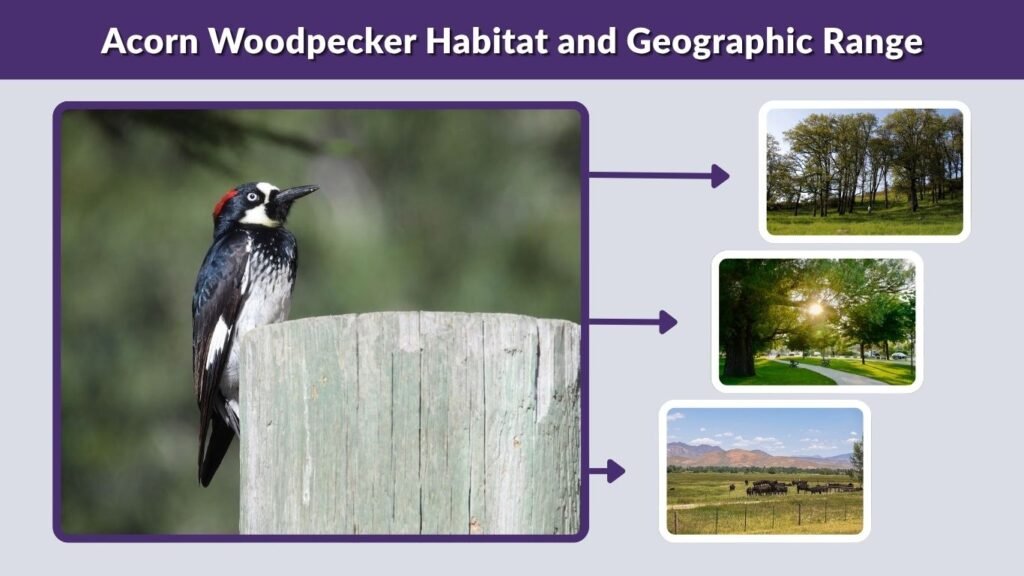
Acorn woodpeckers favor habitats where mature oaks produce dependable acorn crops. They occupy oak woodland, mixed oak-pine forest, wooded canyons, chaparral edges, pastures with scattered trees, parks, and residential areas near natural woodland.
Where Do Acorn Woodpeckers Live?
Their geographic range extends from western Oregon through California and parts of the southwestern United States, Mexico, and Central America into northern South America.
In the United States, they are most strongly associated with California, but populations also occur locally in Oregon, Arizona, New Mexico, and western Texas. Many groups remain close to permanent territories, although local movement can occur when acorn production is poor.
Acorn Woodpeckers in California
California provides extensive oak habitat and supports some of the best-known populations. The birds inhabit coastal oak woodlands, mountain foothills, wooded parks, and suburban communities.
They are especially noticeable during autumn, when family groups gather acorns and transport them to granary trees. Their presence is often revealed by loud calls and trees covered with hundreds or thousands of small holes.
Acorn Woodpecker Social Behavior and Nesting
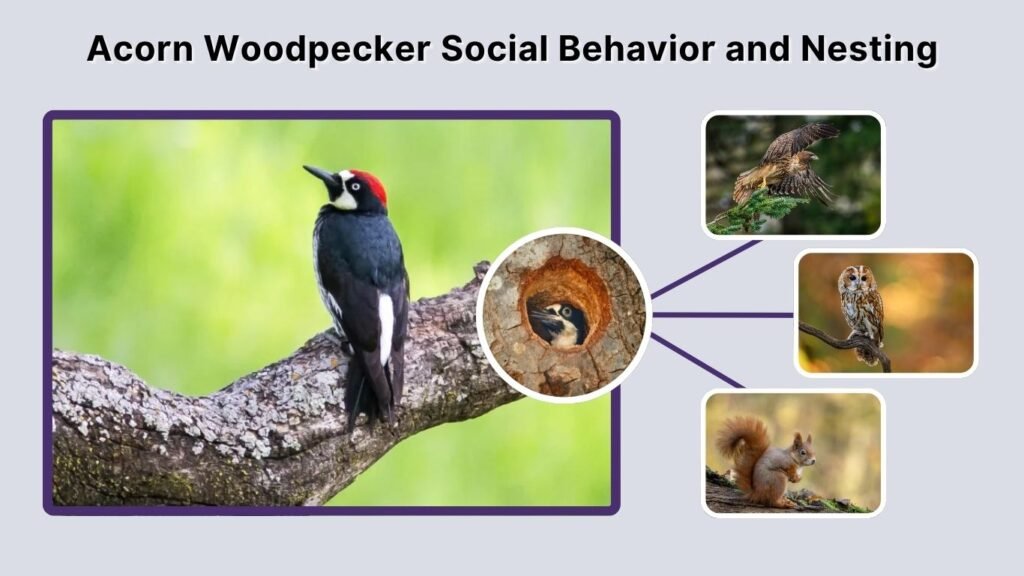
Acorn woodpeckers possess one of the most complicated social systems among North American birds. A group may include breeding males and females, their offspring, and older helpers. Members share duties such as guarding stored food, defending the territory, incubating eggs, and feeding nestlings.
Courtship and Breeding Behavior
Breeding commonly occurs in spring, although timing varies by location and food availability. Some groups contain more than one breeding male or female. Females may place their eggs in a shared nest cavity, and several adults participate in incubation.
This cooperative arrangement gives the group more individuals to protect the nest and feed growing chicks. Young birds may remain with the family and become helpers during later nesting attempts.
Nest, Eggs, and Young
The nest is excavated in a dead tree, decaying limb, or other softened wood. There is no carefully constructed nest inside. Instead, the eggs rest on a layer of fresh wood chips produced during excavation.
A nest cavity may be more than two feet deep, helping protect the young from bad weather and some predators. The chicks hatch without feathers and depend entirely on the group for warmth and food. Members repeatedly deliver insects and other nutritious foods until the juveniles are ready to leave.
Predators and Lifespan
Hawks, owls, snakes, squirrels, and other animals may prey on adults, eggs, or young. Living in a group helps the birds detect danger and collectively confront some intruders.
Acorn woodpeckers can survive for many years when suitable habitat and food remain available. Documented wild individuals have lived for more than 17 years.
Acorn Woodpecker Damage to Houses
These birds sometimes mistake wooden siding, roofs, trim, or utility structures for suitable granaries. They may drill hundreds of holes or drop acorns inside wall spaces. The accumulated nuts can attract insects or rodents and may cause staining, noise, or structural repair costs.
How to Prevent Damage
Property owners can try the following methods:
- Repair and seal existing holes promptly
- Cover vulnerable areas with metal flashing or sturdy mesh
- Replace soft wooden siding with resistant material
- Hang reflective tape near active drilling areas
- Remove food sources that attract birds to the structure
- Ask a licensed wildlife professional for help
Deterrents work best when installed as soon as drilling begins. Avoid trapping, poisoning, or harming the birds, and do not disturb an active nest. For persistent problems, contact the appropriate wildlife authority for legal guidance. Cornell notes that durable, impenetrable siding is generally the most reliable long-term solution.
FAQs
Why do acorn woodpeckers put acorns in trees?
They store acorns as a dependable food supply for winter and other periods when fresh food is limited.
Do acorn woodpeckers kill oak trees?
Their shallow granary holes usually do not kill healthy mature trees. However, extensive drilling can weaken already damaged wood or create cosmetic concerns.
Do acorn woodpeckers migrate?
Most populations remain within established territories throughout the year. Some birds make local movements when acorn crops fail.
Will an acorn woodpecker use a birdhouse?
It may use a properly designed nest box in suitable habitat, but natural tree cavities are generally preferred. A birdhouse will not necessarily prevent drilling elsewhere.
Are acorn woodpeckers aggressive?
They strongly defend their nests, granaries, and territories from competing birds and squirrels. They are not normally dangerous to people.
