
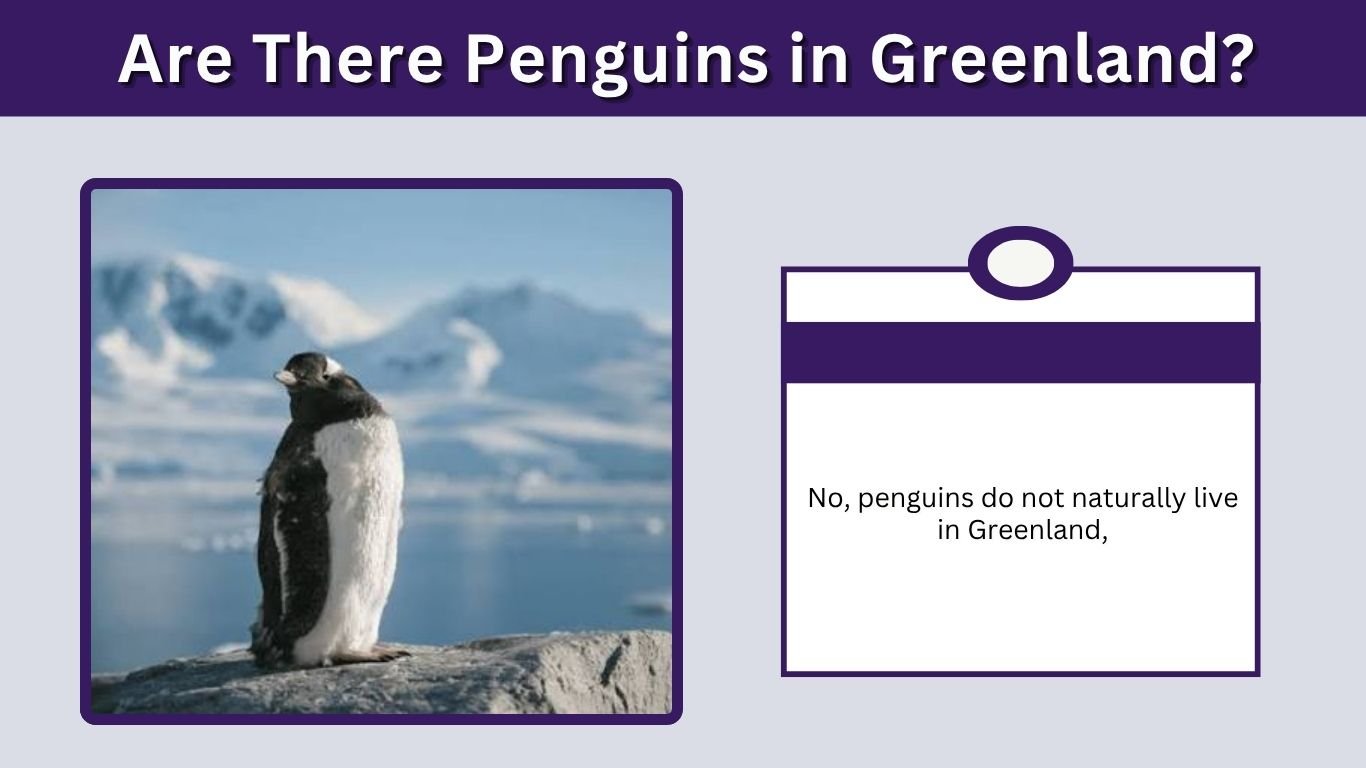
Are there penguins in Greenland? No, penguins do not naturally live in Greenland, even though the island has a cold Arctic climate, glaciers, and extensive ice-covered landscapes. Penguins are primarily native to the Southern Hemisphere, while Greenland belongs to the Northern Hemisphere. However, Greenland is home to several fascinating seabirds that resemble penguins, including Atlantic puffins and guillemots. Understanding why penguins are absent from Greenland reveals interesting differences between Arctic and Antarctic wildlife, including where these flightless birds evolved and how they survive.
Are There Any Penguins in Greenland?
There are no native wild penguins in Greenland. Although the island has freezing temperatures and snowy landscapes similar to Antarctica, its geographical location makes it unsuitable as a natural habitat for existing penguin populations.
Greenland is part of the Arctic region, near the North Pole. Penguins, however, evolved in the Southern Hemisphere and are mainly found around Antarctica, South America, southern Africa, Australia, and New Zealand.
The Galápagos penguin is a notable exception to the usual Southern Hemisphere distribution because its range extends slightly north of the equator.
Visitors exploring Greenland’s coastal areas may encounter black-and-white seabirds that resemble penguins. These birds belong to different families and have developed their own adaptations for Arctic environments.
Why Are There No Penguins in Greenland?
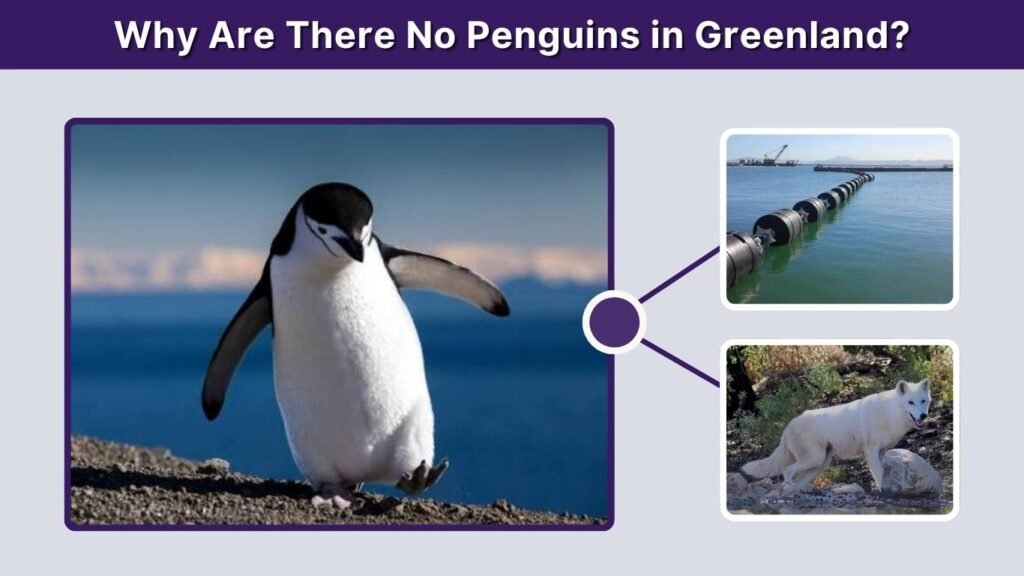
Penguins do not live in Greenland because of their evolutionary history, geographical separation, and natural distribution. Although some penguins are adapted to extremely cold conditions, suitable temperatures alone do not determine where a species can establish a population.
Several important factors explain their absence from the Arctic.
1. Penguins Evolved in the Southern Hemisphere
Penguins evolved approximately 60 million years ago in the Southern Hemisphere. Their ancestors developed specialized swimming abilities that eventually replaced the need for flight.
Over millions of years, penguins spread across southern oceans and established breeding colonies on suitable coastlines and islands.
Unlike flying seabirds, penguins cannot travel across continents or large distances through the air. Their movements depend entirely on swimming, making geographical barriers important in determining their distribution.
2. Warm Ocean Waters Create Barriers
Many penguins depend on productive marine environments where fish, squid, and other prey are abundant.
For cold-water penguin species, reaching the Arctic would require traveling across enormous stretches of ocean, including warm tropical waters.
These conditions create a significant geographical and ecological barrier. Even species living in warmer regions have established ranges and breeding habitats far from Greenland.
Consequently, there is no natural migration route that regularly brings penguins into Greenland’s waters.
3. Arctic Ecosystems Have Different Predators
Greenland’s Arctic ecosystem contains predators such as polar bears, Arctic foxes, and various seabirds that may threaten eggs or chicks.
Penguins breeding in Antarctica developed in environments without native terrestrial mammalian predators, although they face threats from predators in the ocean and from other birds.
Predation could create additional difficulties for penguins attempting to establish Arctic colonies. However, geographical separation and evolutionary history are the principal explanations for their absence.
Where Do Penguins Actually Live?
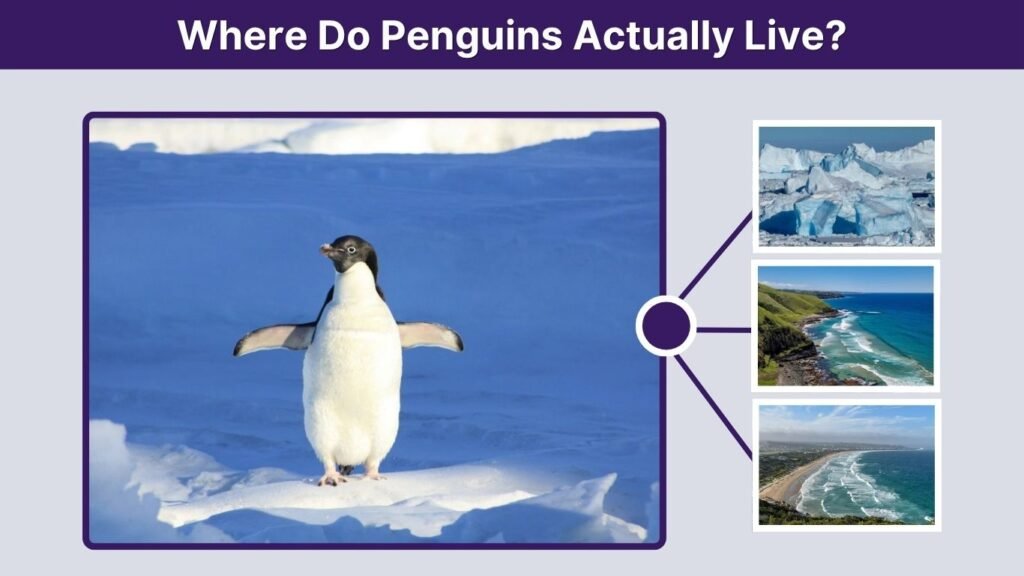
Penguins inhabit several regions of the Southern Hemisphere, ranging from Antarctica’s frozen coasts to islands near the equator. Their geographical distribution demonstrates that not every penguin requires snow or ice to survive.
Different species have adapted to distinct climates and marine environments.
Antarctica and Subantarctic Islands
Antarctica is the best-known penguin habitat. Emperor penguins and Adélie penguins are particularly associated with the Antarctic continent.
Other species, including chinstrap, gentoo, king, and macaroni penguins, inhabit Antarctic or subantarctic coastal regions and islands.
These birds depend on surrounding marine ecosystems for food, including krill, fish, and squid.
South America, Africa, and the Galápagos Islands
Several penguin species inhabit comparatively warm environments.
- African penguins: Found along the coast of southern Africa.
- Magellanic penguins: Native to southern South America.
- Humboldt penguins: Found along the Pacific coasts of Peru and Chile.
- Galápagos penguins: Live near the equator on Ecuador’s Galápagos Islands.
- Little penguins: Found around southern Australia and New Zealand.
These examples show that penguin distribution is influenced by food availability, ocean currents, breeding habitats, and evolutionary history rather than cold temperatures alone.
Are There Penguins in Greenland or Iceland?
Neither Greenland nor Iceland has naturally occurring wild penguin populations. Both places are situated in the Northern Hemisphere, far outside the normal geographical range of modern penguins.
Greenland belongs to the Arctic region and contains enormous ice sheets, glaciers, and Arctic marine ecosystems. Iceland lies farther southeast in the North Atlantic and has a comparatively milder coastal climate.
Despite their geographical differences, both support numerous seabird species, particularly Atlantic puffins.
Iceland is especially famous for its puffin colonies, while Greenland supports smaller breeding populations along parts of its coastline.
Because puffins have black-and-white feathers and an upright appearance when standing, visitors occasionally confuse them with penguins.
However, puffins are capable of flight, whereas penguins are completely flightless.
What Birds Look Like Penguins in Greenland?
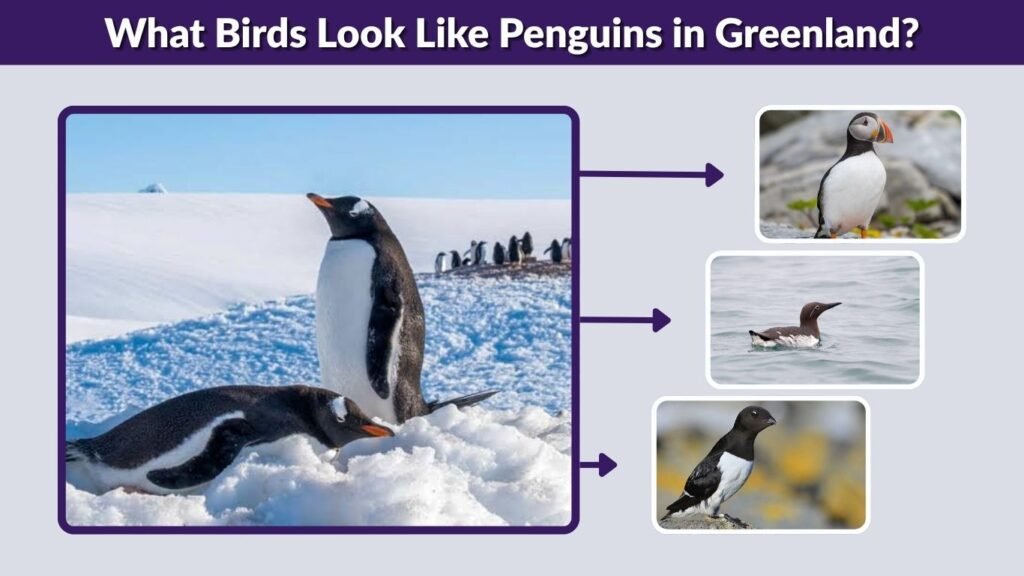
Greenland has several seabird species whose coloring, body shape, and diving behavior resemble those of penguins. These birds occupy important ecological roles in Arctic marine environments.
Three particularly interesting examples are Atlantic puffins, guillemots, and little auks.
Atlantic Puffins
Atlantic puffins (Fratercula arctica) are among the most recognizable seabirds in Greenland.
They have black backs, white undersides, colorful orange bills, and short wings. Their rounded bodies and upright posture can resemble those of small penguins.
Puffins breed on coastal islands and rocky cliffs, including locations near Nuuk and Disko Bay.
Unlike penguins, they can fly and use their wings for both aerial movement and underwater swimming.
Guillemots
Guillemots are diving seabirds found along Greenland’s rocky coastline. The thick-billed guillemot is particularly common in important Arctic seabird colonies.
Its dark upper body, pale underside, pointed bill, and upright posture give it a penguin-like appearance.
Guillemots use their wings to propel themselves underwater while hunting fish and other marine prey. Unlike penguins, they retain the ability to fly.
Little Auks
Little auks (Alle alle) are small Arctic seabirds that breed in enormous colonies in parts of Greenland.
They have compact bodies, black-and-white plumage, and short wings. They feed mainly on tiny marine crustaceans.
Although these birds resemble miniature penguins, they belong to the auk family rather than the penguin family.
Could Penguins Survive in Greenland?
Some cold-adapted penguin species might tolerate certain temperatures found in Greenland. However, surviving cold weather is not the same as establishing a healthy wild population.
Penguins require dependable food sources, suitable nesting locations, successful reproduction, and protection from environmental threats.
Greenland’s predators, seasonal sea-ice conditions, and unfamiliar breeding environments could present additional challenges.
More importantly, no modern penguin species naturally migrates to Greenland or maintains breeding colonies there.
Therefore, whether penguins could theoretically survive under carefully managed conditions is different from asking whether they actually live there in the wild.
Did Trump Say There Are Penguins in Greenland?
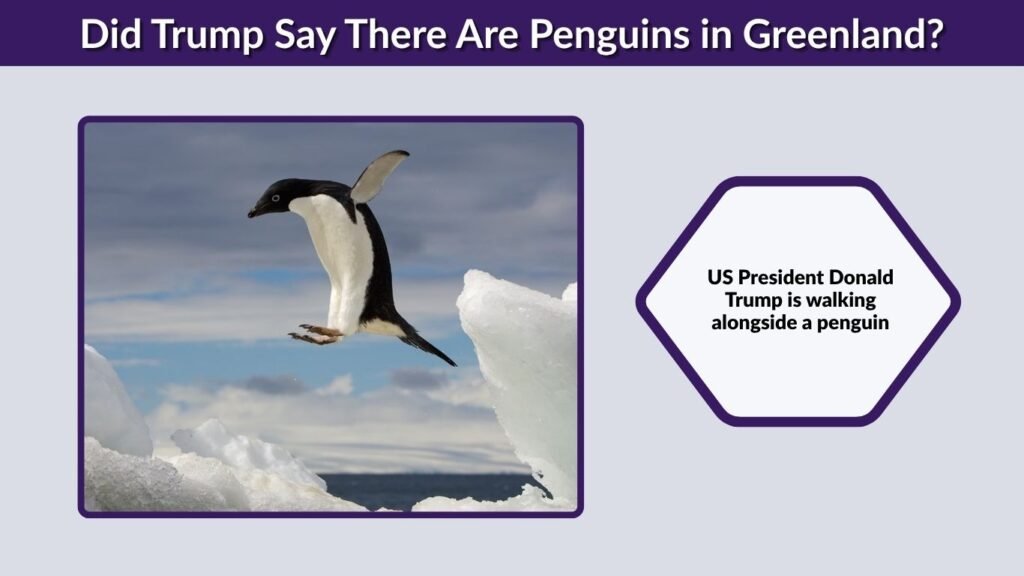
In January 2026, a viral image shared by the official White House X account showed US President Donald Trump walking alongside a penguin holding an American flag toward Greenland.
The AI-generated image was accompanied by the caption “Embrace the penguin.” It attracted attention because penguins do not naturally occur in Greenland.
However, the social media post should not be confused with a verified statement by Trump claiming that penguins inhabit the island. The image was a political meme rather than a genuine wildlife photograph.
The actual geographical fact remains unchanged: modern penguins are not native to Greenland.
Did Greenland Ever Have Penguins?
Greenland has no known natural population of modern penguins. However, the North Atlantic once supported a remarkable flightless seabird called the great auk (Pinguinus impennis).
The great auk had black-and-white feathers, a large body, and specialized wings used for underwater swimming.
It resembled modern penguins but belonged to the auk family and was not closely related to them.
Historically, the word penguin was also associated with the great auk. Unfortunately, intensive human hunting contributed to the species’ extinction in 1844.
Today, its closest living relatives include other members of the auk family, such as puffins and guillemots.
FAQs
1. Do Penguins Live in the Arctic?
No, wild penguins do not naturally inhabit the Arctic. Modern penguins are almost entirely restricted to the Southern Hemisphere, with the Galápagos penguin extending slightly north of the equator. Arctic wildlife includes puffins, guillemots, polar bears, and numerous other species.
2. Why Are There Penguins in Antarctica but Not Greenland?
Penguins evolved in the Southern Hemisphere and established populations in suitable southern marine environments. Greenland is geographically separated from these habitats. Warm tropical oceans, migration limitations, and differences in ecosystems help explain why penguins never established natural Arctic colonies.
3. What Is the Closest Bird to a Penguin in Greenland?
Thick-billed guillemots and Atlantic puffins are among Greenland’s most penguin-like birds. Both have black-and-white plumage and are excellent underwater swimmers. Unlike penguins, however, these seabirds can fly and belong to the auk family rather than the penguin family.
4. Do Polar Bears and Penguins Live Together?
No, polar bears and penguins do not naturally share the same habitat. Polar bears inhabit the Arctic, including Greenland and northern Canada, while penguins live primarily in the Southern Hemisphere. Their natural geographical ranges do not overlap.
5. Are There Penguins in Iceland?
No, Iceland has no native wild penguin populations. However, the country is famous for its Atlantic puffins, which nest along coastal cliffs and islands. Although puffins resemble small penguins, they are different seabirds with the ability to fly.