
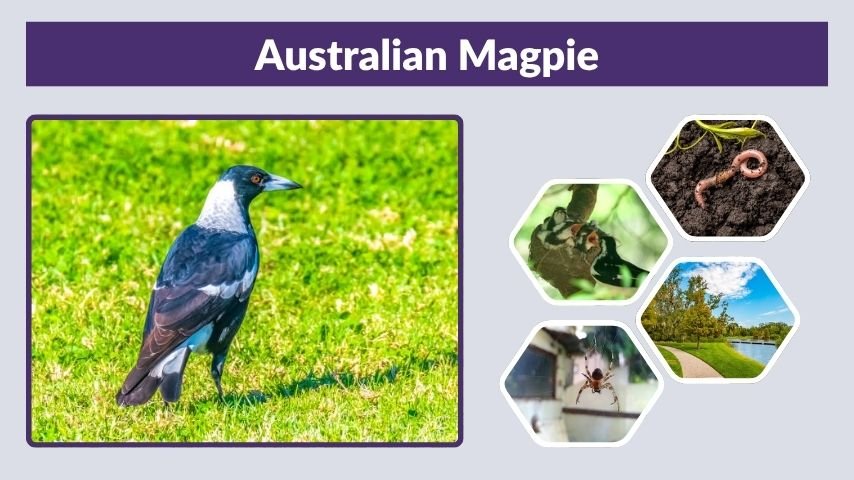
The Australian Magpie is one of Australia’s most recognizable birds, famous for its beautiful warbling song and bold territorial behavior. Found in suburbs, parks, farms, and forests, this intelligent bird has become both loved and feared by many Australians. During breeding season, magpies are known for swooping people who get too close to their nests. Despite their aggressive reputation, Australian magpies are highly social and surprisingly smart birds with complex communication skills and strong family bonds.
Their striking black-and-white feathers, loud calls, and confident personality make them easy to identify. Many people search for information about magpie attacks, sounds, intelligence, habitat, and feeding habits because these birds are common in everyday Australian life.
What Is the Australian Magpie?
The Australian magpie is a medium-sized songbird native to Australia and nearby regions. Although many people compare it to European magpies, it belongs to a different bird family. Australian magpies are admired for their intelligence, beautiful singing voices, and ability to adapt to both urban and rural environments.
Australian Magpie Scientific Classification
The scientific name of the Australian magpie is Gymnorhina tibicen. It belongs to the Artamidae family, which also includes butcherbirds and currawongs. Despite the similar name, Australian magpies are not true corvids like crows or ravens.
Many people wonder whether Australian magpies are related to crows because both birds are highly intelligent and black in color. However, they evolved separately and have different physical features, sounds, and behaviors.
Are Australian Magpies Native to Australia?
Australian magpies are native birds found throughout most parts of mainland Australia and Tasmania. They have adapted extremely well to human development and are now common in cities, suburbs, parks, farms, and open woodland areas.
These birds prefer places with:
- Open grassy ground
- Tall trees for nesting
- Access to insects and worms
- Nearby water sources
- Quiet breeding territories
Australian Magpie vs European Magpie
| Feature | Australian Magpie | European Magpie |
| Scientific Family | Artamidae | Corvidae |
| Main Colors | Black and white | Black, white, and green-blue shine |
| Tail Length | Shorter tail | Very long tail |
| Song | Musical warbling | Harsh chattering |
| Native Region | Australia | Europe and Asia |
Australian Magpie vs Crow
Australian magpies and crows are often confused because both birds are intelligent and dark-colored. However, magpies usually have white patches on their body and produce more musical sounds. Crows are fully black and make rough “caw” calls instead of melodic songs.
Australian Magpie Identification
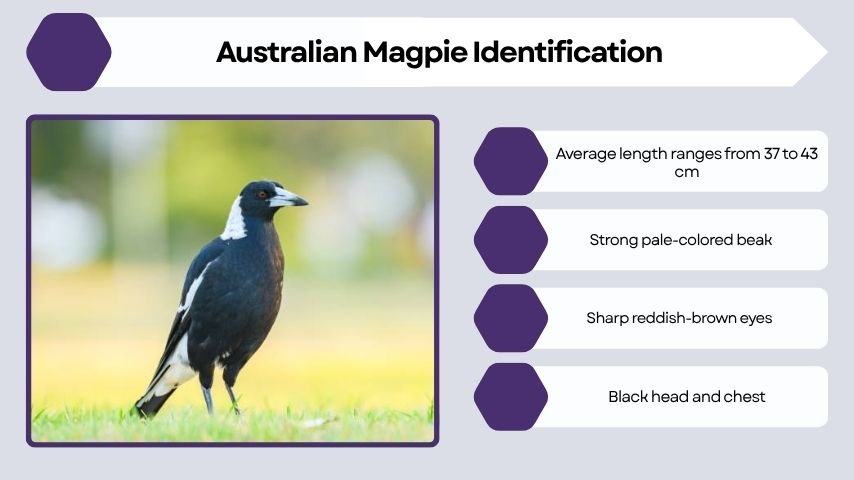
Australian magpies are easy to recognize because of their bold black-and-white feathers and confident posture. Their appearance can vary slightly depending on the region, but they generally share the same body shape and behavior.
Australian Magpie Size and Appearance
- Average length ranges from 37 to 43 cm
- Strong pale-colored beak
- Sharp reddish-brown eyes
- Black head and chest
- White markings on the back and wings
- Strong legs designed for walking on the ground
Male magpies usually have brighter white feathers on the back, while females often display grayish patterns.
Juvenile Australian Magpie Identification
Young magpies look softer and duller compared to adults. Their feathers are often gray-brown instead of deep black. Juvenile birds also make louder begging calls while learning to forage independently.
Young magpies can often be seen following adult birds around parks and gardens during their first months of life.
Australian Birds That Look Like Magpies
Several Australian birds are commonly mistaken for magpies:
- Magpie-lark
- Pied Currawong
- Grey Butcherbird
The magpie-lark is much smaller, while pied currawongs have yellow eyes and different calls.
Australian Magpie Habitat and Range
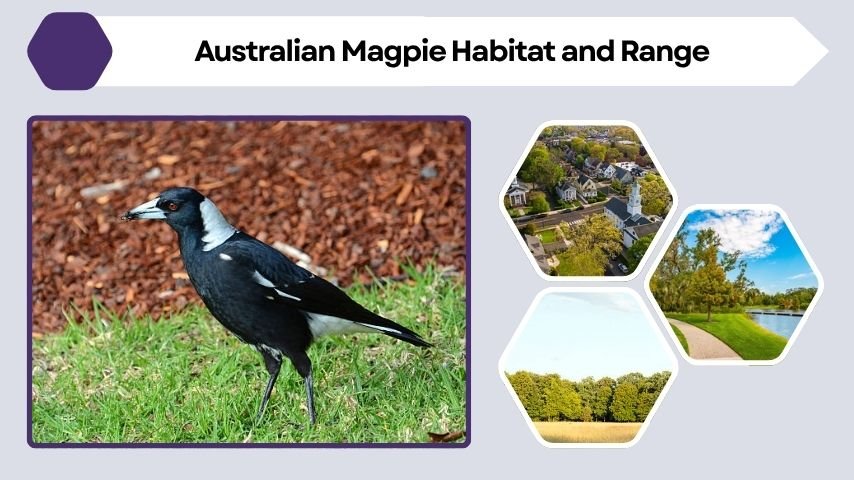
Australian magpies are highly adaptable birds that thrive across many types of environments. Their ability to live close to humans has helped their population remain stable throughout Australia.
Where Do Australian Magpies Live?
Australian magpies commonly live in:
- Urban suburbs
- Public parks
- Golf courses
- Farms and pasturelands
- Woodland edges
- Coastal regions
They usually avoid very dense forests because they prefer open ground where they can easily search for food.
Magpies in Australia by Region
Magpies are found in nearly every Australian state and territory. They are especially common in eastern and southern Australia, where grassy open spaces provide ideal feeding conditions.
Some regional populations have slight differences in feather patterns and body size. Scientists recognize several subspecies across the country.
Australian Magpie Nesting Areas
During breeding season, magpies build nests high in trees using sticks, grass, and soft materials. The female usually builds the nest while the male protects the surrounding territory.
Nests are commonly placed:
- High above the ground
- Near open feeding areas
- Inside tall eucalyptus trees
- Away from busy predators
Australian Magpie Sounds and Communication
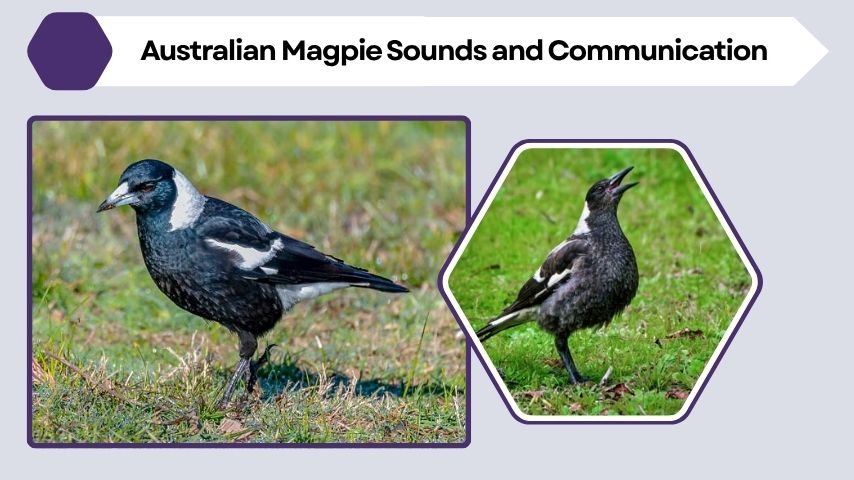
Australian magpies are famous for their complex vocal abilities. Their musical calls are considered some of the most beautiful bird sounds in Australia.
Australian Magpie Song
Magpies produce rich warbling songs that can include whistles, clicks, and flute-like sounds. Birds often sing during sunrise and sunset to communicate with nearby groups and defend territory.
Their songs can sound peaceful and almost human-like, which is one reason many Australians enjoy hearing them each morning.
Australian Magpie Sounds and Calls
Australian magpies use different sounds for different situations:
- Warbling territorial songs
- Alarm calls
- Juvenile begging calls
- Aggressive warning sounds
- Group communication calls
Some magpies can even imitate noises they hear regularly in urban environments.
Australian Magpie Intelligence and Behavior
Australian magpies are widely considered some of the smartest birds in the world. They can recognize human faces, remember locations, and communicate with members of their group using different vocal signals. Their intelligence helps them survive in busy urban areas and protect their territory effectively.
Are Australian Magpies Intelligent?
Research has shown that Australian magpies possess advanced problem-solving abilities and excellent memory. They can remember people who have threatened them in the past and may react differently to familiar faces.
These birds are known for:
- Facial recognition skills
- Long-term memory
- Complex social behavior
- Cooperative group living
- Learning from experience
Many experts compare their intelligence to crows and ravens because of their ability to adapt and solve problems.
Australian Magpie Social Behavior
Australian magpies usually live in groups made up of family members. These groups defend territories together and help raise young chicks during breeding season.
Unlike many birds, magpies spend a lot of time walking on the ground instead of hopping through trees. They often work together while searching for food and warning others about danger.
Magpies also communicate using body language, calls, and posture changes. Their strong social structure is one reason they are successful across Australia.
Can Australian Magpies Talk?
Some Australian magpies can imitate sounds and simple human noises. Birds raised close to people sometimes learn whistles, short tunes, or repeated household sounds. However, they are not true talking birds like parrots.
Their natural singing ability is far more impressive than mimicry. The warbling song of the Australian magpie is considered one of the most beautiful bird calls in the country.
Australian Magpie Diet and Feeding Habits
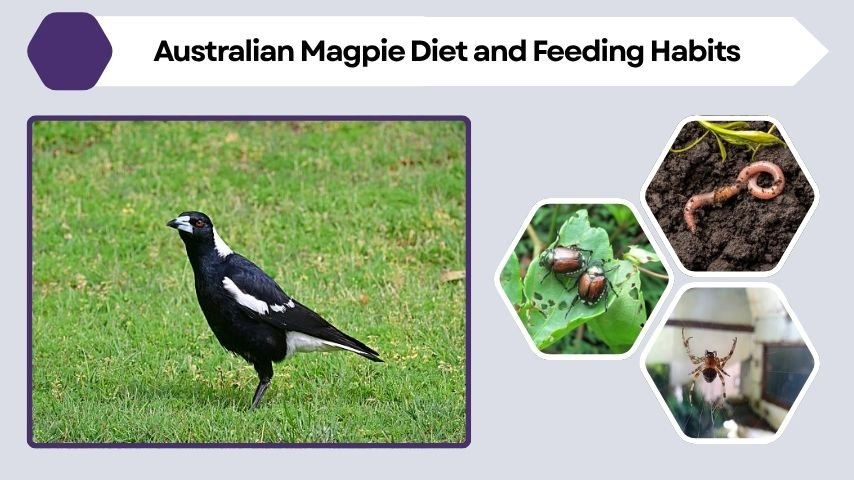
Australian magpies are omnivorous birds with a varied diet. They mostly search for food on the ground and use their sharp beaks to dig through soil and grass.
What Do Australian Magpies Eat?
- Earthworms
- Beetles
- Insects
- Spiders
- Small reptiles
- Seeds
- Fruit
- Grain
Most of their diet comes from insects and other small invertebrates found in grassy areas.
What to Feed Australian Magpies
Many people feed magpies in parks and gardens, but some foods can be harmful to their health. Experts recommend avoiding processed human foods because they may cause nutritional problems.
Safe foods include:
- Small insects
- Special bird food mixtures
- Lean raw meat in moderation
- Fresh water
Foods to avoid include:
- Bread
- Salty foods
- Processed meat
- Sugary snacks
Feeding magpies too often can make them dependent on humans instead of natural food sources.
How Australian Magpies Hunt for Food
Australian magpies spend much of the day walking across lawns and open ground while searching for insects. Their strong eyesight helps them detect movement beneath the soil surface.
When hunting, magpies often:
- Tilt their heads to listen for movement
- Pull worms from soft ground
- Catch insects quickly
- Search after rainfall when worms appear
Their feeding behavior makes them useful for controlling garden pests naturally.
Australian Magpie Breeding and Life Cycle
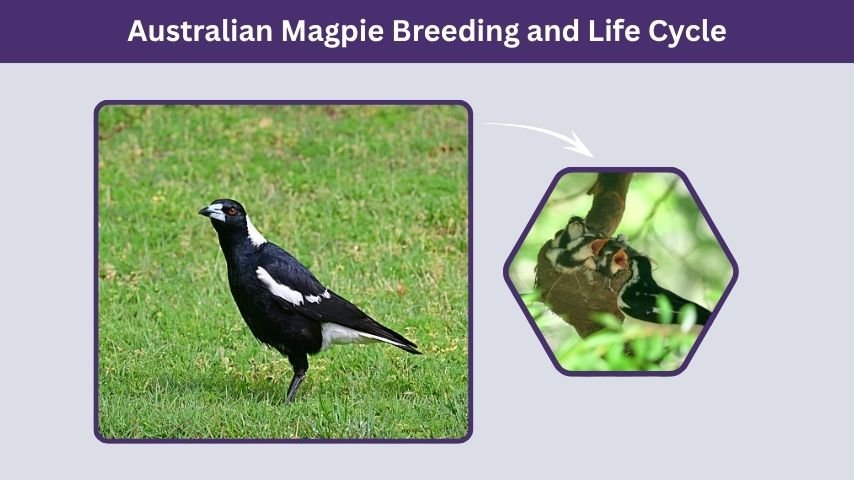
Breeding season is one of the most important periods in a magpie’s life. During this time, birds become highly protective of their nests and young chicks.
Australian Magpie Breeding Season
Breeding season usually occurs between August and October in most parts of Australia. During this period, male magpies become much more territorial and may swoop people who approach nesting areas.
Breeding activities include:
- Territory defense
- Courtship singing
- Nest building
- Feeding chicks
- Protecting young birds
Not every magpie swoops humans, but protective males can become aggressive near nests.
Australian Magpie Eggs and Chicks
Female magpies lay several eggs inside a carefully built nest lined with soft grass and plant material.
Important nesting facts:
- Eggs are usually pale blue or green
- Typical clutch size is 2 to 5 eggs
- Incubation lasts about 3 weeks
- Chicks remain in the nest for several weeks
- Both parents help feed the young
Young magpies continue learning survival skills long after leaving the nest.
Australian Magpie Lifespan
Australian magpies can live surprisingly long lives. In the wild, many survive for more than 20 years if they avoid predators and accidents.
Their lifespan depends on:
- Food availability
- Habitat quality
- Predator pressure
- Human activity
- Disease exposure
Urban magpies often face dangers from cars, pets, and habitat loss.
Australian Magpie Swooping Season
Swooping season is one of the main reasons Australian magpies are famous around the world. During breeding season, some birds aggressively defend their nests against perceived threats.
Why Do Australian Magpies Attack People?
Australian magpies swoop to protect their eggs and chicks. They see humans, cyclists, and pets as possible dangers near the nesting area.
Most swooping behavior is defensive rather than truly aggressive. Birds usually stop attacking once people move away from the nest.
Australian Magpie Swooping Season
Swooping activity is most common:
- During spring
- Between August and October
- Near nesting territories
- Around parks and bike paths
- In suburban neighborhoods
Cyclists are common targets because fast movement can trigger defensive reactions from territorial birds.
Are Australian Magpies Dangerous?
Most magpie swoops do not cause serious injuries, but some attacks can lead to scratches or eye injuries if a bird makes contact.
People should remain calm and avoid provoking nesting birds. Wearing sunglasses and hats may provide extra protection during swooping season.
How to Avoid Magpie Attacks
- Walk calmly through nesting areas
- Avoid known swooping zones
- Wear sunglasses or hats
- Do not wave arms aggressively
- Use alternate walking routes when possible
Many councils in Australia place warning signs near active nesting areas during spring.
FAQs
Are Australian magpies aggressive all year?
No. Australian magpies are usually calm birds for most of the year. They become more defensive during the breeding season when protecting nests and chicks. Swooping behavior mainly happens during spring and only a small number of birds regularly attack people.
Do Australian magpies migrate?
Australian magpies are generally non-migratory birds. Most stay within the same territory throughout the year. Family groups defend their territory and continue living in the same area unless food shortages or habitat changes force them to move.
Can Australian magpies be kept as pets?
In most parts of Australia, keeping native magpies as pets without proper permits is illegal. Magpies are protected wildlife and are best left in their natural environment where they can behave normally and live in family groups.
What predators hunt Australian magpies?
Australian magpies face threats from birds of prey, snakes, foxes, and domestic cats. Eggs and chicks are especially vulnerable to predators. Urban dangers such as vehicles and habitat destruction also affect magpie survival rates.
Why are Australian magpie songs so unique?
Australian magpies produce complex warbling songs made from whistles, clicks, and flute-like sounds. Their vocal abilities help them communicate with family members, defend territory, and attract mates. Each bird may develop slightly different song patterns over time.
