
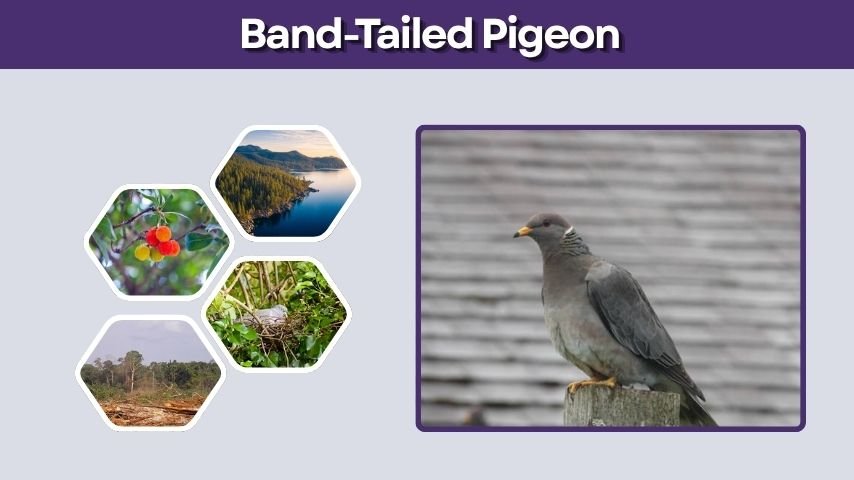
The band-tailed pigeon is a large, wild pigeon of western North America, often mistaken for a rock pigeon or dove at first glance. Unlike common city pigeons, it lives mostly in forests, mountain edges, oak woodlands, and coastal habitats. Birdwatchers search for it by its pale neck marking, yellow bill, gray body, and broad dark tail band.
What Is a Band-Tailed Pigeon?
The band-tailed pigeon is a native wild pigeon known for its strong flight, social behavior, and preference for wooded habitats. It is larger than a mourning dove and more closely resembles a rock pigeon in body shape, but it has a more natural forest-dwelling lifestyle.
This bird is often searched under several names, including band-tailed pigeon, band tailed pigeon, band tail pigeon, and even the misspelled phrase banded tail pigeon. All usually refer to the same species.
Basic Identification
A band-tailed pigeon has a soft gray body, a darker tail with a noticeable band near the end, and a pale mark on the back of the neck. Adults often show a yellow bill tipped with black and yellow legs or feet. In good light, the neck can show a subtle green or purple sheen.
Key field marks include:
- Large pigeon-like body
- Gray head, breast, and back
- Pale crescent or collar on the neck
- Dark band across the tail
- Yellow bill with dark tip
- Fast, direct flight in flocks
Scientific Name and Family
The band-tailed pigeon belongs to the pigeon and dove family, Columbidae. It is related to other pigeons and doves, but its habits are more woodland-based than urban. In many areas, it is considered a true wild pigeon rather than a city bird.
Band-Tailed Pigeon Size and Appearance
Band-tailed pigeons are medium-to-large pigeons with a sturdy build. They look heavier and broader than mourning doves and can appear similar in size to rock pigeons. Their smooth gray plumage helps them blend into tree canopies, especially in oak, pine, and mixed forest habitats.
| Feature | Band-Tailed Pigeon |
| Body type | Large, stocky wild pigeon |
| Main color | Gray to bluish gray |
| Tail | Dark band near the end |
| Bill | Yellow with a dark tip |
| Neck | Pale collar with subtle iridescence |
| Common habitat | Forests, oak woodlands, mountains, coastal regions |
| Similar birds | Rock pigeon, mourning dove, Eurasian collared-dove |
Male Band-Tailed Pigeon
A male band-tailed pigeon usually looks very similar to the female. Males may appear slightly brighter around the neck and head, especially during breeding season, but the difference is subtle. In the field, it is often difficult to identify sex by appearance alone.
Female Band-Tailed Pigeon
Female band-tailed pigeons are generally similar in color and pattern to males. They may look a little duller, but this is not always reliable. Behavior during courtship, nesting, and pairing can be a better clue than plumage.
Juvenile Band-Tailed Pigeon
A juvenile band-tailed pigeon can look plainer than an adult. Young birds may lack the full pale neck collar and can have a duller bill and softer markings. This sometimes causes confusion with young rock pigeons or other gray doves.
Band-Tailed Pigeon Range and Habitat
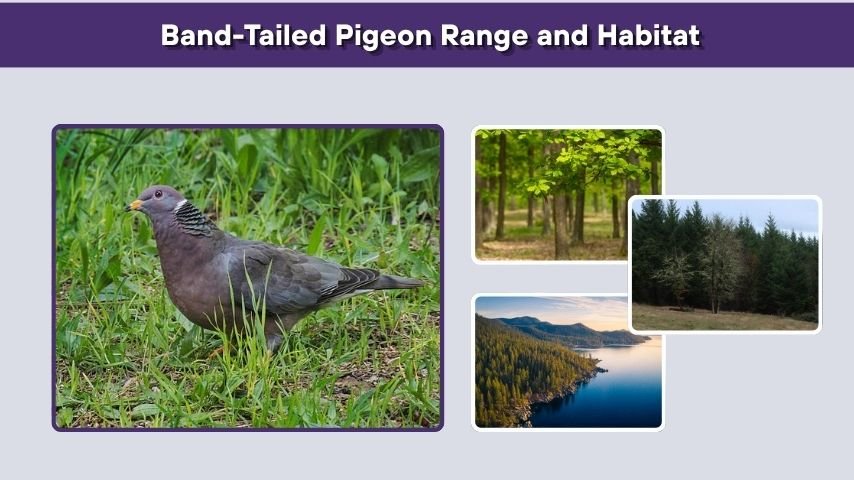
The band-tailed pigeon is most strongly associated with western North America. It can be found along the Pacific Coast, in mountain forests, and in parts of the Southwest. Searches for band tailed pigeon California, band tailed pigeon Oregon, band tailed pigeon Washington State, band tailed pigeon Arizona, and band tailed pigeon Colorado reflect its regional interest.
Pacific Coast Band-Tailed Pigeon
The Pacific Coast population is especially well known. These birds use coastal forests, oak woodlands, coniferous forests, and mountain slopes. They may move seasonally depending on food supply, weather, and elevation.
Common places to look include:
- California oak woodlands
- Oregon forest edges
- Washington mixed forests
- Coastal mountain ranges
- Areas with berry-producing trees and shrubs
- Mineral springs or natural salt sources
Band-Tailed Pigeon in California
California is one of the most searched locations for this bird. Band-tailed pigeons may occur in wooded foothills, coastal ranges, and mountain habitats. They are often linked with oak trees because acorns can be an important seasonal food.
People searching for California band tailed pigeon may be interested in birdwatching, identification, hunting rules, or seasonal movement. For any hunting-related question, always check the current California wildlife regulations before acting, because seasons and limits can change.
Band-Tailed Pigeon in Oregon and Washington
In Oregon and Washington, band-tailed pigeons are often associated with forests, wooded valleys, and coastal habitats. They may gather in flocks where food is abundant. Searches for Oregon band tailed pigeon season and band tailed pigeon Washington State usually relate to either wildlife viewing or hunting information.
What Do Band-Tailed Pigeons Eat?
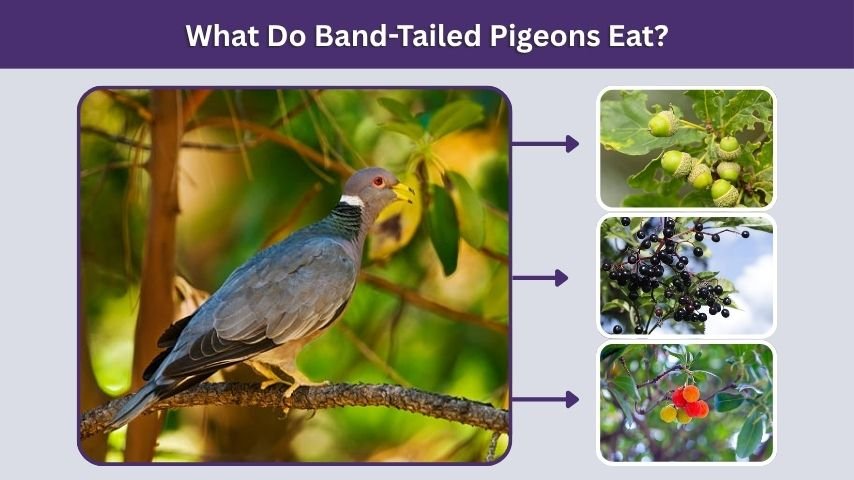
Band-tailed pigeons eat a wide variety of wild plant foods. Their diet changes by season and location. They are especially known for feeding on acorns, berries, seeds, buds, and fruits.
Common Foods
Their natural diet may include:
- Acorns
- Elderberries
- Madrone berries
- Wild cherries
- Seeds and grains
- Tree buds
- Young leaves
- Mineral-rich water or soil
Band-tailed pigeons may also visit feeders in some regions, although they are not as closely tied to human areas as city pigeons. When they appear in backyards, they often prefer large trees nearby and open feeding areas.
Why Mineral Sites Matter
Band-tailed pigeons sometimes gather at mineral springs or salty water sources. These sites may help them obtain minerals that are useful for digestion and reproduction. Flocks at mineral sites can be impressive, but disturbance should be avoided.
Band-Tailed Pigeon Call and Sound
The band-tailed pigeon has a soft, low, owl-like call that can surprise people who are expecting a typical pigeon sound. Searches like band tailed pigeon call, band tailed pigeon sound, band tailed pigeon audio, and what does a band tailed pigeon sound like show that many people identify this bird by voice.
What the Call Sounds Like
The call is often described as a deep, gentle cooing. It may sound like a repeated “whoo” or soft hooting note. Because the bird often calls from trees, people may hear it before they see it.
When They Call
Band-tailed pigeons are most vocal during the breeding season and around areas where they gather. Calls may be heard from forest edges, tall trees, and wooded slopes. Their voice is usually quieter and less familiar than the calls of mourning doves or city pigeons.
Band-Tailed Pigeon Nest and Breeding
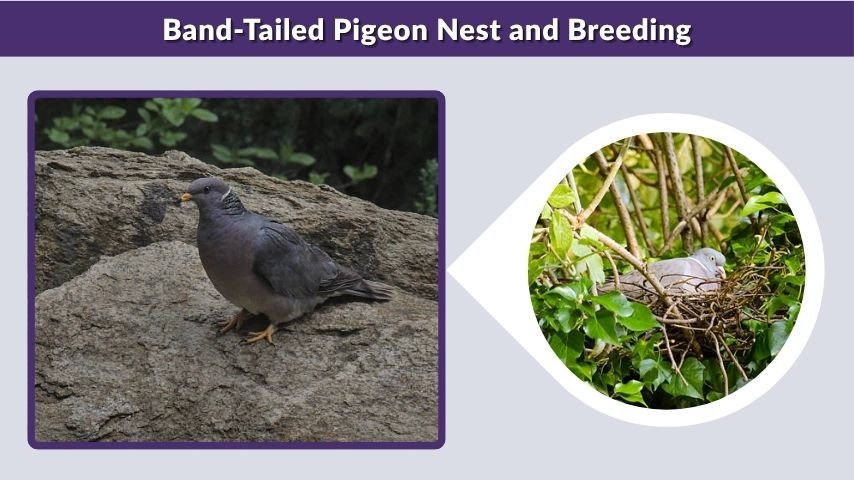
Band-tailed pigeons build simple nests, usually in trees or shrubs. Like many pigeons and doves, the nest may look loose and lightweight. The female usually lays a small clutch, often one egg, and both parents may help care for the young.
Nesting Habitat
They often choose wooded areas with enough cover and nearby food. Nest sites may be found in conifers, oaks, or other trees depending on the region. Because nests can be difficult to see from the ground, many birdwatchers detect breeding birds by calls and repeated adult movement.
Baby Band-Tailed Pigeon
A baby band-tailed pigeon is fed by its parents with crop milk, a nutrient-rich secretion produced by adult pigeons and doves. Young birds grow quickly and leave the nest when they are developed enough to perch and fly short distances.
Band-Tailed Pigeon vs Mourning Dove
The band-tailed pigeon and mourning dove can overlap in some areas, but they are easy to separate with practice. The band-tailed pigeon is larger, heavier, and more forest-oriented. The mourning dove is slimmer, browner, and often seen on wires, open fields, yards, and roadsides.
Main Differences
Band-tailed pigeon:
- Larger and stockier
- Gray body
- Dark band on tail
- Pale neck marking
- Strong, direct flight
- Often in forests or mountains
Mourning dove:
- Smaller and slimmer
- Warm brown or tan color
- Long pointed tail
- Black spots on wings
- Whistling wing sound in flight
- Common in open and suburban areas
Band-Tailed Pigeon vs Rock Pigeon
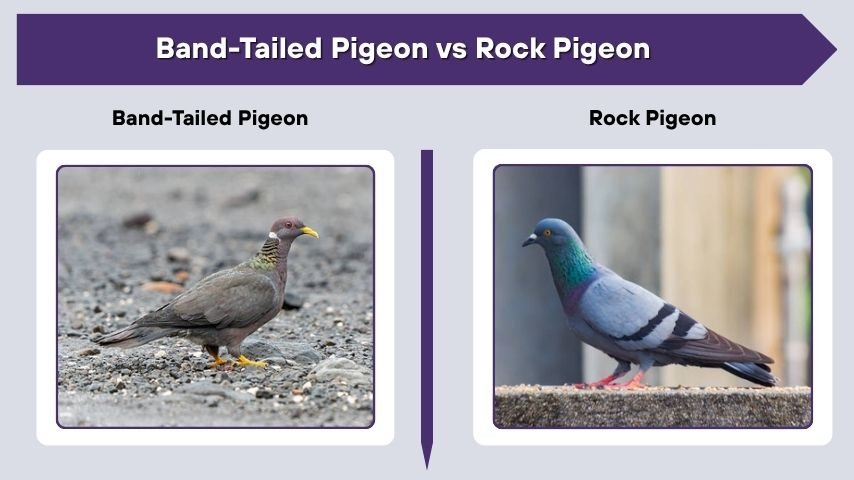
The rock pigeon is the familiar city pigeon seen around buildings, bridges, and sidewalks. A band-tailed pigeon is wilder, more uniform gray, and more likely to be found in forests or wooded hills.
Rock pigeons vary widely in color, while band-tailed pigeons have a more consistent natural appearance. The pale neck crescent, yellow bill, and dark tail band are helpful clues for identifying a band-tailed pigeon.
Band-Tailed Pigeon vs Eurasian Collared-Dove
The Eurasian collared-dove is a pale, sandy-gray dove with a thin black collar on the back of its neck. It is usually slimmer and paler than a band-tailed pigeon. It also tends to live closer to towns, farms, and neighborhoods.
A band-tailed pigeon is darker, larger, and more likely to be found in forested or mountainous areas. Its neck marking is pale rather than a narrow black collar.
Are Band-Tailed Pigeons Endangered?
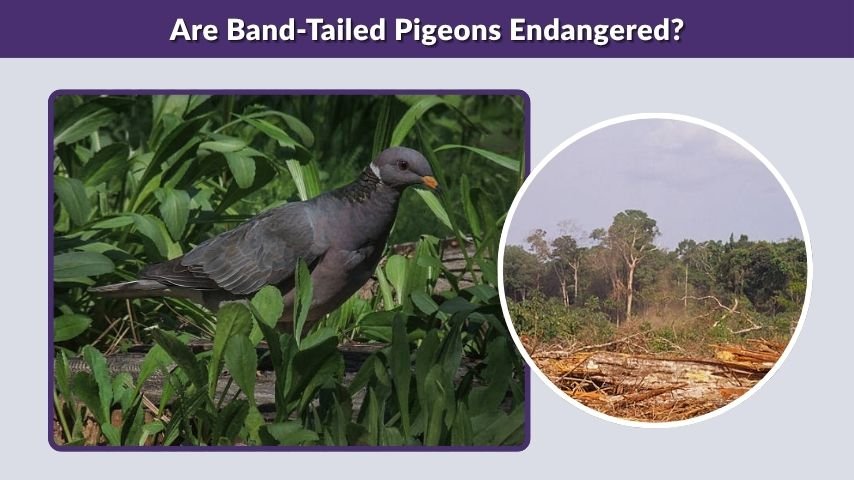
Band-tailed pigeons are not usually described as globally extinct or gone from their range, but local populations can be affected by habitat loss, hunting pressure, disease, food availability, and changes in forest structure. Their status can vary by region and should be checked through current wildlife agencies or conservation sources.
People searching are band tailed pigeons endangered may be concerned after seeing fewer birds than expected. In some areas, band-tailed pigeons can be uncommon, seasonal, or irregular, which makes them seem rarer than they are.
Conservation Concerns
Important concerns include:
- Loss of oak woodland and forest habitat
- Reduced food sources
- Disease outbreaks
- Disturbance at mineral sites
- Poor nesting success in some areas
- Regional hunting pressure
Birdwatchers can help by reporting sightings to citizen science platforms, protecting native trees and shrubs, and avoiding disturbance around nesting or mineral-gathering areas.
Band-Tailed Pigeon Hunting and Seasons
Searches for band tailed pigeon hunting, band tailed pigeon season California, band tailed pigeon season Oregon, hunting band tailed pigeon, and CA band tailed pigeon season show that hunting is a major subtopic. However, hunting rules are highly location-specific.
Before hunting, always check the current state wildlife agency rules for:
- Open season dates
- Daily bag limits
- Possession limits
- License requirements
- Approved hunting zones
- Non-toxic shot rules where applicable
- Species identification requirements
Never rely on old articles, forum posts, or copied season dates. Regulations can change from year to year.
Band-Tailed Pigeon in RDR2
A separate keyword cluster involves band tailed pigeon RDR2, RDR2 band tailed pigeon location, and Red Dead Redemption 2 band tailed pigeon location. These searches refer to the video game Red Dead Redemption 2, not the real-world bird.
In RDR2, players look for the band-tailed pigeon as part of animal collection, hunting, or completion tasks. Game locations may not match real-world range perfectly, so it is best to treat RDR2 content separately from natural history information.
Band-Tailed Pigeon Pictures and Feathers
People often search for band tailed pigeon pictures, band tailed pigeon in flight, and band tailed pigeon feathers because visual ID can be tricky. Photos are useful for comparing the bird with rock pigeons, mourning doves, and collared-doves.
In flight, look for the broad wings, strong direct movement, and dark tail band. Perched birds often show the pale neck mark and yellow bill more clearly.
Feather Identification Caution
Finding feathers can be interesting, but collecting wild bird feathers may be restricted by law in many places. Rules vary, and some native bird feathers are protected. It is safer to photograph feathers where found rather than collect them.
Can You Buy a Band-Tailed Pigeon?
Searches such as band tailed pigeon for sale, band-tailed pigeon for sale, and band tail pigeons for sale appear in the keyword list, but this is a sensitive topic. Band-tailed pigeons are native wild birds, and buying, selling, capturing, or keeping them may be illegal without proper authorization.
Anyone interested in pigeons as pets should look for legal domestic pigeon breeds instead. Domestic pigeons are bred for companionship, racing, showing, or homing, and they are different from wild band-tailed pigeons.
FAQs
Is it a band-tailed pigeon or band tailed pigeon?
The standard common name is usually written as band-tailed pigeon with a hyphen. However, many people search for band tailed pigeon, band tail pigeon, or banded tail pigeon. These terms usually refer to the same wild pigeon.
What do band-tailed pigeons eat?
Band-tailed pigeons eat mostly plant foods, including acorns, berries, seeds, fruits, buds, and young leaves. Their diet changes by season. In some areas, they also visit mineral springs or salty water sources.
How big is a band-tailed pigeon?
A band-tailed pigeon is a large, stocky pigeon, noticeably bigger than a mourning dove and often similar in general size to a rock pigeon. Its broad body, gray color, and dark tail band help separate it from smaller doves.
What does a band-tailed pigeon sound like?
The band-tailed pigeon call is a soft, low cooing or hooting sound. It can seem owl-like to some listeners. The bird often calls from trees, so people may hear it before they see it.
Where do band-tailed pigeons live?
Band-tailed pigeons live mainly in western North America, especially forests, oak woodlands, coastal ranges, and mountain habitats. They are often searched in connection with California, Oregon, Washington, Arizona, Colorado, and the Pacific Coast.
