
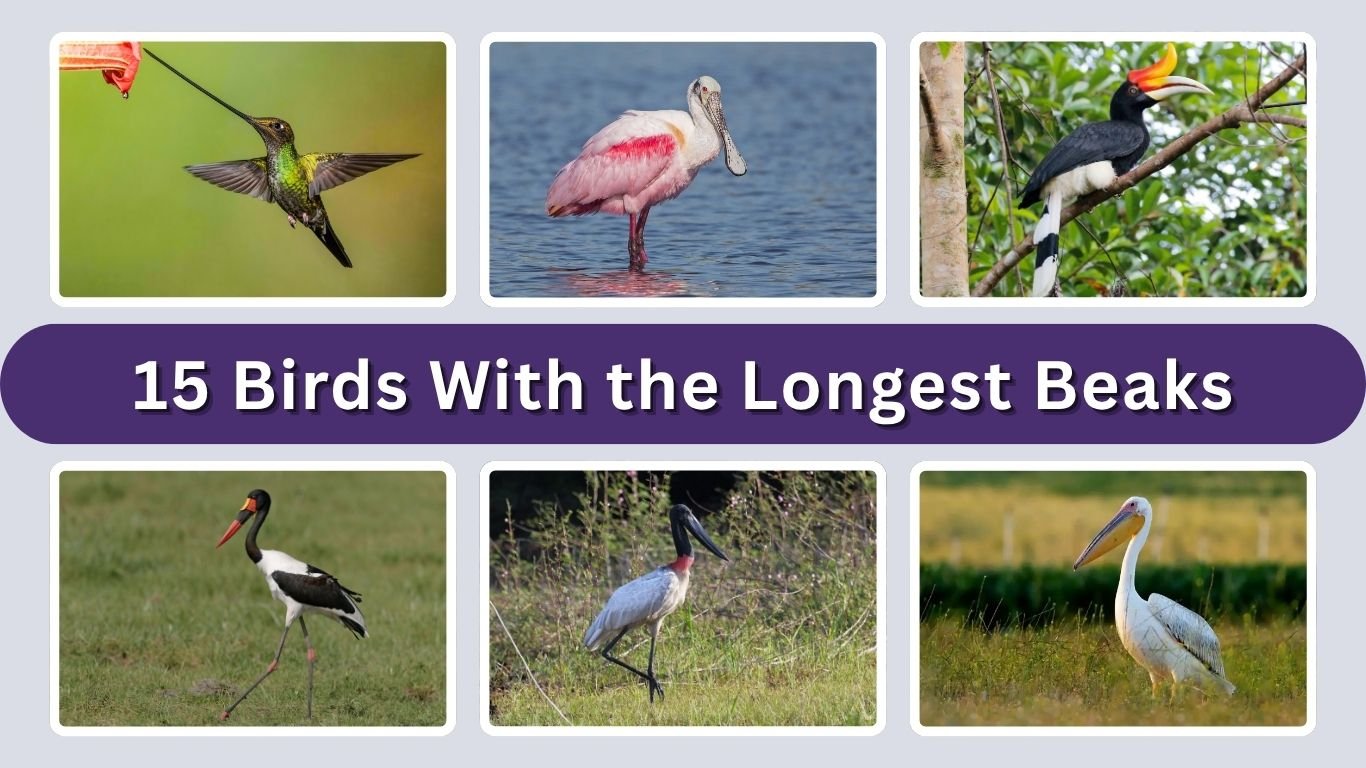
Birds have evolved beaks in remarkable shapes and sizes, but some species stand out for having exceptionally long bills. The bird with the longest beak in absolute length is the Australian pelican, while the sword-billed hummingbird is famous for having the longest beak relative to body size. From pelicans and storks to hornbills, curlews, and hummingbirds, these birds use their long beaks for fishing, probing mud, reaching fruit, and drinking nectar. Here are 15 fascinating birds with some of the longest beaks in the world.
1. Australian Pelican
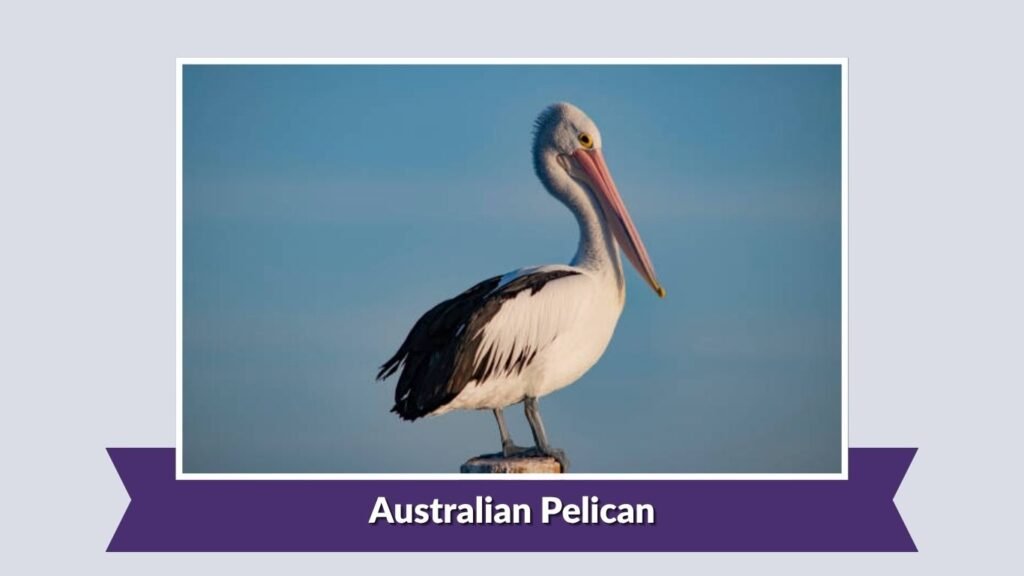
The Australian pelican (Pelecanus conspicillatus) is often recognized as the bird with the longest beak among living birds. Its enormous bill can grow to nearly half a meter long, making it one of the most impressive feeding tools in the bird world. Native mainly to Australia and nearby regions, this large waterbird is also known for its striking black-and-white plumage, broad wings, and expandable throat pouch.
Identification
- Scientific name: Pelecanus conspicillatus
- Body length: About 1.6–1.9 meters
- Wingspan: Around 2.3–2.5 meters
- Beak length: Up to about 47–50 cm
- Color: Mostly white with black wing feathers
- Bill: Long, pale pink, with a large throat pouch
- Habitat: Lakes, rivers, wetlands, estuaries, and coastal waters
- Diet: Mainly fish and other aquatic animals
Why Is It the Bird With the Longest Beak?
The Australian pelican is famous for having an exceptionally long bill. In absolute length, its beak is among the longest found in any living bird and may approach 50 centimeters in large individuals.
This huge bill is especially noticeable because it extends far beyond the bird’s head and supports a flexible pouch underneath. While the sword-billed hummingbird has the longest beak relative to body size, the Australian pelican is generally highlighted when discussing the bird with the longest beak in the world by actual measurement.
How Does Its Long Beak Help It Feed?
The Australian pelican mainly uses its long beak to catch fish. It lowers its bill into the water and opens the throat pouch, creating a large scoop. Fish and water enter the pouch, after which the bird drains the excess water and swallows its prey.
The long bill is particularly useful in shallow water, where pelicans can reach beneath the surface efficiently. Groups may also cooperate to herd fish into concentrated areas before feeding.
Habitat and Behavior
Australian pelicans live in freshwater and coastal environments, including rivers, lakes, wetlands, reservoirs, estuaries, and lagoons. They can travel long distances when water and food conditions change.
Despite their large size, they are excellent fliers. They often soar on rising warm air to conserve energy. Their massive bill, large wingspan, and distinctive appearance make them one of the most recognizable long-beaked birds in the world.
2. Dalmatian Pelican
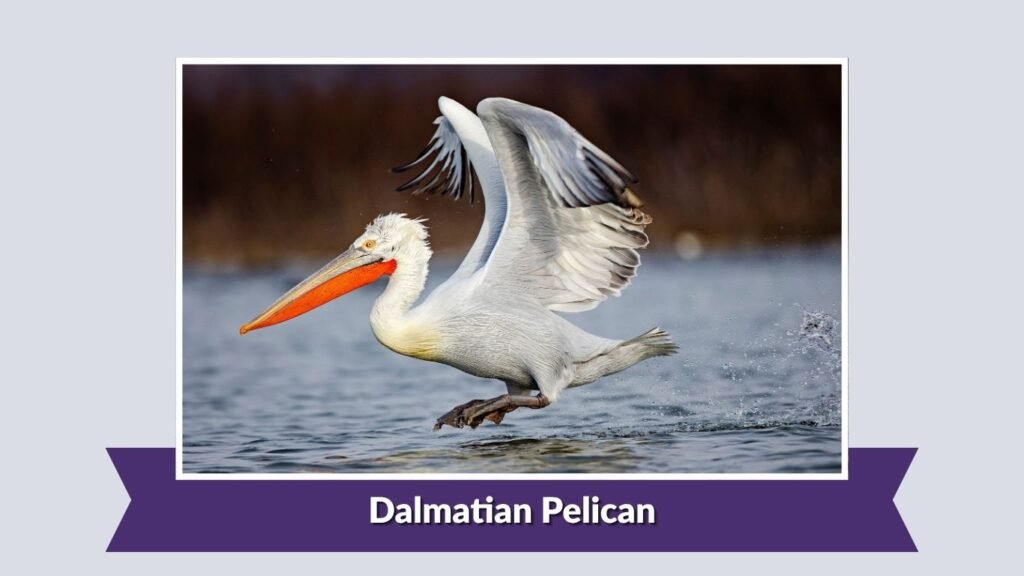
The Dalmatian pelican (Pelecanus crispus) is another enormous waterbird known for its exceptionally long and powerful beak. It is one of the world’s largest pelican species and has a massive body, broad wings, and a long bill with an expandable throat pouch. Although the Australian pelican is usually recognized as the bird with the longest beak, the Dalmatian pelican is also among the most impressive long-beaked birds in the world.
Identification
- Scientific name: Pelecanus crispus
- Body length: About 1.6–1.8 meters
- Wingspan: Around 2.7–3.2 meters
- Beak: Long, heavy, and orange-yellow
- Color: Silvery-white to pale gray
- Head: Curly feathers around the crown and neck
- Habitat: Lakes, wetlands, river deltas, and marshes
- Diet: Mainly fish
How Long Is the Dalmatian Pelican’s Beak?
The Dalmatian pelican has an extremely long bill that can exceed 40 centimeters in some individuals. Its bill is not quite as long as that of the Australian pelican, but it still ranks among the longest beaks found in living birds.
The large lower jaw supports an expandable pouch that makes the bill appear even more impressive. Its enormous size helps the bird capture relatively large fish and makes the Dalmatian pelican easy to recognize from a distance.
How Does Its Beak Help It Feed?
Dalmatian pelicans use their long bills to scoop fish from lakes, rivers, and shallow wetlands. The flexible throat pouch expands when the bird opens its bill underwater, allowing it to collect fish along with water.
After raising its head, the pelican drains the water before swallowing its catch. It may feed alone or alongside other pelicans, particularly where fish are concentrated.
Habitat and Behavior
Dalmatian pelicans occur across parts of southeastern Europe and Asia. They favor large freshwater lakes, wetlands, marshes, lagoons, and slow-moving rivers.
Despite their enormous bodies, these pelicans are powerful fliers. Their broad wings allow them to soar efficiently over long distances. Their combination of huge body size, long bill, and distinctive curly head feathers makes them one of the most remarkable birds with long beaks.
3. Great White Pelican
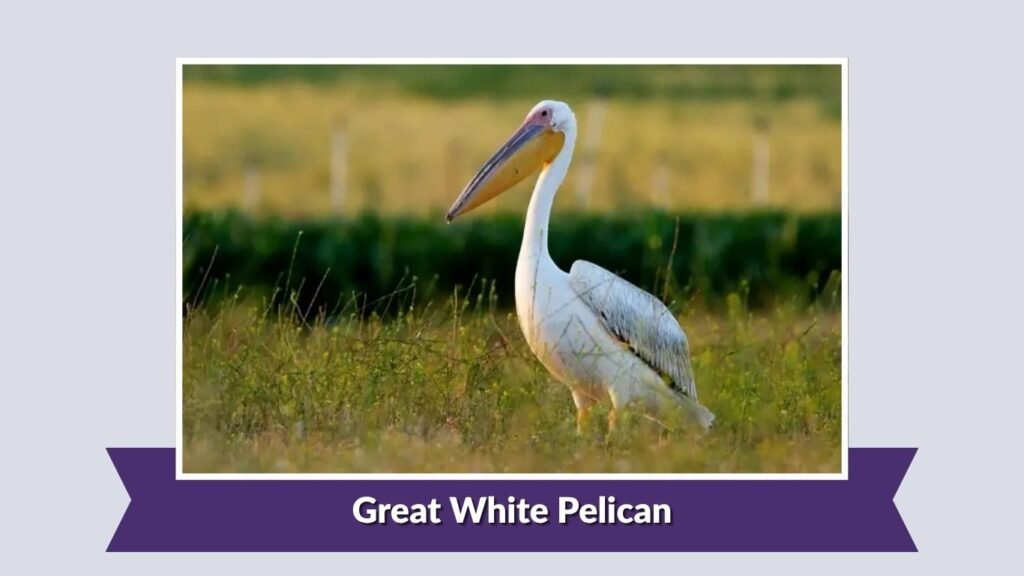
The great white pelican (Pelecanus onocrotalus) is a huge waterbird with a remarkably long beak and expandable throat pouch. It is widely distributed across parts of Africa, Europe, and Asia and is often seen around large lakes, wetlands, and river systems. While it does not hold the absolute record for the longest beak in the world, its bill is extremely long and perfectly designed for catching fish.
Identification
- Scientific name: Pelecanus onocrotalus
- Body length: About 1.4–1.8 meters
- Wingspan: Up to about 3.6 meters
- Color: Mostly white
- Wing feathers: Black flight feathers
- Bill: Long, yellowish to pinkish
- Pouch: Large and expandable
- Diet: Mainly fish
How Long Is the Great White Pelican’s Beak?
The great white pelican has a bill that can measure roughly 30–45 centimeters long, depending on the individual and sex. Males are generally larger and often have longer bills than females.
Although the Australian pelican has a longer maximum bill, the great white pelican still ranks among the birds with the longest beaks. Its huge bill contributes heavily to its unmistakable appearance.
How Does Its Long Beak Work?
The bird uses its beak much like a fishing net. It plunges the open bill into the water while extending the throat pouch. Fish become trapped inside, and the pelican then lifts its head and drains the water.
Great white pelicans are particularly well known for cooperative feeding. Groups sometimes form lines or semicircles and drive schools of fish into shallow areas where they can be caught more easily.
Habitat and Behavior
Great white pelicans inhabit freshwater and brackish environments, including large lakes, marshes, lagoons, reservoirs, and river deltas. Many populations move seasonally depending on breeding conditions and food availability.
These birds are highly social and often gather in large colonies. Their tremendous wings also make them excellent soaring birds. Combined with their long beaks and enormous throat pouches, these features make great white pelicans some of the most spectacular long-billed birds on Earth.
4. American White Pelican
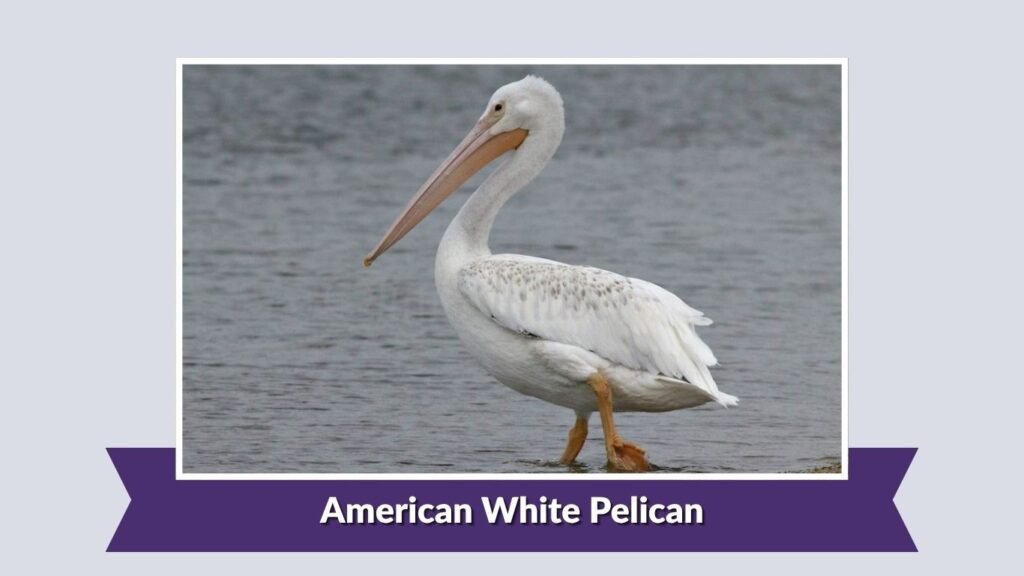
The American white pelican (Pelecanus erythrorhynchos) is a large North American waterbird with a long orange bill and an enormous wingspan. Unlike the brown pelican, it usually catches fish while swimming rather than diving from the air. Its large bill places it among the notable birds with exceptionally long beaks, although it does not surpass the Australian pelican in absolute beak length.
Identification
- Scientific name: Pelecanus erythrorhynchos
- Body length: About 1.3–1.6 meters
- Wingspan: Around 2.4–3 meters
- Color: Mostly white
- Wing tips: Black
- Bill: Long and bright orange
- Legs: Orange
- Habitat: Lakes, rivers, wetlands, and coastal areas
- Diet: Primarily fish
How Long Is the American White Pelican’s Beak?
The American white pelican has a large bill that commonly measures around 25–38 centimeters in length. Males tend to have longer and heavier bills than females.
During the breeding season, adults may also develop a temporary vertical plate or bump on the upper bill. This unusual feature disappears after breeding and is one of the species’ most distinctive seasonal characteristics.
How Does Its Beak Help It Catch Fish?
American white pelicans use their bills and expandable throat pouches to scoop fish from relatively shallow water. They swim along the surface, dip their heads underwater, and trap fish within the pouch.
Groups often cooperate while feeding. Several birds may form a line and move together, driving fish toward shallow water. This coordinated behavior improves their chances of catching prey.
Habitat and Behavior
American white pelicans breed around inland lakes and wetlands in parts of Canada and the United States. Many migrate south during winter to coastal areas, reservoirs, and warmer wetlands.
They are strong, graceful fliers and frequently soar in circles using rising air currents. Their black wing tips become especially obvious in flight. With their oversized orange bills and broad white bodies, American white pelicans are among the easiest long-beaked birds to identify.
5. Shoebill

The shoebill (Balaeniceps rex) is one of the most unusual birds in the world and is famous for its enormous shoe-shaped beak. Native to tropical wetlands of central and eastern Africa, this tall bird uses its massive bill to catch fish, frogs, snakes, and other aquatic prey. Although its beak is not the longest in absolute length, its width and overall size make it one of the largest and most powerful bird bills.
Identification
- Scientific name: Balaeniceps rex
- Height: About 1.1–1.4 meters
- Wingspan: Around 2.3–2.6 meters
- Beak: Large, broad, shoe-shaped, and hooked
- Color: Blue-gray to slate gray
- Legs: Long and dark
- Eyes: Pale yellow to grayish
- Habitat: Freshwater swamps and marshes
- Diet: Fish, frogs, reptiles, and other aquatic animals
How Large Is the Shoebill’s Beak?
The shoebill’s bill can reach roughly 20–25 centimeters long, but its remarkable width makes it look much larger. Unlike pelicans, which have long and relatively narrow bills, the shoebill has a thick, deep, and powerful beak.
A sharp hook at the tip helps it grip and tear prey. This unusual structure gives the bird its common name because the bill resembles a large wooden shoe.
How Does Its Beak Help It Hunt?
Shoebills are patient ambush hunters. They often stand completely still in shallow water, waiting for prey to approach. When a fish or other animal comes within range, the bird suddenly lunges forward and strikes with its massive bill.
Its diet can include lungfish, catfish, frogs, water snakes, and other wetland animals. The strength and size of its beak allow it to handle prey that many smaller wetland birds could not capture.
Habitat and Behavior
Shoebills inhabit large freshwater swamps, papyrus marshes, and flooded wetlands in countries such as Uganda, South Sudan, Zambia, and the Democratic Republic of the Congo.
They are usually solitary and move slowly through dense vegetation while hunting. Their prehistoric appearance, towering height, and enormous bill have made them one of the most famous tropical birds with large beaks.
6. Jabiru
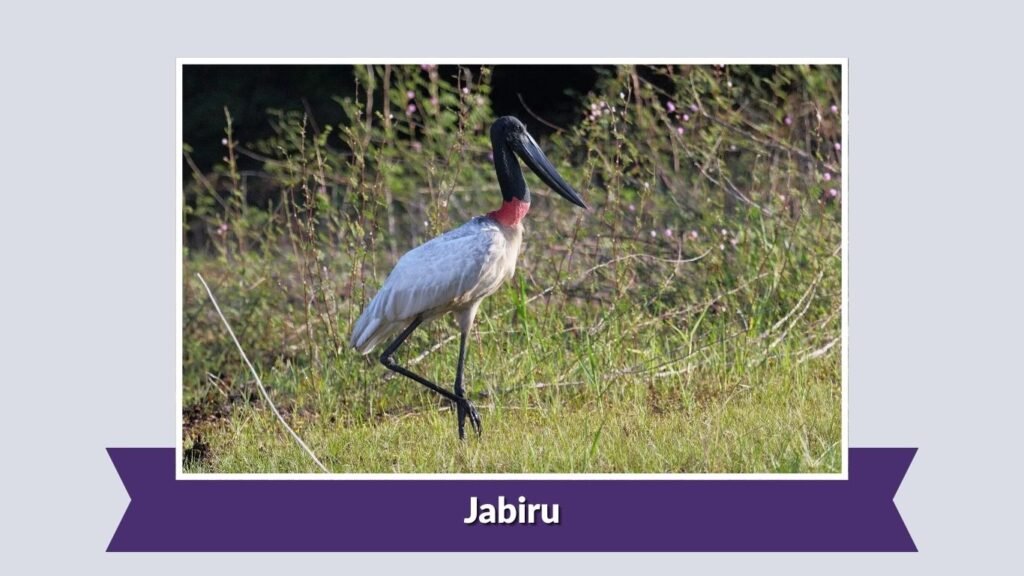
The jabiru (Jabiru mycteria) is a huge stork found in wetlands across Central and South America. It is instantly recognizable by its enormous black bill, white body, and black-and-red neck. Although it is not the bird with the longest beak in the world, its thick, elongated bill is among the most impressive of any large wading bird and is perfectly suited for catching aquatic prey.
Identification
- Scientific name: Jabiru mycteria
- Height: About 1.2–1.4 meters
- Wingspan: Around 2.3–2.8 meters
- Beak: Long, thick, black, and slightly upturned
- Body: Mostly white
- Head and neck: Black with a distinctive red neck pouch
- Legs: Long and dark
- Habitat: Marshes, floodplains, rivers, and wetlands
- Diet: Fish, amphibians, reptiles, and other small animals
How Long is Jabiru’s Beak?
A jabiru’s bill can reach approximately 25–35 centimeters long, making it exceptionally large compared with the bills of most birds. It is both long and heavy, giving the jabiru a powerful tool for hunting in shallow water.
Its bill is not as long as that of the Australian pelican, but the jabiru still deserves a place among birds with the longest beaks because of its impressive dimensions and large overall body size.
How Does Its Long Beak Help It Feed?
Jabirus walk slowly through shallow wetlands while searching for food. They use their long bills to grab fish, frogs, aquatic insects, snakes, and other prey.
Rather than chasing prey at high speed, a jabiru usually relies on careful movements and quick strikes. Its long neck and beak allow it to reach well into the water while keeping much of its body above the surface.
Habitat and Behavior
Jabirus occurs from Mexico through Central America and into much of South America, with especially notable populations in large wetland systems such as the Pantanal.
They often forage alone or in small groups but may gather where food becomes concentrated. Their towering height, enormous black beak, and contrasting white plumage make jabirus one of the most distinctive long-beaked birds in the Americas.
7. Saddle-Billed Stork
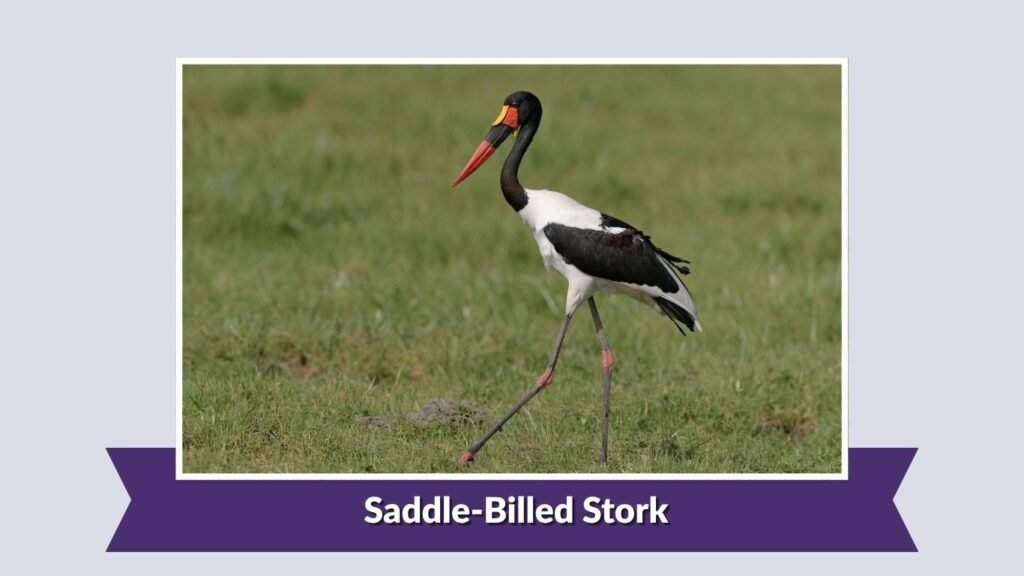
The saddle-billed stork (Ephippiorhynchus senegalensis) is one of Africa’s most striking wading birds. It has an exceptionally long, colorful beak marked with red, black, and yellow. This massive stork uses its bill to capture fish and other wetland prey. While it does not hold the record as the bird with the longest beak, its bill is remarkably long relative to its head and contributes to its unmistakable appearance.
Identification
- Scientific name: Ephippiorhynchus senegalensis
- Height: Around 1.4–1.5 meters
- Wingspan: About 2.4–2.7 meters
- Beak: Very long, red and black with a yellow saddle
- Body: Mostly white
- Wings: Glossy black
- Legs: Long, dark, with reddish joints
- Habitat: Marshes, rivers, floodplains, and shallow lakes
- Diet: Mainly fish, frogs, crustaceans, and small reptiles
How Long Is the Saddle-Billed Stork’s Beak?
The saddle-billed stork has a bill that may reach roughly 30 centimeters or more in large adults. The bill is long, slightly upturned, and sharply pointed at the tip.
Its unusual yellow patch near the base resembles a saddle, which gives the species its common name. Combined with red and black markings, this makes it one of the most colorful large bird beaks in the world.
How Does Its Beak Help It Catch Prey?
Saddle-billed storks forage by slowly walking through shallow water while watching for movement. When prey comes within reach, the bird quickly thrusts its long bill downward.
Fish form a major part of the diet, but these storks can also capture frogs, crustaceans, aquatic insects, and small reptiles. Their long beaks allow them to reach prey without completely submerging their heads.
Habitat and Behavior
Saddle-billed storks inhabit wetlands throughout much of sub-Saharan Africa. They prefer freshwater marshes, floodplains, riverbanks, lakeshores, and other shallow-water habitats.
They are usually seen alone or in pairs rather than in huge flocks. Adults form long-term breeding pairs and build large nests in tall trees. Their enormous size and spectacular bill make the saddle-billed stork one of Africa’s most recognizable birds with long beaks.
8. Marabou Stork
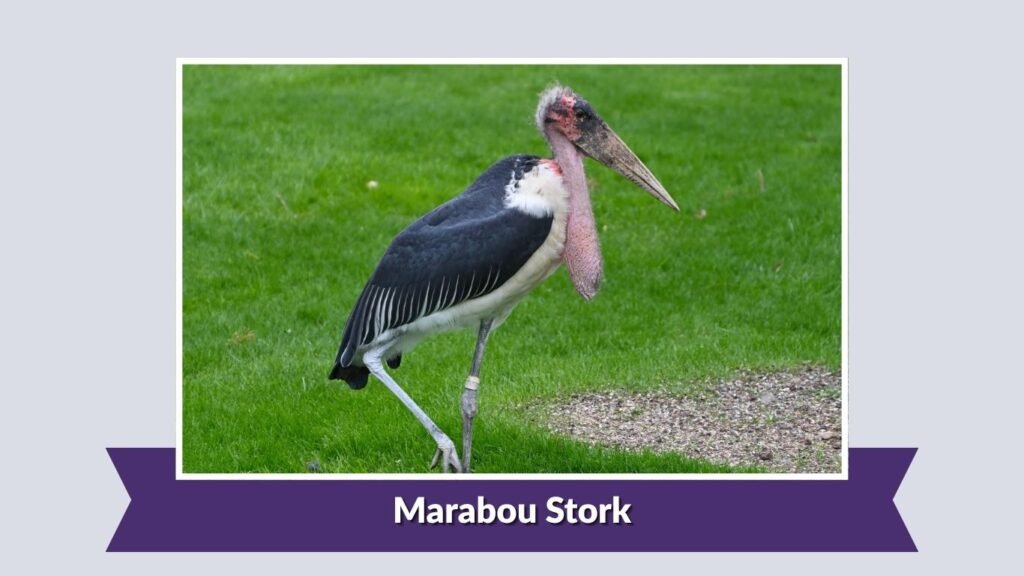
The marabou stork (Leptoptilos crumenifer) is a massive African bird with an exceptionally large, long beak. Its bald head, hanging throat pouch, black-and-white plumage, and imposing size give it a distinctive appearance. Although other species rank higher when determining the bird with the longest beak in the world, the marabou possesses one of the longest and heaviest bills among storks.
Identification
- Scientific name: Leptoptilos crumenifer
- Height: Up to about 1.5 meters
- Wingspan: Around 2.5–3 meters
- Beak: Long, thick, pale, and pointed
- Head: Mostly bald
- Body: Black and white
- Neck: Bare with a hanging throat pouch
- Habitat: Wetlands, savannas, grasslands, and human settlements
- Diet: Carrion, fish, insects, reptiles, and other animals
How Long Is the Marabou Stork’s Beak?
The marabou stork’s bill can measure approximately 25–35 centimeters long. It is thick at the base and tapers toward the tip, giving the bird a powerful tool for handling many different foods.
Unlike the narrow bills of some fishing birds, the marabou’s bill is relatively heavy and robust. Its large size makes it highly effective for scavenging as well as catching live prey.
What Does the Marabou Use Its Long Beak For?
Marabou storks are opportunistic feeders. They use their long beaks to grab carrion, fish, frogs, insects, rodents, reptiles, and other available food.
Their bald heads and necks are particularly useful when feeding on carcasses because feathers would become dirty more easily. Marabous frequently feed alongside vultures and other scavenging animals.
Habitat and Behavior
Marabou storks are widespread across sub-Saharan Africa. They live around wetlands, open grasslands, savannas, river systems, and increasingly near towns where food waste is available.
They are excellent soaring birds and often circle high in the sky using thermal air currents. Although their appearance may seem unusual, marabou storks perform an important ecological role by consuming dead animals and organic waste. Their huge bodies and long beaks make them some of the world’s most impressive large-billed birds.
9. Black-Necked Stork
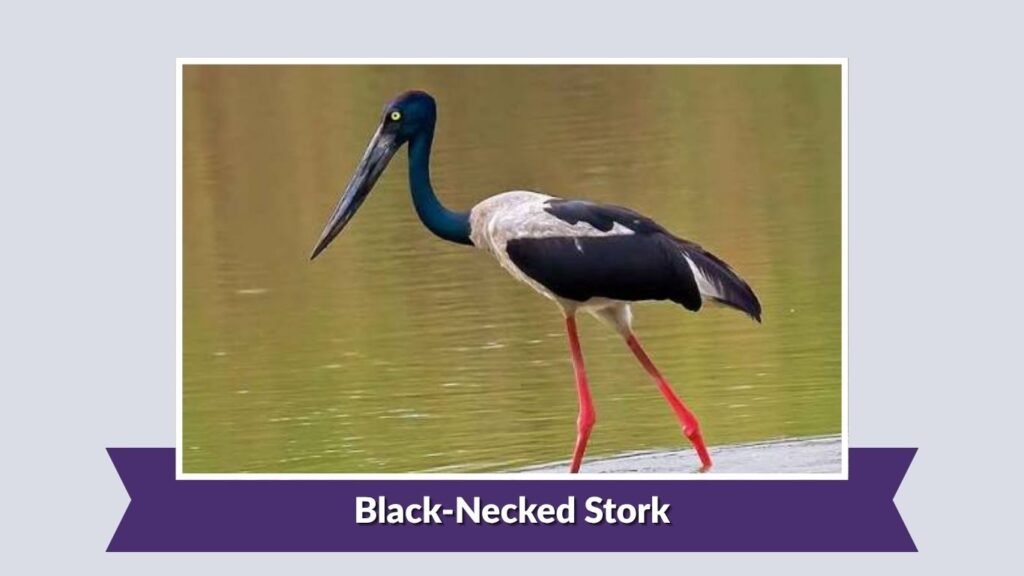
The black-necked stork (Ephippiorhynchus asiaticus) is a tall wetland bird distinguished by its glossy black neck, white body, and long black beak. Found across parts of South and Southeast Asia as well as Australia, it uses its impressive bill to hunt fish and other aquatic animals. Its substantial bill earns it a place among notable birds with long beaks, even though it is not the absolute record holder.
Identification
- Scientific name: Ephippiorhynchus asiaticus
- Height: About 1.2–1.5 meters
- Wingspan: Around 2.2–2.3 meters
- Beak: Long, straight, and black
- Head and neck: Glossy dark green-black
- Body: Mostly white
- Legs: Long and reddish
- Habitat: Freshwater wetlands, floodplains, and marshes
- Diet: Fish, frogs, reptiles, crustaceans, and insects
How Long Is the Black-Necked Stork’s Beak?
The black-necked stork possesses a long, pointed bill that may measure approximately 25–30 centimeters. Its spear-like shape is ideal for catching slippery aquatic prey.
Although pelicans generally have longer bills in absolute measurements, this stork’s beak remains exceptionally large relative to its head. The straight black bill also contrasts sharply with the bird’s white body and dark neck.
How Does Its Long Beak Help With Hunting?
Black-necked storks slowly patrol shallow water while watching for fish, frogs, crabs, snakes, and other animals. When prey appears, they rapidly thrust their beaks forward or downward.
The length of the bill allows the bird to reach into deeper water and vegetation while maintaining a stable standing position. Its long legs provide an additional advantage by allowing it to forage in water that would be too deep for smaller birds.
Habitat and Behavior
These storks inhabit freshwater wetlands, marshes, flooded grasslands, rivers, lakeshores, and agricultural wetlands. Their populations occur across scattered regions from the Indian subcontinent through Southeast Asia to northern Australia.
Black-necked storks are generally seen alone, in pairs, or in small family groups. Their height, dramatic black-and-white coloration, and long pointed beaks make them easy to recognize in open wetlands.
10. Toco Toucan

The toco toucan (Ramphastos toco) is famous for having one of the largest and most colorful beaks relative to its body size. Its enormous orange bill may look heavy, but its internal structure makes it surprisingly lightweight. Although the toucan is not the bird with the longest beak in absolute length, it is one of the most recognizable tropical birds with a long beak and an excellent example of extreme bill adaptation.
Identification
- Scientific name: Ramphastos toco
- Body length: About 55–65 centimeters
- Beak length: Around 15–20 centimeters
- Body: Mostly black
- Throat: White
- Beak: Large, orange with a dark tip
- Skin around eyes: Blue
- Habitat: Woodlands, savannas, forest edges, and open forests
- Diet: Mainly fruit, plus insects, eggs, and small animals
How Long Is the Toco Toucan’s Beak?
The toco toucan’s beak can reach roughly 20 centimeters, meaning the bill accounts for a significant portion of the bird’s total length. This makes it particularly impressive when considering beak length relative to body size.
Despite its enormous appearance, the beak is not solid. It contains a lightweight internal structure covered by a tough outer layer of keratin, allowing the bird to carry such a large bill without excessive weight.
Why Does the Toco Toucan Have Such a Large Beak?
The large bill helps the toucan reach fruit growing on branches that may be too thin to support its body. It can stretch forward, grasp fruit with the tip of its beak, and toss the food backward into its mouth.
The bill may also help with temperature regulation by releasing body heat. Toucans additionally use their beaks during social interactions and occasionally to capture insects or small vertebrates.
Habitat and Behavior
Toco toucans live primarily in South America, including parts of Brazil, Bolivia, Paraguay, and Argentina. Unlike some toucans that favor dense rainforest, this species frequently inhabits open woodland, savanna, forest edges, and areas with scattered trees.
They are active, social birds that often move through trees in small groups. Their enormous orange bills make them one of the most recognizable tropical birds with long beaks in the world.
11. Rhinoceros Hornbill
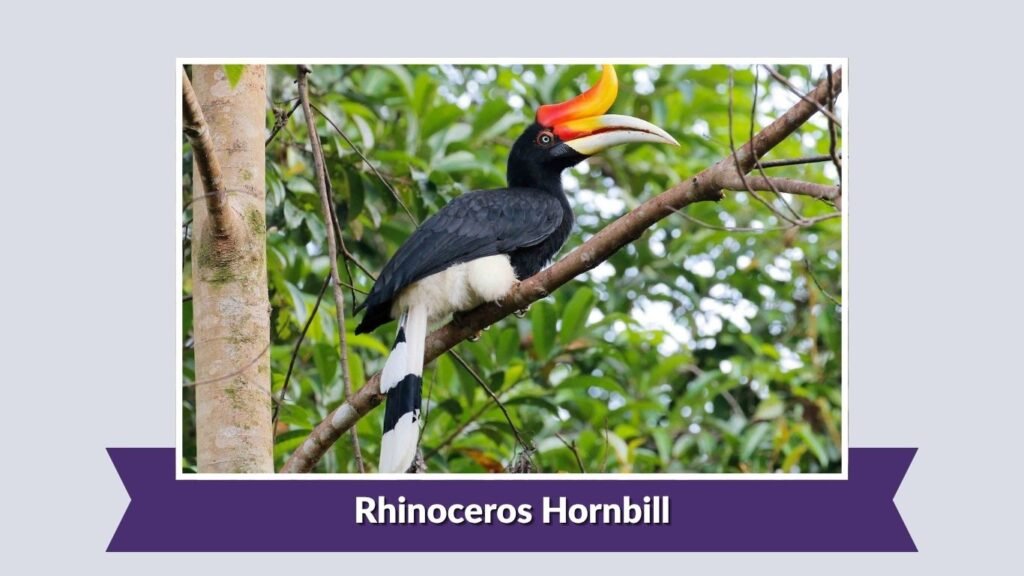
The rhinoceros hornbill (Buceros rhinoceros) is a spectacular tropical bird known for its enormous curved beak and prominent casque. Native to Southeast Asian forests, it has one of the most impressive bills relative to its overall size. Although it is not the bird with the longest beak in the world, its combination of a large bill and colorful casque makes it one of the easiest long-beaked birds to recognize.
Identification
- Scientific name: Buceros rhinoceros
- Family: Bucerotidae
- Body: Mostly black
- Tail: White with a broad black band
- Beak: Large, curved, and usually yellow-orange
- Casque: Large and upward-curving above the bill
- Habitat: Tropical and subtropical forests
- Diet: Primarily fruit, especially figs, plus insects and small animals
Why Does the Rhinoceros Hornbill Have Such a Large Beak?
The rhinoceros hornbill’s long bill helps it reach fruit growing on branches that may not support its weight. Instead of climbing onto thin branches, the bird can stretch its head forward and use the tip of its beak to pick fruit.
Despite its bulky appearance, a hornbill’s bill is relatively lightweight. The prominent casque sitting above the beak makes it appear even larger and gives the rhinoceros hornbill its distinctive profile.
How Does It Use Its Beak for Feeding?
Fruit makes up an important part of the rhinoceros hornbill’s diet, particularly figs. It can also eat insects, small reptiles, rodents, and even small birds.
The bird uses its long bill almost like a pair of tongs. After picking up a piece of fruit, it may toss the food upward and catch it in its mouth before swallowing. The extra reach provided by the bill allows the hornbill to gather food efficiently while remaining perched on a stronger branch.
Habitat and Behavior
Rhinoceros hornbills inhabit tropical forests of Southeast Asia, particularly areas with large mature trees. They spend much of their time high in the canopy searching for fruit and traveling between feeding trees.
Like other hornbills, they play an important ecological role by eating fruits and dispersing seeds throughout the forest. Their extraordinary casque, enormous beak, and contrasting black-and-white plumage make them one of the most distinctive tropical birds with long beaks.
12. Great Hornbill
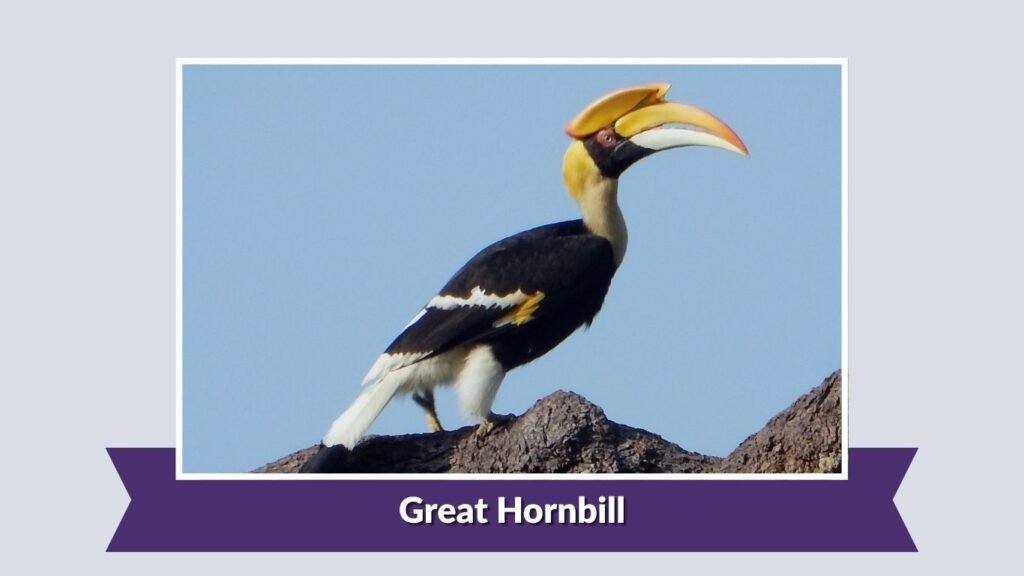
The great hornbill (Buceros bicornis) is one of the largest and most impressive hornbills in Asia. It is famous for its huge yellow bill topped by a prominent casque. The species lives mainly in mature forests across parts of South and Southeast Asia. While it cannot claim the title of bird with the longest beak, its massive bill is among the most recognizable in the bird world.
Identification
- Scientific name: Buceros bicornis
- Family: Bucerotidae
- Body: Mostly black
- Neck and belly: White
- Tail: White with a black band
- Beak: Large, curved, and yellow
- Casque: Prominent structure above the bill
- Habitat: Mature tropical and subtropical forests
- Diet: Mainly fruit, with occasional animal prey
Why Is the Great Hornbill’s Beak So Large?
The great hornbill uses its large bill primarily to collect fruit from trees. Its extra reach allows the bird to pick fruit from thin outer branches without moving its heavy body onto unstable twigs.
A large hollow-looking casque sits above the bill, making the bird’s head appear even more impressive. The casque also plays a role in visual display and may help amplify some of the bird’s calls.
How Does Its Long Beak Help With Feeding?
Great hornbills are primarily fruit eaters, with figs forming an especially important part of their diet. They may also consume insects, reptiles, smaller birds, and small mammals.
Their long beak allows them to pick individual fruits with precision. Hornbills frequently grasp fruit near the tip of the bill and toss it backward into the throat.
This feeding behavior allows them to swallow many fruits whole and later disperse their seeds.
Habitat and Behavior
Great hornbills inhabit forested regions of the Indian subcontinent and Southeast Asia. Large trees are particularly important because hornbills depend on natural tree cavities for nesting.
They spend considerable time moving through the forest canopy in search of fruiting trees. Their wingbeats produce noticeable sounds during flight. With its enormous yellow bill, prominent casque, and impressive body size, the great hornbill easily ranks among the world’s most spectacular birds with long beaks.
13. Sword-Billed Hummingbird

The sword-billed hummingbird (Ensifera ensifera) is especially important when discussing the bird with the longest beak relative to body size. Its extraordinary straight bill can be almost as long as, or even longer than, the rest of its body when the tail is excluded. This remarkable hummingbird lives in the Andes of South America and specializes in feeding from flowers with exceptionally deep floral tubes.
Identification
- Scientific name: Ensifera ensifera
- Family: Trochilidae
- Body length excluding bill: About 13–14 cm
- Beak length: About 8–12 cm
- Color: Mostly green
- Beak: Extremely long, straight, and narrow
- Habitat: Andean montane forests and forest edges
- Diet: Nectar and small arthropods
Is This the Humming Bird With the Longest Beak?
Yes. The sword-billed hummingbird possesses the longest bill of any hummingbird and has an extraordinary bill length compared with its body size. Adults have bills measuring roughly 8–12 cm, while the body excluding the bill measures around 13–14 cm.
Therefore, when people search for the humming bird with the longest beak, the sword-billed hummingbird is the standout species.
Why Did Such a Long Beak Develop?
The long bill enables this hummingbird to reach nectar hidden deep inside long tubular flowers. It is particularly associated with specialized Andean plants, including several passionflowers such as Passiflora mixta.
While hovering, the bird pushes its bill deep into the flower and uses its specialized tongue to collect nectar. In doing so, it can also transfer pollen between flowers.
Its extreme bill also affects grooming behavior. Because reaching its feathers with such a long beak can be difficult, the bird often relies heavily on its feet for scratching and preening.
Habitat and Behavior
Sword-billed hummingbirds inhabit mountainous areas of the Andes, including parts of Colombia, Ecuador, Peru, Bolivia, and Venezuela. They are associated with humid montane forest and areas containing abundant long-tubed flowers.
They regularly travel between nectar sources and also eat small arthropods for protein. Among all birds with unusual beaks, few demonstrate specialization as dramatically as the sword-billed hummingbird.
14. Long-Billed Curlew
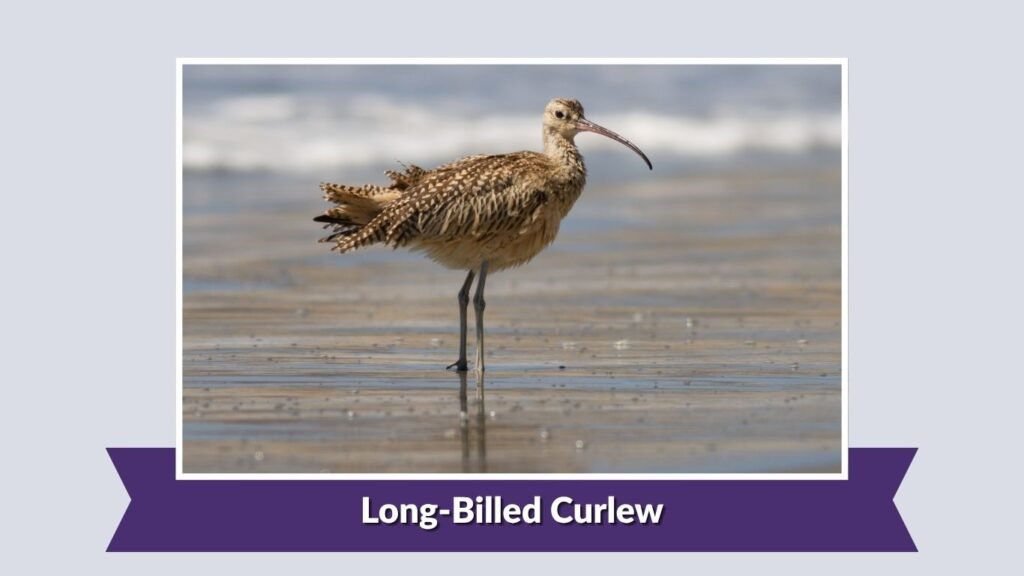
The long-billed curlew (Numenius americanus) is a large North American shorebird famous for its extremely long, slender, downward-curving bill. It is North America’s largest shorebird and uses its remarkable beak to probe deep into soil, sand, and mud for hidden prey. Although pelicans have longer bills in absolute terms, the curlew is an excellent example of a bird with a long beak relative to its size.
Identification
- Scientific name: Numenius americanus
- Family: Scolopacidae
- Body: Mottled brown and buff
- Beak: Extremely long and downward-curved
- Legs: Long and grayish
- Habitat: Grasslands, mudflats, estuaries, and coastal wetlands
- Diet: Insects, worms, crustaceans, and other invertebrates
- Range: Mainly North America
Why Does the Long-Billed Curlew Have Such a Long Beak?
Its exceptionally long bill is primarily an adaptation for reaching prey hidden below the surface. The bird can push its bill deep into soft mud or soil, gaining access to animals that short-billed shorebirds cannot easily reach.
Females generally have especially long bills, and the downward curve helps the bird explore burrows and spaces beneath the ground.
How Does Its Long Beak Help It Find Food?
Long-billed curlews use their bills to probe for earthworms, shrimp, crabs, and other buried invertebrates. They also consume insects such as grasshoppers, beetles, caterpillars, and spiders.
On coastal wintering grounds, the bird can insert its curved bill into mud and even reach prey hiding in underground burrows. In grasslands, it also picks insects directly from the ground.
This makes the long bill useful in several different feeding environments.
Habitat and Behavior
Long-billed curlews breed mainly in open grasslands of western and central North America. During the nonbreeding season, many move to tidal estuaries, wetlands, mudflats, flooded fields, and beaches.
They are often seen walking deliberately across open terrain while probing for prey. Their extremely long, curved bill creates an unmistakable silhouette and makes the long-billed curlew one of the most recognizable long-beaked shorebirds in the world.
15. Roseate Spoonbill
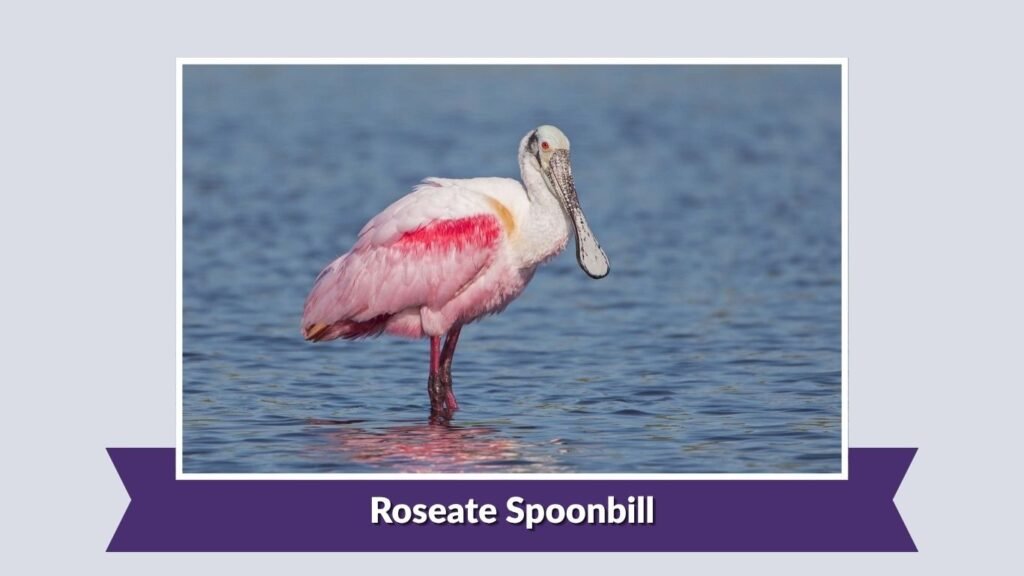
The roseate spoonbill (Platalea ajaja) is a striking pink wading bird with an unusual long bill that widens into a flat, spoon-shaped tip. Unlike birds with narrow spear-like bills, this species uses its broad beak to detect and capture small aquatic prey by touch. Although it is not the bird with the longest beak in the world, its specialized shape makes it one of the most unusual long-beaked birds.
Identification
- Scientific name: Platalea ajaja
- Family: Threskiornithidae
- Body: Pink to bright rose
- Neck: Long and pale
- Beak: Long, flattened, and spoon-shaped
- Legs: Long and adapted for wading
- Habitat: Marshes, mangroves, lagoons, and shallow wetlands
- Diet: Small fish and aquatic invertebrates
Why Does the Roseate Spoonbill Have a Spoon-Shaped Beak?
Its broad bill is highly specialized for feeding in shallow, cloudy water. Instead of depending entirely on eyesight, the spoonbill can detect prey through touch.
The widened tip increases the area that the bird can search as it moves its bill through the water. This unusual adaptation separates spoonbills from storks, herons, and other long-beaked wading birds.
How Does Its Long Beak Help It Feed?
Roseate spoonbills wade through shallow water while sweeping their partly opened bills from side to side. When the sensitive bill encounters prey, the jaws quickly close around it.
Their diet includes small fish, shrimp, crayfish, crabs, aquatic insects, mollusks, and some plant material.
This sweeping feeding technique allows spoonbills to hunt successfully even when muddy water makes prey difficult to see.
Habitat and Behavior
Roseate spoonbills inhabit warm wetlands in the Americas. Suitable habitats include coastal marshes, mangroves, ponds, lagoons, and inland swamps.
They often feed in groups and may share wetlands with herons, egrets, ibises, and other wading birds. Their pink plumage becomes more vivid in mature adults, making them particularly conspicuous.
While the Australian pelican may be associated with the longest beak in absolute length and the sword-billed hummingbird excels relative to body size, the roseate spoonbill demonstrates how a long bill can evolve into an entirely different tool specialized for sweeping food from shallow water.
FAQs
What Bird Has the Longest Beak in the World?
The Australian pelican is generally considered the bird with the longest beak in absolute length. Its bill can reach close to 50 centimeters in especially large individuals.
Which Bird Has the Longest Beak Relative to Body Size?
The sword-billed hummingbird has the longest beak relative to its body size. Its bill can be nearly as long as, or even longer than, the rest of its body excluding the tail.
What Hummingbird Has the Longest Beak?
The sword-billed hummingbird has the longest beak of any hummingbird species. Its specialized bill helps it reach nectar deep inside long tubular flowers.
Why Do Some Birds Have Such Long Beaks?
Long beaks help birds access specific foods. Pelicans use them to scoop fish, curlews probe mud for invertebrates, hummingbirds reach deep flowers, and hornbills use them to collect fruit from branches.
Are Birds With Long Beaks Found Only in Tropical Areas?
No. Birds with long beaks live in many habitats worldwide, including tropical forests, wetlands, grasslands, coastlines, lakes, and mountains. Species such as pelicans, curlews, storks, hornbills, and hummingbirds have evolved long bills for different feeding strategies.