
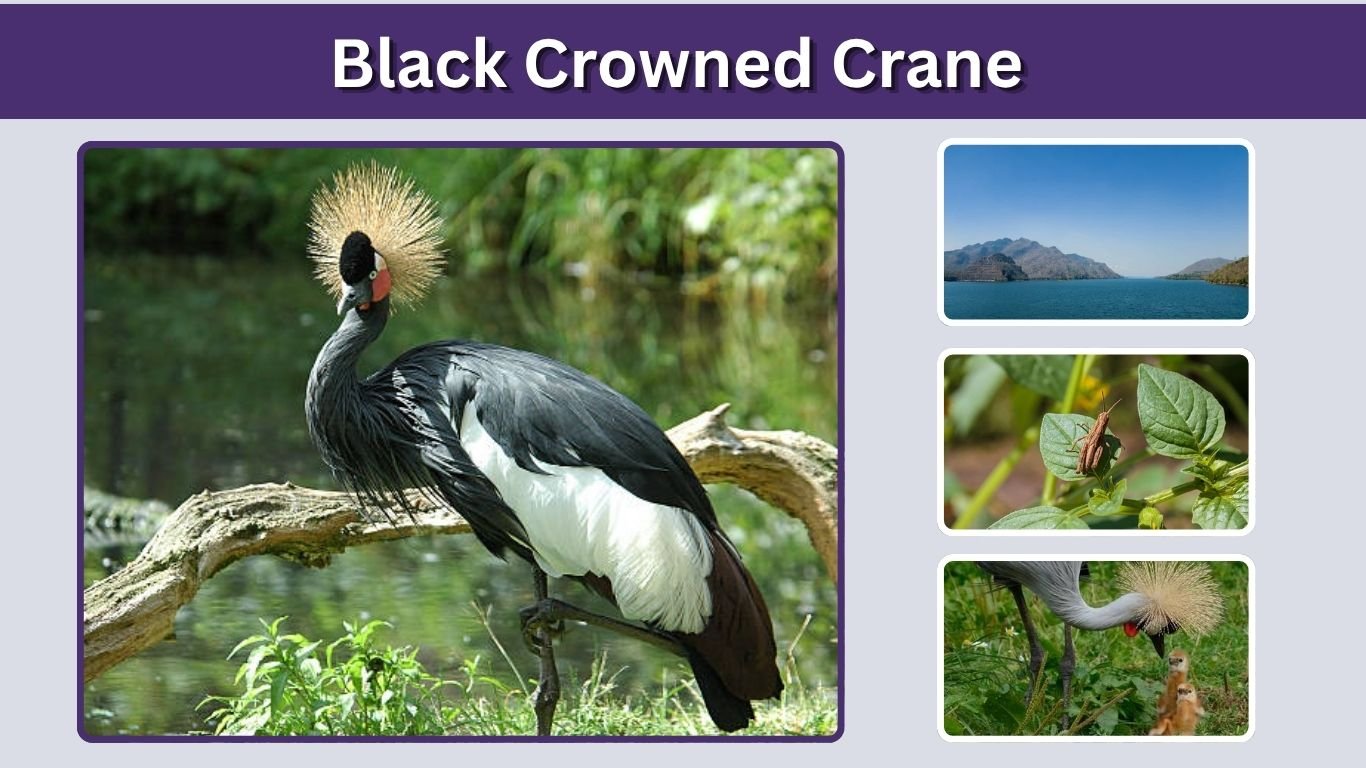
The Black Crowned Crane (Balearica pavonina) is a striking African bird recognized by its dark body, golden feather crown, white wings, colorful cheeks, and red throat pouch. It inhabits wetlands and grasslands across the Sahel and parts of sub-Saharan Africa. Unlike most cranes, it can grip branches and sleep in trees. The species is currently classified as Vulnerable because wetland destruction, drought, poisoning, disturbance, and illegal capture continue to threaten many populations.
Black Crowned Crane Quick Facts
Black Crowned Cranes belong to the crane family, Gruidae. Together with the Grey Crowned Crane, they form the genus Balearica.
| Feature | Description |
| Scientific name | Balearica pavonina |
| Family | Gruidae |
| Height | About 100–105 cm |
| Wingspan | Approximately 180–200 cm |
| Weight | About 3–4 kg |
| Range | Western, central and northeastern Africa |
| Habitat | Wetlands, wet grasslands and farmland |
| Diet | Seeds, grasses, insects and small animals |
| Typical clutch | About 2–4 eggs |
| Lifespan | Around 20–25 years in managed care |
| Conservation status | Vulnerable |
The International Crane Foundation estimates a height of about 104 cm, an average weight of roughly 3.6 kg, and a global population of approximately 83,000 individuals.
What Does a Black Crowned Crane Look Like?
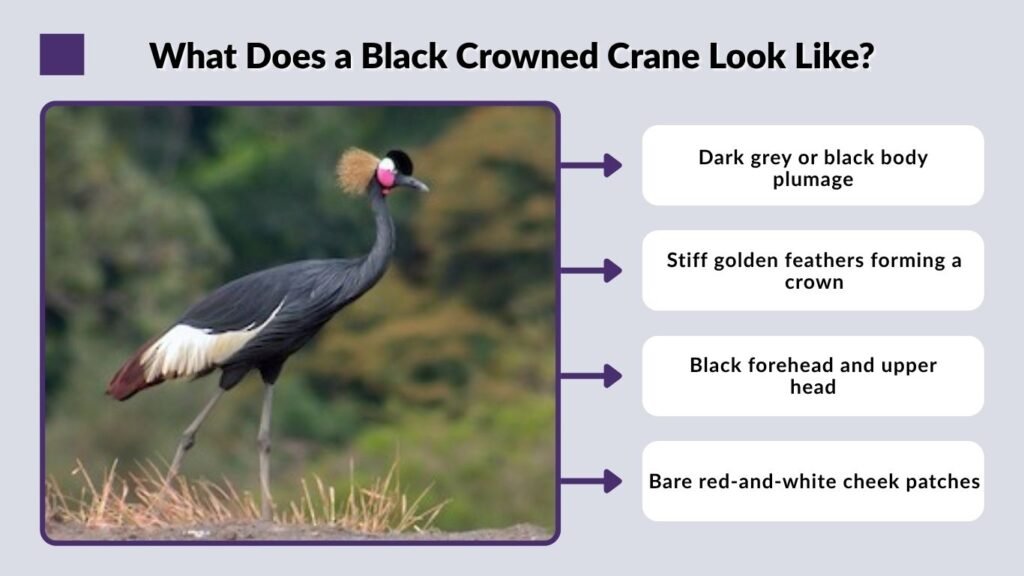
The Black Crowned Crane has an elegant shape with long legs, a long neck, broad wings, and a relatively short grey bill. Its body is not completely black but usually appears dark charcoal-grey or blackish.
Identification Features
- Dark grey or black body plumage
- Stiff golden feathers forming a crown
- Black forehead and upper head
- Bare red-and-white cheek patches
- Small red throat pouch
- White wing patches
- Golden-buff and chestnut wing feathers
- Long black legs
- Short grey or blackish bill
- Pale blue or greyish eyes
Juveniles are less colorful than adults. They have dark plumage, a cinnamon-brown head, no developed cheek patches, and a shorter, duller golden crown.
Male vs. Female Black Crowned Crane
Males and females have almost identical plumage. Males are generally slightly larger, but this difference can be difficult to recognize unless a pair is standing together.
The sexes are more reliably distinguished through measurements, behavior during breeding, or genetic testing. Both males and females possess the golden crown and colorful facial patches.
Black Crowned Crane Classification
Two Black Crowned Crane subspecies are generally recognized.
| Taxonomic rank | Classification |
| Kingdom | Animalia |
| Phylum | Chordata |
| Class | Aves |
| Order | Gruiformes |
| Family | Gruidae |
| Genus | Balearica |
| Species | Balearica pavonina |
West African Black Crowned Crane
The West African Black Crowned Crane, Balearica pavonina pavonina, occurs mainly in western parts of the species’ range. In this subspecies, the lower part of the cheek patch is normally red while the upper portion is white.
Sudan Crowned Crane
The Sudan Crowned Crane, Balearica pavonina ceciliae, occurs farther east. Its red cheek coloring generally extends farther upward than it does in the West African subspecies.
Where Do Black Crowned Cranes Live?
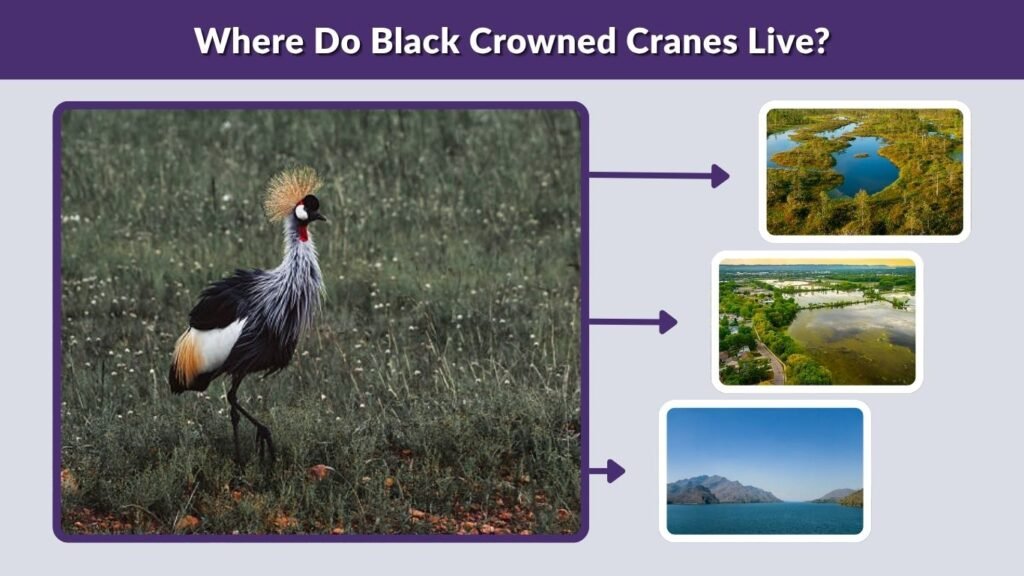
Black Crowned Cranes have a scattered distribution across Africa’s Sahel region. Western populations are centered around Senegal and The Gambia, while larger eastern populations occur around Sudan, South Sudan, Ethiopia, and parts of Kenya. Other populations occur in Chad, Cameroon, and neighboring countries.
Preferred Habitat
These cranes use both wet and relatively dry open environments, including:
- Freshwater marshes
- Floodplains
- Wet grasslands
- Shallow swamps
- River and lake edges
- Open savannas
- Seasonally flooded fields
- Rice fields and other croplands
- Meadows near streams
Wetlands are particularly important during breeding because they provide nesting vegetation and some protection from predators. The cranes frequently feed in nearby grasslands and agricultural areas.
Black Crowned Cranes in Nigeria
Black Crowned Cranes occur in northern Nigerian wetlands and floodplain systems, including areas associated with the Rima River and Sokoto-Zamfara catchments. These habitats are threatened by water extraction, wetland encroachment, hunting, drought, pollution, and changes in agriculture.
The bird is sometimes called Nigeria’s national bird in popular articles. However, Nigeria’s official national-symbol information does not identify a national bird, so this description should be used cautiously.
What Do Black Crowned Cranes Eat?
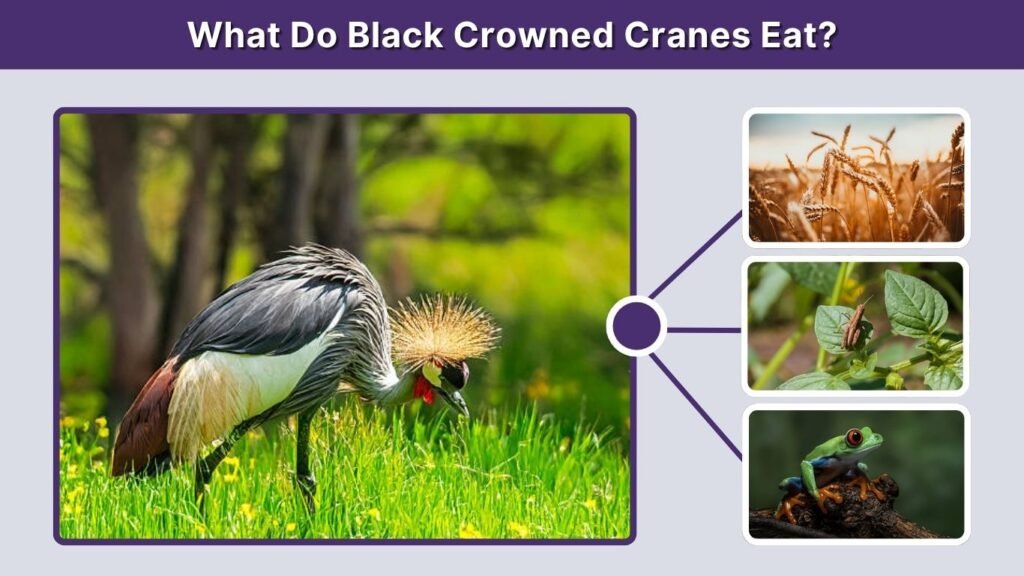
Black Crowned Cranes are omnivores. They consume plant material as well as insects and small vertebrates.
Common Foods
Their diet includes:
- Grass tips and roots
- Seeds and grains
- Agricultural crops
- Beetles and grasshoppers
- Worms and other invertebrates
- Frogs and other amphibians
- Small reptiles
- Small mammals
They may enter cultivated areas to eat crop seeds, including groundnuts and soybeans. This sometimes creates conflict with farmers, especially when groups of cranes gather in agricultural fields.
Feeding Behavior
A feeding crane walks slowly while watching the ground. It may stamp its feet through grass or shallow water to disturb hidden insects and other small prey.
Black Crowned Cranes also forage near cattle. Grazing animals disturb insects as they walk, allowing the cranes to capture the exposed prey.
Behavior and Adaptations
The Black Crowned Crane is active during the day and may be seen alone, in pairs, or in large groups. Its behavior changes according to food availability, rainfall, and breeding activity.
Can Black Crowned Cranes Fly?
Yes. They are powerful fliers with wingspans approaching two meters. During flight, they extend their necks forward and trail their legs behind their bodies.
Some populations remain within the same general region, while others make local or seasonal movements to reach temporary wetlands created by rainfall.
Why Do They Sleep in Trees?
The Black Crowned Crane is one of the few cranes capable of gripping tree branches. It has a long hind toe that helps it hold onto a perch.
Roosting above the ground may provide protection from wild cats, dogs, and other terrestrial predators. This tree-perching ability is shared with the closely related Grey Crowned Crane.
Black Crowned Crane Dance and Sound
Black Crowned Cranes perform energetic dances involving running, bowing, wing spreading, jumping, short flights, and throwing pieces of vegetation into the air.
Dancing plays an important role in courtship and pair bonding. Young cranes also dance, possibly to develop coordination and communication skills.
What Does a Black Crowned Crane Sound Like?
Its voice is usually described as a low, mellow honk. Calls may sound like “ka-wonk, ka-wonk” or a two-part “graa-oww.”
Pairs perform coordinated unison calls to reinforce their relationship and defend their territory. A crane may also make a short, sharp guard call when it detects danger.
Nesting, Eggs and Chicks
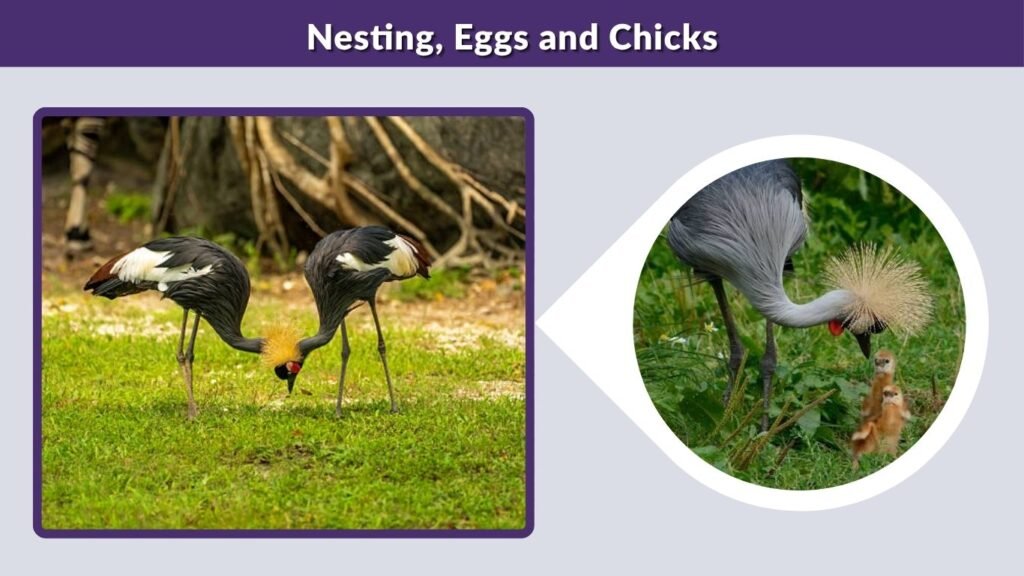
Black Crowned Cranes usually breed around the rainy season, although the exact timing varies across their wide African range.
Nest Construction
The pair builds a platform-shaped nest from grasses, sedges, and other wetland plants. It is normally placed in shallow water, dense marsh vegetation, or a flooded field.
Both adults participate in nest building, incubation, and chick care. A study around Ethiopia’s Lake Tana recorded nests in wetlands containing substantial standing water.
Eggs and Young
A female commonly lays around two to four eggs. Both parents incubate the clutch for approximately 28–31 days.
The chicks hatch covered in down and can walk soon afterward. Their parents guide them through wetland vegetation, protect them from danger, and help them locate food. Young chicks face threats from wild cats, dogs, snakes, and birds of prey.
Black Crowned Crane vs. Grey Crowned Crane
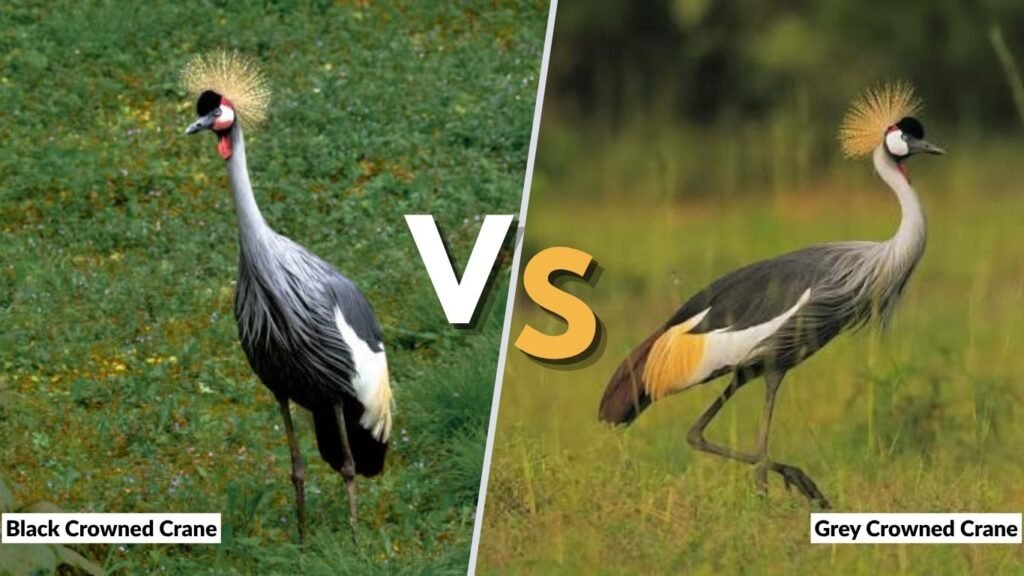
These closely related species share golden crowns, white wing patches, red throat pouches, and tree-perching feet. Body color is the easiest way to separate them.
| Feature | Black Crowned Crane | Grey Crowned Crane |
| Scientific name | Balearica pavonina | Balearica regulorum |
| Body color | Dark grey to black | Pale pearl-grey |
| Cheeks | Red and white | Mainly white with red markings |
| Throat pouch | Relatively small | Usually larger |
| Main range | Western, central and northeastern Africa | Eastern and southern Africa |
| Global status | Vulnerable | Endangered |
The Black Crowned Crane is generally darker and has more obvious red in its cheek patches. The Grey Crowned Crane has a pale neck and body with mostly white cheeks.
Why Is the Black Crowned Crane Vulnerable?
The Black Crowned Crane is classified as Vulnerable. Although approximately 83,000 individuals may remain, population conditions differ considerably across its range.
Major threats include wetland drainage, conversion of grasslands to farmland, desertification, drought, disturbance around nests, pesticide poisoning, hunting, and illegal capture for commercial trade. Removing eggs or chicks is especially damaging because cranes reproduce slowly and invest heavily in each breeding attempt.
FAQs
How long do Black Crowned Cranes live?
They may live for approximately 20–25 years in zoos or other managed environments. Their average wild lifespan is less certain because birds face predators, disease, drought, habitat loss, and human disturbance.
Are Black Crowned Cranes endangered?
They are classified as Vulnerable rather than Endangered. This means they face a high risk of extinction in the wild unless habitat destruction, illegal trade, poisoning, and other threats are controlled.
Where are Black Crowned Cranes most commonly found?
Most populations occur across the Sahel and nearby regions, particularly from West Africa eastward through Chad, Sudan, South Sudan, Ethiopia, and parts of Kenya.
What does a Black Crowned Crane symbolize?
The bird is often associated with elegance, rain, renewal, and the arrival of the wet season. In parts of West Africa, its seasonal appearance around temporary wetlands is traditionally regarded as a sign of coming rain.
Can Black Crowned Cranes be kept as pets?
They are unsuitable as ordinary pets and are protected under international wildlife-trade controls. They require extensive space, suitable social conditions, specialized care, and access to secure wetland habitat. Illegal collection is one of the threats facing wild populations.
