
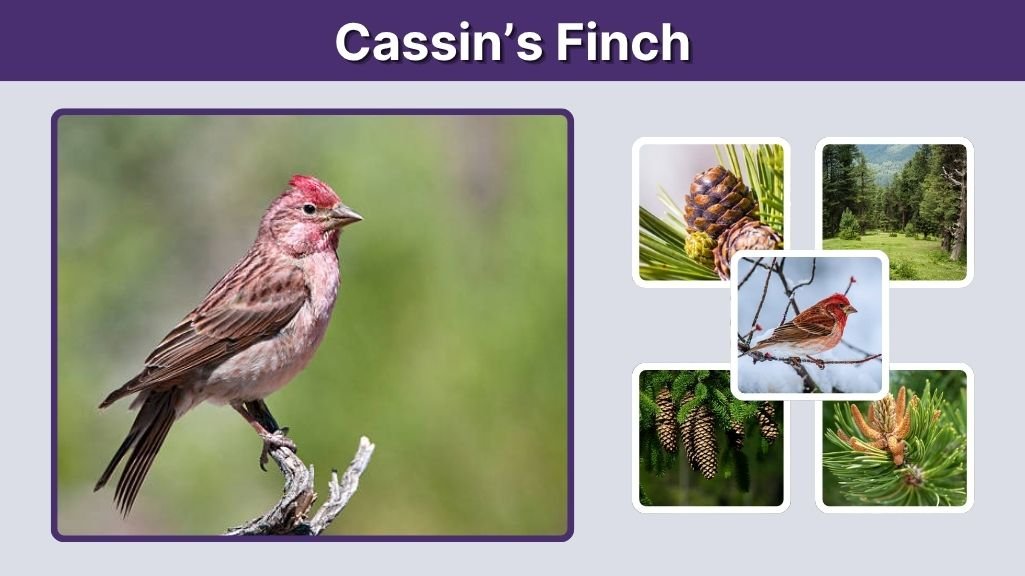
Cassin’s Finch (Haemorhous cassinii) is a medium-sized finch native to western North America, recognized for its pinkish-red head and streaked brown body. Males display bright red plumage during breeding season, while females and juveniles are more subdued. Often confused with House and Purple Finches, proper identification relies on careful observation of plumage, size, and song. This guide provides a complete overview of Cassin’s Finch, covering its identification, habitat, diet, courtship, breeding behavior, seasonal movements, and tips for distinguishing it from similar finches, making it ideal for birdwatchers and ornithologists.
Cassin’s Finch Overview
The Cassin’s Finch inhabits coniferous forests across western North America, breeding in mountainous regions and descending to lower elevations in winter. Its pinkish-red head, streaked brown plumage, and social flocking behavior make it identifiable. Males perform distinctive courtship displays and warbling songs, which, along with subtle size and color differences, distinguish it from similar finches such as House and Purple Finches.
Physical Description
Cassin’s Finch is 14–16 cm long with a short tail and rounded wings. Males exhibit a red forehead and pinkish chest, while females are brown with lighter streaking. Juveniles are duller and may lack the red forehead. Both sexes have a small conical bill adapted for efficient seed eating.
Male vs Female
Male Cassin’s Finches show brighter red coloration and more pronounced streaking than females. Females are overall lighter brown, with subtle pink hints on the head. Juveniles blend in with adults in mixed flocks, making identification challenging until plumage matures.
Vocalizations
The song is a high-pitched warbling trill, commonly used in courtship and territorial displays. Calls are sharp “pit-pit” notes, often heard during foraging or in flight. These vocal traits help distinguish Cassin’s Finch from House and Purple Finches.
Cassin’s Finch Habitat and Range
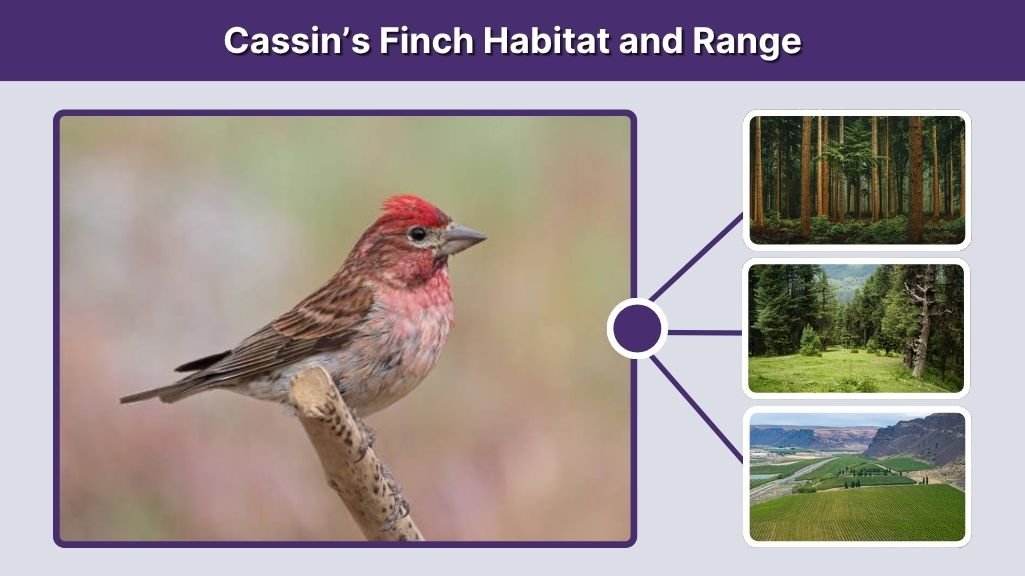
Found primarily in coniferous forests of western North America, Cassin’s Finch breeds in mountainous areas, including the Rockies, Sierra Nevada, and Pacific Northwest. During winter, it moves to lower elevations and valley forests. Its habitat overlaps with House and Purple Finches, making careful observation of behavior, plumage, and vocalizations crucial for proper identification in overlapping ranges.
Breeding Habitat
- Prefers coniferous forests, particularly pine and fir stands
- Builds cup-shaped nests high in trees, well-concealed
- Nests lined with moss, twigs, and feathers
- Clutch size typically 3–5 eggs
Winter Habitat
- Moves to lower elevations, open forests, and valley areas
- Often visits feeders in winter, joining small flocks
- Flocks are social and mixed with other finches
Range Notes
Cassin’s Finch range spans western U.S. and Canada, including Idaho, Colorado, Utah, California, British Columbia, and Alberta. Rare sightings occur east of the Rocky Mountains or in unusual winter irruptions.
Cassin’s Finch Diet and Feeding
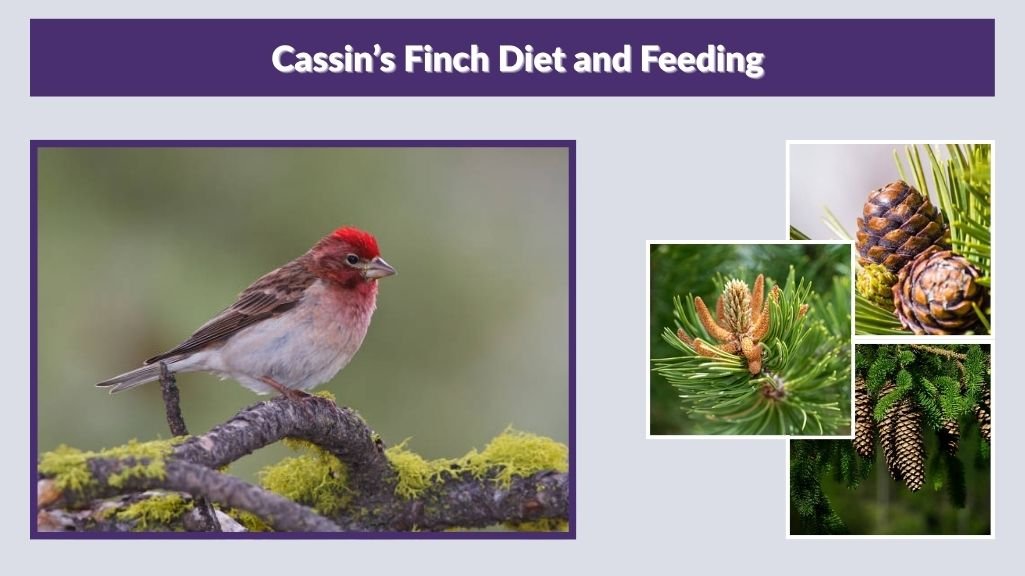
Primarily seed-eaters, Cassin’s Finches feed on conifer seeds, thistle, and weed seeds. During the breeding season, insects and buds provide protein for chicks. They forage in trees and shrubs and often form small social flocks, using their conical bills efficiently to extract seeds from cones and plants.
Seed Preferences (List Items)
- Pine, fir, and spruce seeds
- Thistle and weed seeds
- Occasional buds and berries
Feeding Behavior
Cassin’s Finches forage actively in trees and shrubs. They may cling upside down to reach seeds on twigs or cones. Winter flocks feed collectively, which helps locate abundant food sources and provides safety from predators.
Seasonal Diet Variation
During summer, insects and buds supplement their diet, especially for feeding chicks. In winter, their diet consists almost entirely of seeds, supporting their energy needs during colder months.
Cassin’s Finch Breeding and Courtship
Cassin’s Finch breeds in coniferous forests of western North America, typically at higher elevations. Males perform distinctive courtship displays, including dancing and wing fluttering while singing. Both parents participate in feeding the chicks. Nesting and reproductive behaviors are essential for survival in mountainous habitats and also aid in species identification.
Courtship Displays (List Items)
- Males perform dancing displays on branches or exposed perches
- Wing fluttering while singing attracts females
- Color intensity signals breeding readiness
Nesting
Nests are cup-shaped, built high in conifer trees to avoid predators. Lined with moss, twigs, and feathers, they contain 3–5 eggs per clutch. Incubation lasts approximately 11–13 days, and both parents feed the young until fledging at 14–16 days.
Juvenile Development
Juveniles are dull brown with faint streaks and lack the red forehead of adults. They join mixed-species flocks after fledging, allowing young birds to learn foraging and social behavior within protective groups.
Cassin’s Finch vs Similar Species

Cassin’s Finch is frequently confused with House and Purple Finches due to overlapping ranges and similar size. Differences in male plumage, female coloration, streaking patterns, and song are key for field identification. Observing these characteristics in the breeding season and during winter flocks allows birdwatchers to distinguish these species accurately.
Comparison Table
| Feature | Cassin’s Finch | House Finch | Purple Finch |
| Size | 14–16 cm | 13–15 cm | 14–15 cm |
| Male Color | Pinkish-red head & chest | Red forehead, variable streaks | Deep raspberry red head & back |
| Female Color | Brown streaked, subtle pink | Brown streaked, lighter | Brown streaked, less streaked |
| Bill | Small, conical | Slightly larger conical | Shorter conical |
| Song | Warbling trill | Complex warble | High-pitched warble |
| Habitat | Coniferous forests | Urban/suburban, open woodlands | Mixed forests, higher elevations |
Field Identification Tips
Males of Cassin’s Finch show pinkish-red on chest and head, while Purple Finch males are deeper raspberry and House Finch males vary more. Females are subtly different: Cassin’s females may show pink hints on the head, whereas House Finch females are lighter brown. Vocalizations provide additional cues, as Cassin’s song is a simpler warble compared to House Finch’s complex warble.
Irruptions and Winter Movements
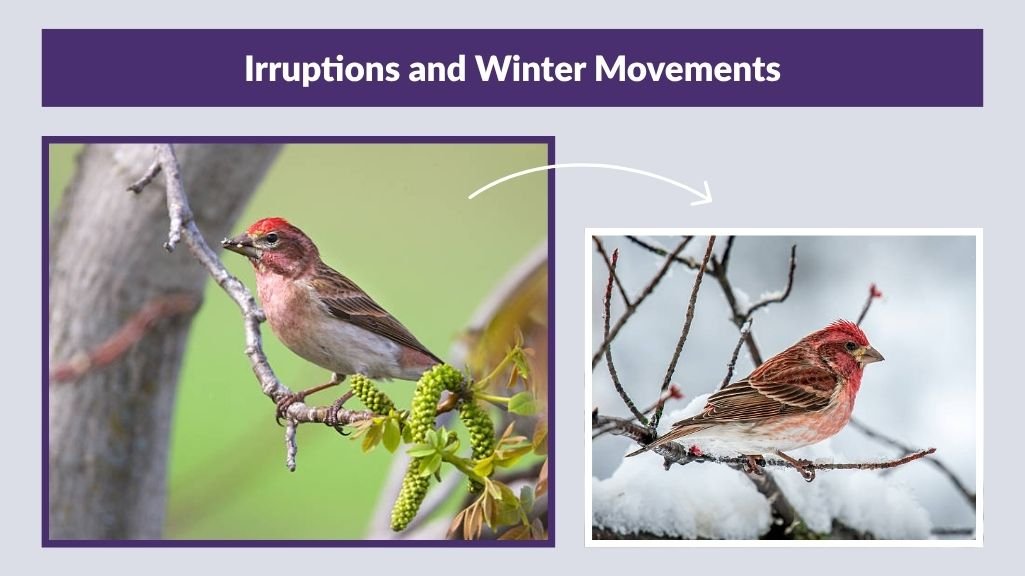
Cassin’s Finch populations may descend to lower elevations in winter, sometimes forming large flocks in valleys or at feeders. Irruptions occur when seed availability is low at higher elevations. These movements provide opportunities to observe mixed flocks and to compare species differences in the field.
Winter Flocks
Cassin’s Finches often join small or moderate-sized flocks. They feed in trees, shrubs, or at feeders. Flocking improves foraging efficiency and reduces predation risk. Birds may mix with House Finches or Pine Siskins in some regions.
Irruptions
When high-elevation seed crops fail, Cassin’s Finches may travel farther south than usual. Such movements are irregular and may result in sightings in lower-elevation areas or outside their typical range.
Interesting Facts
Overview: Cassin’s Finch exhibits remarkable adaptations for mountain environments. Its feeding behavior, flight patterns, and social interactions enable survival in harsh climates. Coloration, courtship, and flocking behavior make it a favorite among birdwatchers and provide useful markers for identification.
- Can survive at elevations above 2,500 meters
- Uses its small conical bill efficiently to extract seeds from cones
- Courtship dancing and wing fluttering are unique to the species
- Juveniles can be challenging to distinguish from females and House Finches
- Flocks in winter may contain mixed species, including House and Purple Finches
FAQs
How do you distinguish Cassin’s Finch from a House Finch?
Cassin’s males are pinkish-red on the head and chest; House Finch males have more variable red patterns, sometimes extending onto the back. Vocalizations also differ: Cassin’s song is simpler, while House Finch has a complex warble.
Where do Cassin’s Finches breed?
They breed in western coniferous forests, primarily in the Rocky Mountains, Sierra Nevada, and Pacific Northwest, usually at higher elevations.
What do they eat?
Primarily seeds from conifers and thistles. During the breeding season, insects and buds provide protein for chicks.
How can you identify a female Cassin’s Finch?
Females are brown with streaked underparts and may show faint pink on the head. Juveniles are duller with no red forehead.
Do Cassin’s Finches appear in the eastern U.S.?
Rarely, usually as vagrants. Most sightings occur in western mountains or lower-elevation wintering areas.