
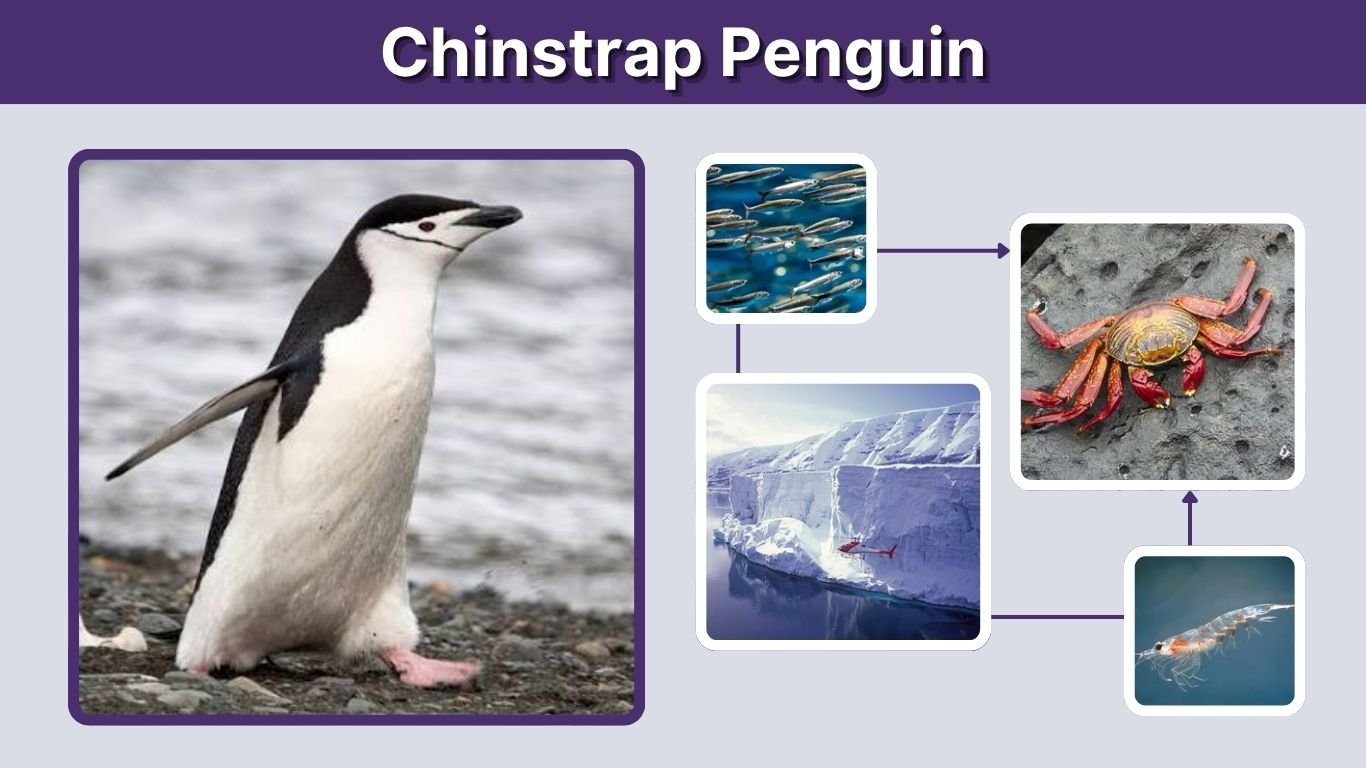
The chinstrap penguin is one of Antarctica’s most recognizable seabirds, named for the thin black line running beneath its chin like a helmet strap. These energetic penguins live in enormous colonies around the Antarctic Peninsula and nearby islands, where they breed on rocky, ice-free ground. Chinstraps are skilled swimmers that depend heavily on Antarctic krill for food. From their unusual microsleep habits to their dedicated parenting behavior, chinstrap penguins have several remarkable adaptations that help them survive the harsh Southern Ocean environment.
Chinstrap Penguin Facts and Physical Characteristics
Chinstrap penguins are medium-sized members of the brush-tailed penguin group. Their bold black-and-white plumage makes adults relatively easy to identify, especially because no other penguin has the same narrow black line beneath the chin. They are closely related to Adélie and gentoo penguins and share many of the swimming and cold-weather adaptations typical of Antarctic penguins.
Scientific Name and Classification
The chinstrap penguin is commonly given the scientific name Pygoscelis antarcticus, although some Antarctic scientific authorities use Pygoscelis antarctica. It belongs to the family Spheniscidae and the genus Pygoscelis, along with Adélie and gentoo penguins.
Chinstrap Penguin Size, Height, and Weight
Typical physical characteristics include:
- Height: About 68–75 cm, or roughly 27–30 inches
- Weight: Approximately 3.5–5.5 kg, or 7.7–12 pounds
- Body: White underside with a black back and head
- Chin marking: Thin black feather band extending beneath the chin
- Feet: Pinkish to orange with dark soles
- Eyes: Reddish-brown
- Bill: Short, strong, and black
Males and females look very similar, although males tend to be somewhat larger and heavier.
What Does a Chinstrap Penguin Look Like?
The easiest identification feature is its distinctive black “chinstrap.” Its face is largely white, while the top of the head is black. The contrasting black back and white belly also provide countershading in the ocean, helping the penguin blend with dark water when viewed from above and brighter surface light when viewed from below.
Chinstrap Penguin Habitat and Distribution
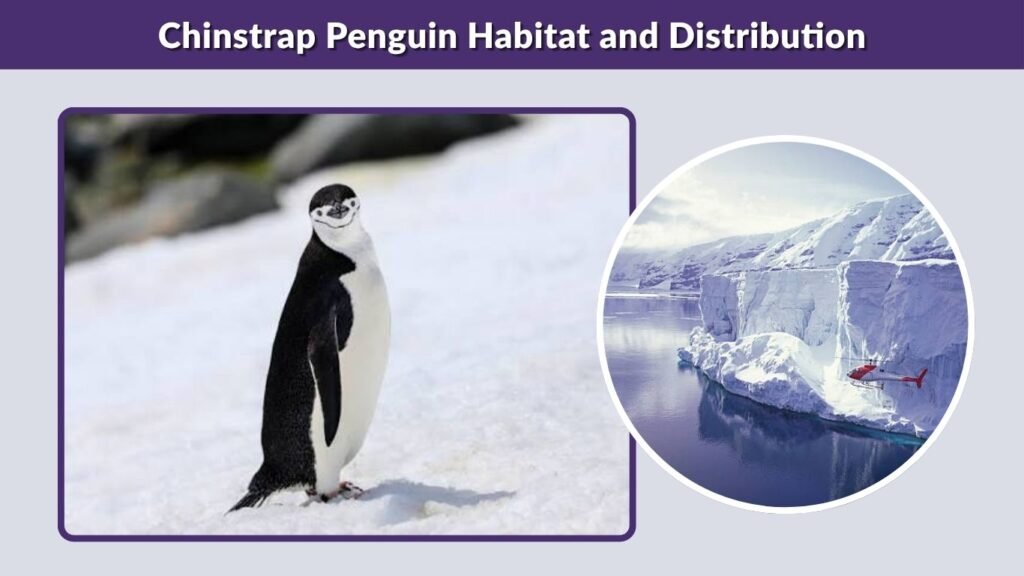
The chinstrap penguin habitat centers on the cold waters and rocky islands of the Southern Ocean. Although strongly associated with Antarctica, chinstraps generally prefer relatively ice-free breeding locations rather than the interior of the continent. Large colonies occur throughout the Antarctic Peninsula region, particularly where exposed slopes provide suitable nesting areas close to productive feeding waters.
Where Does the Chinstrap Penguin Live?
Major breeding areas include the Antarctic Peninsula, South Shetland Islands, South Orkney Islands and South Sandwich Islands. Smaller populations occur around South Georgia, Bouvet Island and the Balleny Islands. A global assessment found that most breeding chinstraps are concentrated in the southwest Atlantic sector of the Southern Ocean.
Chinstrap Penguin Habitat Adaptations
Several adaptations allow these birds to function in freezing conditions:
- Dense, overlapping feathers create an insulating waterproof layer.
- Body fat provides additional protection against cold temperatures.
- Streamlined bodies reduce resistance while swimming.
- Powerful flippers provide underwater propulsion.
- Countershading provides camouflage while at sea.
- Strong feet, claws and bills help them climb steep rocky nesting areas.
Chinstraps can also slide across snow and ice on their bellies in a form of movement known as tobogganing.
Colonies and Seasonal Movement
During breeding, thousands of chinstrap penguins may gather on exposed rocky slopes. Some colonies contain well over 100,000 breeding pairs, while Zavodovski Island supports more than one million breeding chinstrap penguins. After breeding and moulting, many birds move north of the pack-ice zone for winter before returning during spring.
Chinstrap Penguin Diet and Feeding Behavior
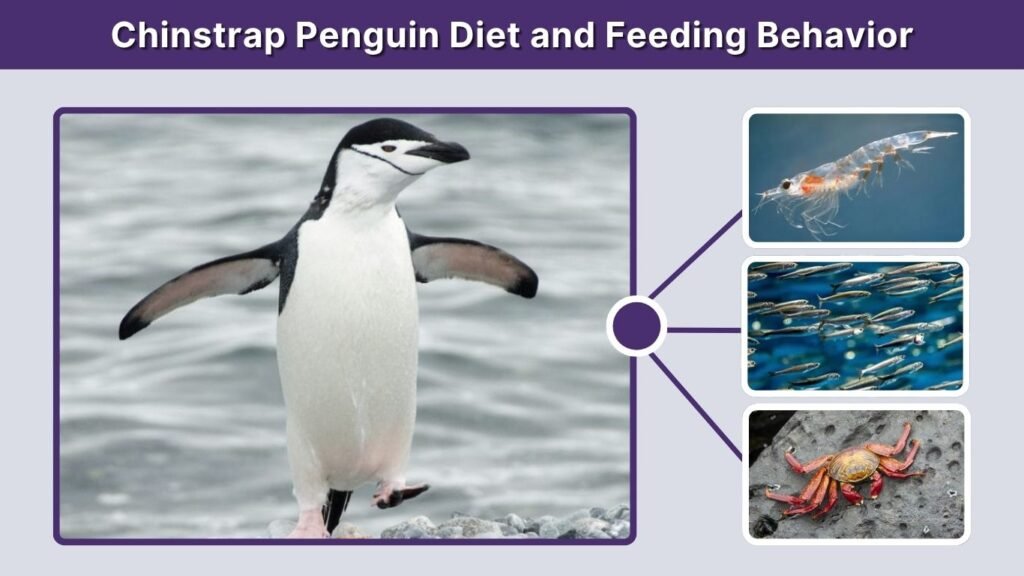
The chinstrap penguin diet is closely tied to the Southern Ocean food web. Antarctic krill are particularly important, although fish and other small marine organisms may also be eaten. Because prey availability varies by location and season, these penguins adjust their feeding behavior and diving patterns as conditions change. Their dependence on marine prey also makes them useful indicators of ecosystem changes.
What Does a Chinstrap Penguin Eat?
Common foods include:
- Antarctic krill
- Small fish
- Other crustaceans
- Amphipods
- Occasional squid and similar marine prey
Studies at Signy Island have found Antarctic krill making up the overwhelming majority of food consumed by chinstraps during some breeding periods.
Swimming and Hunting
Chinstrap penguins pursue prey underwater using their flippers like wings. Many feeding dives occur within the upper 40 meters of water, although considerably deeper dives have been recorded. Research has documented dives reaching roughly 179 meters under some conditions, demonstrating considerable flexibility in their foraging behavior.
Chinstrap Penguin Predators
Their main predators include:
- Leopard seals: Important predators of adults at sea
- Killer whales: Can prey on swimming penguins
- Skuas: Frequently take exposed eggs and young chicks
- Southern giant petrels: May prey on chicks
- Sheathbills: Can take eggs and vulnerable young
Adults therefore face different dangers depending on whether they are swimming, nesting or protecting chicks.
Breeding, Chicks, Sleep, and Life Cycle
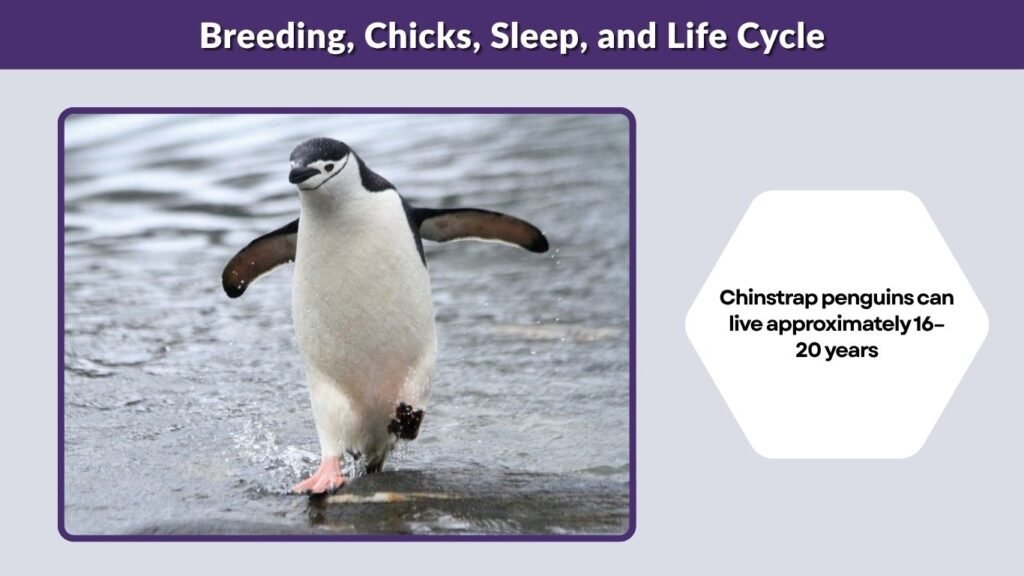
Chinstrap penguins return to breeding areas during the Antarctic spring, commonly between October and November. Their reproductive cycle requires close cooperation between both parents because eggs and young chicks need protection while adults must also travel to sea for food. This demanding period has produced some especially unusual behavior, including one of the most fragmented sleep patterns documented in birds.
Eggs and Chinstrap Penguin Chicks
Females normally lay two eggs, typically in late November. Both parents incubate them, and incubation usually lasts around 33–36 days. Newly hatched chicks have soft gray down and remain dependent on their parents for food and protection. They later join groups called crèches and generally fledge at roughly seven to eight weeks of age.
Chinstrap Penguin Sleep and Microsleeps
One of the most fascinating chinstrap penguin facts involves sleep. Researchers studying nesting birds found that they could fall asleep more than 10,000 times per day, with individual microsleeps averaging only about four seconds. Despite these extremely short naps, the accumulated sleep exceeded 11 hours per day for each brain hemisphere.
This strategy may allow a nesting bird to gain necessary rest while repeatedly becoming alert enough to monitor eggs, chicks, predators and aggressive neighbors.
Chinstrap Penguin Lifespan
Chinstrap penguins can live approximately 16–20 years, although individual survival varies with food supply, predation, breeding conditions and environmental changes. They may begin breeding at around three years old. Adult pairs often return to established breeding areas during subsequent seasons.
Chinstrap Penguin Population and Conservation Status
Chinstrap penguins remain widespread and numerous, but their abundance is not uniform across Antarctica. Some colonies remain exceptionally large while others have experienced major declines. Scientists therefore monitor individual colonies, breeding success and food availability rather than relying only on a single global population figure. These studies are particularly important because chinstraps depend heavily on krill and changing Southern Ocean conditions.
How Many Chinstrap Penguins Are Left?
A comprehensive global assessment published in 2020 estimated approximately 3.42 million breeding pairs across 375 extant breeding sites. The researchers also found that among colonies with sufficient historical information, many had declined since counts made during the 1980s, while some had increased.
Is the Chinstrap Penguin Endangered?
The chinstrap penguin is currently classified as Least Concern, but the overall population trend has been described as decreasing. Climate-driven changes in marine ecosystems, shifts in krill availability and interactions with fisheries are among the issues scientists continue to investigate. Conservation monitoring around Antarctica helps researchers understand how these pressures affect individual colonies.
FAQs
Chinstrap penguins attract attention not only because of their distinctive appearance but also because of their huge colonies, unusual sleeping pattern and ability to survive around the Southern Ocean. These quick answers cover several of the most common questions about their habitat, diet, lifespan and behavior.
1. Why is it called a chinstrap penguin?
It gets its name from the narrow black line of feathers running from one side of its head to the other underneath the chin. The marking resembles the strap of a helmet.
2. Where do chinstrap penguins live?
They live mainly around the Antarctic Peninsula and nearby Southern Ocean islands, especially the South Shetland, South Orkney and South Sandwich Islands.
3. What do chinstrap penguins eat?
Their diet consists mainly of Antarctic krill, supplemented by fish and other small marine animals. Diet composition varies with location and prey availability.
4. How long does a chinstrap penguin live?
A chinstrap penguin may live for approximately 16 to 20 years under natural conditions.
5. Do chinstrap penguins really sleep thousands of times a day?
Yes. Research on nesting chinstraps recorded more than 10,000 brief microsleeps per day, averaging about four seconds each. Together, those naps allowed the birds to accumulate more than 11 hours of sleep while remaining repeatedly alert around their nests.
