
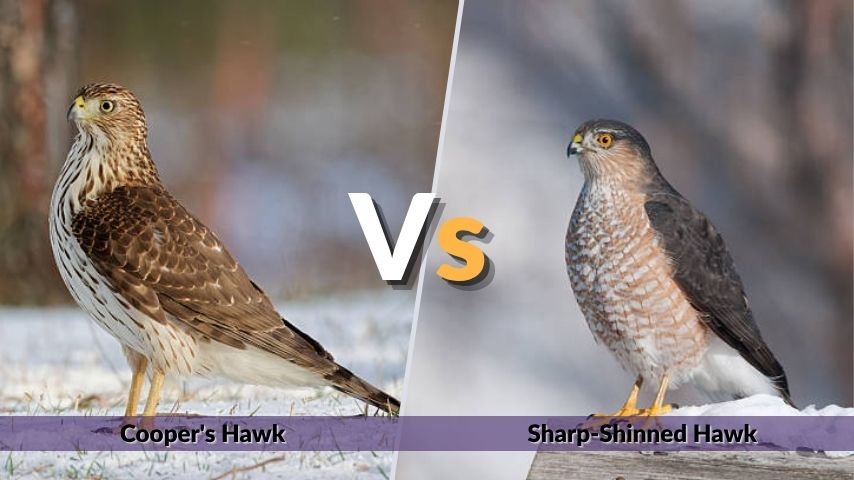
Birdwatchers often struggle to distinguish a Cooper’s Hawk from a Sharp-Shinned Hawk because both belong to the Accipiter family and share many physical traits. At first glance, they appear nearly identical, especially when seen in flight or from a distance. However, several important differences can help with identification. Understanding their size, body shape, behavior, and habitat preferences makes it much easier to tell these two raptors apart. This guide explores the most reliable field marks and characteristics that separate Cooper’s Hawks from Sharp-Shinned Hawks.
Cooper’s Hawk vs Sharp-Shinned Hawk: Quick Comparison
Before diving into detailed identification features, it helps to compare the most noticeable differences side by side. While both species are agile hunters that specialize in capturing birds, their size, appearance, and behavior vary significantly.
| Feature | Cooper’s Hawk | Sharp-Shinned Hawk |
| Average Length | 14–20 inches | 9–13 inches |
| Wingspan | 24–35 inches | 17–22 inches |
| Head Shape | Large and blocky | Small and rounded |
| Tail Shape | Rounded tip | Square tip |
| Preferred Habitat | Forest edges and suburbs | Dense forests |
| Common Prey | Medium-sized birds | Small songbirds |
What Is a Cooper’s Hawk?
Cooper’s Hawk (Accipiter cooperii) is a medium-sized bird of prey commonly found across North America. It has adapted well to suburban neighborhoods, wooded parks, and residential areas where bird feeders attract potential prey. This species is known for its powerful flight and remarkable agility while pursuing birds through trees.
Physical Characteristics
Several traits make Cooper’s Hawks easier to recognize:
- Large, blocky head
- Long tail with rounded edges
- Broad chest and sturdy body
- Red eyes in mature adults
- Blue-gray back and wings
Adult females are considerably larger than males, which can sometimes make identification more challenging.
Habitat and Distribution
Cooper’s Hawks occupy a wide range of environments. They thrive in mixed woodlands, suburban neighborhoods, parks, and forest edges. Their ability to adapt to human development has helped their population remain stable across much of North America.
What Is a Sharp-Shinned Hawk?
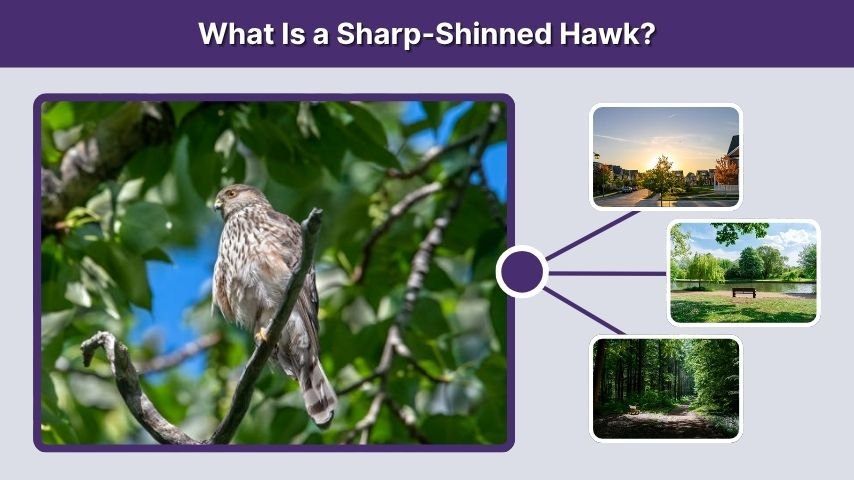
The Sharp-Shinned Hawk (Accipiter striatus) is the smallest hawk in North America. Although it resembles a miniature Cooper’s Hawk, its smaller size and different body proportions provide valuable identification clues. This species spends much of its time in dense forests and wooded habitats.
Physical Characteristics
Sharp-Shinned Hawks display several unique features:
- Small, rounded head
- Slim body structure
- Short neck
- Square-tipped tail
- Thin legs and feet
Their compact build allows them to maneuver quickly through dense woodland environments while chasing small birds.
Habitat and Distribution
Unlike Cooper’s Hawks, Sharp-Shinned Hawks prefer heavily forested areas. They are especially common in coniferous forests during the breeding season. During migration, they may also appear in suburban areas, parks, and backyard feeding stations where songbirds gather.
Size Differences Between Cooper’s Hawk and Sharp-Shinned Hawk
Size remains one of the most reliable ways to distinguish these two species. However, observers should remember that female Sharp-Shinned Hawks can sometimes overlap in size with male Cooper’s Hawks.
Body Size Comparison
Cooper’s Hawks are noticeably larger and heavier than Sharp-Shinned Hawks. Many birders compare the size difference to that of a crow versus a blue jay.
A Cooper’s Hawk generally appears more powerful, with a broader chest and longer body. In contrast, a Sharp-Shinned Hawk has a lightweight, compact appearance that reflects its specialization in hunting small songbirds.
Why Size Can Be Misleading
Size alone should never be used as the only identification factor. Viewing distance, lighting conditions, and the absence of nearby objects for comparison can distort perceptions. For this reason, experienced birdwatchers combine size estimates with other field marks such as head shape and tail structure.
Head Shape and Facial Features
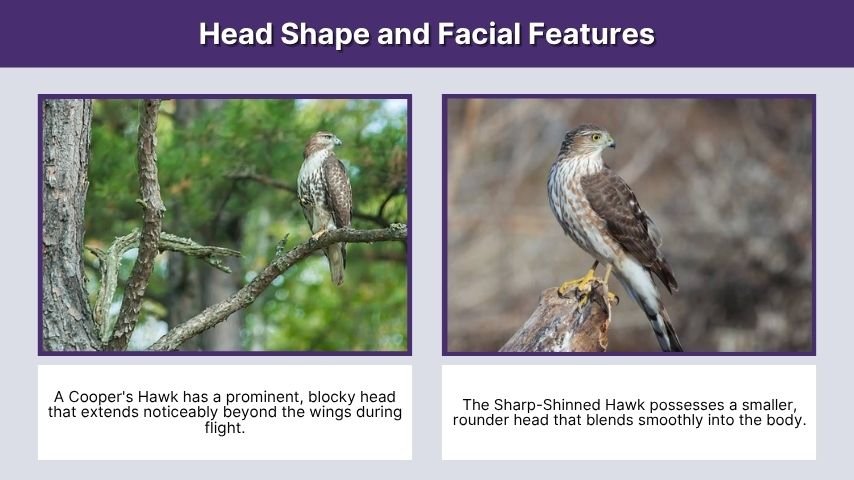
Head shape is often considered the quickest way to identify these hawks in the field. Even when perched far away, differences in the head and facial structure can be surprisingly noticeable.
Cooper’s Hawk Head Shape
A Cooper’s Hawk has a prominent, blocky head that extends noticeably beyond the wings during flight. The larger head gives the bird a fierce and confident appearance.
The eyes are positioned closer to the front of the face, creating a more intense expression. Mature birds often display deep red eyes that stand out against their darker head coloration.
Sharp-Shinned Hawk Head Shape
The Sharp-Shinned Hawk possesses a smaller, rounder head that blends smoothly into the body. Its head projects less noticeably during flight, creating a streamlined silhouette.
Because the eyes appear larger relative to the head, many observers describe the species as having a softer facial expression compared to the more aggressive appearance of the Cooper’s Hawk.
Tail Shape: One of the Best Identification Clues
Tail shape provides another dependable method for separating these two raptors. When viewed from behind or while perched, the difference can often be obvious.
Cooper’s Hawk Tail
The Cooper’s Hawk features a rounded tail tip because its outer tail feathers are shorter than the central feathers. This creates a curved appearance that remains visible in both perched and flying birds.
Sharp-Shinned Hawk Tail
The Sharp-Shinned Hawk typically shows a squared-off tail tip. Its tail feathers are nearly equal in length, resulting in a straighter and more even edge.
For many birders, tail shape becomes the deciding characteristic when size and head shape are difficult to judge.
Flight Behavior Comparison
Flight patterns can reveal important clues when trying to identify a hawk in motion. Although both species are fast and agile, they move differently in the air.
Cooper’s Hawk Flight Style
Cooper’s Hawks display strong, deliberate wingbeats followed by short glides. Their larger body and broader wings create a powerful appearance during flight.
Common flight characteristics include:
- Slow, steady wingbeats
- Deep gliding motions
- Strong pursuit flights through trees
- Confident soaring over open areas
Their larger size often makes them appear less frantic and more controlled in the air.
Sharp-Shinned Hawk Flight Style
Sharp-Shinned Hawks are known for rapid wingbeats and exceptional maneuverability. Their smaller body allows them to weave through dense forest cover with remarkable speed.
Birdwatchers often notice:
- Quick, fluttering wingbeats
- Faster directional changes
- Compact flight profile
- Agile movement through wooded habitats
These behaviors reflect their specialization in hunting small birds among thick vegetation.
Juvenile Cooper’s Hawk vs Juvenile Sharp-Shinned Hawk
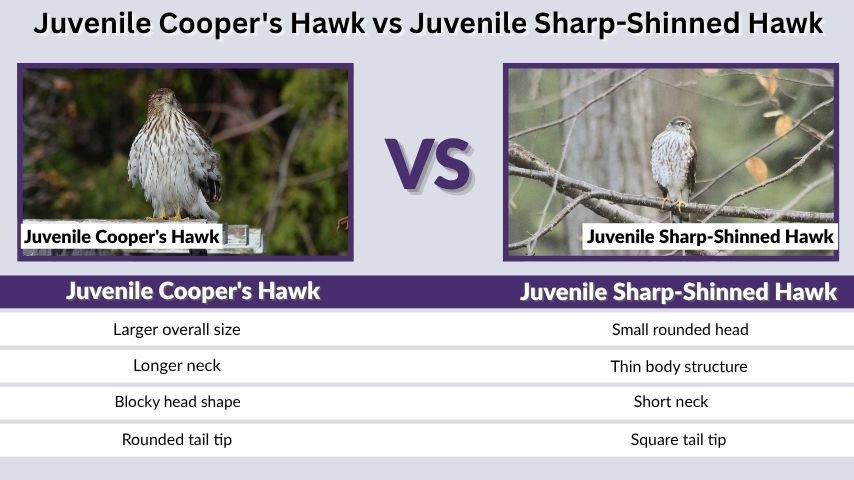
Juvenile birds are often more difficult to identify because they lack many of the adult features that birders rely on. Both species display brown upperparts and streaked underparts during their first year.
Juvenile Cooper’s Hawk
Young Cooper’s Hawks typically show heavier bodies and broader chests. Their streaking tends to appear thicker and more concentrated on the breast.
Additional identification clues include:
- Larger overall size
- Longer neck
- Blocky head shape
- Rounded tail tip
These features remain useful even before the bird develops adult plumage.
Juvenile Sharp-Shinned Hawk
Juvenile Sharp-Shinned Hawks maintain their compact proportions from an early age. Their body appears slimmer, and their head often seems tucked into the shoulders.
Key field marks include:
- Small rounded head
- Thin body structure
- Short neck
- Square tail tip
Combining these characteristics helps improve identification accuracy when observing young birds.
Hunting Behavior and Diet
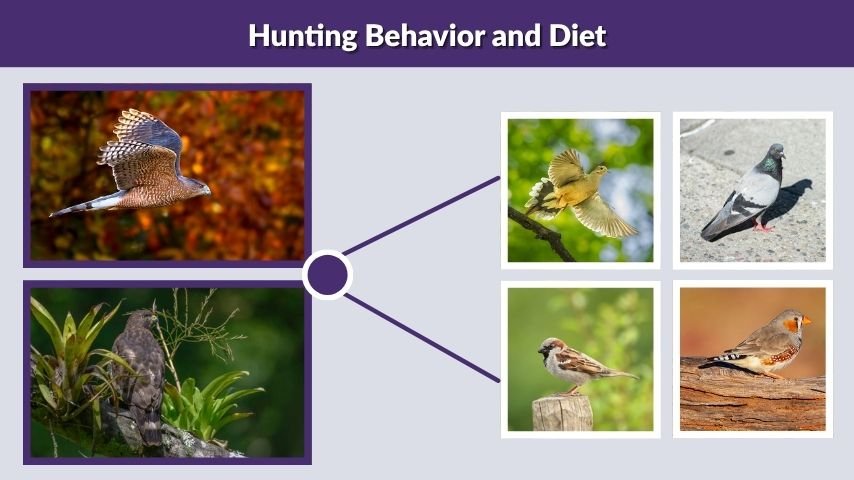
Both species are skilled predators, but their hunting strategies differ due to size and habitat preferences. Understanding these differences can provide valuable identification clues.
Cooper’s Hawk Hunting Techniques
Cooper’s Hawks frequently target medium-sized birds such as doves, pigeons, and jays. They often launch surprise attacks from concealed perches and use their speed to capture prey.
Because they have adapted well to urban environments, they are frequently observed near backyard bird feeders where prey is abundant.
Sharp-Shinned Hawk Hunting Techniques
Sharp-Shinned Hawks primarily hunt small songbirds. Their lightweight build allows them to pursue prey through dense vegetation where larger predators would struggle.
They commonly target:
- Sparrows
- Finches
- Chickadees
- Warblers
Their hunting style relies heavily on agility and quick bursts of speed.
Calls and Vocalizations
Vocalizations are not always heard, but they can assist with identification during the breeding season.
Cooper’s Hawk Call
Cooper’s Hawks produce a series of loud, repeated calls often described as a sharp “cak-cak-cak-cak.” These sounds are commonly heard near nesting territories.
The call tends to be deeper and stronger than that of the Sharp-Shinned Hawk.
Sharp-Shinned Hawk Call
Sharp-Shinned Hawks produce higher-pitched vocalizations. Their calls are often described as rapid, sharp notes repeated several times in succession.
Because they spend much of their time in dense forests, these sounds may be heard more often than the birds are seen.
Common Identification Mistakes
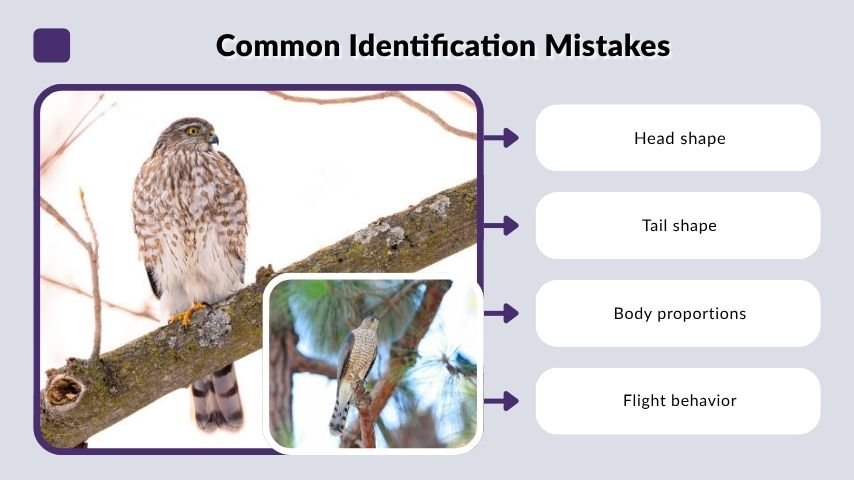
Even experienced birdwatchers occasionally confuse these two species. Several factors contribute to misidentification.
Relying Only on Size
Size can be deceptive, especially when there are no nearby objects for comparison. A large female Sharp-Shinned Hawk may appear similar in size to a small male Cooper’s Hawk.
Ignoring Multiple Field Marks
Using a single characteristic often leads to mistakes. Accurate identification usually requires evaluating several features together, including:
- Head shape
- Tail shape
- Body proportions
- Flight behavior
- Habitat
Misidentifying Juveniles
Young birds lack the distinctive colors of adults, causing many observers to rely on plumage alone rather than structure and proportions.
Expert Tips for Accurate Hawk Identification
Successful identification often comes down to observing overall shape rather than focusing on a single detail.
Best Features to Observe
When viewing an unfamiliar hawk, prioritize these characteristics:
- Relative size
- Head projection
- Tail shape
- Neck length
- Flight pattern
These traits are often more reliable than color patterns.
Observation Strategy
Spend time watching how the bird moves, perches, and interacts with its environment. The longer the observation, the easier it becomes to notice subtle differences that separate the two species.
FAQs
Which is bigger, a Cooper’s Hawk or a Sharp-Shinned Hawk?
A Cooper’s Hawk is noticeably larger than a Sharp-Shinned Hawk. Adult Cooper’s Hawks measure about 14–20 inches in length with a wingspan of up to 35 inches, while Sharp-Shinned Hawks typically reach only 9–13 inches long with a wingspan of 17–22 inches.
What is the easiest way to tell a Cooper’s Hawk from a Sharp-Shinned Hawk?
The easiest identification clues are head shape and tail shape. Cooper’s Hawks have a larger, blocky head and a rounded tail tip, while Sharp-Shinned Hawks have a smaller, rounded head and a square-tipped tail.
Do Cooper’s Hawks and Sharp-Shinned Hawks hunt the same prey?
Both species primarily hunt birds, but their prey size differs. Cooper’s Hawks often target doves, pigeons, and larger songbirds, whereas Sharp-Shinned Hawks usually prey on smaller birds such as sparrows, finches, and chickadees.
Which hawk is more likely to visit backyard bird feeders?
Cooper’s Hawks are more commonly seen around backyard bird feeders because they have adapted well to suburban and urban environments. However, both species may visit feeders to hunt birds rather than feed on seed.
Are Cooper’s Hawks and Sharp-Shinned Hawks found in the same areas?
Yes, their ranges overlap across much of North America. Cooper’s Hawks prefer forest edges, parks, and suburban neighborhoods, while Sharp-Shinned Hawks are more often found in dense forests, especially during the breeding season. During migration, both species may be observed in similar habitats.
