
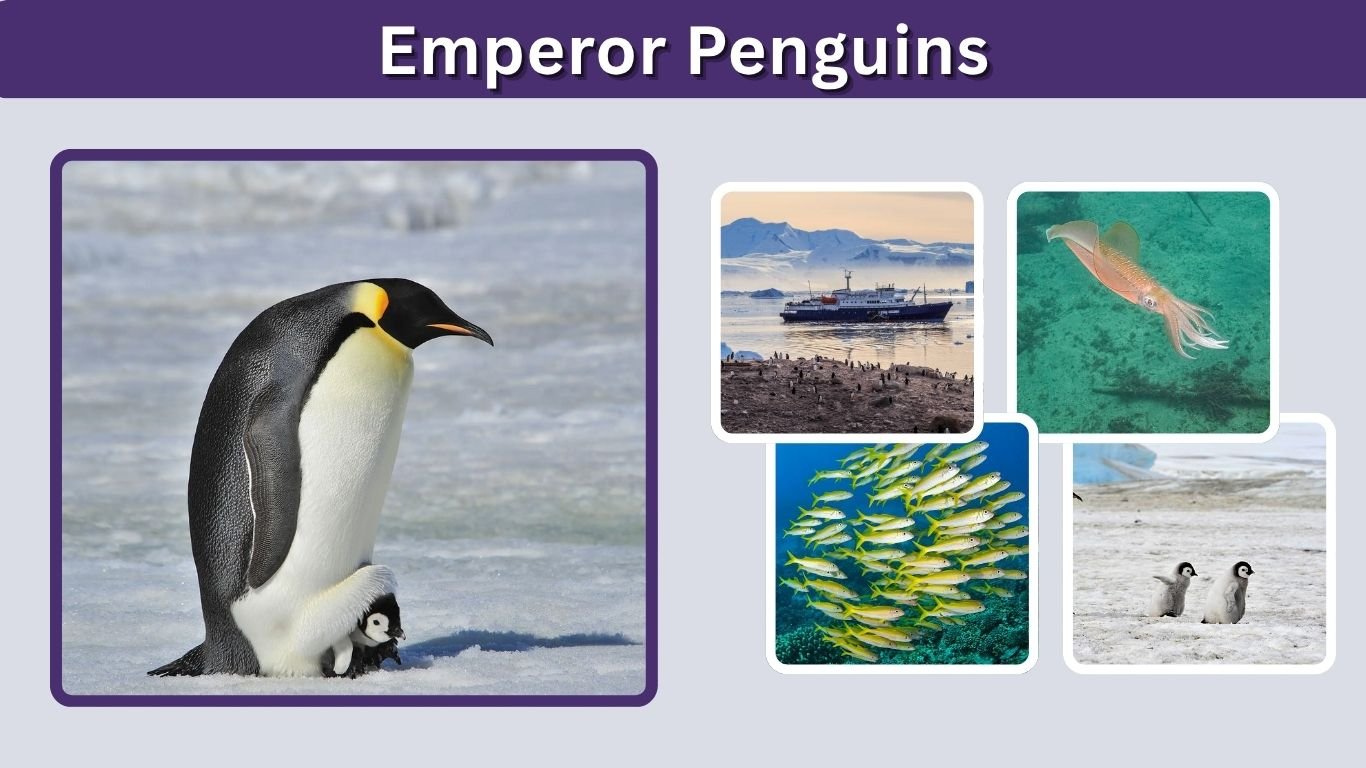
Emperor penguins (Aptenodytes forsteri) are the largest living penguins and among the most remarkable animals in Antarctica. They endure the brutal Antarctic winter, breed on sea ice, dive hundreds of meters for food, and gather in tightly packed huddles to conserve warmth. Adults can weigh around 40 kg before the breeding season, while their diet consists mainly of fish, krill, and squid. This guide covers emperor penguin size, habitat, food, lifespan, behavior, breeding, adaptations, predators, conservation status, and interesting facts.
What Are Emperor Penguins?
Emperor penguins are flightless seabirds found only in Antarctica and the surrounding Southern Ocean. Their scientific name is Aptenodytes forsteri. They are immediately recognizable by their large bodies, black-and-white plumage, and yellow-orange patches around the neck. Unlike most penguins, emperors undertake their breeding cycle during the Antarctic winter, when conditions are extraordinarily cold and windy.
Emperor Penguin Identification
- Scientific name: Aptenodytes forsteri
- Largest living penguin species
- Black head and back
- White belly
- Yellow-orange patches around the neck
- Long, slightly curved bill
- Short, powerful legs
- Stiff flippers adapted for swimming
- Dense insulating plumage
Adult emperor penguins are substantially larger than most other penguin species. Their upright stance, long body, and bright neck markings make mature birds relatively easy to recognize.
Where Do Emperor Penguins Live?
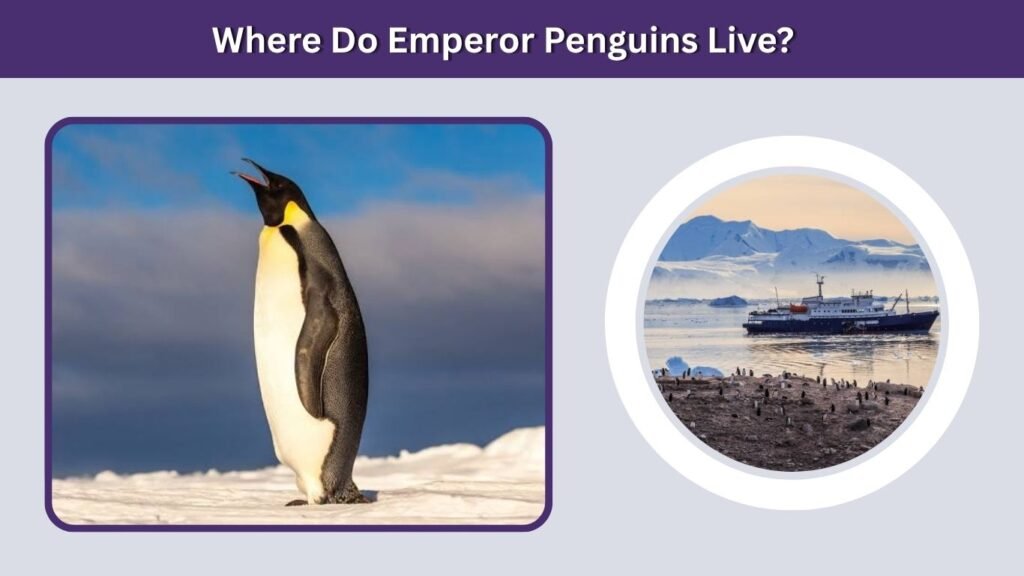
Emperor penguins are uniquely associated with Antarctica. Most breeding colonies occur on stable fast ice attached to the Antarctic coast, although some colonies have also been recorded on ice shelves or land. They depend heavily on sea ice during reproduction but require access to open water for feeding, creating a close connection between their survival and seasonal Antarctic ice conditions.
Emperor Penguin Habitat
During autumn, adults travel to breeding colonies as sea ice forms and becomes strong enough to support them. Colonies may be located considerable distances from open water.
Outside breeding periods, emperor penguins spend much more time in the marine environment. They forage throughout Antarctic waters, diving beneath sea ice and traveling substantial distances in search of prey.
Do Emperor Penguins Live at the South Pole?
No. Emperor penguins live around coastal Antarctica rather than at the geographic South Pole itself. Their survival depends on access to marine food, so colonies form closer to coastal areas and sea ice connected with the Southern Ocean.
The interior South Pole is far from productive ocean habitat and is therefore unsuitable for emperor penguins.
What Do Emperor Penguins Eat?
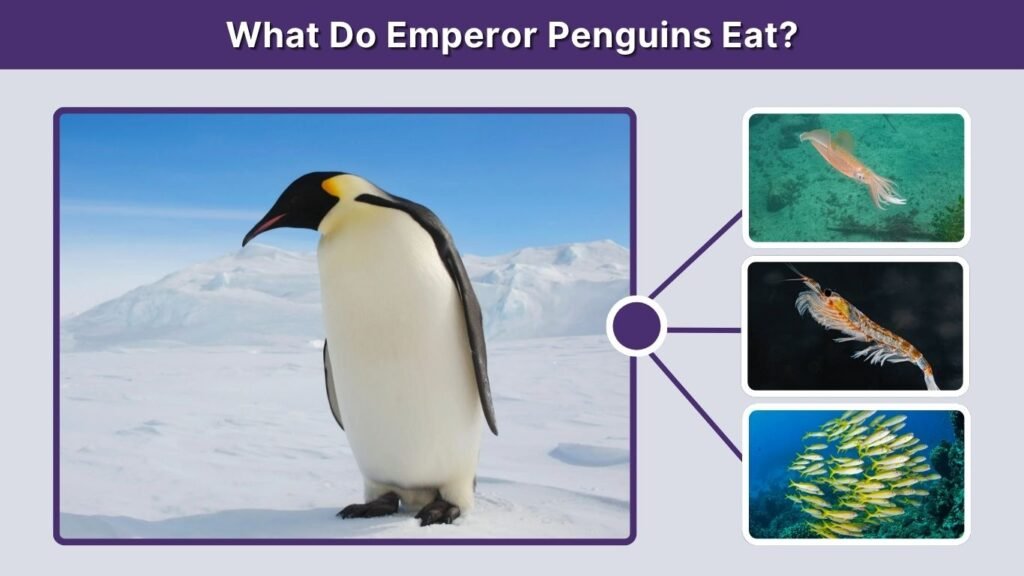
Emperor penguins are carnivorous marine predators. Their diet changes according to location, season, and prey availability, but fish are especially important. Antarctic silverfish are among their most frequently eaten prey. Emperor penguins are powerful divers and can travel well below the surface to pursue prey that would be inaccessible to many other seabirds.
Emperor Penguin Diet
- Antarctic silverfish
- Other small fish
- Antarctic krill
- Squid
- Other small marine animals
An adult normally consumes around 2–3 kg of food per day, although individuals preparing for breeding or moulting may eat considerably more and build large energy reserves.
How Do Emperor Penguins Hunt?
Emperors propel themselves underwater using their powerful flippers while steering with their feet and bodies. Most foraging dives reach approximately 150–250 meters, although much deeper dives are possible.
The Australian Antarctic Program reports a deepest recorded dive of 565 meters and a longest recorded dive lasting about 22 minutes.
Emperor Penguin Size and Cold-Weather Adaptations
Being large provides an important advantage in Antarctica because a relatively low surface-area-to-volume ratio helps reduce heat loss. Emperor penguins combine this body shape with dense feathers, stored fat, specialized heat-conservation mechanisms, and cooperative huddling. These adaptations allow them to endure winter temperatures well below freezing while facing extremely powerful Antarctic winds.
How Big Are Emperor Penguins?
Adult emperors can weigh up to approximately 40 kg at the start of the breeding season, although their weight changes considerably as they fast and breed. They stand roughly 1.1 — 1.2 meters, or around 3.5 — 4 feet tall.
Males can lose a substantial proportion of their body weight while incubating an egg during the winter.
Adaptations That Help Emperor Penguins Survive
- Several layers of dense, scale-like feathers
- Thick reserves of body fat
- Small bills and flippers that reduce heat loss
- Nasal passages that recover heat from exhaled air
- Large body size that conserves warmth
- Huddling behavior during severe weather
- Powerful flippers for underwater hunting
- Physiological adaptations for deep diving
Their feathers provide such effective protection that winds exceeding roughly 110 km/h are required to noticeably ruffle them.
Emperor Penguin Breeding and Life Cycle
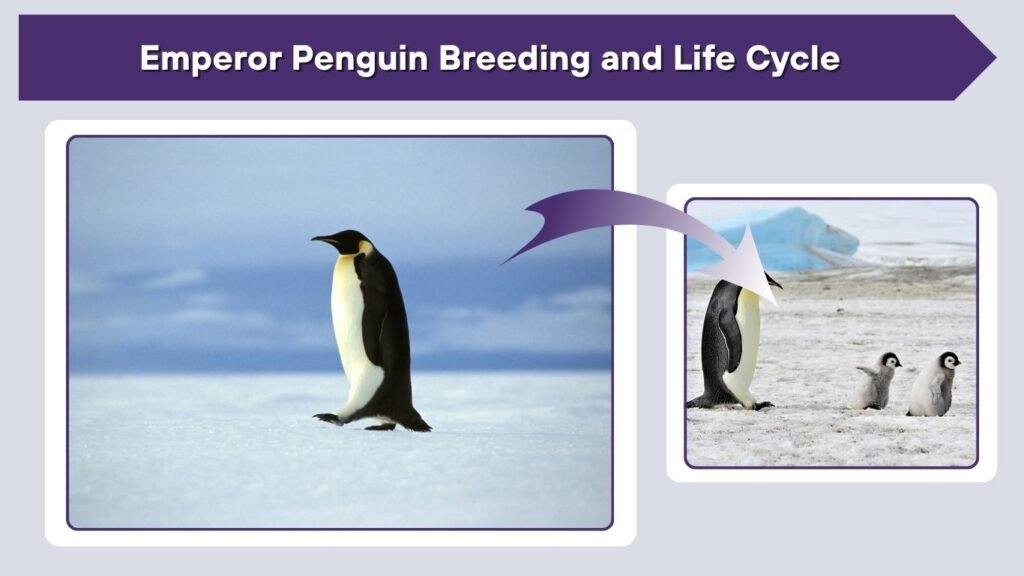
The emperor penguin has one of the most extraordinary breeding cycles of any bird. Rather than waiting for Antarctic summer, adults begin reproduction as winter approaches. Breeding on sea ice allows chicks to mature before the ice normally breaks up later in the year, but it also forces adults to tolerate darkness, intense cold, and long periods without food.
How Do Emperor Penguins Breed?
Adults arrive at breeding sites during autumn and form pairs through calls and courtship displays. The female eventually lays one egg, which she carefully transfers to the male.
The male places the egg on his feet beneath a warm fold of abdominal skin. He then remains at the colony through the harsh winter while the female travels to sea to feed.
Male Emperor Penguins Incubate the Egg
Incubation lasts approximately 65–75 days. Males cannot leave the egg to feed, so by the time hatching occurs they may have fasted for roughly four months and lost close to half their body mass.
Females return around the time chicks hatch and provide food, allowing exhausted males to travel back to sea.
Do Emperor Penguins Mate for Life?
Not necessarily. Emperor penguins may reunite with previous partners, but they are not permanently paired for life. Because breeding success depends on both adults arriving at the colony at the right time, individuals may choose new partners between seasons.
Their strong vocal recognition system helps mates locate one another in crowded colonies.
Why Do Emperor Penguins Huddle Together?
Huddling is one of the emperor penguin’s most famous behaviors. During Antarctic winter storms, males carrying eggs gather extremely close together to conserve body heat. Birds continually change positions, allowing individuals at the colder outer edge eventually to move toward the warmer interior. This social strategy significantly reduces the amount of energy required to maintain body temperature.
Surviving the Antarctic Winter
Emperor colonies can experience blizzards with winds approaching 200 km/h. A lone bird would lose heat much more rapidly under these conditions.
By forming moving huddles, thousands of penguins collectively reduce exposure. Their fat reserves and insulating feathers provide additional protection while males endure their prolonged breeding fast.
Emperor Penguin Predators and Lifespan
Emperor penguins occupy a high position in the Antarctic food web, but they are not free from predators. The threats faced by chicks and adults differ because young birds spend months on sea ice while adults regularly enter the ocean. Their long lifespan helps compensate for producing only one egg during each breeding attempt.
Common Emperor Penguin Predators
- Leopard seals
- Orcas or killer whales
- South polar skuas, particularly around vulnerable chicks
- Giant petrels, which may prey on chicks
Adult emperor penguins face their greatest predation risks in the water, particularly from leopard seals and killer whales.
How Long Do Emperor Penguins Live?
Some emperor penguins can live for more than 40 years, although most wild individuals do not survive that long. Their slow reproductive strategy depends on adults having opportunities to breed repeatedly across many years.
Emperor Penguin vs. King Penguin
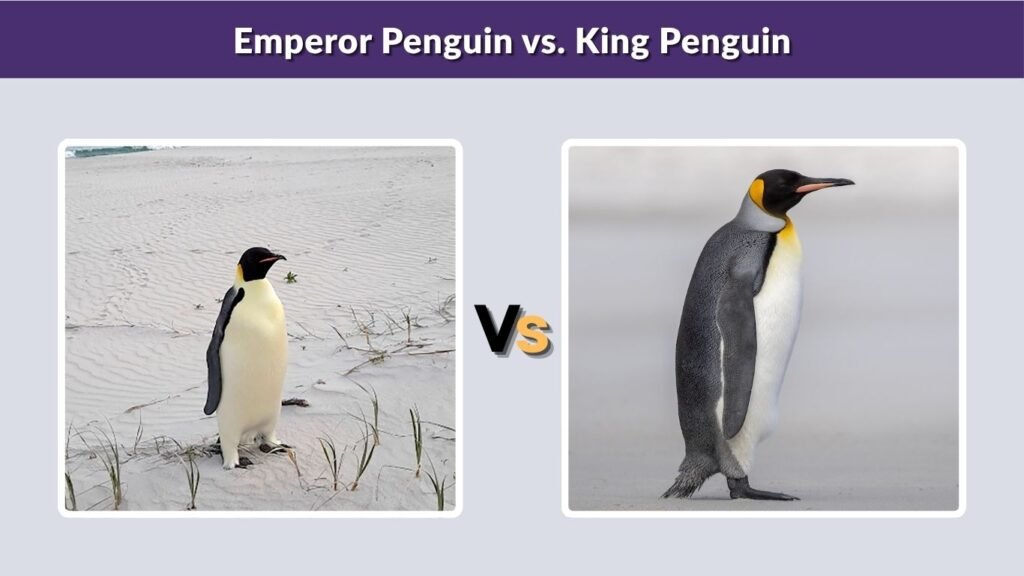
Emperor and king penguins are close relatives and share similar black, white, yellow, and orange coloration. However, emperors are larger and have a distinctly different breeding strategy. King penguins generally breed on subantarctic islands, whereas emperor penguins are strongly associated with Antarctic sea ice and famously reproduce during winter.
Main Difference Between Them
The emperor penguin is the largest living penguin, while the king penguin is the second largest. Emperor adults also tend to have paler yellow patches that blend into the upper breast, whereas king penguins often display brighter orange coloration.
Their life cycles are also different. Emperor males incubate a single egg through the Antarctic winter on sea ice.
Are Emperor Penguins Endangered?
The conservation outlook for emperor penguins has become increasingly concerning because their breeding cycle depends heavily on stable sea ice. Colonies can suffer severe breeding failure when ice breaks apart before chicks have developed waterproof plumage. Long-term climate-driven reductions in Antarctic sea ice are therefore expected to affect reproduction, moulting, feeding habitat, and population survival.
Current Conservation Status
In 2026, the Emperor Penguin was uplisted from Near Threatened to Endangered on the IUCN Red List. BirdLife International, the Red List Authority for birds, identified climate-driven sea-ice loss as the main reason for the worsening assessment.
Because emperor penguins produce only one chick per breeding attempt, repeated breeding failures can have significant long-term effects on populations.
FAQs
1. How tall are emperor penguins?
Adult emperor penguins stand approximately 1.1–1.2 meters, or around 3.5–4 feet tall, making them the tallest living penguin species.
2. What do emperor penguins eat?
Their diet consists mainly of fish, particularly Antarctic silverfish, along with krill and squid. Adults commonly consume about 2–3 kg of food per day.
3. How deep can emperor penguins dive?
Most feeding dives occur around 150–250 meters deep, but the deepest recorded emperor penguin dive reached approximately 565 meters.
4. Why do emperor penguins huddle?
They huddle to conserve heat and energy during extreme Antarctic winter conditions. Individuals continually reposition themselves so that different birds receive time in the warmer center of the group.
5. Are emperor penguins endangered?
Yes. In 2026, the IUCN assessment moved the Emperor Penguin from Near Threatened to Endangered, primarily because climate-driven sea-ice loss threatens future breeding success and population stability.