
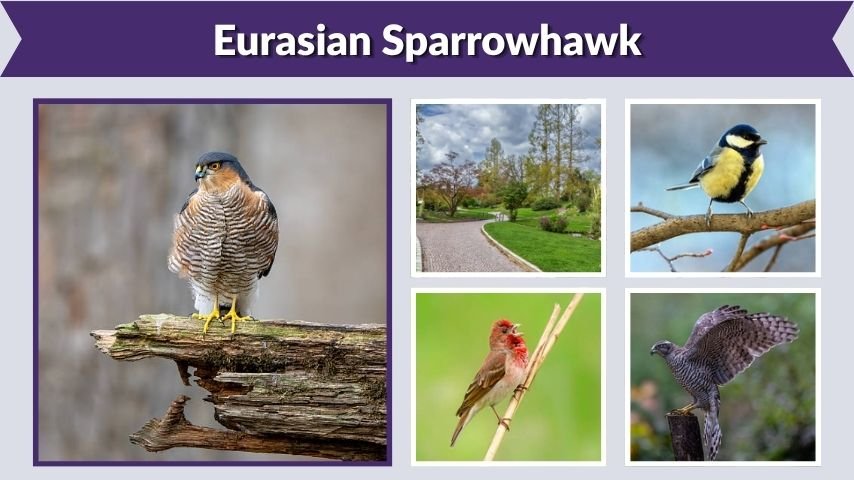
The Eurasian sparrowhawk is a small but powerful bird of prey known for fast flight, sharp talons, and sudden attacks on small birds. Its scientific name is Accipiter nisus, and it is common across Europe, parts of Asia, and some wintering areas in Africa. Males and females look quite different, with females much larger than males. This article explains the Eurasian sparrowhawk’s size, diet, habitat, call, hunting style, juvenile features, range, and key identification facts.
What Is a Eurasian Sparrowhawk?
The Eurasian sparrowhawk is a woodland hawk built for speed and surprise. It belongs to the accipiter group, which includes hawks with short rounded wings and long tails. These features help it twist through trees, hedges, gardens, and forest edges while chasing birds. In Britain and Ireland, it is often called simply the sparrowhawk.
Scientific Name and Classification
The scientific name of the Eurasian sparrowhawk is Accipiter nisus. It belongs to the family Accipitridae, which includes hawks, eagles, kites, buzzards, and other birds of prey. It is a true raptor, meaning it hunts live prey using sharp talons, strong eyesight, and quick flight.
This species is widely known across Europe and Asia. In the United Kingdom, Ireland, and many European countries, it is one of the most familiar small birds of prey.
Why It Is Called a Sparrowhawk
The name “sparrowhawk” comes from its habit of hunting small birds, including sparrows and other garden or woodland birds. However, it does not eat only sparrows. Its diet can include finches, tits, blackbirds, thrushes, starlings, and sometimes pigeons, especially when hunted by larger females.
Eurasian Sparrowhawk Size and Appearance
The Eurasian sparrowhawk is small compared with many hawks, but it is strong for its size. One of its most important features is sexual dimorphism, which means males and females differ greatly in size. Females are much larger and heavier, while males are smaller, slimmer, and more colorful, especially on the chest and underparts.
How Big Is a Eurasian Sparrowhawk?
A Eurasian sparrowhawk is built for speed, agility, and quick turns rather than heavy lifting. Its short wings allow rapid acceleration, and its long tail helps it steer during fast chases. Females can appear noticeably larger than males, especially when perched or carrying prey.
Key size features include:
- Small to medium-sized bird of prey
- Female much larger than male
- Short rounded wings
- Long narrow tail
- Slim body shape
- Sharp hooked bill
- Long legs and sharp talons
- Lightweight compared with goshawks
Male Eurasian Sparrowhawk
The male Eurasian sparrowhawk is smaller and often more colorful than the female. It usually has blue-grey upperparts and orange or rusty barring on the underparts. Its eyes are yellow to orange, giving it a sharp and alert expression.
Because the male is smaller, it usually catches smaller birds. Finches, tits, sparrows, and similar-sized birds are common prey. The male’s smaller body helps it move quickly and hunt in tighter spaces.
Female Eurasian Sparrowhawk
The female Eurasian sparrowhawk is larger, heavier, and browner than the male. She usually has brown or grey-brown upperparts and pale underparts with brown barring. Her size allows her to catch bigger birds, including blackbirds, thrushes, starlings, and sometimes pigeons.
Female sparrowhawks are often the birds people notice in gardens after a sudden attack. Their larger size can make them look similar to small goshawks, but they are still slimmer and lighter than true goshawks.
Juvenile Eurasian Sparrowhawk Identification
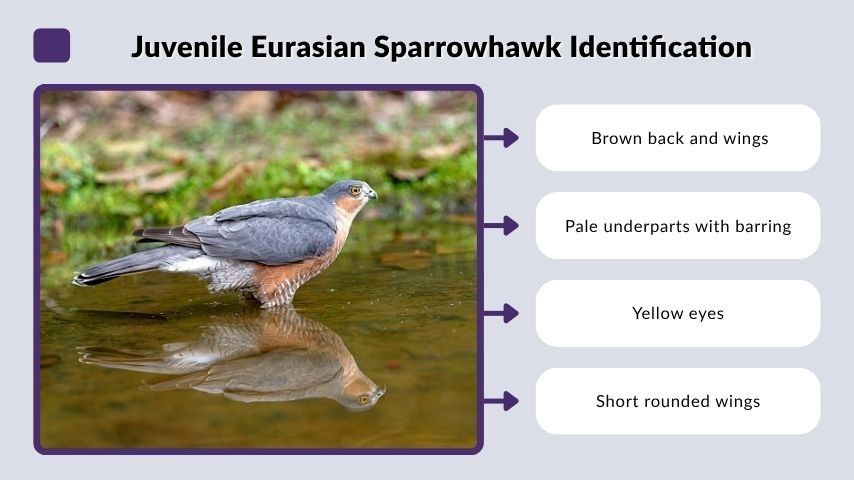
Juvenile Eurasian sparrowhawks can be confusing because they often resemble adult females. Young birds are usually brown above with barred or streaky underparts. Their plumage may look less neat than that of adults. Birdwatchers should look carefully at shape, flight style, eye color, and tail length when identifying juvenile birds.
What Does a Juvenile Eurasian Sparrowhawk Look Like?
A juvenile Eurasian sparrowhawk has brown upperparts and pale underparts marked with brown barring or streaky markings. Its eyes are usually yellow, and its body shape is slim with a long tail and short rounded wings.
Juvenile identification features include:
- Brown back and wings
- Pale underparts with barring
- Yellow eyes
- Long tail
- Short rounded wings
- Slim accipiter shape
- Less clean markings than adults
Juvenile vs Adult Sparrowhawk
Adult males are usually blue-grey above with orange barring below. Adult females are larger and brownish with barred underparts. Juveniles are also brown, but their markings often look messier or less even. They may appear warmer-toned than adult females.
The best way to identify a juvenile is to combine several clues. Plumage alone may not be enough, so shape, size, behavior, and flight pattern should also be considered.
Juvenile Sparrowhawk in Flight
In flight, a juvenile Eurasian sparrowhawk shows the same basic shape as adults. It has short rounded wings, a long tail, and fast wingbeats followed by short glides. It may fly low along hedges, woodland paths, walls, or garden edges before suddenly turning toward prey.
Eurasian Sparrowhawk Habitat and Range
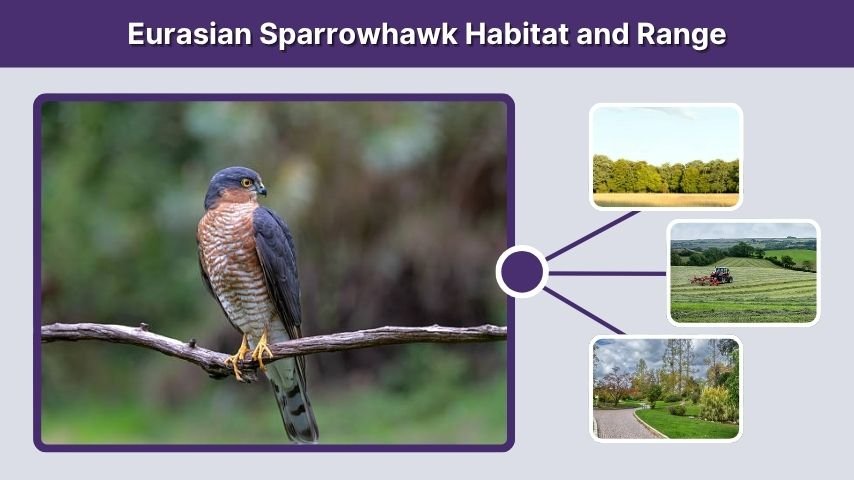
The Eurasian sparrowhawk lives in a wide range of wooded and semi-wooded habitats. It is found across much of Europe and Asia, and some birds move south during winter. It can live in forests, farmland edges, parks, gardens, and suburban areas, as long as there are trees, cover, and enough small birds to hunt.
Where Do Eurasian Sparrowhawks Live?
Eurasian sparrowhawks are found across Europe, including the UK, Ireland, Wales, Scotland, and many parts of mainland Europe. They also occur across large parts of Asia. Some northern populations migrate south in winter, while many birds in milder areas stay in the same general region all year.
In Britain and Ireland, the bird is one of the best-known birds of prey. It may appear in rural woodland, city parks, village gardens, and farmland with hedgerows.
Eurasian Sparrowhawk Habitat
The best habitat for this species includes woodland mixed with open hunting areas. Sparrowhawks need trees for nesting and cover, but they also hunt around edges where small birds gather. Gardens with bird feeders may attract small birds, and sparrowhawks may visit these places to hunt.
Common habitats include:
- Woodlands
- Forest edges
- Hedgerows
- Farmland
- Parks
- Gardens
- Suburban areas
- Shelterbelts
- Mixed countryside
Eurasian Sparrowhawk Migration
Migration depends on region and climate. Birds from colder northern areas may move south in winter when food becomes harder to find. In milder regions, many sparrowhawks remain resident throughout the year.
Young birds may also disperse after leaving the nest. This means they move away from their birth area to find their own territory and hunting space.
What Do Eurasian Sparrowhawks Eat?
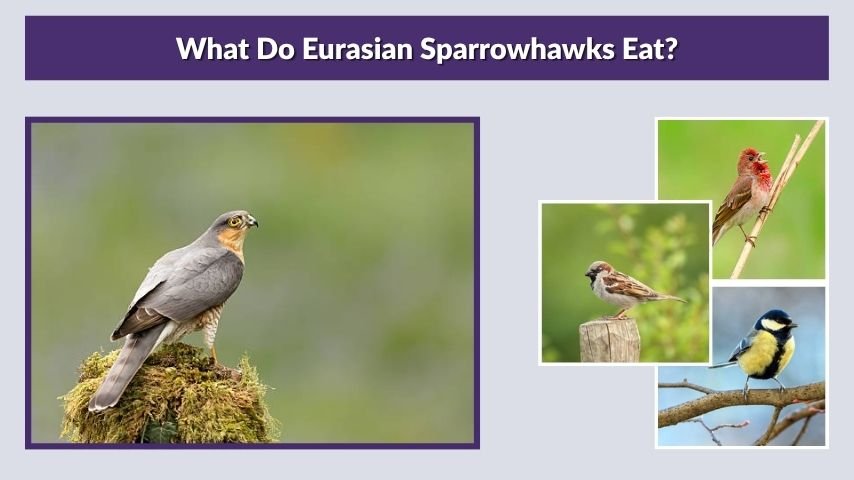
The Eurasian sparrowhawk mainly eats birds. Its diet changes depending on location, season, and whether the hunter is male or female. Males usually catch smaller birds, while larger females can take bigger prey. This difference helps reduce competition between the sexes and allows the species to use a wider range of prey.
Main Eurasian Sparrowhawk Diet
Sparrowhawks are specialist bird hunters. They rely on quick surprise attacks rather than long chases in open sky. Their prey is often caught near trees, hedges, gardens, or woodland edges.
Common prey includes:
- Sparrows
- Finches
- Tits
- Blackbirds
- Thrushes
- Starlings
- Robins
- Dunnocks
- Woodpeckers
- Pigeons, mostly by females
- Other small garden and woodland birds
Do Eurasian Sparrowhawks Eat Pigeons?
Yes, Eurasian sparrowhawks can eat pigeons, but this is more common with females. Male sparrowhawks are usually too small to handle large pigeons easily, so they focus on smaller birds. A female sparrowhawk may catch young pigeons, weakened pigeons, or smaller dove species.
Pigeons are not the only prey, though. Small birds still make up the main part of the sparrowhawk’s diet.
How Much Can a Eurasian Sparrowhawk Lift?
A Eurasian sparrowhawk can carry small birds, but it cannot lift very large animals. Males carry lighter prey, while females can manage heavier birds. If prey is too heavy, the sparrowhawk may eat it on the ground or carry it only a short distance.
Eurasian Sparrowhawk Hunting, Flight and Speed
The Eurasian sparrowhawk is designed for fast attacks in tight spaces. It does not usually soar like buzzards or eagles. Instead, it uses cover, low flight, and sudden movement to surprise prey. Its long tail works like a steering tool, helping it turn quickly through trees, hedges, fences, and garden spaces.
Hunting Style
A sparrowhawk often flies low and fast, using hedges, walls, trees, and buildings to hide its approach. It may appear suddenly and rush toward a bird before the prey has time to escape. This hunting method depends on surprise.
If the first attack fails, the sparrowhawk may continue a short chase. However, it usually relies on speed and timing rather than long-distance pursuit.
Eurasian Sparrowhawk in Flight
In flight, the Eurasian sparrowhawk shows a classic accipiter shape. It has short rounded wings, a long tail, and quick wingbeats. It often flies with a flap-flap-glide pattern, especially when crossing open areas.
When hunting, its flight becomes more direct and urgent. It may twist around branches, dip below hedges, or turn sharply after prey.
Eurasian Sparrowhawk Speed
The sparrowhawk is fast, but its greatest skill is agility. It can accelerate suddenly and change direction quickly. This makes it dangerous to small birds in wooded and garden habitats. Its speed is most effective over short distances, especially when prey is surprised.
Eurasian Sparrowhawk Call and Sound
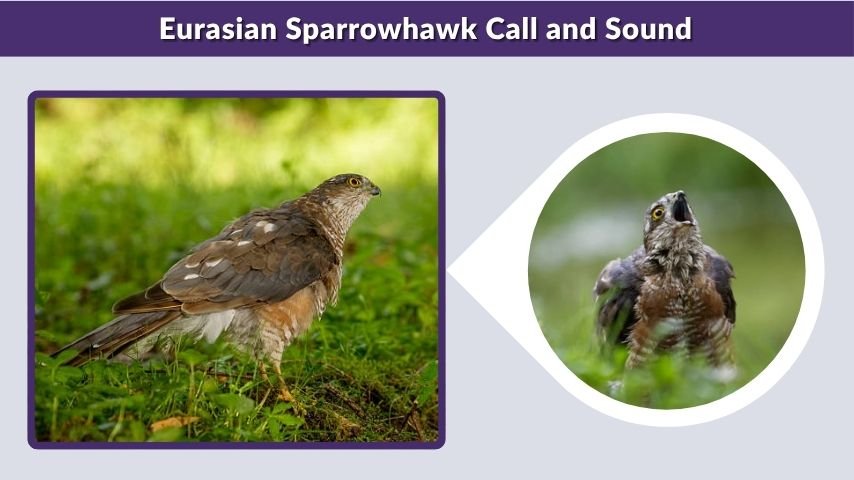
The Eurasian sparrowhawk is not always a noisy bird, but it can be vocal around the breeding season. Its call is usually heard near nesting areas or when adults and young communicate. Because sparrowhawks often stay hidden in trees, hearing the call can help birdwatchers notice their presence.
What Does a Eurasian Sparrowhawk Sound Like?
The call of a Eurasian sparrowhawk is usually sharp, repeated, and high-pitched. It may sound like a quick series of alarm notes. Different calls may be used for contact, warning, courtship, or communication between adults and young.
It is difficult to describe bird sounds perfectly in words, so sound recordings are helpful for learning this species.
When Do Sparrowhawks Call?
Sparrowhawks call most often during the breeding season. Adults may call near the nest, during food delivery, or when warning of danger. Young birds may also call when begging for food.
Outside the breeding season, sparrowhawks are often quieter. Many people see them briefly in flight without hearing any sound.
Using Sound for Identification
Sound can help identify a Eurasian sparrowhawk, but it should not be used alone. Other birds of prey and woodland birds can also make sharp calls. Good identification should include call, size, flight style, habitat, and plumage.
Eurasian Sparrowhawk vs Similar Birds
The Eurasian sparrowhawk can be confused with other birds of prey, especially shikra, goshawk, and small falcons. Identification depends on location, size, shape, markings, and flight style. The sparrowhawk is smaller than a goshawk and usually has rounded wings, a long tail, and a slim body.
Eurasian Sparrowhawk vs Shikra
The shikra and Eurasian sparrowhawk can look similar, especially in parts of Asia. The shikra is common in South Asia and Africa, while the Eurasian sparrowhawk is more widespread across Europe and northern Asia. In India, both identification and season are important.
The shikra often has a different facial expression, eye color, and underpart pattern. Location is one of the strongest clues when separating these two species.
Eurasian Sparrowhawk vs Goshawk
A goshawk is much larger and more powerful than a Eurasian sparrowhawk. It has a heavier body, broader wings, and a stronger head. The sparrowhawk is smaller, slimmer, and more likely to appear in gardens or small wooded areas.
A female sparrowhawk may look large, but it is still much lighter than a goshawk.
Quick Comparison Table
| Feature | Eurasian Sparrowhawk | Goshawk | Shikra |
| Size | Small raptor | Large raptor | Small raptor |
| Wings | Short and rounded | Broad and powerful | Short and rounded |
| Tail | Long | Long and strong | Long |
| Habitat | Woods, gardens, hedges | Large forests | Open woodland, towns |
| Main prey | Small birds | Birds and mammals | Small birds, lizards, insects |
Eurasian Sparrowhawk Nesting and Breeding
Eurasian sparrowhawks usually breed in woodland or wooded landscapes. They build nests in trees where there is enough cover and nearby hunting space. The breeding season is an important time because the female needs regular food from the male, and the chicks require a steady supply of small birds.
Nest Location
The nest is usually built in a tree, often in woodland, conifers, or mixed forest. It is made of sticks and placed where the birds have cover from disturbance and predators. Sparrowhawks may choose areas close to good hunting routes.
They do not usually nest in open fields. Trees are important for both nesting and protection.
Eggs and Chicks
The female lays a small clutch of eggs and spends much time incubating them. The male provides food, especially in the early part of the breeding season. After the chicks hatch, they grow quickly and need frequent feeding.
Young birds remain dependent on their parents for a while after fledging. They must learn to fly well and hunt successfully.
Breeding Behavior
During the breeding season, sparrowhawks may become more vocal and active near the nest. Adults communicate through calls, food transfers, and flight displays. The male often hunts and brings prey, while the female prepares food for the chicks.
Conservation and Human Interest
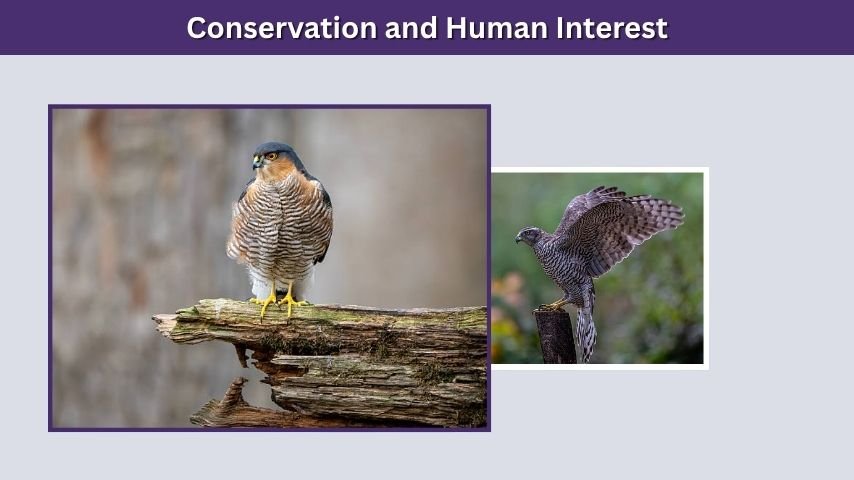
The Eurasian sparrowhawk is not globally endangered and remains widespread across much of its range. However, like many raptors, it has faced threats from persecution, pesticides, habitat change, and illegal trapping. In many places, protection laws and improved awareness have helped birds of prey recover from past declines.
Is the Eurasian Sparrowhawk Endangered?
The Eurasian sparrowhawk is generally not considered endangered worldwide. It has a wide range and is still common in many countries. However, local populations can be affected by habitat loss, poisoning, illegal killing, or reduced prey numbers.
Conservation still matters because healthy sparrowhawk populations depend on healthy bird communities and suitable nesting habitats.
Predators and Threats
Adult sparrowhawks are predators themselves, but they can still face danger. Larger birds of prey, goshawks, owls, and some mammals may threaten eggs, chicks, or young birds. Harsh weather and food shortages can also affect survival.
Human-related threats include illegal trapping, habitat destruction, and disturbance near nests.
Falconry, Price and Pet Questions
Some people search for Eurasian sparrowhawk price, for sale, or falconry. This bird is a wild raptor and is protected by wildlife laws in many countries. It should not be captured, bought, kept, or handled without proper legal permission.
A sparrowhawk is not a pet. It needs expert care, legal licensing, and specialist knowledge.
Interesting Eurasian Sparrowhawk Facts
The Eurasian sparrowhawk is one of the most fascinating small birds of prey because it lives close to people yet remains secretive. Many people only notice it when it flashes through a garden or woodland edge. Its speed, size difference between sexes, and bird-hunting skill make it especially interesting.
Quick Facts
Important facts include:
- Its scientific name is Accipiter nisus.
- It is often called simply “sparrowhawk” in the UK.
- Females are much larger than males.
- Males are blue-grey above with orange barring.
- Females are brownish with barred underparts.
- Juveniles look similar to females.
- It mainly eats birds.
- It hunts with surprise attacks.
- It has short rounded wings and a long tail.
- It is found across Europe and parts of Asia.
Eurasian Sparrowhawk Pronunciation
Eurasian sparrowhawk is pronounced yoo-RAY-zhun SPAR-oh-hawk. The word “Eurasian” refers to Europe and Asia, while “sparrowhawk” describes its long-known habit of hunting small birds.
Why People Notice Sparrowhawks
People often notice sparrowhawks because they appear suddenly. One moment a garden may be full of small birds, and the next moment a sparrowhawk flashes through at high speed. This dramatic hunting style makes the species exciting, but it is also a natural part of the ecosystem.
FAQs
Is a Eurasian sparrowhawk a bird of prey?
Yes, the Eurasian sparrowhawk is a bird of prey. It hunts live animals, mainly small birds, using sharp talons, fast flight, and excellent eyesight. It belongs to the hawk family and is one of the most familiar small raptors in Europe.
What do Eurasian sparrowhawks eat?
Eurasian sparrowhawks mainly eat birds. Males usually catch smaller birds such as sparrows, tits, and finches. Larger females can catch bigger prey, including blackbirds, thrushes, starlings, and sometimes pigeons. Small mammals and insects are much less common in their diet.
How can you tell a male from a female Eurasian sparrowhawk?
The male is smaller and usually blue-grey above with orange barring below. The female is much larger, brown or grey-brown above, and has pale underparts with brown barring. Females also look heavier and can catch larger prey than males.
What is the difference between a Eurasian sparrowhawk and a shikra?
The Eurasian sparrowhawk and shikra are similar small hawks, but they differ in range, markings, and appearance. Shikras are common in South Asia and Africa, while Eurasian sparrowhawks are widespread across Europe and parts of Asia. Location is often the best first clue.
Can you keep a Eurasian sparrowhawk as a pet?
No, a Eurasian sparrowhawk should not be kept as a pet. It is a wild bird of prey and is protected by law in many countries. Keeping or handling one usually requires special permits, expert training, and legal approval from wildlife authorities.
