
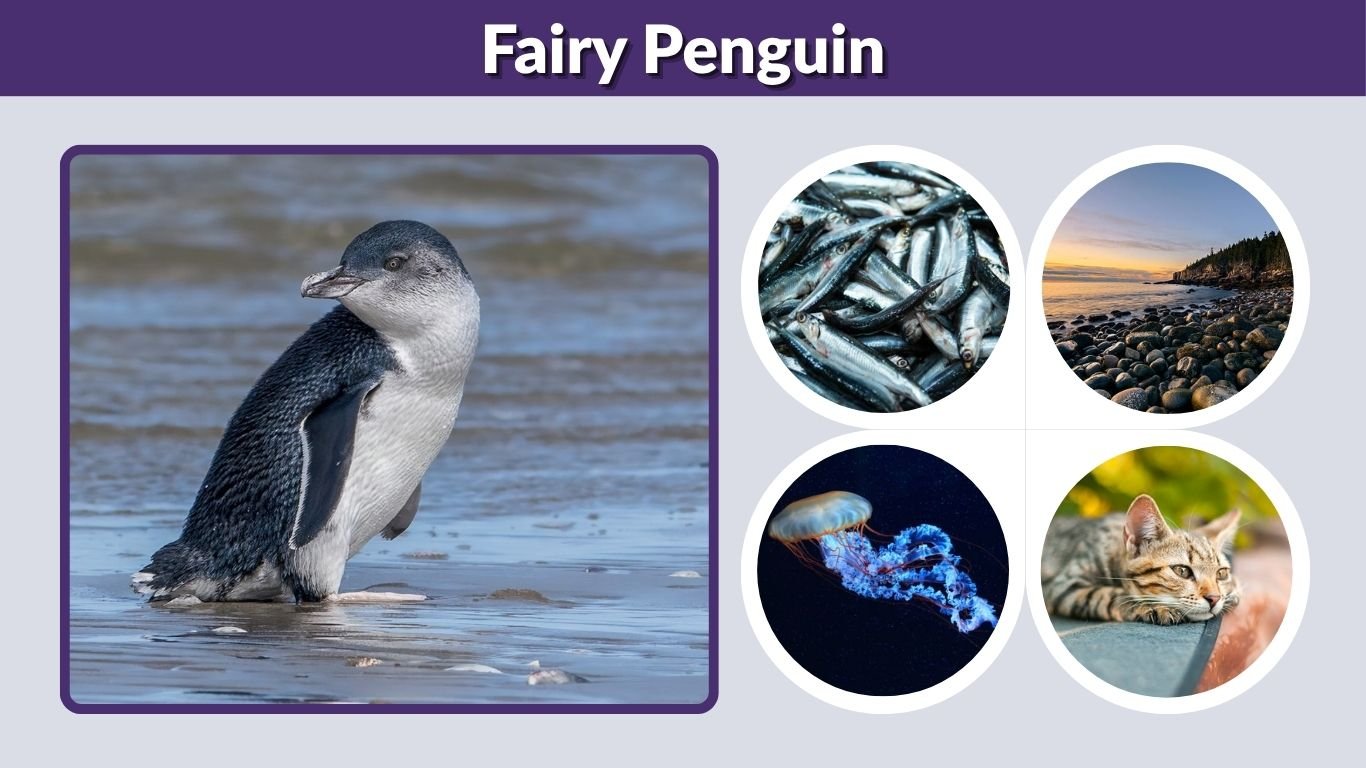
The fairy penguin is the world’s smallest penguin and is famous for its tiny body, blue-gray feathers, and nighttime journeys from the sea to coastal burrows. More commonly called the little penguin, this species lives along southern Australia and New Zealand, where it is also known as kororā. Fairy penguins spend most of their lives at sea hunting small fish, squid, and other prey. Their unusual coloring, compact size, burrowing behavior, and impressive swimming ability make them one of the most distinctive penguins.
What Is a Fairy Penguin?
A fairy penguin is the same bird generally called the little penguin. Its scientific name is Eudyptula minor. “Fairy penguin” remains a familiar name in Australia, while New Zealand commonly uses little penguin or the Māori name kororā. These compact seabirds breed on land but spend most of their time feeding and traveling in coastal waters.
Fairy Penguin Scientific Name
The scientific name is Eudyptula minor. The genus name Eudyptula relates to the bird’s diving ability, an appropriate description for a penguin that spends much of its life swimming and hunting underwater.
Despite different common names such as fairy penguin, little blue penguin, blue penguin, and kororā, they refer broadly to these small Eudyptula penguins.
Little Penguin vs. Fairy Penguin
There is no basic size or lifestyle difference between a “fairy penguin” and a “little penguin” when the names refer to Eudyptula minor. They are different common names for the same penguin.
Phillip Island Nature Parks notes that little penguins are sometimes called fairy penguins or little blue penguins.
Fairy Penguin Size and Appearance
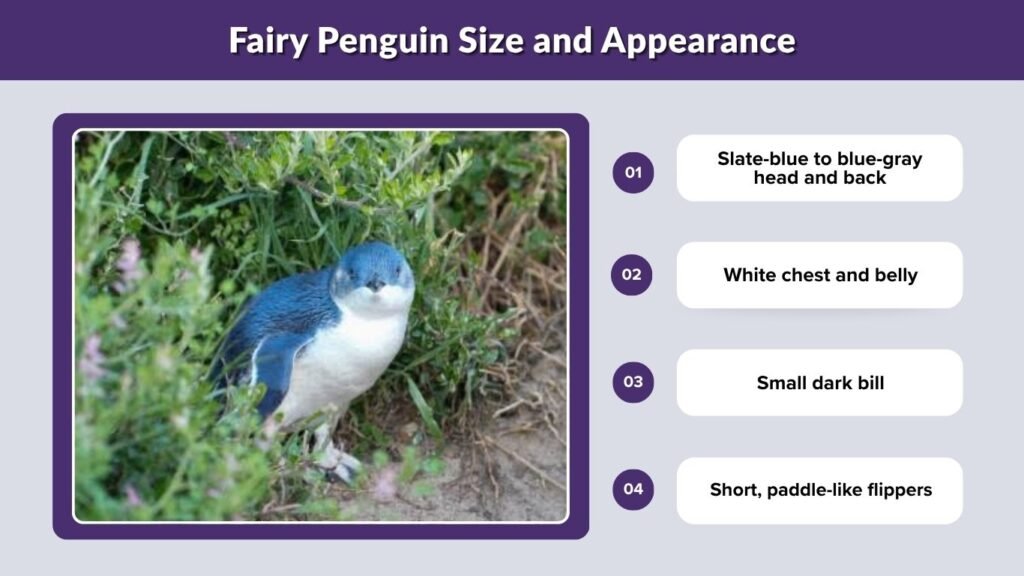
The fairy penguin stands out because of its remarkably small size and unusual blue plumage. It is officially recognized as the smallest penguin species. Adults have a dark blue-gray upper body and contrasting pale underside, helping them blend into the ocean from both above and below while swimming. Their short legs and compact build create their characteristic waddling appearance.
How Big Is a Fairy Penguin?
An adult little penguin averages about 30–33 cm tall and generally weighs around 1 kg, although weight changes through the year. Parks Victoria lists an average height of approximately 33 cm, while New Zealand’s Department of Conservation describes kororā as just over 25 cm tall and about 1 kg.
That makes the species dramatically smaller than emperor penguins, which can stand more than three times taller.
Key Appearance Features
A fairy penguin can be recognized by its:
- Slate-blue to blue-gray head and back
- White chest and belly
- Small dark bill
- Short, paddle-like flippers
- Pale pinkish feet
- Compact, upright body
- Dark eyes
- Blue upper surfaces on the flippers
Their blue-and-white plumage is especially distinctive; Phillip Island Nature Parks describes little penguins as the only penguin species with blue and white feathers.
Where Does the Fairy Penguin Live?
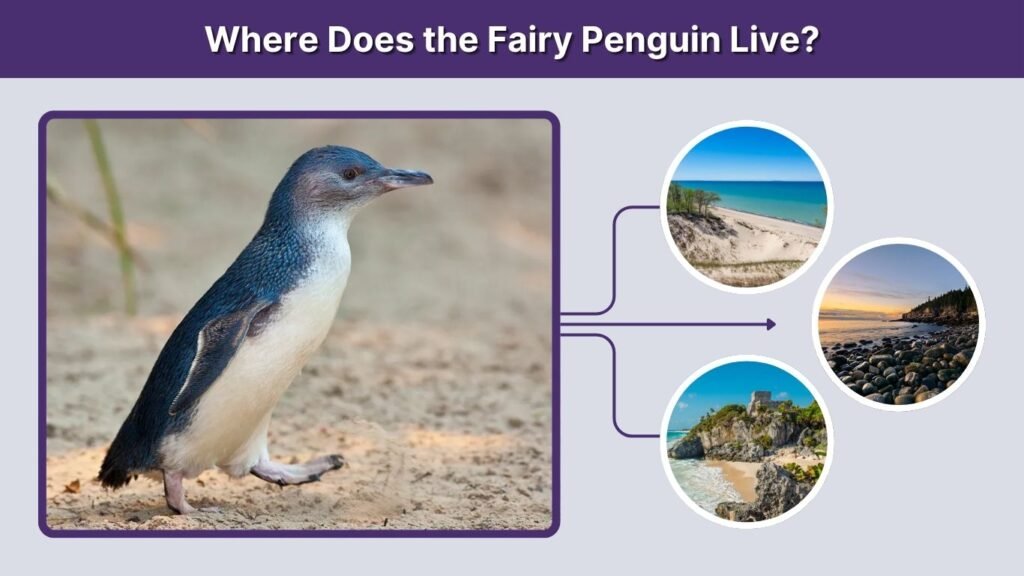
Fairy penguins are coastal seabirds closely associated with southern Australia and New Zealand. They forage at sea during the day and usually return to protected nesting areas after dark. Although they may travel considerable distances while feeding, suitable coastal nesting habitat is essential for breeding, moulting, resting, and raising chicks.
Fairy Penguin Habitat
Little penguins occur along coastlines of southern Australia and New Zealand. They use coastal waters for feeding and protected land areas for nesting.
Suitable nesting habitat includes sand dunes, rocky shorelines, coastal vegetation, caves, crevices, and sheltered areas close to the ocean.
In modified environments, some penguins have even nested beneath houses, boat sheds, pipes, and piles of timber.
Fairy Penguin Burrows and Colonies
Fairy penguins commonly shelter and reproduce in underground burrows or protected rock crevices.
During the day, adults may be feeding offshore while birds tending eggs or chicks remain around the nest. At dusk, returning penguins often gather offshore in groups known as rafts before crossing the beach together. This nighttime behavior can reduce exposure to daytime predators.
Phillip Island in Victoria supports a particularly large colony, with about 40,000 breeding little penguins on the Summerland Peninsula.
What Does a Fairy Penguin Eat?
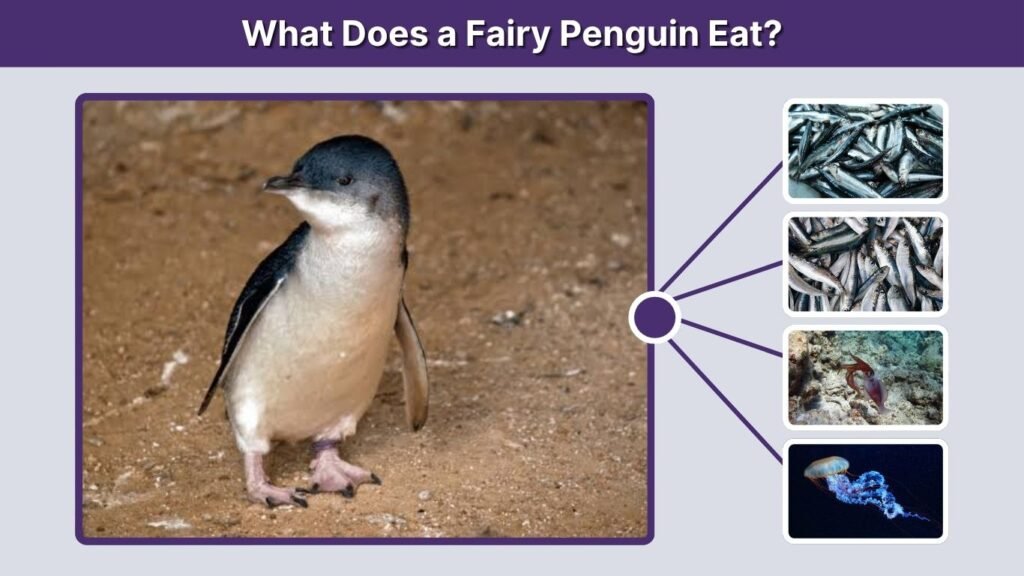
The fairy penguin diet consists mainly of small marine animals that can be caught while diving. Rather than feeding on land, adults search coastal waters for schools of fish and other prey. Food availability strongly affects body condition and breeding success because parents must repeatedly return from feeding trips with enough energy to support themselves and their developing chicks.
Common Fairy Penguin Foods
Their diet may include:
- Anchovies
- Pilchards
- Young barracouta
- Red cod
- Warehou
- Squid
- Small crustaceans
- Sea jellies
Phillip Island research records fish such as anchovies and pilchards as important foods, along with squid and other marine prey.
How Fairy Penguins Hunt
Fairy penguins “fly” underwater using their flippers for propulsion while their streamlined bodies reduce drag.
They can make repeated dives while pursuing schools of fish. New Zealand research has recorded little penguins making as many as 98 dives in an hour, while dives of roughly 35 metres have also been recorded.
They may spend about 80% of their lives at sea, returning to land mainly for breeding, nesting, resting, and moulting.
Fairy Penguin Life Cycle and Chicks
The fairy penguin life cycle depends on both land and sea. Adults return to nesting areas to establish or reuse burrows, form breeding pairs, incubate eggs, and feed their young. Chicks remain dependent on their parents during early development but must eventually enter the sea without receiving swimming or hunting lessons from adults.
Eggs and Breeding
Breeding timing varies among populations and environmental conditions. Adults return to established colonies and prepare nest sites before eggs are laid.
Both parents contribute to raising the young. While one parent remains associated with the nest during early chick development, the other can forage at sea and return with food.
Fairy Penguin Chicks
Parents feed young penguins by regurgitating food gathered at sea.
Important chick stages include:
- Parents initially remain closely involved with young chicks.
- Chicks grow rapidly within the nest.
- After several weeks, both adults spend more time foraging.
- Juvenile waterproof feathers gradually develop.
- At roughly eight weeks, many chicks leave the nest.
- Young birds enter the sea and learn to hunt independently.
Phillip Island Nature Parks reports that chicks generally head to sea at around eight weeks old and must learn swimming and feeding behavior largely by instinct.
Fairy Penguin Adaptations and Predators
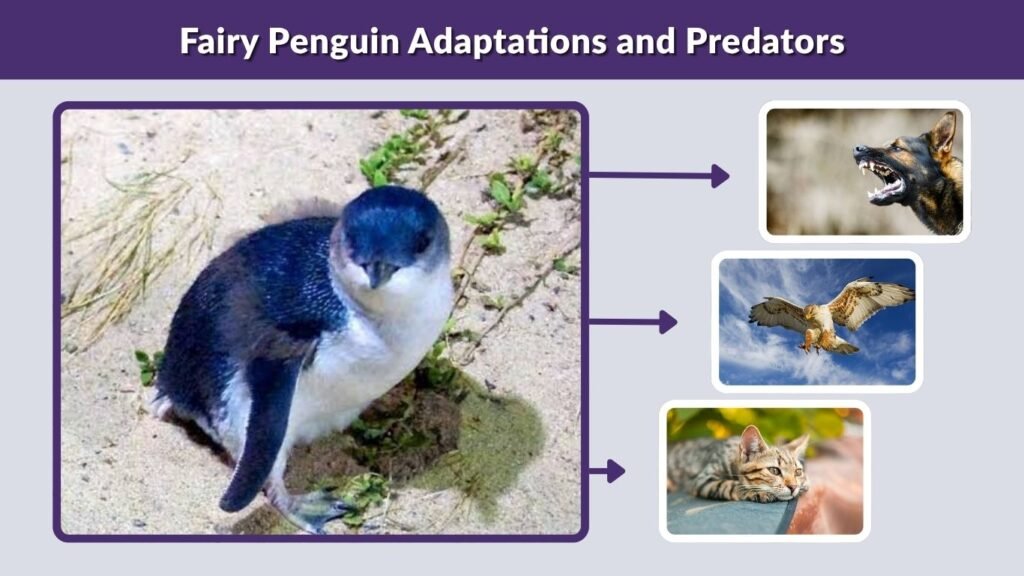
Living between land and ocean requires several specialized adaptations. Fairy penguins need to swim efficiently, maintain body temperature, remove excess salt, keep feathers waterproof, and avoid predators. Their small size makes them agile in the water but can also leave them vulnerable when they come ashore to breed or moult.
Important Fairy Penguin Adaptations
Several features help them survive:
- Streamlined body for efficient swimming
- Flippers that provide underwater propulsion
- Dense waterproof feathers
- Blue back that provides ocean camouflage
- White belly that helps conceal them from below
- Salt glands that remove excess salt
- Strong feet for moving through burrows and rocky areas
- Nocturnal shore crossings that reduce some predation risk
A gland above the eyes helps little penguins remove excess salt acquired from seawater.
Predators and Threats
Threats can include:
- Dogs
- Cats and other introduced predators
- Birds of prey
- Road traffic
- Habitat destruction
- Food shortages
- Marine pollution
- Changing ocean conditions
New Zealand’s Department of Conservation identifies dogs, introduced predators, and road kills among important threats to little penguins.
How Long Do Fairy Penguins Live?
Fairy penguins can live much longer than their small size might suggest. Survival varies greatly because young birds face particularly challenging conditions at sea, while adults must cope with predators, changing food supplies, storms, disease, and human disturbance throughout their lives.
Fairy Penguin Lifespan
Historical monitoring at Phillip Island estimated an average life expectancy of about 6.5 years, but individual birds can live much longer. Wild little penguins as old as 25 years have been documented there.
Reaching such an advanced age is exceptional rather than typical.
Conservation of Fairy Penguins
The little penguin is globally regarded as a species of relatively low conservation concern, but individual colonies can still decline significantly.
Habitat development, dogs, road traffic, introduced predators, disturbance, and changes in marine food availability can all affect local populations. Long-term protection at Phillip Island helped its colony recover from about 12,000 penguins in the mid-1980s to an estimated 40,000.
FAQs
Fairy penguins are best known for being extremely small, but their blue plumage, nighttime behavior, burrow nesting, diving ability, and long ocean journeys are equally distinctive. The following answers address some of the most common questions about their size, habitat, diet, naming, and conservation.
1. Is a fairy penguin the same as a little penguin?
Yes. Fairy penguin is a common name historically and popularly used for the little penguin, Eudyptula minor. Little blue penguin and kororā are other names used for these birds.
2. How tall is a fairy penguin?
Fairy penguins are roughly 30–33 cm tall, although measurements vary somewhat among populations and sources. They are the world’s smallest penguin species.
3. Where do fairy penguins live?
They live primarily along coastal areas of southern Australia and New Zealand. They forage at sea and return to burrows, rocky crevices, vegetation, or other protected coastal nesting locations.
4. What does a fairy penguin eat?
Fairy penguins primarily eat small fish such as anchovies and pilchards, along with squid, crustaceans, and other small marine prey.
5. Is the fairy penguin endangered?
The species is not currently considered globally endangered, although conservation status can differ regionally and individual colonies face serious threats. In New Zealand, little penguins/kororā are listed as At Risk–Declining.
