
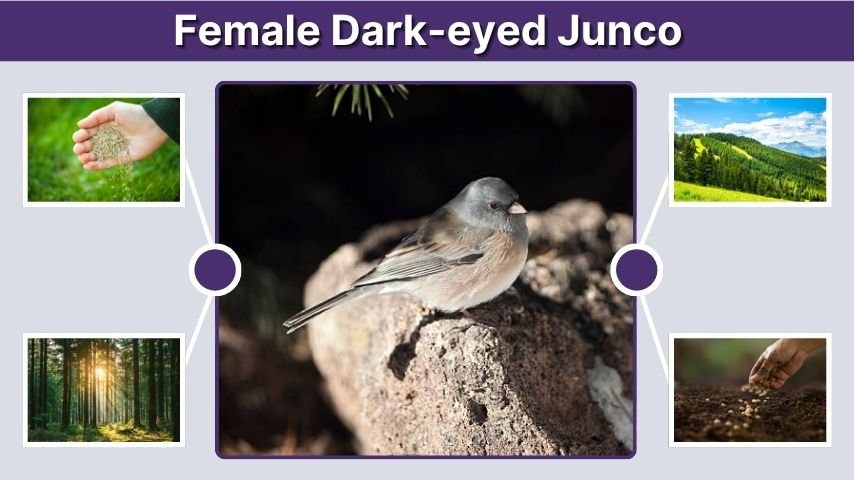
The female Dark-eyed Junco is a small, sparrow-like bird with soft gray, brown, and white markings that can change by region. She often looks plainer than the male, but her rounded body, pale bill, white belly, and flashing white tail feathers make her easier to recognize. This guide explains how to identify female juncos, compare them with males, and understand their behavior.
What Does a Female Dark-eyed Junco Look Like?
Female Dark-eyed Juncos are neat, compact songbirds with a rounded head, short pinkish bill, and a slim tail. Their colors vary across North America, but females are usually softer, browner, or less sharply marked than males. This makes identification tricky, especially when comparing Slate-colored, Oregon, and Pink-sided forms.
Key Identification Features
A female Dark-eyed Junco usually shows a gentle mix of gray, brown, white, and buff tones. The exact appearance depends on the regional form, but several field marks are helpful.
- Small sparrow-like body with a rounded shape
- Short, pale pink or whitish bill
- Dark eyes that contrast with the face
- White belly or lower underside
- Brownish or grayish upperparts
- White outer tail feathers visible when the bird flies
- Softer markings than most adult males
- Ground-feeding behavior under shrubs, trees, and feeders
The female often appears less bold than the male. Instead of a deep black or dark slate hood, she may have a gray, brownish-gray, or washed-looking head. Her back can be brown, gray-brown, or chestnut depending on the regional type.
Size and Shape
Female Dark-eyed Juncos are about the size of a small sparrow. They have a round body, fairly short neck, and a long-looking tail compared with their body size. Their posture is usually upright when perched, but they often hop quickly along the ground while feeding.
The bill is short and cone-shaped, built for eating seeds. This pale bill is one of the easiest features to notice at close range. The tail is also important because juncos often flash white outer tail feathers when they fly away.
Color Pattern
The female’s color pattern is usually softer than the male’s. In Slate-colored females, the body may look gray-brown above and pale below. In Oregon females, the head is often grayish, the back is brown, and the sides may look buff or rusty. Some females can look very similar to young birds, so it is best to use several features together instead of relying on color alone.
Female vs Male Dark-eyed Junco
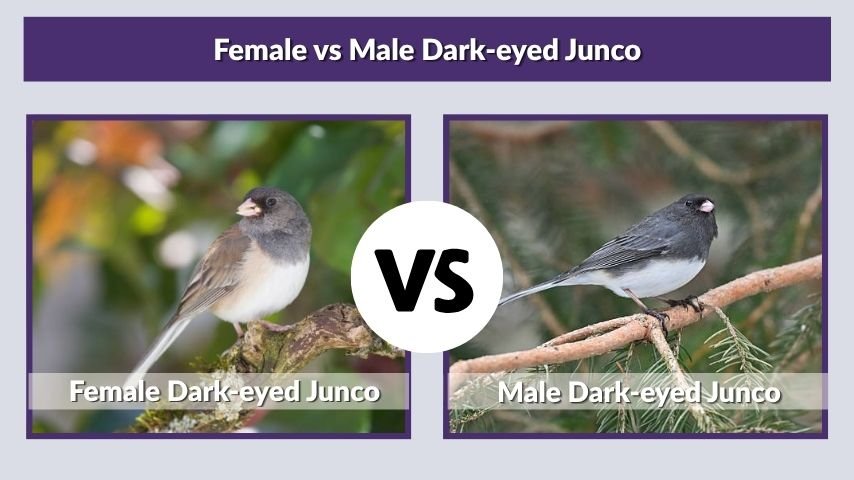
Male and female Dark-eyed Juncos can look similar at first, but careful observation reveals useful differences. Males usually appear darker, sharper, and more strongly patterned. Females are often browner, paler, or more blended in color. These differences are clearest in adult birds during good light.
| Feature | Female Dark-eyed Junco | Male Dark-eyed Junco |
| Overall color | Softer, browner, or paler | Darker and more defined |
| Head | Gray, brownish-gray, or washed | Dark slate, blackish, or bold gray |
| Back | Brownish or gray-brown | Often stronger brown, slate, or dark gray |
| Belly | White or pale gray-white | White or sharply pale below |
| Markings | Less contrast | Clearer contrast |
| Behavior clue | Often quieter near feeders | May sing more and defend territory |
Plumage Differences
The most useful difference is the tone of the plumage. Males often have a cleaner, darker hood or upper body, while females look softer and less sharply divided. In Oregon-type birds, the male may show a dark hood and rich chestnut back, while the female has a paler gray hood and duller brown back.
In Slate-colored birds, males are usually more solid gray above with a bright white belly. Females often show more brown mixed into the gray, especially on the back and sides. However, lighting, age, molt, and regional variation can make the difference subtle.
Behavior Differences
Behavior can also help, especially during breeding season. Males are more likely to sing from exposed perches and defend a territory. Females may be seen carrying nesting material, staying lower in shrubs, or moving quietly through cover.
At feeders during winter, behavior is not always enough to identify sex. Both males and females hop on the ground, scratch through leaf litter, and feed on scattered seeds. Plumage and season should be used together for the best result.
Female or Juvenile?
Female juncos and juvenile juncos can be confusing. Juveniles may look streakier, duller, or more uneven in color. Adult females usually have a cleaner body pattern, even if their colors are muted. If the bird looks heavily streaked, especially on the breast, it may be a young junco rather than an adult female.
Oregon Female Dark-eyed Junco
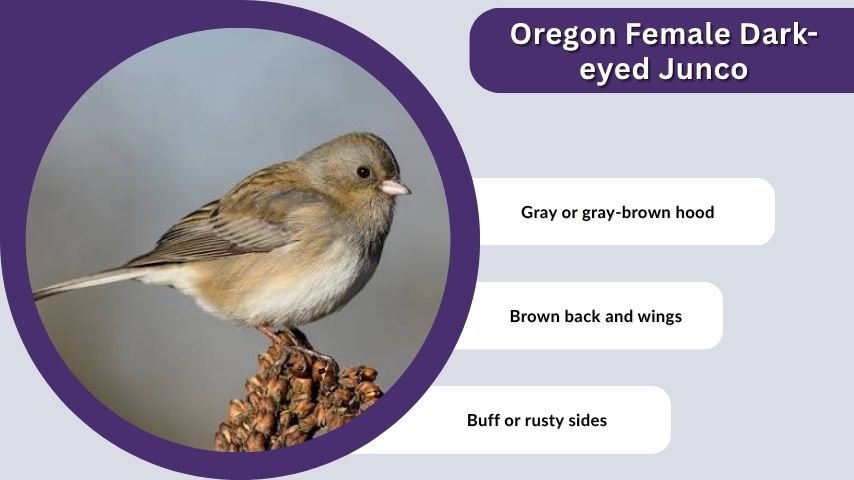
The Oregon form is one of the most recognizable western Dark-eyed Juncos. Females have a soft gray hood, brown back, pale belly, and warm buff or rusty sides. They are usually paler than males, which often have a darker hood and stronger contrast between the head, back, and sides.
How to Recognize the Oregon Female
A female Oregon Dark-eyed Junco often looks like a neatly patterned bird with a gray head and brown back. Her sides may show warm peachy, buff, or rusty tones. The white belly is usually visible, and the pale bill stands out against the darker face.
Important clues include:
- Gray or gray-brown hood
- Brown back and wings
- Buff or rusty sides
- White belly
- Pale bill
- White outer tail feathers in flight
This form is common in many western areas, especially in forests, wooded neighborhoods, brushy edges, and winter yards.
Oregon Male vs Female
The Oregon male is usually more dramatic. He often shows a dark blackish or slaty hood, strong brown back, and warm sides. The female has the same general pattern, but the colors look lighter and less intense.
Because some females can appear fairly dark and some males can appear worn or dull, it is better to compare several marks: hood darkness, back color, side color, and overall contrast.
Slate-colored Female Dark-eyed Junco
The Slate-colored form is widespread in eastern and northern North America. Females are often gray-brown rather than clean dark gray. They may look duller than males, with a softer boundary between the gray upperparts and the pale underside.
Field Marks of Slate-colored Females
Female Slate-colored Juncos usually have a grayish-brown head, back, and chest with a white belly. The sides may show brown tones, and the whole bird can look slightly washed compared with a male. The pale bill and white tail edges remain useful identification marks.
This form is often seen in winter around yards, woodland edges, parks, and brushy fields. When a small gray-brown bird hops under feeders and flashes white tail feathers as it flies, a female Slate-colored Junco is a strong possibility.
Common Confusion Species
Female Dark-eyed Juncos may be confused with other small brown or gray birds. However, juncos usually look rounder and cleaner than many sparrows. They also have a pale bill and white outer tail feathers.
Possible confusion species include:
- Chipping Sparrow
- American Tree Sparrow
- Song Sparrow
- White-throated Sparrow
- Female House Finch
Look for the junco’s plain face, pale bill, white belly, and tail flash. Many sparrows have stronger streaking, face stripes, or different bill colors.
Female Dark-eyed Junco Habitat and Distribution
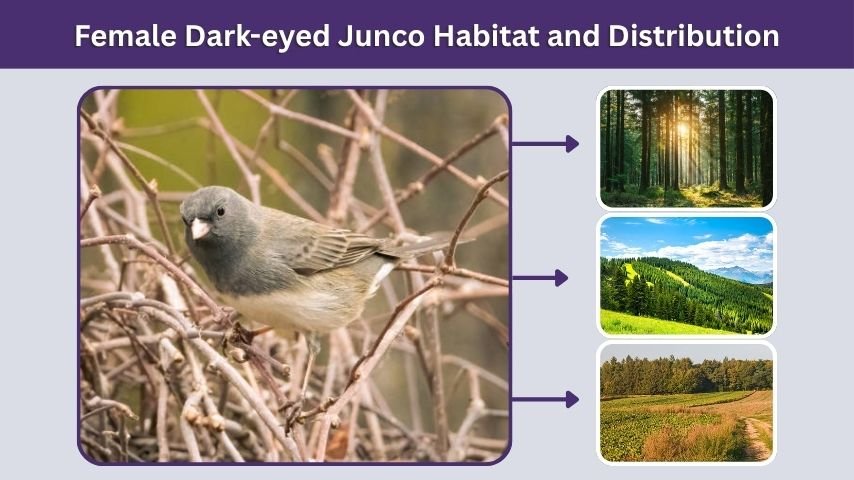
Female Dark-eyed Juncos use forests, woodland edges, mountain slopes, brushy areas, and backyards. During winter, they become familiar visitors under bird feeders, along hedges, and near leaf litter. Their range changes with season, and many birds move south or to lower elevations when cold weather reduces food availability.
Where Female Juncos Live
Dark-eyed Juncos breed mainly in forested areas, including coniferous, mixed, and mountain forests. In winter, they spread into towns, gardens, parks, fields, and yards. They prefer places with ground cover because they feed mostly on or near the ground.
In the West, some populations remain year-round in suitable habitat, while others move short distances. In the East, many people notice juncos mainly in winter, which is why they are often called “snowbirds.”
Backyard Habitat
A female junco is likely to visit a yard that has shrubs, native plants, low cover, and scattered seeds. They usually feed below hanging feeders rather than clinging to the feeder itself. They also search through leaf litter for natural seeds and small insects.
Good backyard features include:
- Native grasses and seed-producing plants
- Shrubs for cover
- Leaf litter beneath trees
- Low brush piles
- Clean water source
- Ground-level feeding areas
Avoid removing every leaf from the yard if you want to support juncos. Leaf litter provides food, shelter, and foraging space.
Female Dark-eyed Junco Behavior, Diet, and Calls
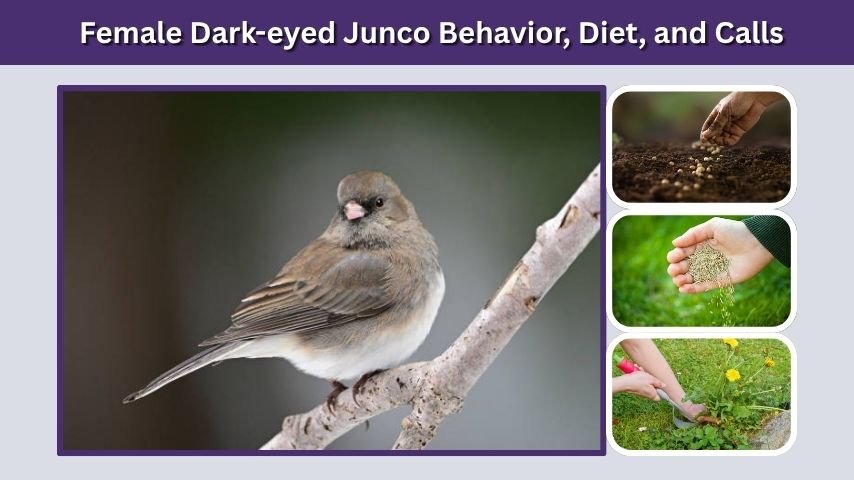
Female Dark-eyed Juncos are active, social, and often easy to watch in winter. They spend much of their time hopping on the ground, picking up seeds, and moving in small flocks. Their behavior is usually gentle, but juncos can show social ranking around feeding areas.
Feeding Habits
Dark-eyed Juncos eat mostly seeds, especially outside the breeding season. They take seeds from grasses, weeds, and backyard feeding areas. During spring and summer, they also eat insects, which provide protein for breeding adults and growing young.
They often feed by hopping and scratching at the ground. Instead of staying high in trees, they prefer open ground near cover. If startled, they fly quickly to shrubs or low branches, flashing white tail feathers.
Calls and Songs
Female juncos give short calls used for contact and alarm. These sounds help flock members stay together as they move through brush or feeding areas. Males are more commonly heard singing during breeding season, but females can still make calls and quiet sounds.
The common call is a sharp, light note. Around feeders, several juncos may call while moving in and out of cover. Listening for these small notes can help locate birds hidden under shrubs.
Nesting Role
Female juncos usually choose the nest site and build the nest. Nests are often placed on or near the ground, hidden by grass, roots, logs, or low vegetation. The nest is cup-shaped and made from grasses, moss, rootlets, and other fine materials.
Because nests are low, they can be vulnerable to disturbance. During breeding season, avoid walking through dense ground cover where birds may be nesting.
Seasonal Changes and Migration
Dark-eyed Juncos are strongly linked with seasonal movement. Many arrive in lower elevations, towns, and backyards during fall and winter, then leave for breeding areas in spring. In some regions, however, juncos stay all year.
Winter Appearance
In winter, females may appear in mixed flocks with males and young birds. Plumage can look duller in poor light, and wet feathers may make markings harder to judge. Watch for the pale bill, white belly, and white tail edges rather than expecting one exact color pattern.
Winter is also when many people see juncos at feeders. They often stay below the feeder, eating seeds that fall to the ground. They may return daily if food and cover are reliable.
Summer Range
During summer, many Dark-eyed Juncos move to cooler forest habitats. In mountains, they may nest at higher elevations. In northern areas, they breed in broad forest zones. Some western populations remain closer to the same region but shift by elevation or habitat.
A female in summer may be harder to spot because she spends more time in nesting cover. She may also move quietly while feeding young.
FAQs
How can you tell if a Dark-eyed Junco is female?
A female Dark-eyed Junco is usually softer, browner, or paler than a male. She may have a gray-brown head, brownish back, white belly, pale bill, and white outer tail feathers. In Oregon birds, females often show a gray hood and warm brown back with buff sides.
Are female Dark-eyed Juncos darker or lighter than males?
Females are generally lighter or less sharply marked than males. Males often have darker hoods, stronger contrast, and cleaner color patterns. However, the difference can be subtle because Dark-eyed Juncos vary by region, age, season, and feather wear.
What does a female Oregon Dark-eyed Junco look like?
A female Oregon Dark-eyed Junco usually has a gray or gray-brown hood, brown back, pale belly, and buff or rusty sides. She looks similar to the male but is usually paler, duller, and less strongly contrasted, especially around the head and chest.
Do female Dark-eyed Juncos sing?
Female Dark-eyed Juncos are more often heard giving calls than full territorial songs. Males are the main singers during the breeding season. Females still use contact and alarm calls while feeding, moving through cover, or communicating with nearby birds.
Where do female Dark-eyed Juncos go in summer?
Many female Dark-eyed Juncos move to forests, mountains, or northern breeding areas in summer. Some western populations may stay in the same general region but shift to suitable nesting habitat. In winter, they often become more visible in yards, parks, and woodland edges.
