
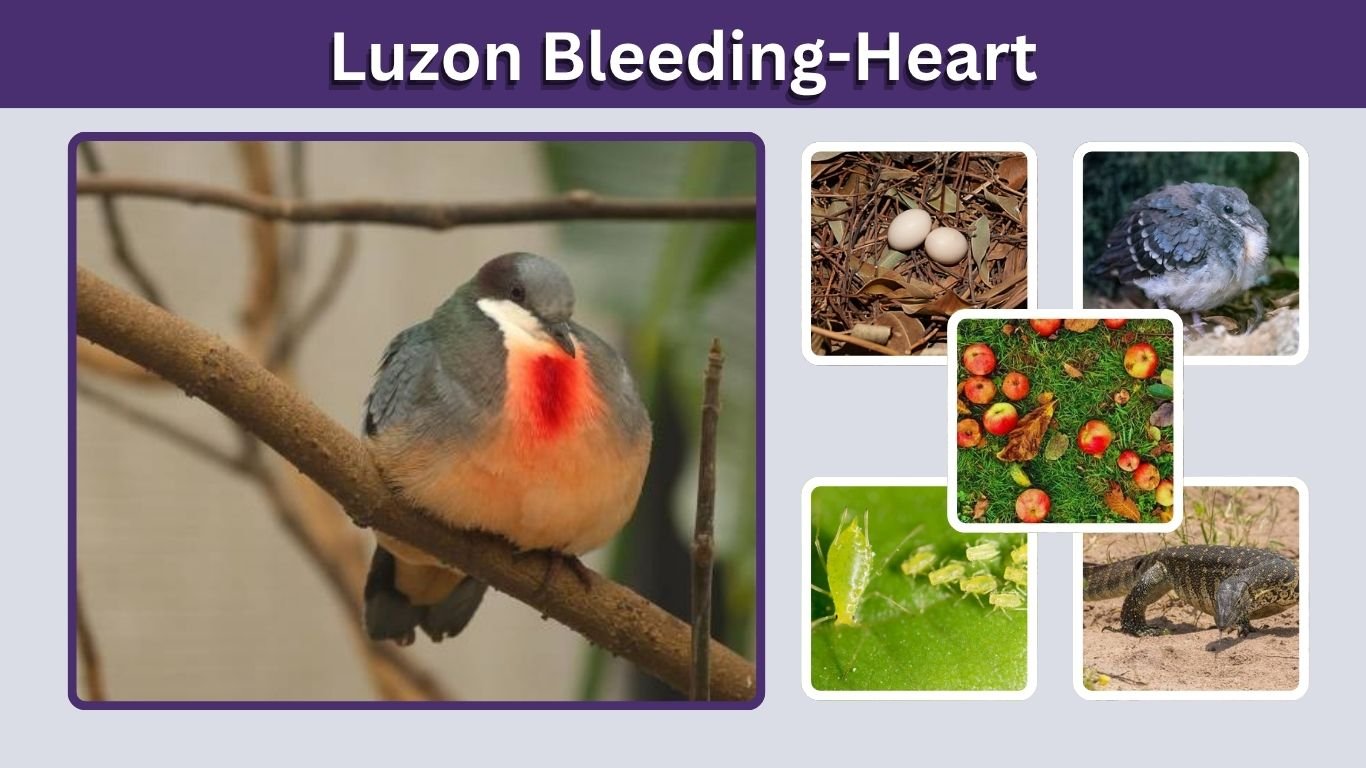
The Luzon bleeding-heart is one of the most unusual doves in the world. Its soft gray body, white breast, and bright red chest patch make it look as if it has a fresh wound. This rare ground dove lives in the forests of the Philippines, where it quietly searches the forest floor for seeds, fruits, and small invertebrates.
What Is Luzon Bleeding-Heart?
The Luzon bleeding-heart is a medium-sized ground dove known for the dramatic red mark on its chest. It belongs to the pigeon and dove family, but it does not behave like a common city pigeon. Instead, it spends much of its life walking through forest undergrowth, staying hidden from predators and people.
Scientific Name and Classification
The scientific name of the Luzon bleeding-heart is Gallicolumba luzonica. It is also called the Luzon bleeding-heart dove, bleeding-heart pigeon, or simply bleeding-heart dove. In the Philippines, it may be known locally as punay, and older references sometimes use names linked to the “wounded” look of the bird.
Basic classification:
- Common name: Luzon bleeding-heart
- Other names: Luzon bleeding-heart dove, bleeding-heart pigeon
- Scientific name: Gallicolumba luzonica
- Family: Columbidae
- Order: Columbiformes
- Native region: Philippines
- Main range: Luzon and nearby islands
- Bird type: Ground dove
- Conservation status: Near Threatened
The name “bleeding-heart” comes from the red patch on the breast. Among bleeding-heart doves, this species is especially famous because the red mark looks very vivid against the pale chest.
Luzon Bleeding-Heart Appearance
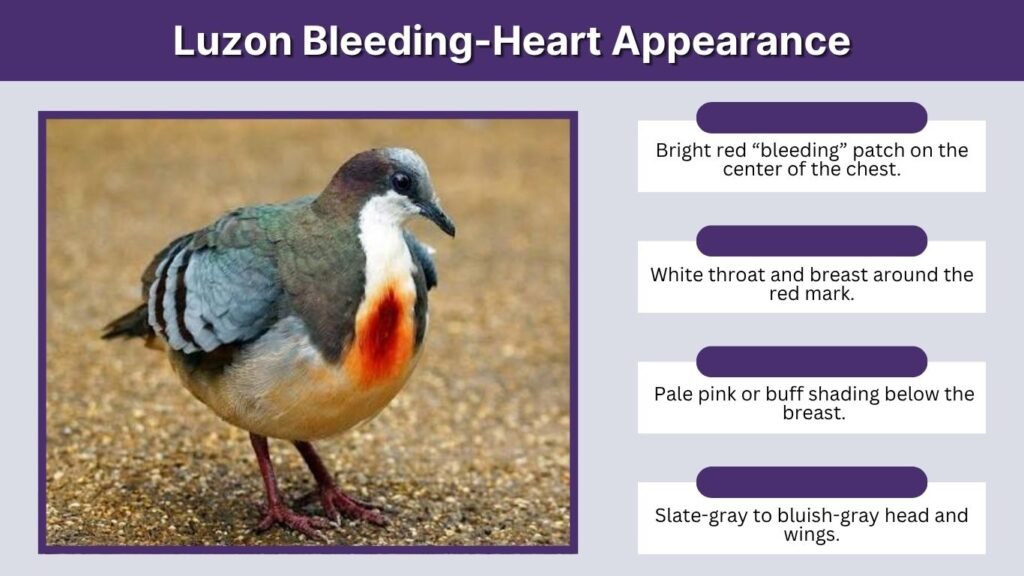
The Luzon bleeding-heart has a soft, rounded body, short tail, long legs, and a small dark bill. Its upper body may look gray, bluish, greenish, or purplish depending on light. The most recognizable feature is the deep red patch in the middle of the white breast, surrounded by a faint pink wash.
Identification Features
You can identify a Luzon bleeding-heart by these features:
- Bright red “bleeding” patch on the center of the chest
- White throat and breast around the red mark
- Pale pink or buff shading below the breast
- Slate-gray to bluish-gray head and wings
- Iridescent green, blue, or purple shine on upper feathers
- Short tail compared with many other doves
- Long reddish legs and feet
- Blackish bill
- Dark eyes
- Dark wing bands or bars
- Ground-walking behavior in forest habitat
Male and female Luzon bleeding-hearts look very similar. In some descriptions, males may be slightly larger or show a stronger red chest patch, but the difference is not always easy to see. For most people, sexing the bird by appearance alone is difficult.
Luzon Bleeding-Heart Size and Weight
The Luzon bleeding-heart is not a large pigeon like a crowned pigeon, but it is still a noticeable forest dove. Its body is compact and rounded, and its long legs help it walk through leaf litter. It looks delicate, but it is well adapted to ground life.
Size Comparison Table
| Feature | Luzon Bleeding-Heart | Common City Pigeon |
| Length | About 11–12 inches | About 11–14 inches |
| Weight | Up to about 6.5 ounces | About 9–13 ounces |
| Tail | Short | Medium length |
| Legs | Long for ground walking | Shorter and sturdier |
| Main habitat | Forest floor | Cities, farms, cliffs |
| Most visible mark | Red chest patch | Usually gray wing bars |
The bird’s shape is one reason it looks different from ordinary pigeons. The body is round, the tail is short, and the legs are relatively long. These features help it move quietly across the forest floor while searching for food.
Where Does the Luzon Bleeding-Heart Live?
The Luzon bleeding-heart is native to the Philippines. It is most strongly associated with Luzon, the largest island in the country, but it has also been recorded from nearby islands such as Polillo and Catanduanes. Its distribution is not even across the whole region; it is patchy and often linked to remaining forest areas.
Habitat and Distribution
This dove lives mainly in tropical and subtropical forests. It prefers areas with dense vegetation, leaf litter, and cover near the ground. It may occur in primary forest and some secondary forest, especially where enough cover remains.
Typical habitats include:
- Lowland forest
- Moist tropical forest
- Secondary forest with dense cover
- Forest undergrowth
- Leaf-littered ground areas
- Protected forest reserves
It is a shy bird and may be difficult to see even where it occurs. Because it often stays low and hidden, it can be underreported in some areas. However, habitat loss has made suitable forest patches smaller and more isolated.
Luzon Bleeding-Heart Diet
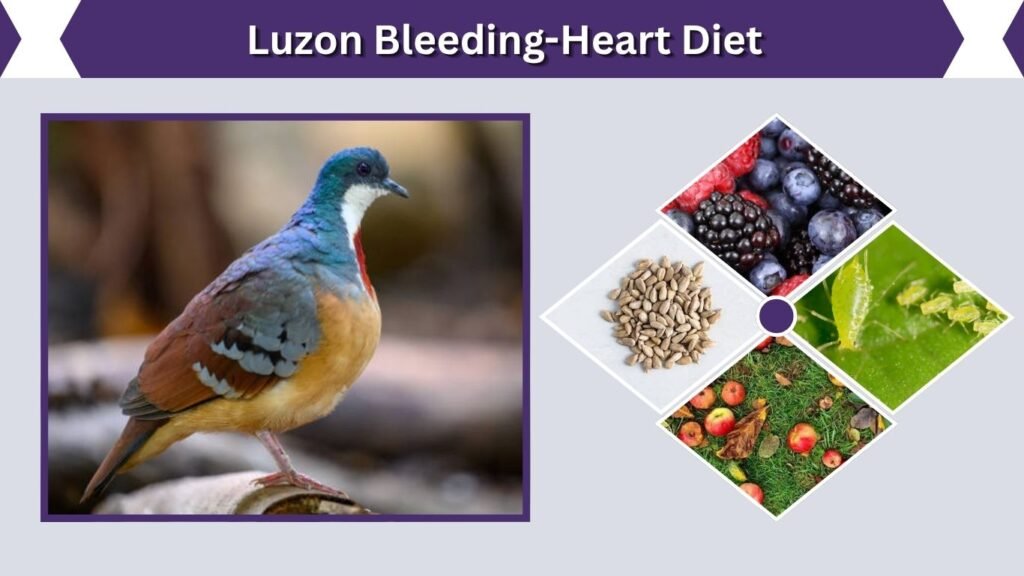
The Luzon bleeding-heart feeds mostly on the ground. It walks slowly through leaf litter, picking up small food items. Like many doves, it eats plant matter, but it may also take small animals when available.
What Does It Eat?
Its diet includes seeds, fallen fruits, berries, and small invertebrates. In forests, fallen food from trees is important because this dove usually feeds at ground level. In managed care, zoos may provide a balanced diet with seeds, grains, chopped fruits, greens, and special bird feed.
Common food items include:
- Seeds
- Fallen fruits
- Berries
- Small insects
- Worms
- Other small invertebrates
- Soft plant material
- Grains in managed care
Because it feeds on the ground, the Luzon bleeding-heart depends on a healthy forest floor. When forests are cleared or heavily disturbed, the bird loses food sources, hiding places, and safe movement routes.
Luzon Bleeding-Heart Behavior and Lifestyle
The Luzon bleeding-heart is a quiet and secretive dove. It is usually seen alone or in pairs rather than in large flocks. It spends much of the day walking under dense vegetation, where its soft colors help it blend into the shaded forest floor.
Movement, Call, and Social Behavior
This bird can fly, but it is mainly terrestrial. When threatened, it may flush upward into low branches or thick cover. Most daily activities happen close to the ground, including feeding, walking, and hiding.
Its behavior includes slow walking, short flights, and careful movement through the forest. The bird is not as bold as city pigeons and usually avoids open areas. It may remain still or disappear into cover when disturbed.
During courtship, males may display to females. Like other doves, they may use body postures, calls, and chest displays. The red breast patch may become especially noticeable during these courtship movements.
Can the Luzon Bleeding-Heart Fly?
Yes, the Luzon bleeding-heart can fly. However, it is not usually seen flying long distances in open spaces. It is a ground dove, so it spends most of its time walking and foraging low in the forest.
Flying and Ground Adaptations
The bird’s short tail, long legs, and rounded body match its ground-based lifestyle. It can use quick flights to escape danger, reach a roost, or move through forest cover, but it is not built for the same type of powerful urban flight seen in common pigeons.
Important adaptations include:
- Long legs for walking through leaf litter
- Short tail for moving through dense vegetation
- Soft gray and brown tones for camouflage
- Red chest patch used in recognition and display
- Ground-feeding behavior
- Quick escape flights into cover
- Secretive habits that reduce predator attention
Its ability to fly helps it survive, but its first defense is usually staying hidden in dense vegetation.
Luzon Bleeding-Heart Breeding and Nesting
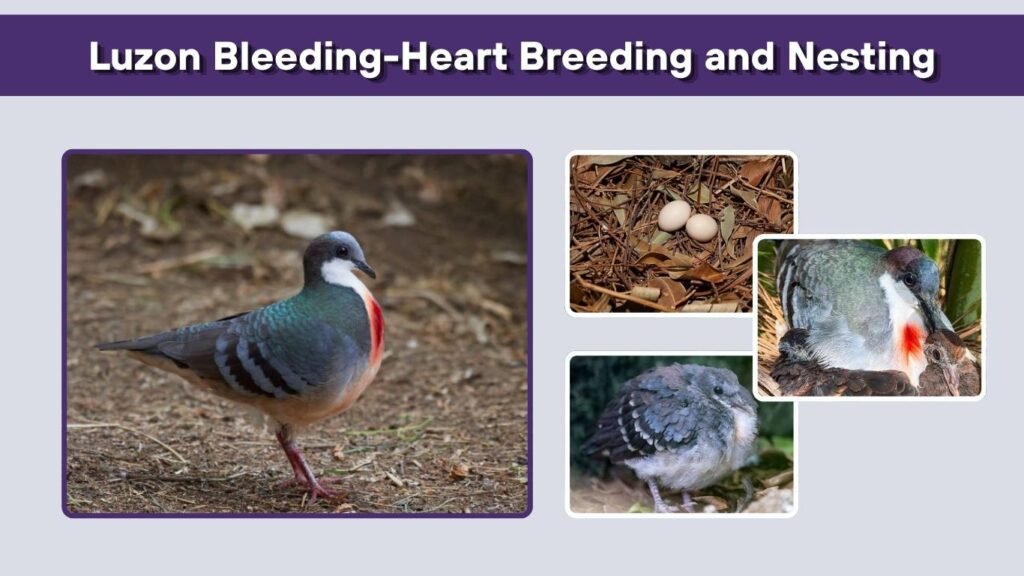
The Luzon bleeding-heart has a typical dove breeding style. Pairs form during the breeding season, and both parents may help with nesting and chick care. In many doves, parental care is shared, which helps the young survive during the early stage.
Eggs, Chicks, and Parental Care
Unlike some other bleeding-heart doves, the Luzon bleeding-heart is reported to lay two eggs in a clutch. The nest is usually a simple platform made from twigs and plant material, placed above the ground in vegetation or a low tree.
After hatching, the chicks are fed by their parents. Like other pigeons and doves, the adults can produce crop milk, a rich food for young chicks. This early feeding helps the chicks grow before they begin eating more solid foods.
Breeding success depends on safe nesting sites, low disturbance, and enough forest cover. If forests are cut or nests are disturbed, breeding pairs may fail to raise young.
Lifespan of the Luzon Bleeding-Heart
The lifespan of the Luzon bleeding-heart can vary between wild and managed conditions. In the wild, it faces predators, habitat loss, hunting pressure, and food changes. In zoos or aviaries, proper care can help birds live longer.
How Long Does It Live?
Some zoo sources report that Luzon bleeding-heart doves may live around 15 years in the wild. In managed care, lifespan may be longer when birds receive a good diet, protection from predators, clean housing, and veterinary attention.
A long lifespan also means that adult survival is important. If adult birds are removed from the wild through hunting or trapping, the population may decline more quickly, especially in areas where breeding habitat is already limited.
Is the Luzon Bleeding-Heart Endangered?
The Luzon bleeding-heart is listed as Near Threatened. This means it is not currently in the highest danger category, but it is still at risk. Its population is considered scarce or rare in many parts of its range, and pressure on its habitat continues.
Conservation Status
The main threats to the Luzon bleeding-heart are forest loss, hunting, trapping, and wildlife trade. Lowland forest in the Philippines has been heavily affected by logging, agriculture, settlement, and other forms of land conversion.
The species is also vulnerable because it is attractive and unusual. Its red chest patch makes it desirable in the bird trade, while its ground-dwelling behavior may make it easier to catch.
Major threats include:
- Deforestation
- Forest fragmentation
- Hunting for food
- Capture for the bird trade
- Snares set for other ground birds
- Disturbance in remaining forest patches
- Small and scattered populations
Protected areas help, but protection must be active and effective. Forest reserves need monitoring, enforcement, and habitat restoration to support long-term survival.
Predators and Natural Dangers
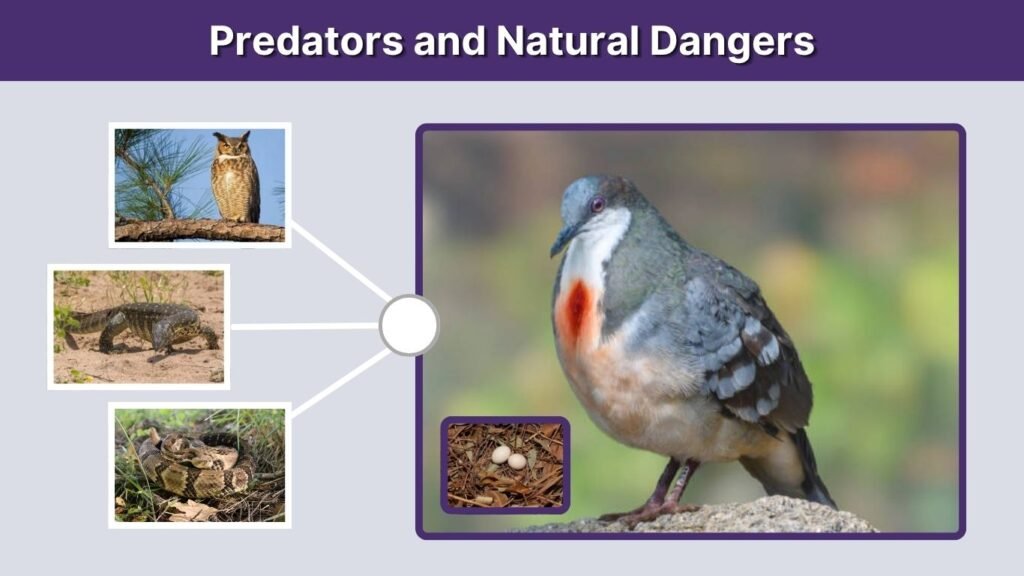
Like many ground birds, the Luzon bleeding-heart may face threats from predators that hunt eggs, chicks, or adults. Forest predators can include snakes, monitor lizards, birds of prey, and small carnivorous mammals. Introduced animals may also be a problem in some areas.
Why Ground Doves Are Vulnerable
Ground-dwelling birds face extra risks because they nest, feed, and move close to the ground. Eggs and chicks can be found by predators, while adult birds can be caught in snares or disturbed by people and domestic animals.
Their secretive behavior helps reduce danger, but it cannot fully protect them when forests are cleared. Dense vegetation is one of their best defenses. Without it, they have fewer places to hide, feed, and nest.
Luzon Bleeding-Heart Symbolism
The Luzon bleeding-heart has strong symbolic value because of its red chest mark. The patch looks like a wound, so people often connect the bird with ideas of love, sacrifice, pain, beauty, and vulnerability. Its appearance is both beautiful and emotional.
Meaning and Cultural Interest
The bird’s “bleeding heart” look can symbolize a tender heart, deep emotion, or suffering hidden inside beauty. It may also represent the fragility of forest wildlife in the Philippines. Because the species is threatened by habitat loss and hunting, it can be seen as a symbol of conservation and the need to protect rare island birds.
However, symbolism should not replace the bird’s real biological importance. It is not only a beautiful animal; it is part of a forest ecosystem and deserves protection in the wild.
Can You Keep a Luzon Bleeding-Heart as a Pet?
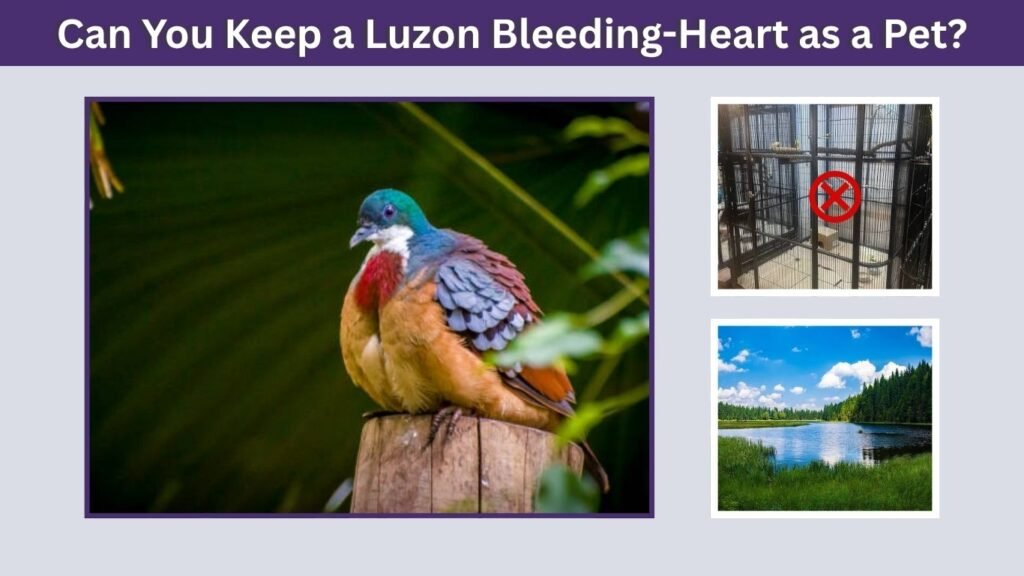
The Luzon bleeding-heart is sometimes kept in specialist aviaries, but it is not a good pet for most people. It is a rare and sensitive species with legal and ethical concerns. In many places, keeping or trading this bird may require permits.
Pet and Sale Concerns
People searching for a Luzon bleeding-heart dove for sale should be very careful. Wild-caught birds harm conservation and may be illegal. Any legal captive bird should come with proper documents and proof of captive breeding.
Important points to consider:
- It needs a large, quiet aviary
- It requires warm and stable conditions
- It needs a balanced specialist diet
- It is shy and easily stressed
- It may be legally protected
- It should never be taken from the wild
- Long-term avian veterinary care is necessary
For most bird lovers, the best choice is to see the Luzon bleeding-heart in a zoo, conservation aviary, or educational wildlife facility rather than trying to own one privately.
Interesting Facts About the Luzon Bleeding-Heart
The Luzon bleeding-heart is famous because of its appearance, but many other facts make it special. It is part of a group of bleeding-heart doves found in the Philippines and nearby regions.
Quick Facts
Here are some interesting facts:
- Its scientific name is Gallicolumba luzonica.
- It is native to the Philippines.
- It is named after the island of Luzon.
- The red chest patch looks like a bleeding wound.
- It is a ground dove, not a tree-living city pigeon.
- It usually walks more than it flies.
- It is shy and hard to observe in the wild.
- It may be seen alone or in pairs.
- Its diet includes seeds, fruits, and small invertebrates.
- It is listed as Near Threatened.
- Habitat loss is one of its biggest threats.
- It belongs to the same family as pigeons and doves.
- It is one of several “bleeding-heart” dove species.
- The sexes look very similar.
- It is an important symbol of Philippine forest wildlife.
FAQs
Why is it called the Luzon bleeding-heart?
It is called the Luzon bleeding-heart because it comes from the Luzon region of the Philippines and has a bright red patch on its chest. The red mark sits on a pale breast and looks like a bleeding wound, giving the bird its dramatic common name.
Is the Luzon bleeding-heart endangered?
The Luzon bleeding-heart is listed as Near Threatened. It is not officially endangered, but its population is under pressure. Habitat loss, hunting, trapping, and illegal wildlife trade are the main reasons this species is considered at risk in the wild.
Where does the Luzon bleeding-heart live?
The Luzon bleeding-heart lives in the Philippines, mainly on Luzon and nearby islands such as Polillo and Catanduanes. It prefers tropical forest habitats with dense undergrowth, leaf litter, and enough cover for feeding, nesting, and hiding from predators.
What does the Luzon bleeding-heart eat?
The Luzon bleeding-heart eats seeds, fallen fruits, berries, and small invertebrates. It usually feeds on the forest floor, walking through leaf litter and picking up food. In managed care, it may receive fruits, grains, greens, seeds, and balanced bird feed.
Can the Luzon bleeding-heart fly?
Yes, the Luzon bleeding-heart can fly, but it spends most of its time on the ground. It usually uses short flights to escape danger or reach cover. Its long legs, short tail, and secretive behavior make it well suited for ground life in dense forests.