
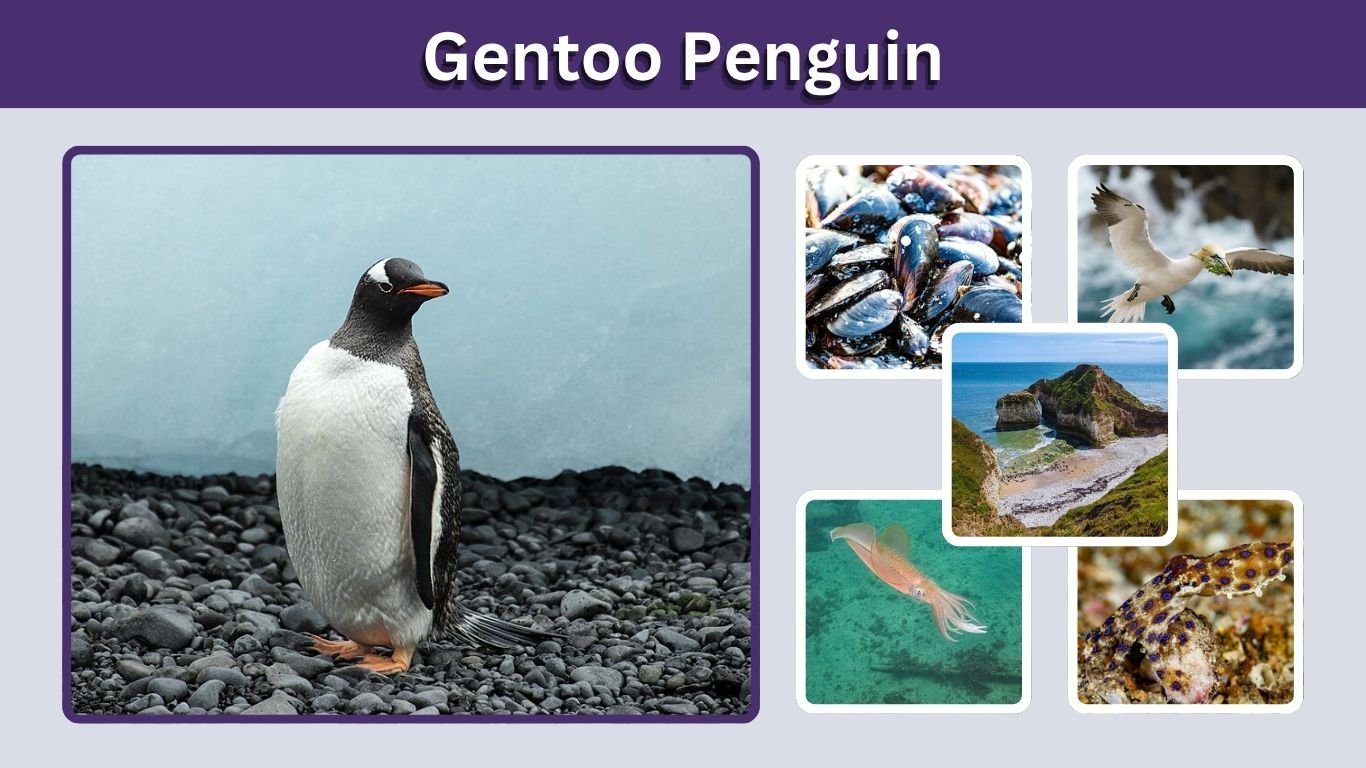
The gentoo penguin is one of the most recognizable penguins of the Southern Hemisphere, known for its bright orange-red bill, white head markings, long tail, and energetic swimming style. Scientifically called Pygoscelis papua, it lives around the Antarctic Peninsula and several sub-Antarctic islands. Gentoo penguins spend much of their lives near cold coastal waters, where they hunt fish, krill, squid, and other marine prey. Their pebble nests, strong pair bonds, curious behavior, and adaptable feeding habits make them especially fascinating seabirds.
Gentoo Penguin Identification and Characteristics
Gentoo penguins belong to the brush-tailed penguin genus Pygoscelis, alongside Adélie and chinstrap penguins. They are generally considered the third-largest living penguin species. Their combination of a dark head, white belly, orange feet, colorful bill, and distinctive white markings above the eyes makes an adult gentoo relatively easy to identify among other Antarctic penguins.
Scientific Name and Classification
The gentoo penguin’s scientific name is Pygoscelis papua. It belongs to the family Spheniscidae and the order Sphenisciformes. The genus name Pygoscelis is associated with the group’s distinctive brush-like tails. Gentoo penguins have particularly noticeable tail feathers that project behind them as they walk.
Gentoo Penguin Appearance and Size
Adult gentoos have black backs and heads contrasted against white underparts. A white marking extends around and above each eye, while the bill ranges from orange to reddish orange. Their webbed feet are also orange.
Typical physical characteristics include:
- Length: roughly 70–95 cm (28–37 inches)
- Average length: about 75 cm (30 inches)
- Weight: approximately 4.5–8.5 kg (10–19 pounds)
- Body: streamlined for underwater movement
- Bill: orange-red with darker areas
- Feet: broad, orange and webbed
- Tail: unusually prominent compared with many penguins
Males and females look similar, although males tend to be somewhat larger.
Where Do Gentoo Penguins Live?
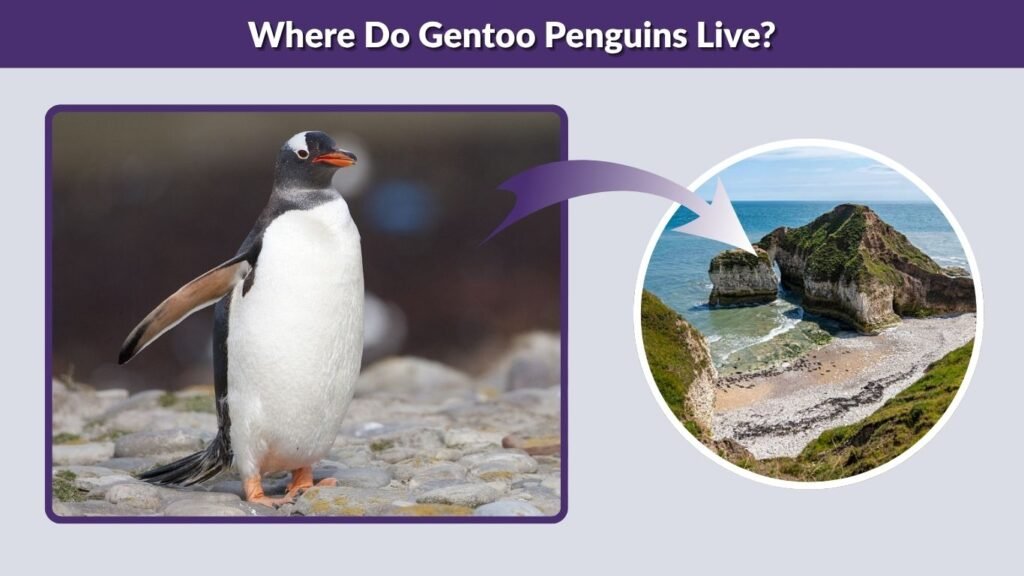
Gentoo penguins have a broad southern distribution. Instead of living exclusively on the Antarctic continent, populations occur across the Antarctic Peninsula and numerous sub-Antarctic islands. They usually remain relatively close to their breeding regions throughout the year, although movements can vary depending on local ice and food availability.
Gentoo Penguin Habitat
Their habitat combines ice-free nesting ground with easy access to productive marine waters. Colonies may occur on beaches, coastal plains, valleys, low hills and other relatively open areas.
Important breeding areas include the Antarctic Peninsula, Falkland Islands, South Georgia and various sub-Antarctic islands. Some populations also occur around islands of the southern Indian Ocean.
Gentoo Penguin Colonies
Gentoo penguins breed colonially, but their colonies can differ greatly in size. Unlike some penguins that show extremely rigid nest-site attachment, gentoos may shift their nesting locations slightly between seasons.
A suitable breeding ground must provide space for nests while allowing adults reasonable access to the sea. This matters because breeding adults repeatedly travel between the colony and feeding areas while raising their chicks.
What Does a Gentoo Penguin Eat?
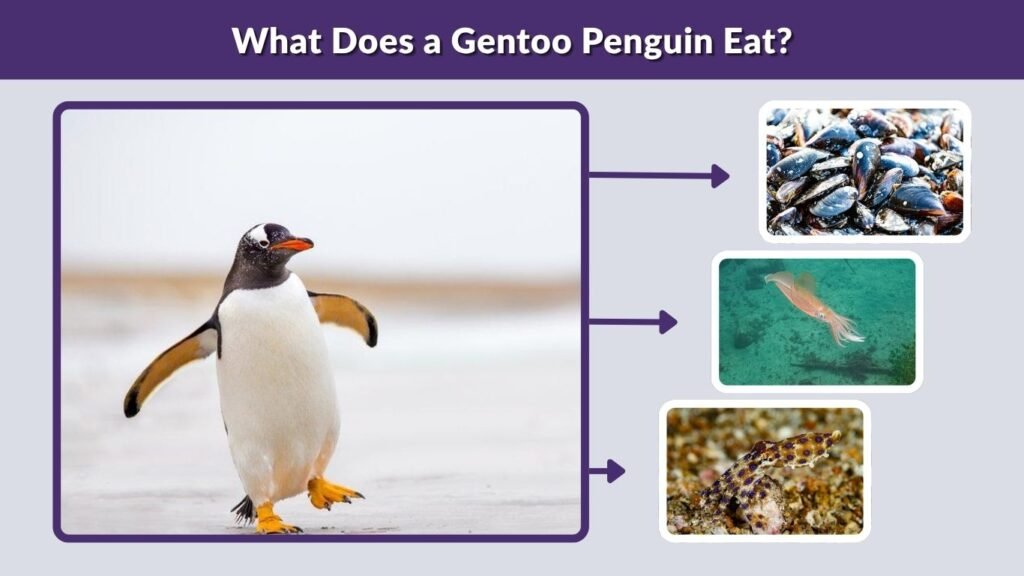
A gentoo penguin diet is flexible rather than consisting of one specific prey species. These penguins are opportunistic marine hunters, and what they eat changes according to location, season and prey availability. This flexibility can help populations respond to changing conditions, although successful breeding can still depend heavily on access to abundant, energy-rich prey.
Main Gentoo Penguin Foods
Common prey includes:
- Antarctic krill and other crustaceans
- Small fish
- Squid
- Other small cephalopods
- Locally abundant marine organisms
A long-term British Antarctic Survey study at South Georgia found considerable year-to-year variation between fish and crustaceans in gentoo diets. Researchers identified numerous prey species, demonstrating how adaptable their feeding habits can be.
Swimming and Hunting
Gentoo penguins are highly adapted for underwater pursuit. Their compact bodies reduce resistance in the water, while their modified wings function as powerful flippers.
They also maintain waterproof plumage by spreading oil from a gland near the tail over their feathers. This feather system helps insulate the body and limit water penetration during repeated dives in extremely cold seas.
Breeding, Pebble Nests and Gentoo Penguin Chicks
Gentoo penguin breeding is particularly interesting because both parents contribute extensively to nesting and chick care. Adults typically breed between about two and four years of age. Colonies become busy with courtship, nest defense, egg incubation and constant feeding trips as pairs attempt to raise their young successfully.
Gentoo Penguin Pebble Nests
Gentoo penguins commonly construct nests from pebbles, stones and other available material. Pebbles are valuable around breeding colonies, and birds vigorously defend their nest sites.
Pairs often maintain strong bonds, and British Antarctic Survey observations indicate that individuals frequently return to the same partner from the previous season even when the precise nest site changes.
Eggs, Chicks and Life Cycle
The basic gentoo penguin life cycle includes:
- Egg laying: females normally produce two eggs.
- Incubation: approximately 34–37 days.
- Early chick stage: parents protect and feed newly hatched chicks.
- Crèche stage: chicks begin gathering into groups at around a month old.
- Fledging: commonly around 80–90 days, although timing varies geographically.
- Young adulthood: birds eventually reach breeding age and return to colonies to reproduce.
Both adults participate in incubation and chick feeding.
Behavior, Predators and Survival Adaptations
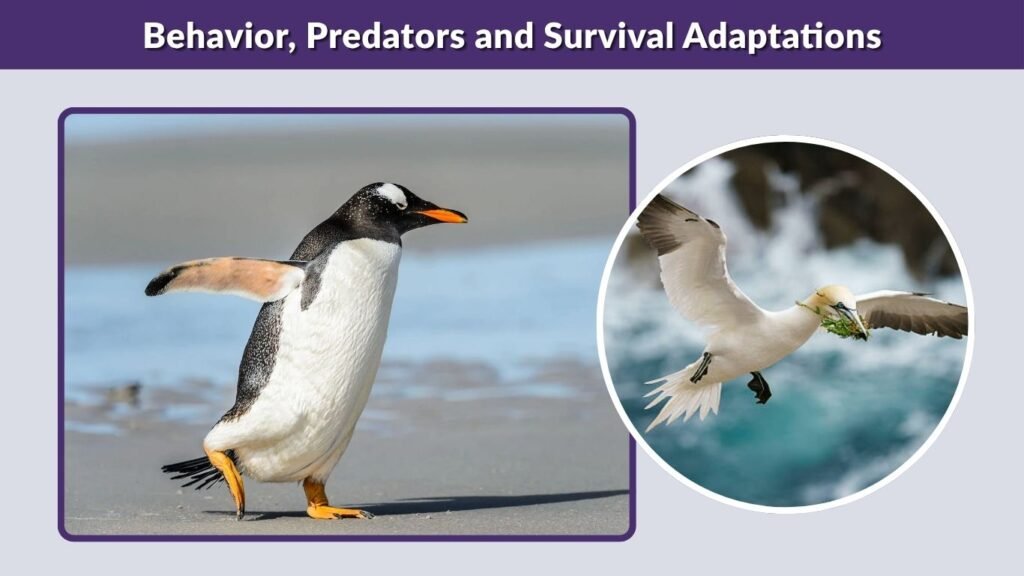
Life around Antarctica and the sub-Antarctic requires adaptations for cold temperatures, marine hunting and intense seasonal breeding. Gentoo penguins combine waterproof feathers, strong swimming ability, webbed feet and social breeding behavior with considerable flexibility in their choice of food and nesting locations. These characteristics help them exploit environments that would be extremely challenging for most birds.
Gentoo Penguin Behavior
Gentoos may occur in smaller groups than some other Antarctic penguins and sometimes mix with other penguin species. During the breeding season, however, they become strongly territorial around their nests.
Their plumage requires frequent maintenance. Preening spreads protective oil across the feathers, helping preserve their waterproof barrier. Adults also spend considerable time traveling between feeding grounds and colonies when chicks require food.
Gentoo Penguin Predators
Predators vary according to the penguin’s age and whether it is on land or at sea. Eggs and small chicks can be especially vulnerable to predatory seabirds, whereas adults face larger marine predators.
Recorded threats include skuas attacking eggs, while giant petrels and other birds may prey on young penguins. Leopard seals are among the important predators of older gentoo penguins in the marine environment.
Important Gentoo Penguin Adaptations
Several adaptations support their survival:
- Streamlined bodies for efficient swimming
- Flipper-like wings for underwater propulsion
- Webbed feet useful for swimming and movement
- Dense, waterproof plumage for cold-water protection
- Countershading, with dark backs and light bellies
- Flexible feeding behavior when prey availability changes
These traits make the gentoo well suited to a lifestyle divided between cold ocean waters and exposed coastal nesting areas.
Gentoo Penguin Lifespan
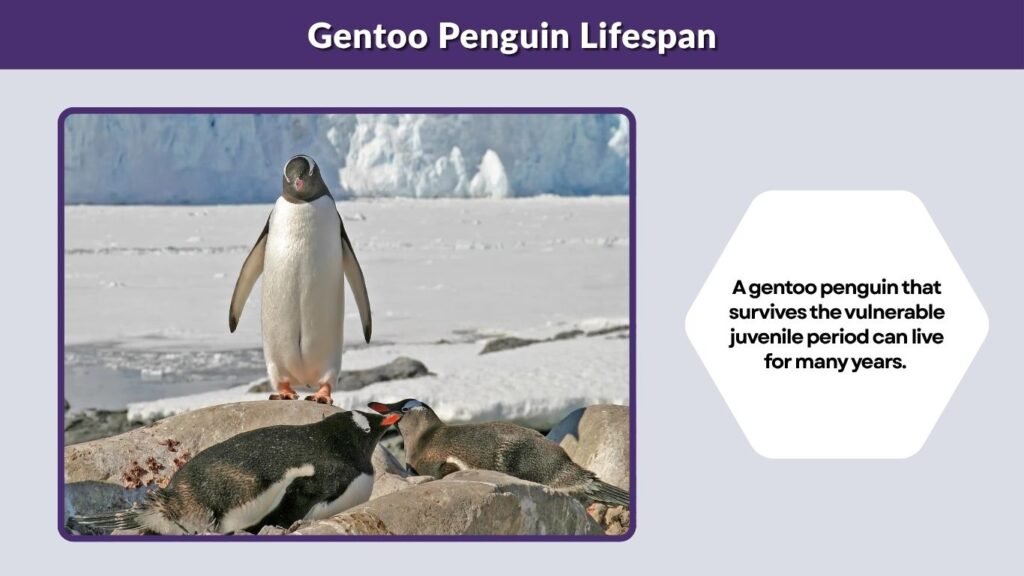
A gentoo penguin that survives the vulnerable juvenile period can live for many years. Estimates differ among sources and populations, but an average of around 13 years has been reported, while other references commonly give ranges around 12–20 years. Juvenile survival is substantially lower than adult survival because young birds face predation, food shortages and harsh environmental conditions.
Male vs. Female Gentoo Penguins
Male and female gentoo penguins are visually very similar, so determining sex just by looking at an individual can be difficult. Males tend to be larger overall, including differences in measurements such as bill and flipper length.
Both sexes play important parental roles, sharing duties associated with incubating eggs and feeding their growing chicks.
Gentoo Penguin Conservation Status
Gentoo penguins are currently categorized as Least Concern, but population patterns are not identical throughout their enormous range. Some Antarctic Peninsula populations have expanded, while populations elsewhere have shown different trends. Consequently, scientists monitor colonies separately instead of assuming that changes in one region describe the entire species.
Population and Environmental Change
A global assessment published in 2020 estimated approximately 432,000 breeding pairs, with evidence of substantial growth along the western Antarctic Peninsula compared with earlier assessments. Other estimates differ because surveys cover different years and locations.
Environmental change can affect gentoo penguins in complicated ways. Regional warming and changes in sea ice have coincided with expansion in parts of the Antarctic Peninsula, while fisheries, pollution, disturbance and changes in prey resources remain potential pressures.
Interesting Facts About the Gentoo Penguin
Gentoo penguins have several characteristics that distinguish them from their relatives. Their conspicuous white head markings are visible even in younger birds, although they become more defined in adults. Their long tail is another distinctive feature and helps explain their membership in the so-called brush-tailed penguin group.
Pebbles Are Important During Breeding
Pebbles are more than random objects around a gentoo colony. They are important nest-building material and become part of breeding interactions between pairs. Adults gather suitable stones throughout the nesting period and aggressively protect completed nests from neighboring birds.
Young Gentoos Can Travel Surprisingly Far
Although gentoo populations generally stay relatively close to their breeding regions, wandering young individuals occasionally travel considerable distances. British Antarctic Survey records note sightings of young gentoos as far away as the coasts of New Zealand and Africa.
FAQs
Gentoo penguins attract many questions because their distribution, appearance and breeding behavior differ from the popular image of penguins living permanently on Antarctic ice. Understanding where they live, what they eat, how large they become and how they raise chicks provides a clearer picture of how this remarkably adaptable seabird survives in Southern Ocean environments.
1. What is the scientific name of the gentoo penguin?
The scientific name is Pygoscelis papua. Gentoo penguins belong to the same genus as Adélie and chinstrap penguins.
2. Where does a gentoo penguin live?
Gentoo penguins live around the Antarctic Peninsula and sub-Antarctic islands, including the Falkland Islands, South Georgia and several southern Indian Ocean islands.
3. What does a gentoo penguin eat?
Gentoo penguins primarily eat fish, krill and other crustaceans, along with squid and other cephalopods. Their exact diet varies by season and location.
4. How tall is a gentoo penguin?
Adults are generally around 70–95 cm (28–37 inches) long, with an average near 75 cm. Their size varies between populations and between males and females.
5. Are gentoo penguins endangered?
No. The gentoo penguin is currently classified as Least Concern. However, scientists continue monitoring individual colonies because population trends and environmental pressures differ considerably between regions.
