
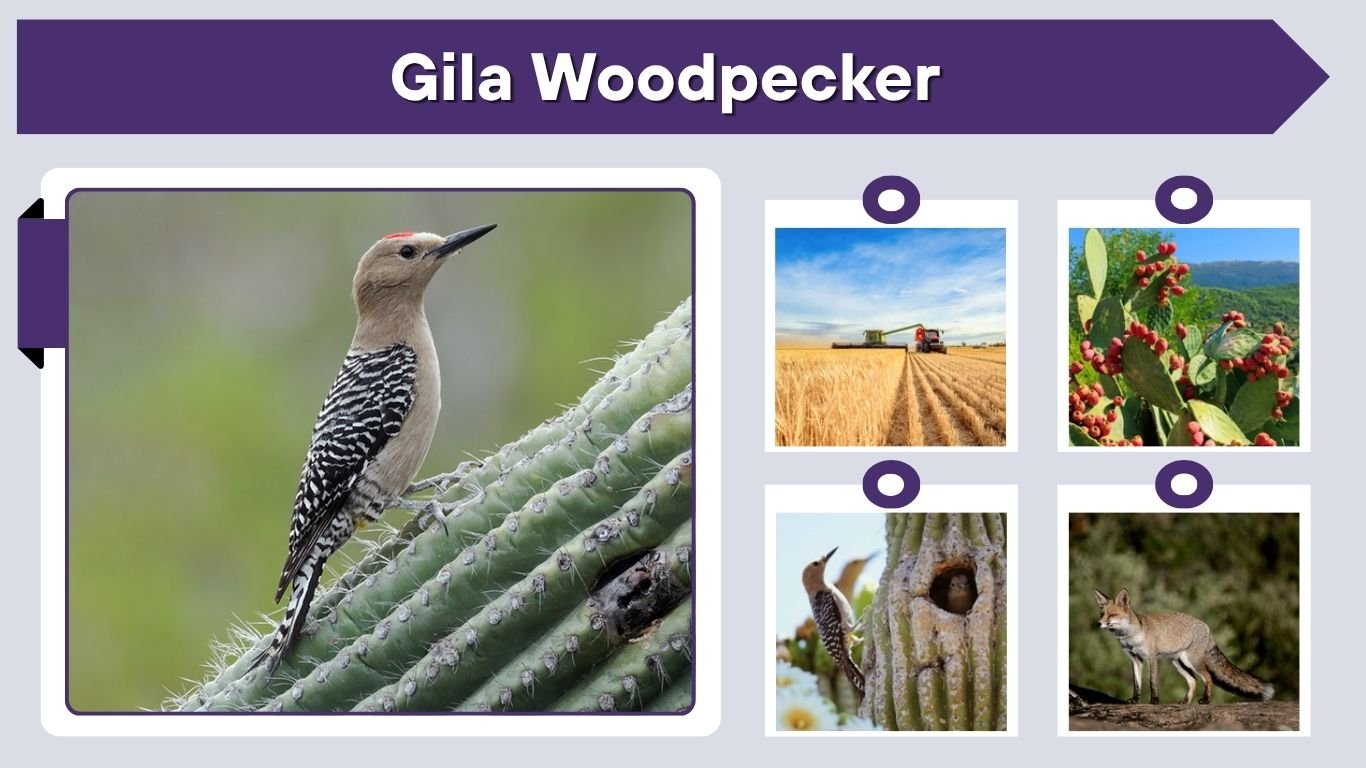
The Gila woodpecker is a noisy, adaptable desert bird best known for excavating nest cavities inside giant saguaro cacti. Its scientific name is Melanerpes uropygialis, and “Gila” is pronounced “HEE-lah.” This medium-sized woodpecker has a tan head and body, strongly barred black-and-white wings, and a conspicuous white wing patch in flight. Found primarily in the southwestern United States and western Mexico, it eats insects, fruit, seeds, and nectar while creating valuable homes for numerous other desert animals.
Gila Woodpecker Identification
A Gila woodpecker is about the size of an American robin but has the upright posture, pointed bill, and stiff tail typical of woodpeckers. Its pale brown body contrasts sharply with the zebra-like pattern across its back and wings. Both sexes look similar except for one noticeable feature on the male’s head.
Key Identification Features
- Scientific name: Melanerpes uropygialis
- Family: Picidae
- Length: Approximately 8 to 10 inches
- Wingspan: About 15 to 16 inches
- Weight: Roughly 2.1 to 2.8 ounces
- Head and underparts: Grayish-brown or tan
- Back and wings: Black with narrow white bars
- Wing patch: Large and white, especially visible in flight
- Bill: Long, straight, and dark
- Flight pattern: Undulating, with alternating flaps and glides
Male vs Female Gila Woodpecker
An adult male has a small red patch on the top of his head. This red cap is normally the easiest way to distinguish him from a female.
The female has a completely brownish-gray crown without red feathers. Otherwise, she shares the male’s pale face, plain underparts, barred back, dark tail, and white wing patches.
Males and females may also forage in slightly different places. Males often search the trunks and large branches of saguaros, while females commonly investigate outer branches and decaying sections.
Juvenile Gila Woodpecker
Young Gila woodpeckers resemble adult females because they initially lack the male’s distinctive red crown. Their plumage may appear softer, duller, or less clearly marked.
Juveniles remain dependent on their parents after leaving the nest. As young males mature, red feathers begin developing on the crown.
Gila Woodpecker Habitat and Range
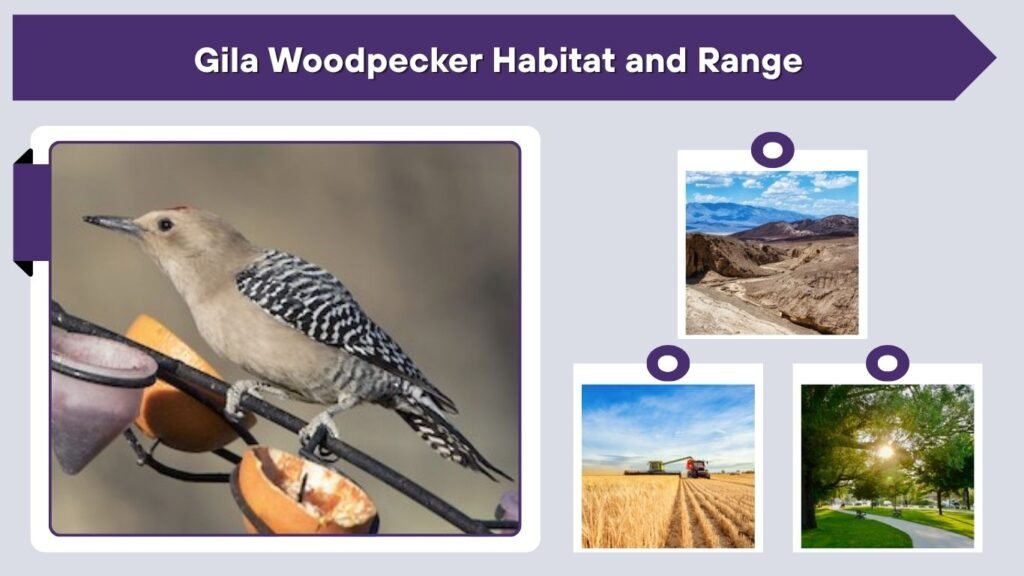
The Gila woodpecker is strongly associated with the Sonoran Desert. However, it is not limited to untouched cactus forests. It also occupies desert washes, agricultural areas, parks, towns, golf courses, and residential neighborhoods containing suitable feeding and nesting locations.
Where Do Gila Woodpeckers Live?
Their range includes:
- Southern and central Arizona
- Southeastern California
- Southwestern New Mexico
- Extreme southern Nevada
- Baja California
- Western and central Mexico
They are particularly common around Tucson, Phoenix, and other parts of southern Arizona. Typical habitats contain saguaros, mesquite, cottonwood, willow, or large ornamental trees.
Do Gila Woodpeckers Migrate?
Gila woodpeckers are mostly permanent residents. They remain within the same general region throughout the year instead of undertaking long-distance seasonal migrations.
Some individuals make short local movements in response to food, weather, or elevation. During periods when cactus fruit or berries are abundant, several birds may gather around productive feeding locations.
Gila Woodpecker and Saguaro Cactus
The relationship between the Gila woodpecker and saguaro cactus is one of the best-known wildlife associations in the Sonoran Desert. A saguaro provides an elevated, insulated nesting location, while the bird’s abandoned cavity later becomes shelter for other animals.
How Does It Build a Cactus Nest?
A pair uses its strong bills to excavate through a saguaro’s outer surface and into its softer tissue. The cactus responds by forming hard, callused tissue around the injury. This hardened lining creates a structure commonly called a “saguaro boot.”
The birds may wait several months before using a newly excavated cavity, giving its interior time to dry and harden. Saguaro tissue helps insulate the chamber against severe daytime heat and cooler nighttime temperatures.
Gila woodpeckers can also nest in mesquite, cottonwood, willow, palm trees, utility poles, and appropriately designed nest boxes.
Does the Woodpecker Harm the Saguaro?
A healthy, mature saguaro can usually seal the damaged tissue and survive the excavation. However, repeated holes, disease, structural weakness, or damage in a young cactus may create problems.
The relationship is not always a perfect example of mutualism because the woodpecker receives the most direct benefit. The cactus usually tolerates the cavity, while the surrounding desert community benefits when other animals inherit the abandoned nest.
Which Animals Use Abandoned Cavities?
Former Gila woodpecker nests may become homes for:
- Elf owls
- American kestrels
- Ferruginous pygmy-owls
- Purple martins
- Ash-throated flycatchers
- Brown-crested flycatchers
- Lucy’s warblers
- Cactus wrens
Because many of these animals cannot excavate their own holes, Gila woodpeckers serve as important ecosystem engineers. The cavities they create increase the number of safe nesting sites available in a landscape with relatively few large trees.
Gila Woodpecker Nesting and Life Cycle
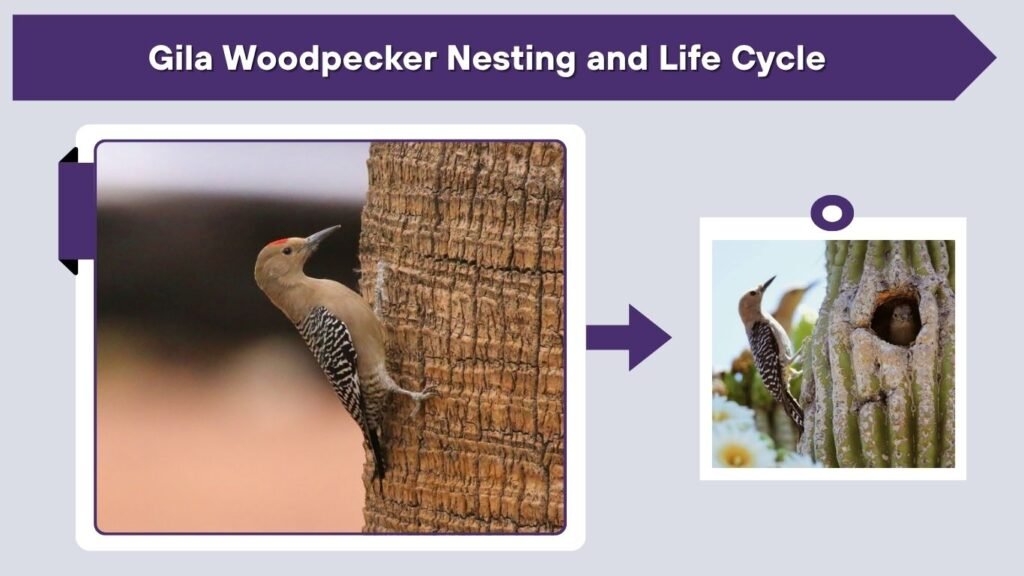
Gila woodpeckers begin defending nesting territories during winter. Males drum, call, and chase intruders away from potential cavities. Both members of a pair participate in excavation, incubation, and feeding their nestlings.
Eggs and Young
Typical nesting characteristics include:
- Clutch size: Three to six eggs
- Egg color: Plain white
- Incubation: Approximately 13 to 14 days
- Number of broods: One to three per year
- Hatchling condition: Naked, helpless, and dependent
- Nest type: Unlined cavity inside a cactus or tree
The breeding period commonly begins in spring, although exact timing varies with location and environmental conditions. Both parents bring insects and plant foods to the developing chicks.
Do Gila Woodpeckers Mate for Life?
They form monogamous breeding pairs and may remain together beyond a single nesting attempt. However, describing every pair as lifelong mates would be too definite. Pair bonds can change following the disappearance or death of one bird.
What Do Gila Woodpeckers Eat?
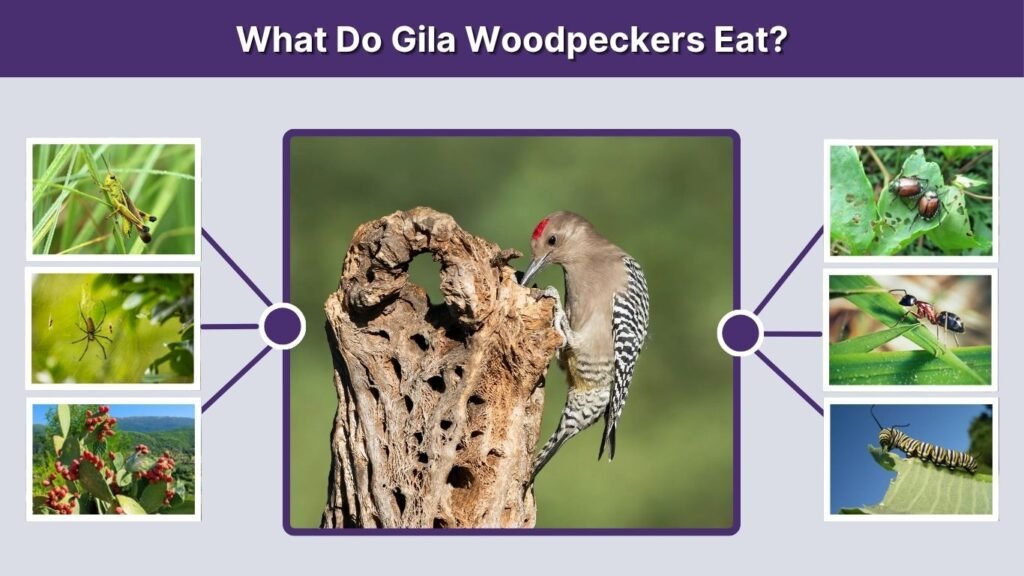
Gila woodpeckers are omnivorous and opportunistic. Their diet changes with the season and includes both animal and plant foods. Instead of drilling deeply into hard wood at every meal, they frequently collect insects from bark, flowers, fruit, foliage, and the ground.
Common Foods
- Beetles and beetle larvae
- Ants
- Caterpillars
- Grasshoppers
- Spiders
- Other small arthropods
- Saguaro fruit
- Mistletoe berries
- Other desert fruits
- Seeds and nuts
- Flower nectar
- Pollen
- Small lizards
- Eggs or nestlings on rare occasions
They may eat scorpions when an opportunity arises, but scorpions are not considered their principal food. In ecological terms, the Gila woodpecker is a consumer rather than a producer or decomposer.
Do Gila Woodpeckers Eat Brains?
Reports of Gila woodpeckers attacking nestlings have produced sensational descriptions of them “eating brains.” Such behavior represents rare opportunistic predation, not the bird’s regular feeding method.
Most of its diet consists of insects, cactus fruit, berries, nectar, and other readily available foods. The species should not be characterized primarily as a predator of other birds.
Do They Visit Hummingbird Feeders?
Gila woodpeckers sometimes cling to hummingbird feeders and drink sugar water. Their weight can tip or damage feeders designed for much smaller birds.
They also visit platform, tube, suet, and fruit feeders. Suitable offerings include unsalted nuts, suet, corn, and small pieces of fruit. Regularly clean feeders and avoid supplying salty, seasoned, moldy, or heavily processed foods.
Gila Woodpecker Calls, Sounds, and Behavior
Gila woodpeckers are active during the day rather than at night. They are particularly noticeable in the morning, when they call from saguaros, utility poles, trees, and other exposed perches.
What Does a Gila Woodpecker Sound Like?
Its best-known call is a loud, rolling churr or churrr-churrr. It also produces sharp yelps, nasal notes, rattles, and harsh chattering sounds.
Like other woodpeckers, it drums on resonant surfaces to claim territory or attract a partner. Metal flashing, gutters, pipes, and chimney caps can make its drumming sound much louder than drumming on wood.
Desert Adaptations
Several physical and behavioral features help it survive:
- Strong feet grip cactus surfaces and vertical trunks.
- Stiff tail feathers brace the body while climbing.
- A pointed bill excavates cavities and exposes insects.
- A long, sticky tongue removes prey from crevices.
- Strong neck muscles support repeated pecking.
- Cactus cavities provide insulation from temperature extremes.
- An omnivorous diet allows it to use changing seasonal foods.
- Early-morning activity reduces exposure to intense midday heat.
Gila Woodpecker vs Flickers
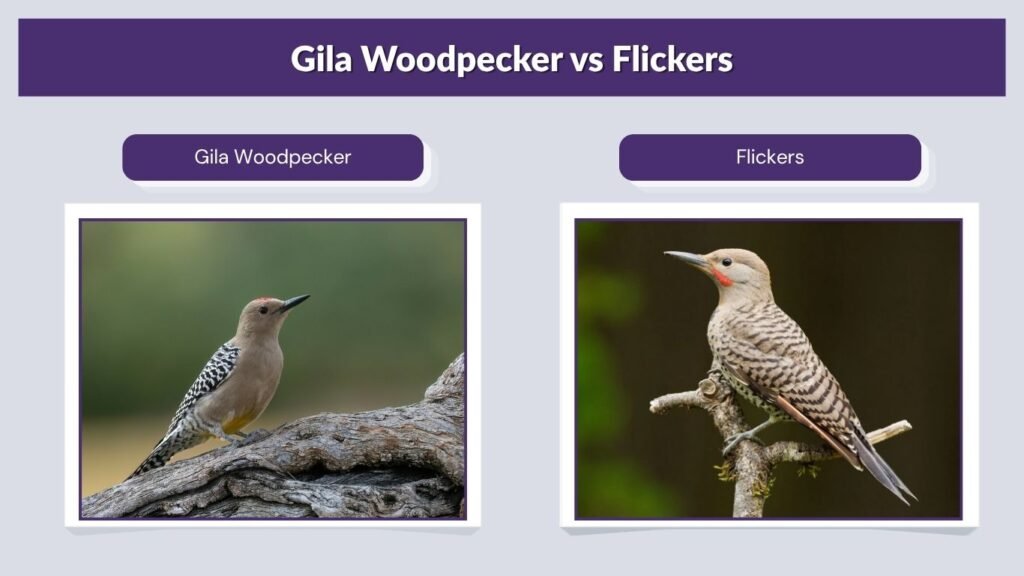
Gila woodpeckers share their desert habitat with several similar-looking species. Size, belly markings, head patterns, and wing color are the most useful identification clues.
Gilded Flicker vs Gila Woodpecker
A gilded flicker is larger and has a spotted belly, a dark crescent on its chest, and yellow coloring under its wings. A male gilded flicker has a red mustache-like stripe beside the bill.
The Gila woodpecker is smaller, has mostly plain tan underparts, and displays black-and-white barring across the back. Its male has a red crown patch rather than a red mustache.
Northern Flicker vs Gila Woodpecker
The Northern flicker is noticeably larger and has a spotted belly, black chest crescent, and prominent white rump. Its feathers show red or yellow underneath, depending on the regional form.
The Gila woodpecker has plainer underparts, a zebra-barred back, and large white wing patches.
Ladder-Backed vs Gila Woodpecker
A ladder-backed woodpecker is smaller and generally shows more black-and-white patterning around the face and underparts. The male’s red crown is more extensive.
The Gila woodpecker has a plain tan face and belly, larger white wing patches, and a red patch limited to the male’s central crown.
Predators and Conservation
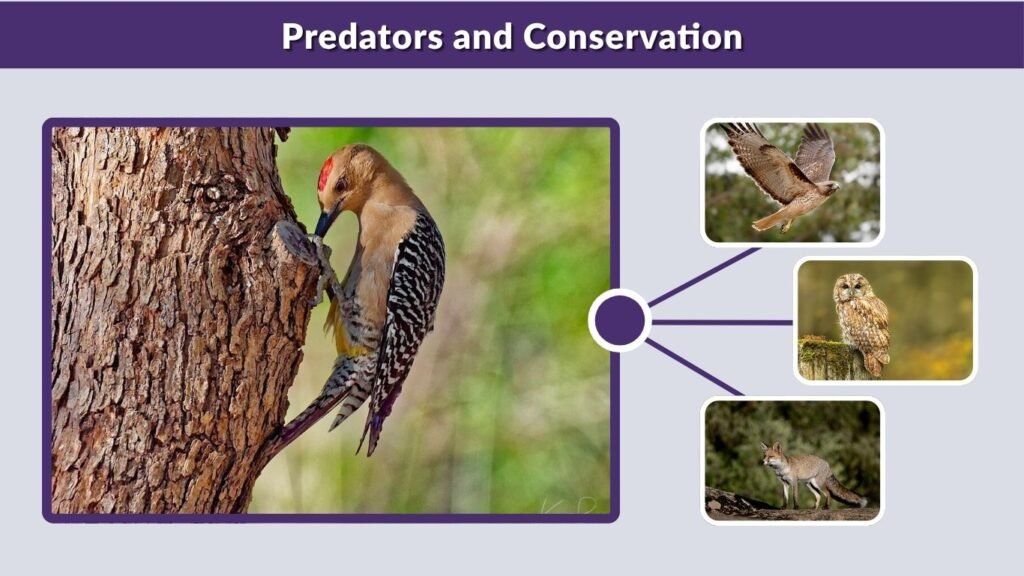
Hawks, owls, snakes, bobcats, foxes, coyotes, and free-roaming cats may prey on Gila woodpeckers or their young. Nest cavities offer some protection, although eggs and chicks can remain vulnerable to snakes and competing cavity nesters.
Is the Gila Woodpecker Endangered?
The species is not globally endangered and is currently categorized as Least Concern. However, it has disappeared from portions of its former California range, and local populations can be affected by habitat loss, cactus removal, extreme heat, and competition for nesting cavities.
Gila woodpeckers are protected wildlife. In Arizona, capturing, killing, or possessing a woodpecker generally requires authorization under state and federal law.
FAQs
What is special about the Gila woodpecker?
It is one of the few woodpeckers that regularly excavates nests in living cacti. Its abandoned cavities also provide homes for many other desert animals.
What does a female Gila woodpecker look like?
The female has a tan head and belly, barred black-and-white back, and white wing patches. Unlike the male, she does not have a red crown.
Are Gila woodpeckers nocturnal?
No. They are active during daylight and are frequently heard calling or drumming in the morning.
What is the home of a Gila woodpecker called?
Its cactus cavity is commonly called a saguaro boot because hardened cactus tissue forms a boot-shaped lining around the chamber.
How can I attract Gila woodpeckers?
Plant native desert vegetation, retain safe nesting trees or saguaros, provide clean water, and offer suet, unsalted nuts, fruit, or corn on a sturdy feeder.
