
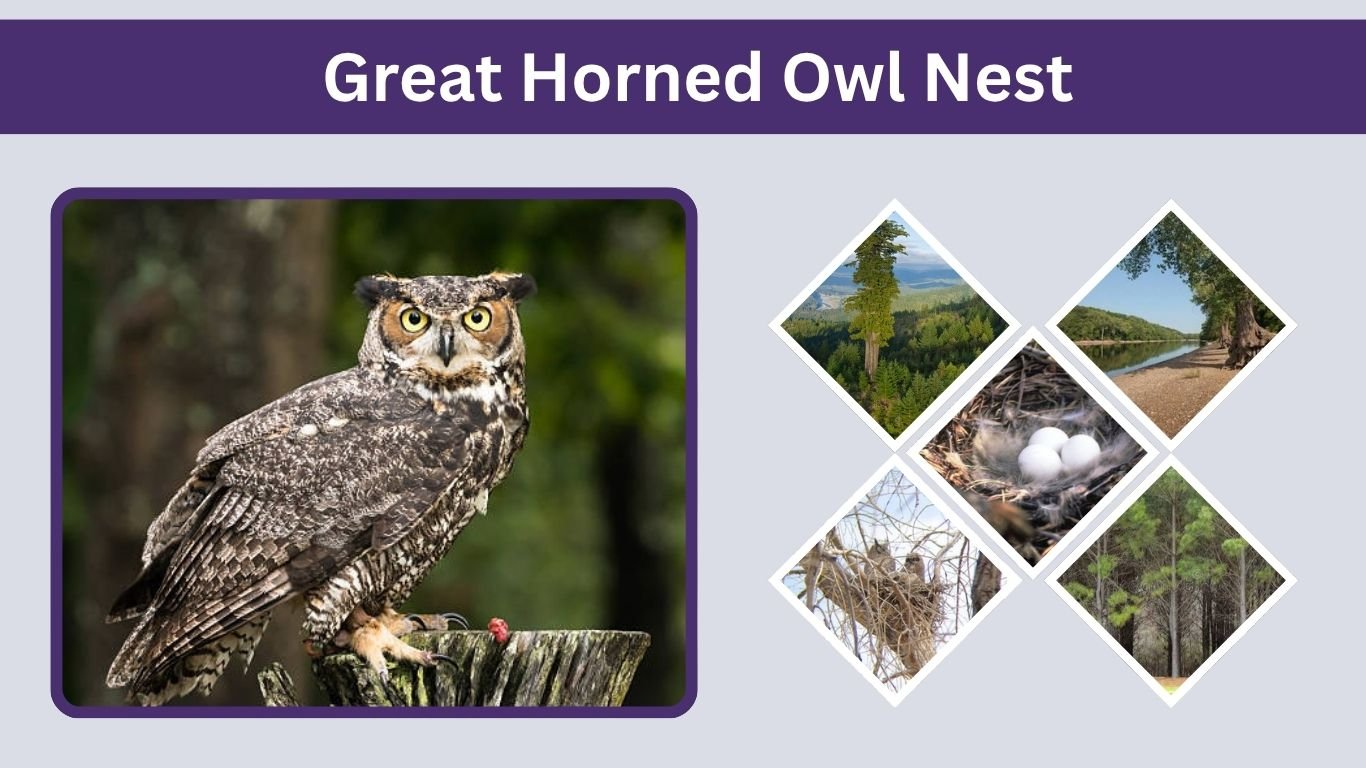
A great horned owl nest is usually not built by the owl itself. Instead, this powerful bird of prey often takes over old nests made by hawks, crows, ravens, herons, eagles, or squirrels. Great horned owls may also nest on cliffs, ledges, broken tree tops, buildings, cactus arms, or artificial nesting platforms. Their nesting season starts earlier than many birds, often in late winter. This guide explains where great horned owls nest, what their nests look like, when they lay eggs, and whether they use nest boxes.
Do Great Horned Owls Build Nests?
Great horned owls usually do not build their own nests. Unlike songbirds that weave grass, twigs, and plant fibers into a nest, great horned owls prefer to reuse existing structures. They may take over a large stick nest built by another bird or use a natural site that already provides support.
This behavior saves time and energy. Since great horned owls begin nesting very early in the year, they often claim old nests before many other birds start breeding.
Common Nest Sources
- Old hawk nests
- Old crow or raven nests
- Eagle nests
- Heron nests
- Squirrel nests
- Broken tree cavities
- Cliff ledges
- Building ledges
- Cactus arms
- Artificial nesting platforms
Great horned owls may add little or no nesting material. In many cases, the female simply settles into an old nest and lays eggs.
Where Do Great Horned Owls Nest?
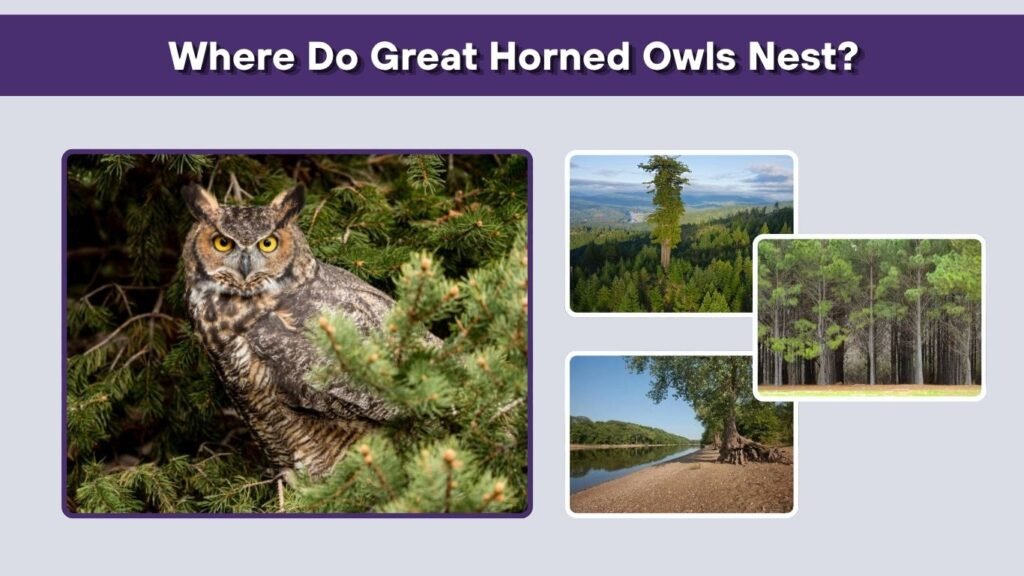
Great horned owls nest in many habitats because they are highly adaptable. They can nest in forests, deserts, wetlands, suburbs, farms, parks, and city edges. The key requirement is a safe elevated place near good hunting areas.
They usually prefer sites with a clear view of the surroundings. A nest high in a tree, on a cliff, or on a platform gives them protection and makes it easier to watch for danger.
Common Nesting Sites
- Tall trees in forests
- Cottonwoods near rivers
- Pine trees and wooded edges
- Desert cliffs and rocky ledges
- Large cactus arms in desert regions
- Old raptor nests
- Barns and building ledges
- Utility structures
- Nesting platforms
- Quiet suburban woodlots
Great horned owls do not need deep forests. They can nest wherever there is enough prey, cover, and a suitable nest site.
What Does a Great Horned Owl Nest Look Like?
A great horned owl nest often looks rough, bulky, and reused. If the owl takes over a hawk or crow nest, it may appear as a large pile of sticks placed in a tree fork or on strong branches. Since great horned owls do not do much nest repair, the nest may look messy or worn.
In some cases, the nest may not look like a nest at all. On cliffs or ledges, the eggs may be placed in a shallow scrape, depression, or protected corner. In desert areas, the nest may be in a cactus or old bird nest.
| Nest Type | What It Looks Like | Common Location |
|---|---|---|
| Old hawk nest | Large stick platform | Tall tree |
| Crow or raven nest | Smaller stick nest | Tree or utility structure |
| Cliff nest | Shallow scrape or ledge | Rocky cliff |
| Cactus nest | Nest in cactus arms | Desert habitat |
| Building ledge | Simple scrape or sheltered spot | Barns or structures |
| Nesting platform | Open wooden platform or basket | Tree or pole |
A great horned owl nest is not usually neat. It is practical, strong enough to hold eggs and chicks, and placed where predators are less likely to reach it.
Great Horned Owl Nesting Season
Great horned owls are among the earliest nesting birds in North America. In many areas, courtship begins in winter. Nesting may start from late winter to early spring, depending on location and climate.
In warmer regions, they may begin nesting earlier. In colder northern areas, nesting may happen later, but still earlier than many songbirds.
General Nesting Timeline
- Courtship: Late fall to winter
- Nest selection: Winter
- Egg laying: Late winter to early spring
- Incubation: About one month
- Hatching: Early to mid-spring in many regions
- Branching stage: Several weeks after hatching
- Fledging: Usually several weeks after leaving the nest
Because great horned owls nest early, people may see adults sitting on eggs while snow is still on the ground.
Great Horned Owl Eggs
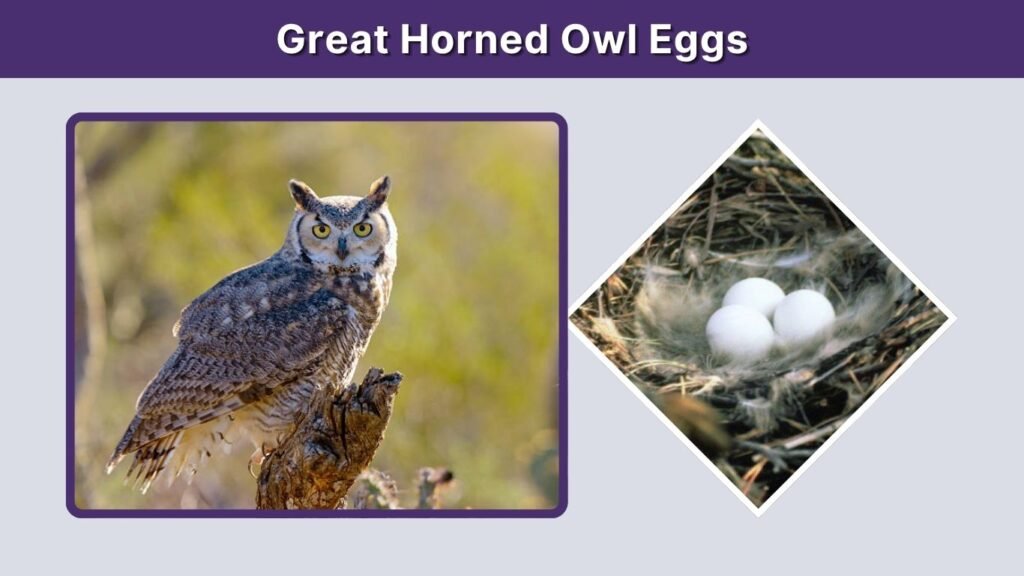
Great horned owl eggs are usually white and rounded. The female lays them in the chosen nest site and begins incubation. Clutch size is commonly 1–3 eggs, though 2 eggs is typical in many areas.
The female does most of the incubation. During this time, the male hunts and brings food. He may deliver prey to the nest or nearby perch while the female stays with the eggs.
Egg and Incubation Facts
- Egg color: White
- Common clutch size: 1–3 eggs
- Incubation: About 30–37 days
- Main incubator: Female
- Male role: Hunts and brings food
- Nest defense: Both parents may defend the area
Great horned owls are protective during nesting season. They may become aggressive if people or animals approach too closely.
How Long Do Baby Great Horned Owls Stay in the Nest?
Baby great horned owls stay in the nest for several weeks after hatching. At first, they are covered in white down and depend completely on their parents for warmth and food. As they grow, they become stronger and more alert.
Before they can fly well, young owls often leave the nest and move onto nearby branches. This stage is called branching. A young owl on the ground or low branch may not be abandoned. In many cases, the parents are still nearby and feeding it.
Baby Owl Development
- Newly hatched: Blind or weak, covered in down
- First weeks: Fed small pieces of prey by parents
- Growing stage: Develops thicker down and stronger legs
- Branching stage: Leaves nest and climbs nearby branches
- Fledging stage: Begins short flights
- Post-fledging: Still fed by parents for a period
If you find a baby great horned owl on the ground, do not assume it needs rescue. Keep pets away and contact a licensed wildlife rehabilitator if it appears injured or in danger.
Do Great Horned Owls Return to the Same Nest?
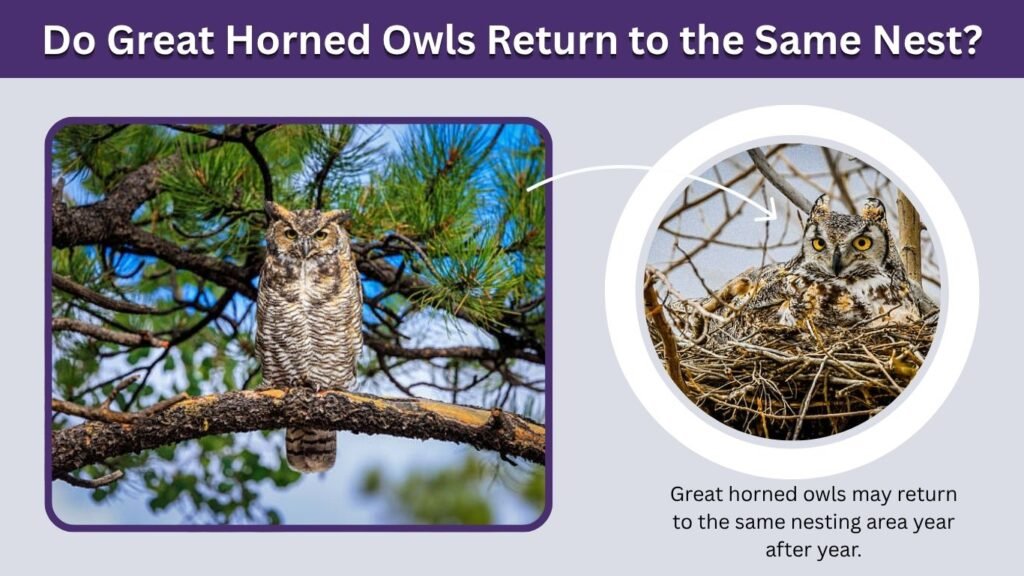
Great horned owls may return to the same nesting area year after year, especially if the location is safe and prey is abundant. However, they may not use the exact same nest every season. Old nests can fall apart, become unsafe, or be taken by other birds.
A pair may use several possible nest sites within a territory. They may choose an old hawk nest one year and a different tree or platform the next.
Why They May Change Nests
- The old nest collapsed
- Another bird took the nest
- Human disturbance occurred
- Predators found the site
- A better nest became available
- Weather damaged the structure
Even if the nest changes, the owls may remain in the same general territory.
Great Horned Owl Nest Size
Great horned owl nest size depends on the original builder. Since they often use old nests made by other birds, the size can vary. A reused red-tailed hawk or eagle nest may be large and bulky, while a crow nest may be smaller.
The nest must be strong enough to hold the female, eggs, and growing chicks. Since great horned owl chicks become large before leaving, weak nests may break down.
| Nest Feature | Typical Description |
|---|---|
| Shape | Open platform or shallow cup |
| Material | Sticks, twigs, old nesting material |
| Lining | Often little or none added by owl |
| Placement | Tree fork, ledge, platform, cactus, or structure |
| Condition | Often old, messy, or weathered |
| Strength | Must support large chicks |
Great horned owls may also use artificial nesting platforms when natural nest sites are limited.
Do Great Horned Owls Use Nest Boxes?
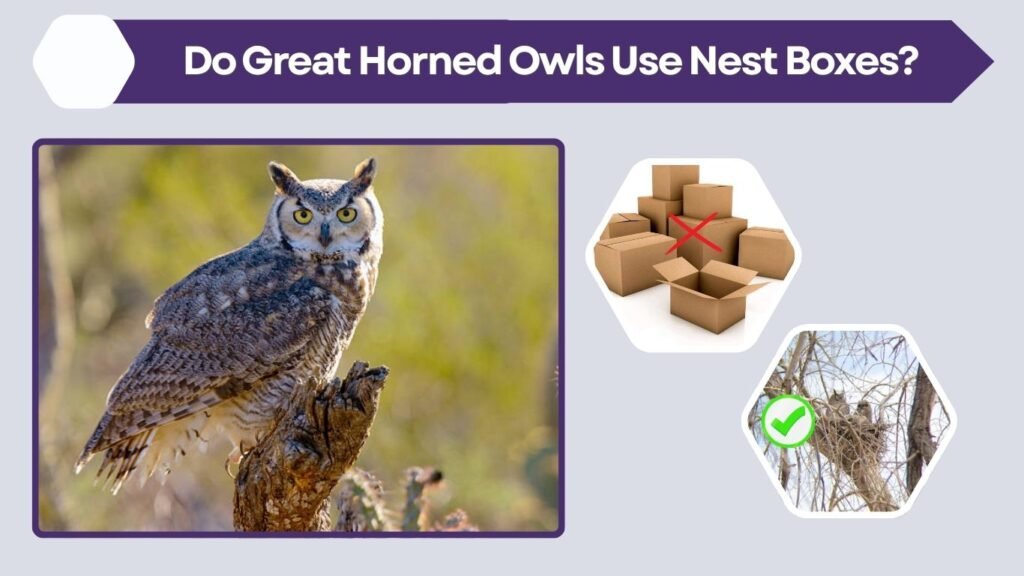
Great horned owls are not typical nest box birds. They are too large for small enclosed boxes used by screech owls, kestrels, or wood ducks. However, they may use large open nesting platforms, nest baskets, or artificial nest cones.
A “great horned owl nest box” is usually not a closed box. It is better described as a large open platform or basket placed high in a tree or on a strong pole.
Best Artificial Nest Options
- Large open platform
- Strong stick basket
- Nest cone
- Reused raptor-style platform
- Secure structure placed high above ground
The platform should be sturdy, open, and placed in a quiet area near suitable hunting habitat.
Great Horned Owl Nest Box and Platform Ideas
If natural nesting sites are limited, a nesting platform may help. It should be large enough for a big owl and its chicks. It also needs drainage, strong support, and a safe location away from heavy disturbance.
The platform should not be placed too close to houses, busy roads, or areas with frequent human activity. Great horned owls are powerful predators, so avoid attracting them near small outdoor pets or poultry.
Nesting Platform Tips
- Place the platform high in a sturdy tree or pole.
- Use strong materials that can handle wind and weather.
- Keep the design open rather than fully enclosed.
- Add sticks or natural material to make it look like an old nest.
- Choose a quiet area with nearby hunting habitat.
- Avoid placing it near chicken coops or pet areas.
- Install before nesting season begins.
A good platform can resemble an old hawk nest and may be accepted if owls are already present in the area.
Do Great Horned Owls Nest on the Ground?
Great horned owls usually do not nest directly on the ground, but it can happen in some open or treeless habitats. More often, they use elevated sites such as trees, cliffs, cactus arms, or structures.
Ground nesting is riskier because eggs and chicks are more exposed to predators. However, in places with few trees, a protected ground or cliff site may be used.
Great Horned Owl Nesting Behavior
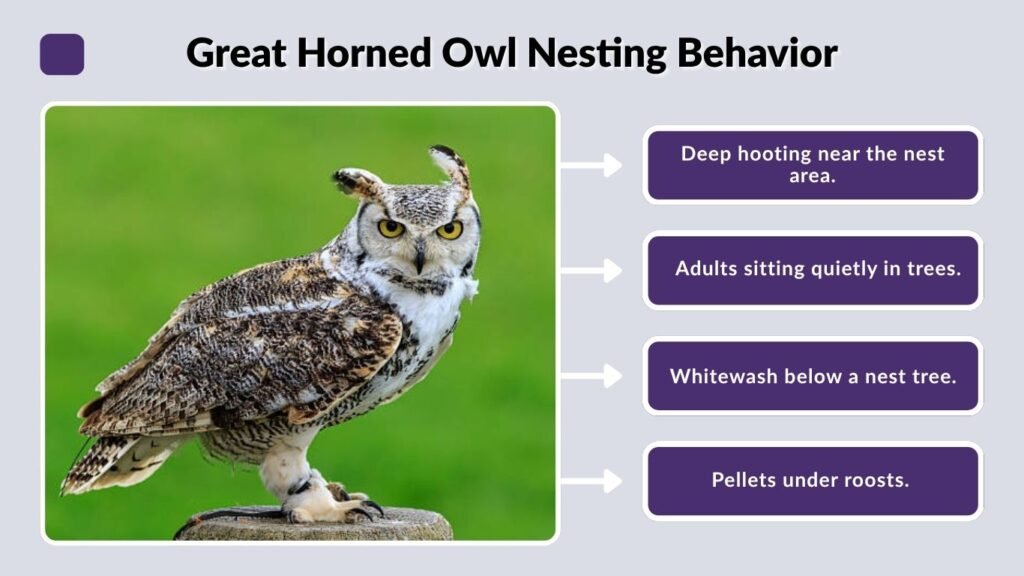
During nesting season, great horned owls become territorial. Males and females may call to each other with deep hoots. The male often brings food to the female while she incubates eggs.
After the eggs hatch, both parents help feed the young. The female may stay close to the nest while the male hunts. As the chicks grow, both adults may bring food.
Nesting Behaviors to Notice
- Deep hooting near the nest area
- Adults sitting quietly in trees
- Whitewash below a nest tree
- Pellets under roosts
- Prey remains near the nest
- Defensive behavior if approached
- Young owls branching near the nest
Birdwatchers should observe from a distance. Getting too close can stress the birds and may cause defensive attacks.
How to Find a Great Horned Owl Nest
Finding a great horned owl nest requires patience and careful observation. The best clue is often sound. Great horned owls call during winter courtship, especially at dusk, night, and early morning.
Look for large stick nests in tall trees, especially in areas where owls are heard regularly. Also check for pellets, white droppings, and feathers under roosting trees.
Signs of a Nest Nearby
- Repeated hooting from the same area
- Large stick nest in a tree fork
- Owl pellets below trees
- White droppings on branches or ground
- Adult owl perched near a nest
- Crows or other birds mobbing an owl
- Prey remains under a tree
Never climb to a nest or disturb the owls. Great horned owls can defend their nest aggressively, and disturbing active nests may be illegal in many areas.
FAQs
Do great horned owls build their own nests?
Great horned owls usually do not build their own nests. They often reuse old nests made by hawks, crows, ravens, eagles, herons, or squirrels. They may also nest on cliffs, ledges, cactus arms, building structures, or artificial nesting platforms.
Where do great horned owls nest?
Great horned owls nest in tall trees, old raptor nests, cliffs, cactus arms, building ledges, and sometimes artificial platforms. They choose places near good hunting habitat and usually prefer elevated sites with a clear view of the area.
When do great horned owls nest?
Great horned owls nest very early compared with many birds. Courtship may begin in winter, and egg laying often starts in late winter or early spring. In warmer regions, nesting can begin earlier than in colder northern areas.
Do great horned owls use nest boxes?
Great horned owls usually do not use small enclosed nest boxes. They may use large open nesting platforms, baskets, or nest cones that resemble old raptor nests. These should be strong, high, open, and placed in quiet habitat.
How long do great horned owls stay in the nest?
Young great horned owls stay in the nest for several weeks, then enter the branching stage before they can fly well. During this time, they may sit on nearby branches or even end up on the ground while parents continue feeding them.
