
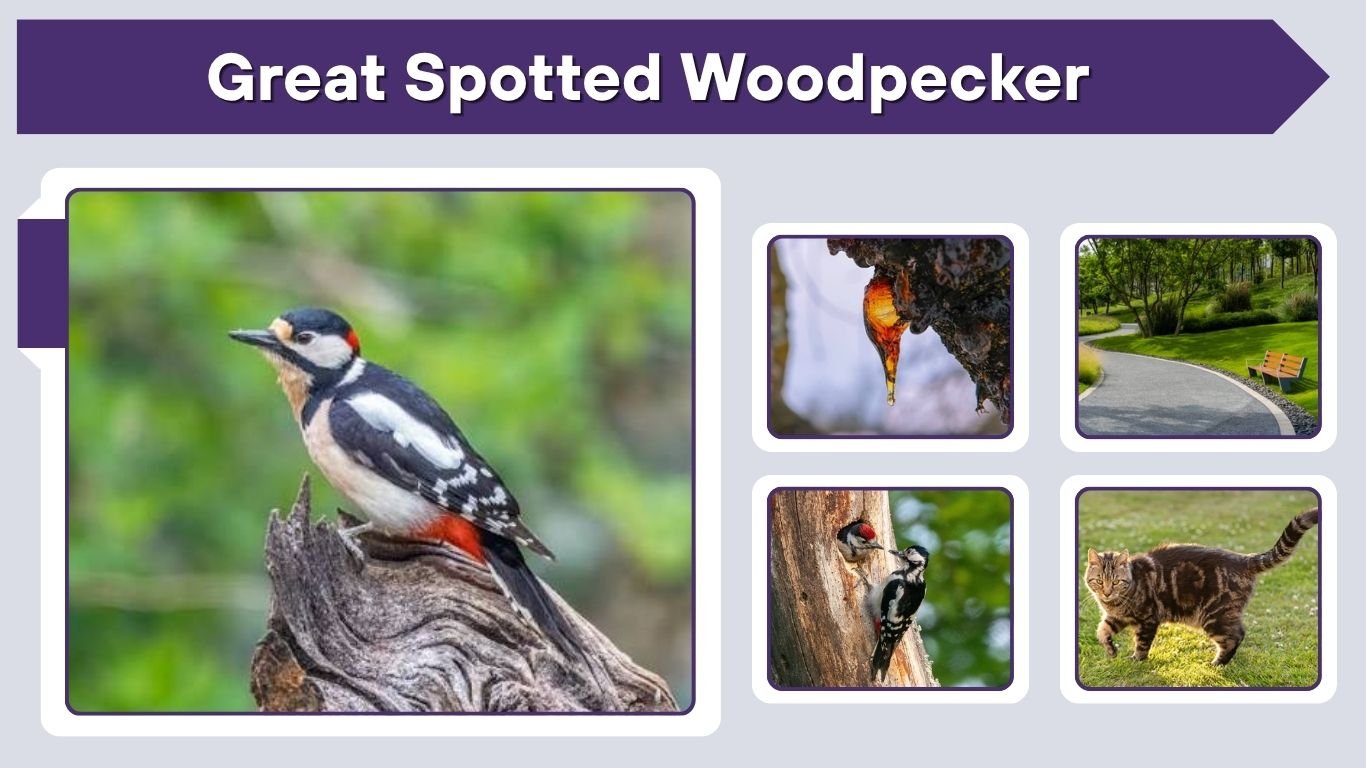
The great spotted woodpecker is a striking black, white, and red bird found across Europe and large parts of Asia. About the size of a blackbird, it is recognized by bold white shoulder patches, red undertail feathers, and an undulating flight. Males have a red patch behind the head, while females do not. This adaptable species lives in woodland, parks, and gardens, where it drums on trees and visits feeders for peanuts, seeds, and suet. It also excavates cavities for raising its chicks.
Great Spotted Woodpecker Identification
The great spotted woodpecker, Dendrocopos major, is a medium-sized member of the woodpecker family. Its contrasting plumage can appear surprisingly well camouflaged against sunlit tree bark. Although “greater spotted woodpecker” is frequently used, the officially accepted common name is “great spotted woodpecker.”
Key Identification Features
- Scientific name: Dendrocopos major
- Family: Picidae
- Length: Approximately 20 to 24 centimeters
- Wingspan: Around 34 to 39 centimeters
- Weight: Usually 70 to 90 grams
- Back: Predominantly black
- Shoulders: Large white patches
- Face: White with bold black markings
- Undertail: Bright red
- Belly: Pale cream or buff
- Flight: Bouncy and undulating
- Bill: Straight, dark, and chisel-shaped
Male vs Female Great Spotted Woodpecker
An adult male has a small but noticeable red patch on the back of his head. The female has an entirely black crown and nape, without this red marking. Both sexes display red feathers beneath the tail.
The sexes are otherwise very similar in size and plumage. Watching the back of the head is therefore the simplest way to tell an adult male from a female.
Juvenile Great Spotted Woodpecker
Juveniles have a red crown covering the top of the head. This feature sometimes causes them to be mistaken for adult males, but the location of the red is different.
A juvenile may also have duller plumage, less defined facial markings, and faint dark streaks on its pale underparts. The red crown disappears as the bird develops its first adult plumage.
Great Spotted Woodpecker Feathers
Wing and back feathers are generally black with white spots or bars. Tail feathers are stiff and mostly dark, helping support the bird against vertical trunks. The brilliant red feathers are concentrated around the lower belly and undertail.
A loose black-and-white feather cannot always be identified confidently because several birds have similar patterns. Symbolic meanings associated with woodpecker feathers—including persistence, opportunity, and determination—come from personal or cultural interpretations rather than scientific evidence.
Great Spotted Woodpecker Habitat and Geographic Range
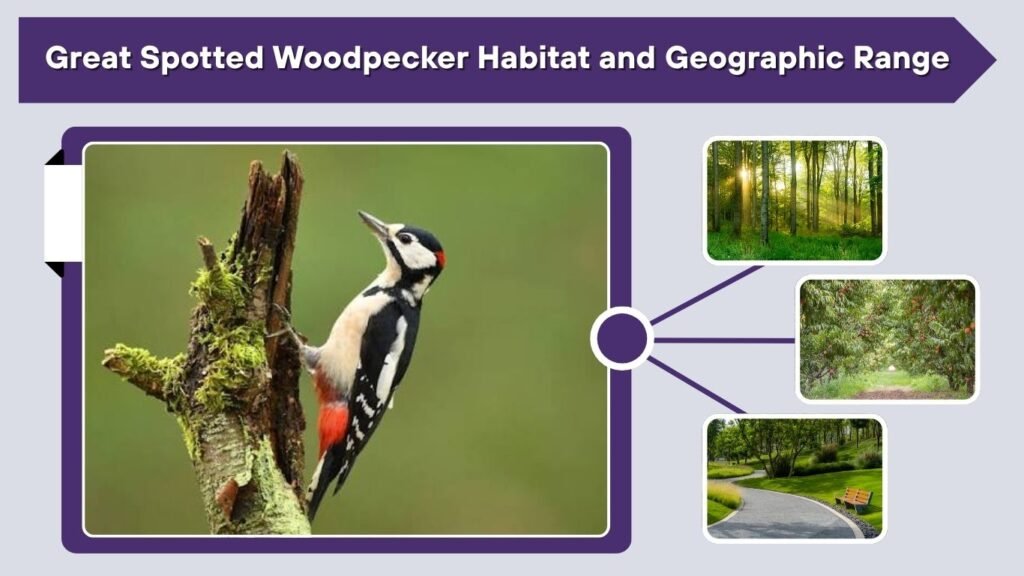
Great spotted woodpeckers occupy an enormous geographic area containing many woodland types. They require trees for feeding, drumming, roosting, and nesting, but they do not depend entirely on untouched forests. Mature gardens and urban parks may provide suitable habitat when old trees and reliable food remain available.
Where Do Great Spotted Woodpeckers Live?
Typical habitats include:
- Deciduous woodland
- Coniferous forest
- Mixed woodland
- Orchards
- Urban parks
- Large gardens
- Farmland with mature trees
- Cemeteries
- Wooded riverbanks
- Forest edges
The species occurs across most of Europe and extends eastward through large parts of Asia. Populations also inhabit sections of North Africa. It is not a regular native woodpecker of mainland North America, although rare individuals may reach western Alaska from Asia.
Great Spotted Woodpeckers in the UK and Ireland
The species is widespread across England, Wales, and much of Scotland. Its British range has expanded northward, and it is now one of the most familiar woodpeckers visiting garden feeders.
Great spotted woodpeckers have also successfully recolonized Ireland after a long absence. They are established in parts of Northern Ireland and the Republic of Ireland, where their distribution continues to expand westward.
Do Great Spotted Woodpeckers Migrate?
Most birds in Britain and western Europe remain within their territories throughout the year. They may make short local movements when searching for food, especially during autumn and winter.
Populations living in northern and eastern parts of the species’ range can be more migratory. Food shortages may produce larger movements in some years, with young birds particularly likely to travel beyond their normal areas.
Great Spotted Woodpecker Diet and Feeding Habits
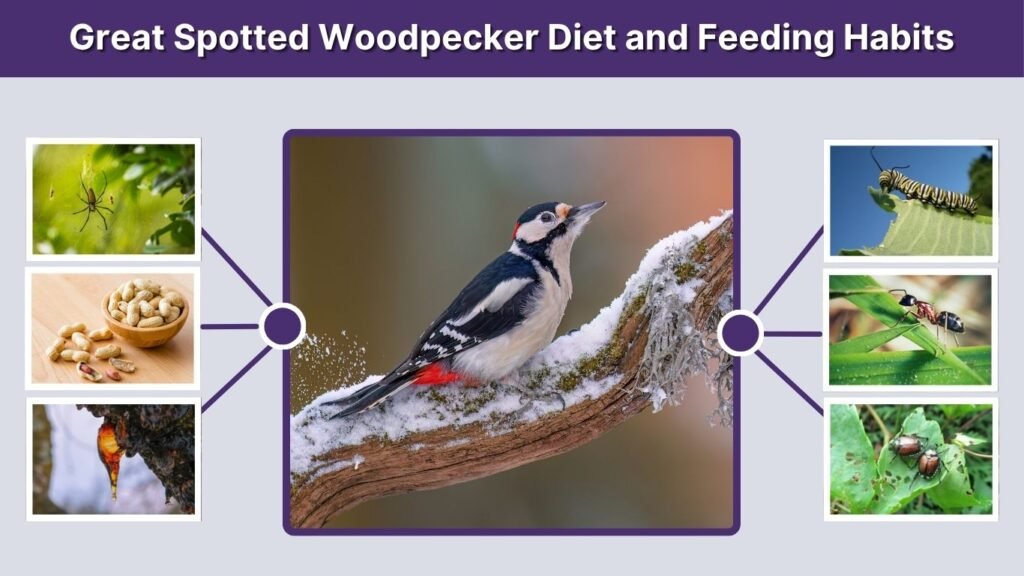
The great spotted woodpecker has a broad, seasonally changing diet. It searches trunks, branches, leaves, and the ground for food. Its strong bill exposes insects beneath bark, while its tongue reaches prey inside narrow crevices. Plant foods become especially valuable during autumn and winter.
What Do Great Spotted Woodpeckers Eat?
- Beetles and their larvae
- Ants
- Caterpillars
- Spiders
- Wood-boring insects
- Pine and spruce seeds
- Sunflower hearts
- Peanuts
- Hazelnuts
- Walnuts
- Acorns
- Berries
- Tree sap
- Suet
- Eggs and nestlings occasionally
During winter, a bird may wedge a pine cone into a crack in a tree and hammer it open to extract the seeds. This feeding location is sometimes called a woodpecker’s anvil. Discarded cones accumulating beneath one tree can reveal a regularly used feeding site.
Visiting Garden Feeders
Great spotted woodpeckers readily visit feeders containing unsalted peanuts, sunflower hearts, and suet. A sturdy feeder is helpful because the bird is heavier and more powerful than most garden songbirds.
Whole peanuts should be supplied inside a secure mesh feeder rather than left loose, particularly during the breeding season. Avoid salted, seasoned, moldy, or sweetened foods. Nearby mature trees make a feeding area more attractive by providing cover and natural foraging opportunities.
Do They Eat Baby Birds?
Great spotted woodpeckers sometimes take eggs or chicks from the nests of smaller birds, especially when feeding their own young. They may enlarge the entrance of a nest box to reach the contents.
This behavior is natural but represents only part of a varied diet. Most feeding involves insects, larvae, seeds, nuts, and other plant material.
Great Spotted Woodpecker Nesting and Life Cycle
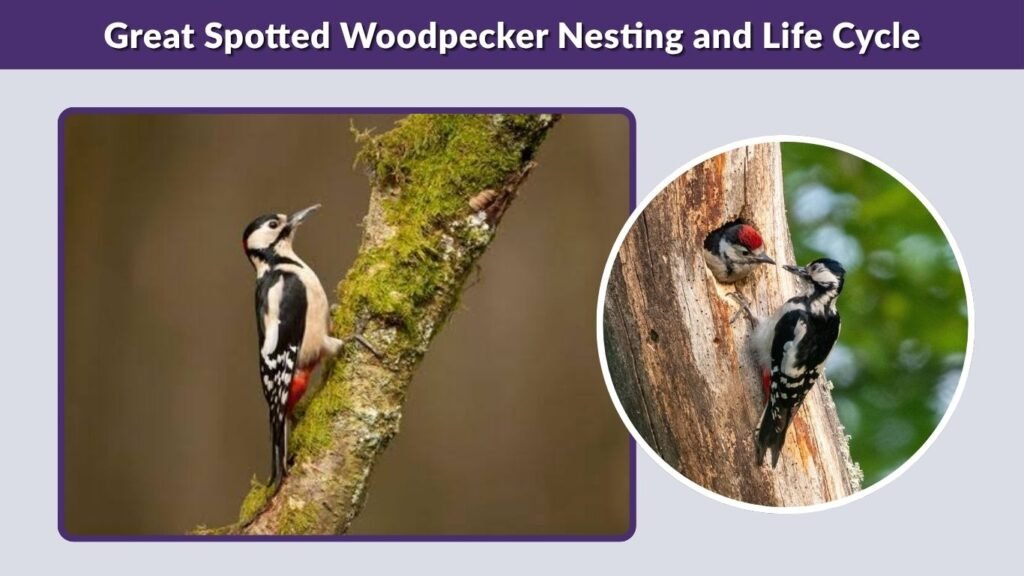
The breeding season begins with increasingly frequent calling, chasing, and drumming. A pair normally excavates a new cavity in a tree containing sufficiently soft or decaying wood. Wood chips remain at the bottom, but the birds do not construct a conventional nest from grass, twigs, or feathers.
Nest Location
Great spotted woodpeckers commonly select birch, oak, alder, beech, willow, or conifer trees. They may use living trees with decayed heartwood, dead trunks, or large branches.
Both adults help excavate, although the male may complete more of the work. The circular entrance is roughly five to six centimeters across. Excavation can take several weeks, after which the female lays her eggs directly on the wood chips inside.
Eggs and Chicks
- Clutch size: Usually four to six eggs
- Egg color: Glossy white
- Typical broods: One per year
- Incubation: Approximately 14 to 16 days
- Chick condition: Naked, blind, and helpless at hatching
- Time in nest: Roughly 20 to 24 days
- Parental care: Both adults feed and protect the chicks
Great spotted woodpecker chicks become extremely noisy as they grow. Their repeated begging calls can make an active nest surprisingly easy to locate. The adults bring insects and other protein-rich foods throughout the day.
Fledglings and Lifespan
Young woodpeckers leave the cavity before they are completely independent. Their parents continue feeding them for several days while they learn to climb, fly, and locate food.
The young eventually disperse from their parents’ territory. Many wild birds die during their first year, but individuals that survive early dangers may live for several years. Exceptional ringed birds have lived for more than a decade.
Calls, Drumming, and Behavior
Great spotted woodpeckers do not produce a complex musical song. Instead, they communicate through sharp calls, drumming, body postures, and chasing displays. Their sounds become especially noticeable from late winter through spring, when birds establish territories and attract breeding partners.
What Does the Call Sound Like?
The usual call is a short, sharp “kik” or “chik.” It may be repeated when a bird is alarmed, excited, or moving between trees. Juveniles produce persistent begging sounds around the nest.
Alarmed adults may use louder, repeated calls while approaching a predator or intruder. These vocalizations differ from drumming because they are produced with the voice rather than the bill.
Why Do They Drum?
Drumming advertises ownership of a territory and helps attract a mate. The bird selects a resonant dead branch, hollow trunk, pole, or occasionally part of a building and strikes it extremely rapidly.
Both sexes can drum, although males generally do so more frequently. Drumming is most intense from late winter into spring and is not primarily an attempt to obtain food.
Flight and Tree-Climbing Adaptations
The great spotted woodpecker flies with several quick wingbeats followed by a brief glide, producing a rising-and-falling flight path. Large white shoulder patches can be particularly noticeable in flight.
Two toes point forward and two backward, providing a strong grip on bark. Stiff tail feathers brace the body, while a powerful bill and long tongue allow the bird to reach insects hidden inside wood.
Great vs Lesser Spotted Woodpecker
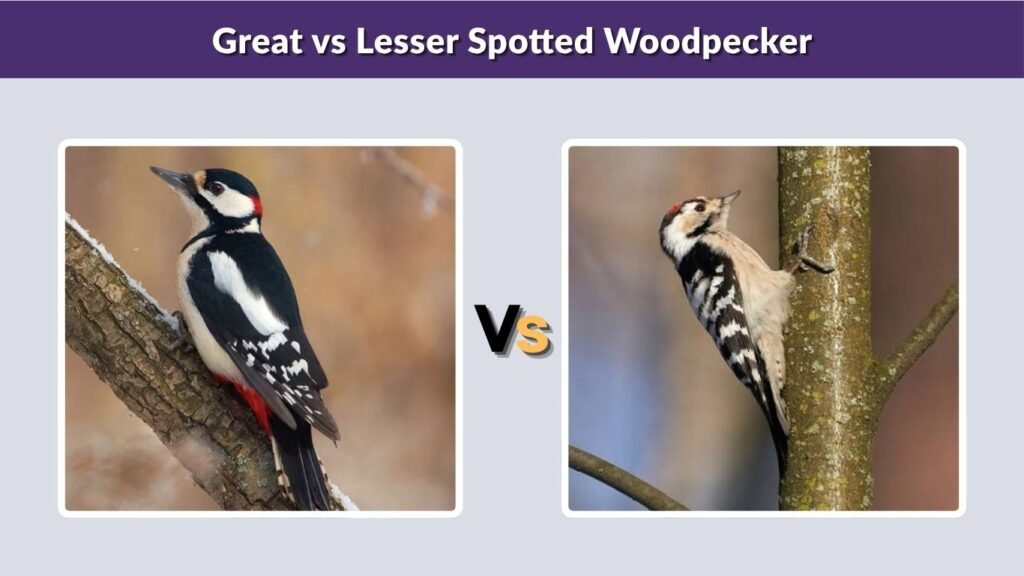
These two species share black-and-white plumage but differ substantially in size, markings, behavior, and abundance. The lesser spotted woodpecker is much smaller and generally remains high among thin branches, making it considerably more difficult to observe.
Important Differences
| Feature | Great Spotted | Lesser Spotted |
| Size | Approximately blackbird-sized | Approximately sparrow-sized |
| Red undertail | Present | Absent |
| White shoulder patches | Large and obvious | Absent |
| Back pattern | Mostly black with white patches | Strong black-and-white barring |
| Adult male’s red | Back of head | Top of crown |
| Female’s head | Entirely black | Black without red |
| UK abundance | Common and increasing | Scarce and declining |
| Feeding position | Trunks and large branches | Thin branches in the canopy |
Population and Conservation Status
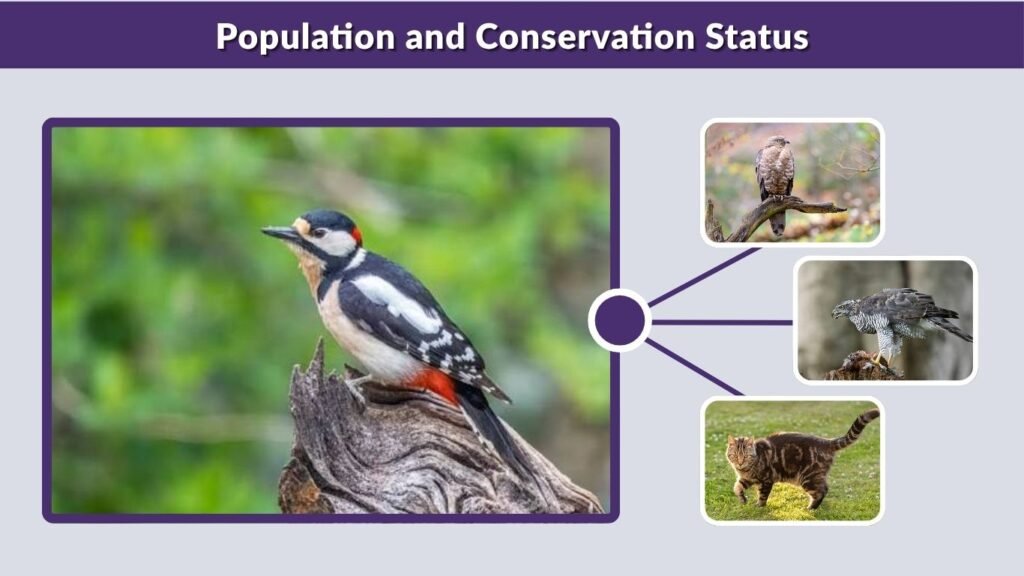
The great spotted woodpecker is not considered rare across most of its extensive range. Its adaptability, varied diet, and willingness to use parks and gardens have helped it succeed. The presence of mature trees, deadwood, and connected woodland remains important for sustaining healthy populations.
Is the Great Spotted Woodpecker Rare?
It is common and increasing in the UK. British Trust for Ornithology data estimate approximately 130,000 breeding pairs and show a substantial long-term population increase. The species is currently placed on the UK Green List rather than being considered threatened.
Local abundance varies. The bird may remain uncommon on treeless islands, in intensively developed landscapes, or in areas without mature woodland.
Predators and Threats
Sparrowhawks, goshawks, martens, domestic cats, and some owls may prey on adults or young. Eggs and chicks can also be threatened by squirrels and other cavity visitors.
The removal of old trees and deadwood reduces feeding and nesting opportunities. Preserving mature woodland, retaining safe standing deadwood, and reducing pesticide use can benefit the species.
FAQs
Great spotted woodpeckers are often heard before they are seen, creating questions about their sounds, seasonal movements, and visits to gardens. The following answers address some of the most common points about this adaptable woodland bird.
Are great spotted woodpeckers rare?
No. They are widespread and relatively common across Britain and much of Europe, although their local abundance depends on suitable woodland and mature trees.
What is the difference between a male and female?
The male has a red patch on the back of his head. The female lacks this patch, while both sexes have red feathers beneath the tail.
Do great spotted woodpeckers mate for life?
They form a pair during the breeding season, but the same birds do not necessarily remain together for life. Partners may change before a later season.
Where do great spotted woodpeckers nest?
They excavate cavities in living or dead trees, usually selecting wood softened by decay. The eggs are laid on loose wood chips inside the chamber.
What does a great spotted woodpecker sound like?
Its common call is a sharp “kik” or “chik.” During late winter and spring, it also produces a brief, rapid burst of drumming on resonant wood.
