
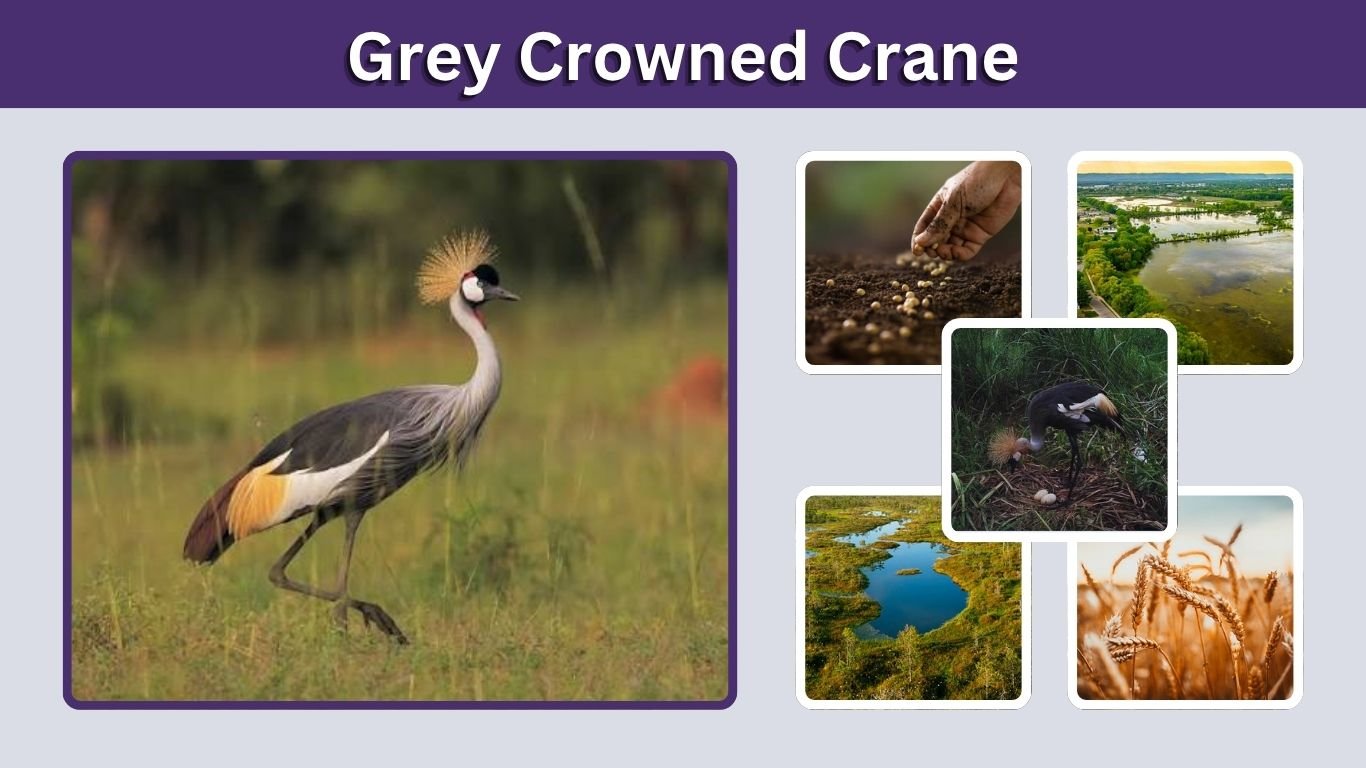
The Grey Crowned Crane (Balearica regulorum) is one of Africa’s most distinctive birds. It has a pearl-grey body, white wings, a red throat pouch, and a spectacular crown of stiff golden feathers. Found in wetlands and grasslands across eastern and southern Africa, this crane feeds on seeds, insects, small animals, and crops. It is also Uganda’s national bird and appears on the country’s flag and coat of arms. Despite its cultural importance, the species is endangered because of wetland loss, illegal capture, poisoning, and human disturbance.
Grey Crowned Crane Quick Facts
The Grey Crowned Crane belongs to the crane family, Gruidae. It is one of only two living crowned-crane species and is especially unusual because it can perch and roost in trees.
| Feature | Description |
| Scientific name | Balearica regulorum |
| Family | Gruidae |
| Height | Approximately 3–3.5 feet |
| Wingspan | Approximately 6–6.5 feet |
| Weight | Around 6.5–9 pounds |
| Diet | Omnivorous |
| Main habitat | Wetlands, grasslands and farmland |
| Typical clutch | 2–4 eggs |
| Global status | Endangered |
| Population trend | Decreasing |
The International Crane Foundation estimates a height of roughly 104 centimeters, a weight near 3.6 kilograms, and a global population of approximately 29,500–36,000 birds.
What Does a Grey Crowned Crane Look Like?
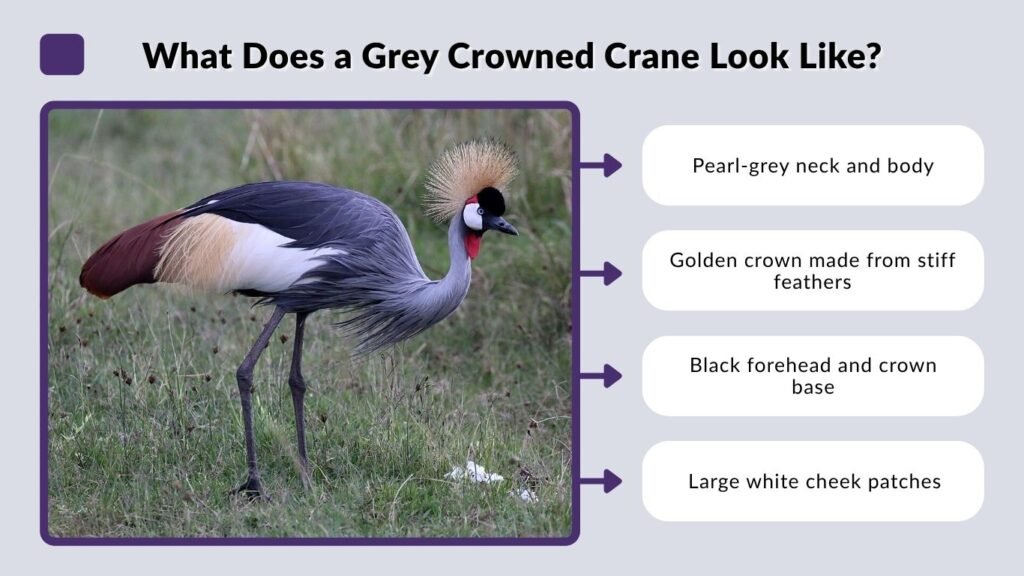
An adult Grey Crowned Crane has a long neck, long black legs, broad wings, and a short grey bill. Its most recognizable feature is the golden crown that spreads around the back and sides of its head.
Identification
- Pearl-grey neck and body
- Golden crown made from stiff feathers
- Black forehead and crown base
- Large white cheek patches
- Red throat pouch or gular sac
- White wings with brown, chestnut and golden feathers
- Long black legs and feet
- Short, straight grey bill
- Long hind toe adapted for gripping branches
- Neck held straight while flying
Males and females have nearly identical plumage, although males are generally slightly larger. Juveniles are duller, with grey-brown bodies, brown crowns and less-developed red throat pouches.
Why Does It Have a Golden Crown?
The crown consists of long, stiff golden feathers tipped with black. It is used as a visual signal during courtship, territorial displays and communication.
The bird may raise or emphasize its crown while dancing or reacting to another crane. However, the golden feathers are not believed to be warning coloration. They mainly contribute to recognition and social display.
Where Do Grey Crowned Cranes Live?
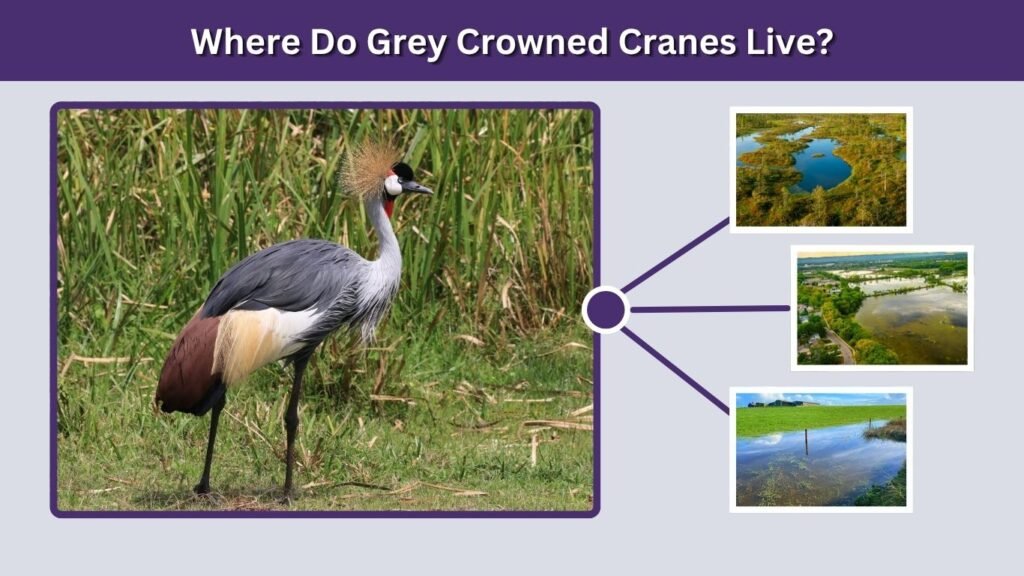
Grey Crowned Cranes occur from the eastern Democratic Republic of Congo, Uganda and Kenya southward through Tanzania, Zambia, Zimbabwe and neighbouring regions to South Africa. They do not undertake long-distance migrations, although they make local or seasonal movements as water and food conditions change.
Preferred Habitat
These cranes require access to both wetlands and open feeding areas. Their common habitats include:
- Freshwater marshes
- Floodplains
- Wet grasslands
- Savannas
- River edges
- Seasonal wetlands
- Pastures
- Croplands
- Irrigated agricultural areas
They usually nest in or beside shallow wetlands containing tall vegetation. Open grasslands and agricultural fields nearby provide feeding opportunities. Unlike most cranes, Grey Crowned Cranes have long hind toes that allow them to perch and sleep in trees.
East African and South African Grey Crowned Cranes
Two subspecies are commonly recognized.
East African Grey Crowned Crane
The East African Grey Crowned Crane (Balearica regulorum gibbericeps) occurs from Uganda and Kenya southward into northern Zimbabwe and Mozambique. It generally has a larger red area on its white cheek patch.
This is the subspecies displayed on Uganda’s national flag and coat of arms. It is also known locally as the crested crane.
South African Grey Crowned Crane
The South African Grey Crowned Crane (Balearica regulorum regulorum) occurs from Angola and Namibia through Botswana and Zimbabwe to South Africa.
Its cheek patch usually contains less red than that of the East African subspecies. Otherwise, the two forms have very similar body shapes, plumage and feeding habits.
What Do Grey Crowned Cranes Eat?
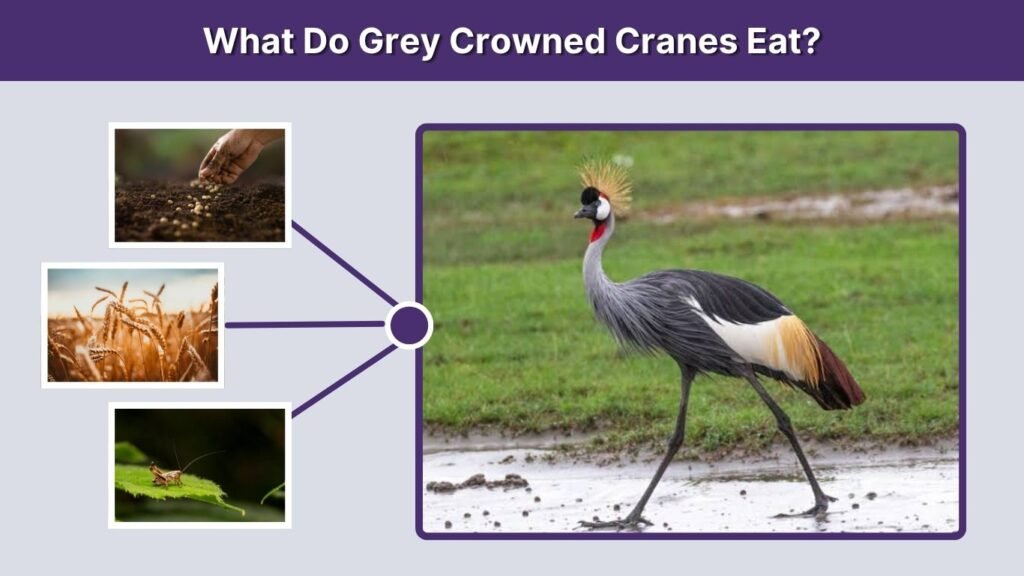
Grey Crowned Cranes are omnivores that consume both plant and animal foods. They forage by walking slowly through grasslands, wetlands and agricultural fields.
Common Foods
Their diet includes grass tips, seeds, grain, insects, worms, frogs, lizards, small fish and other small vertebrates. They may also eat groundnuts, soybeans, millet and maize when foraging in cultivated fields.
Feeding Behavior
A crane may stamp its feet while walking to disturb insects hidden in grass or soil. It then quickly picks up the exposed prey with its bill.
Grey Crowned Cranes sometimes follow cattle and other large grazing animals because their movement flushes insects from the vegetation. They also search newly ploughed fields for worms, seeds and invertebrates.
Grey Crowned Crane Dance and Call
Grey Crowned Cranes are famous for elaborate dances involving running, bowing, jumping, wing spreading and tossing grass into the air. These displays are associated with courtship but may also strengthen pair bonds or express excitement.
Courtship Dance
Either member of a pair may begin dancing. The birds inflate their red throat pouches, call, bob their heads, spread their wings and leap into the air.
Young cranes also dance before reaching breeding age. This behaviour may help them develop coordination and social skills. Pairs are generally monogamous and may remain together for many breeding seasons.
Sound and Communication
Adult Grey Crowned Cranes produce loud, low, booming or honking calls. Their inflatable throat pouch helps amplify the sound, allowing it to carry across open wetlands and grasslands.
Pairs may call together in coordinated duets. Chicks use sharp peeping calls, while adults communicate with them using lower, softer sounds.
Grey Crowned Crane Nesting and Eggs
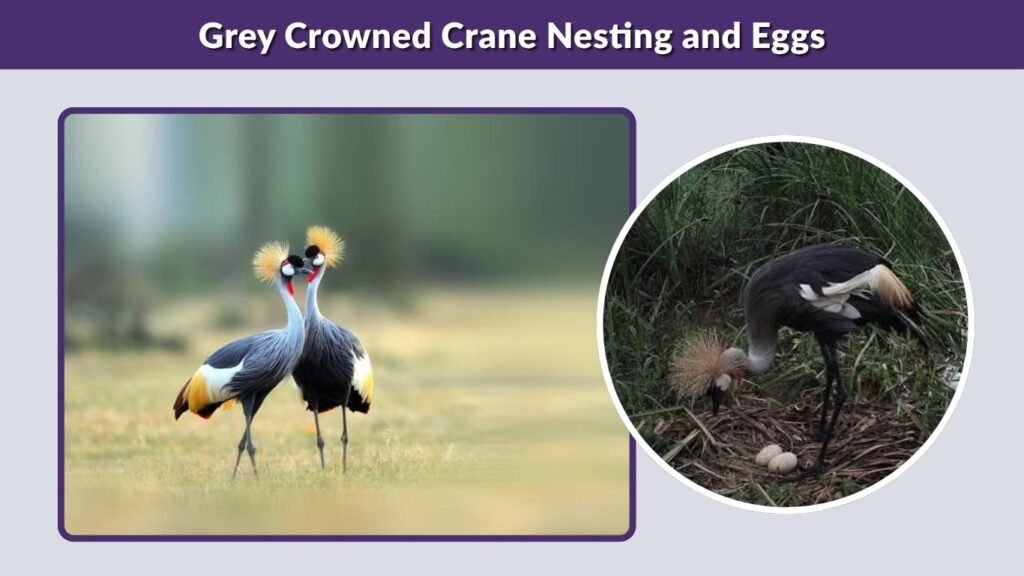
Breeding is closely connected to rainfall and wetland conditions. In East Africa, nesting may occur throughout the year but commonly increases during wetter periods. In southern parts of the range, breeding is more seasonal.
Nest Construction
Both adults build a platform nest from grasses, sedges and other wetland vegetation. The nest is usually placed in shallow water or close to it, where tall plants hide the body of the incubating crane.
The surrounding water and dense vegetation provide some protection from terrestrial predators. Both parents defend the nesting territory.
Eggs and Chicks
A female usually lays two to four pale blue eggs. Both parents incubate them for approximately 28–30 days.
The chicks are precocial, meaning they hatch covered in down and can move soon afterward. They can swim within hours and begin following their parents to feeding areas after only a day or two. Young cranes generally fledge between about 56 and 100 days after hatching.
Can Grey Crowned Cranes Fly?
Grey Crowned Cranes are strong fliers despite spending much of their time walking on the ground. In flight, they extend their necks forward and trail their legs behind the body.
Their broad wings may span approximately six feet or more. They use flight to travel between feeding, nesting and roosting locations and to escape threats. At night, they may fly into trees and grip branches with their long hind toes.
Grey Crowned Crane vs. Black Crowned Crane
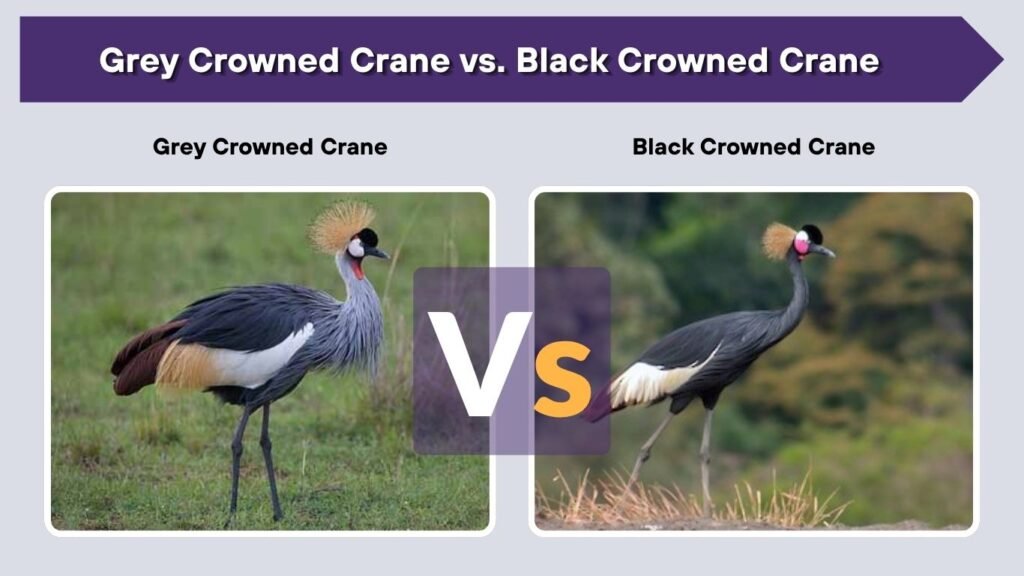
The Grey Crowned Crane is closely related to the Black Crowned Crane. Both have golden crowns, red throat pouches and the ability to perch in trees.
| Feature | Grey Crowned Crane | Black Crowned Crane |
| Body color | Mostly pearl grey | Mostly dark grey or black |
| Neck | Pale grey | Darker grey or black |
| Range | Eastern and southern Africa | Western and central Africa |
| Cheek patch | Mainly white with red | White and red pattern differs |
| Scientific name | Balearica regulorum | Balearica pavonina |
The overall body colour is the easiest distinction. Grey Crowned Cranes look noticeably paler, while Black Crowned Cranes have much darker bodies and necks.
Why Is the Grey Crowned Crane Endangered?
The Grey Crowned Crane is globally classified as Endangered, and its population continues to decline. Current estimates place the wild population in the tens of thousands rather than hundreds of thousands.
Main Threats
Wetlands are drained or converted for agriculture, development and livestock grazing, removing important nesting habitat. Cranes may also be poisoned by pesticides, collide with power lines, or be captured for the illegal pet and ornamental-bird trade.
Farmers sometimes persecute cranes that feed on maize or damage young crops. NatureUganda reports that the species has declined dramatically over recent decades as wetlands have become degraded and fragmented.
Why Is the Grey Crowned Crane Important to Uganda?
The East African Grey Crowned Crane is Uganda’s national bird. It appears at the centre of the national flag and beside the shield on the country’s coat of arms.
Ugandan government sources describe it as a symbol of beauty, elegance and national identity. The bird’s raised leg on the flag is commonly associated with forward movement, although the official national-symbol description primarily confirms its position as the country’s national bird and emblem.
FAQs
How long do Grey Crowned Cranes live?
Available records suggest they may live for more than 20 years. One species account reports up to about 22 years in the wild and 25 years in managed care, although lifespan varies with habitat, disease, predation and human threats.
Can female Grey Crowned Cranes be identified by appearance?
Females and males look almost identical. Males are usually slightly larger, but this difference is difficult to judge unless both members of a pair are standing together. Behaviour or genetic testing may be needed for reliable identification.
What predators eat Grey Crowned Cranes?
Eggs and chicks may be threatened by reptiles, mammals and large birds. Domestic dogs are also known predators. Adults reduce risk by remaining alert, living in groups and roosting in trees above many ground-based predators.
Do Grey Crowned Cranes migrate?
They are considered non-migratory. However, they may make seasonal and local movements in response to rainfall, wetland conditions and food availability. Movements can become extensive in dry regions.
Are Grey Crowned Cranes good pets?
They should not be treated as ordinary pets. They require extensive space, specialised food, social companionship and suitable wetland habitat. Illegal capture and trade are major conservation threats, so cranes should only be kept by properly authorised conservation or zoological facilities.