
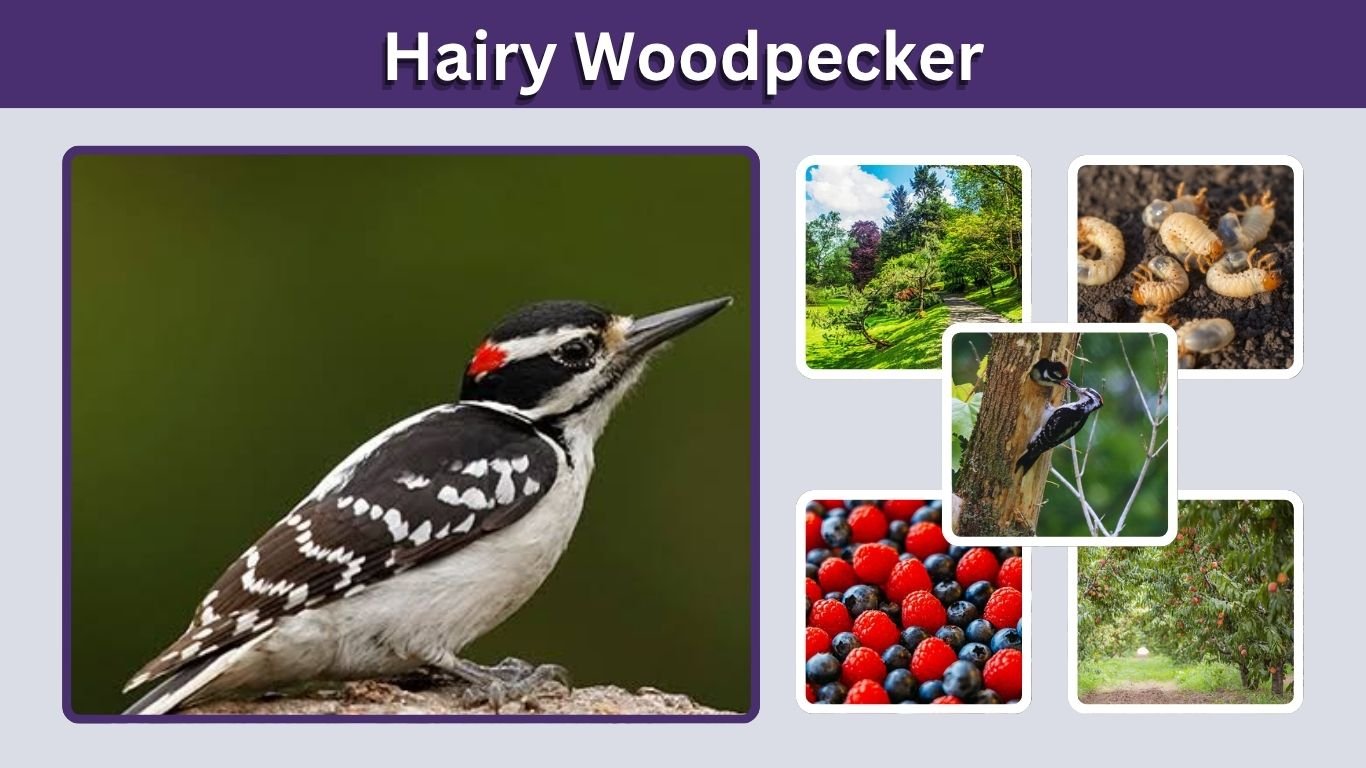
The hairy woodpecker is a medium-sized North American woodpecker recognized by its black-and-white plumage, long pointed bill, and energetic climbing behavior. It closely resembles the smaller downy woodpecker, making the two species easy to confuse at backyard feeders. Hairy woodpeckers inhabit forests, parks, wooded suburbs, and other areas containing mature trees. They feed mainly on insects hidden in bark and wood but also visit feeders for suet and seeds. Males, females, and juveniles have several useful features that help with identification.
Hairy Woodpecker Identification and Size
The hairy woodpecker (Dryobates villosus) has a classic black-and-white woodpecker appearance. Its back shows a broad white patch surrounded by black wings patterned with white spots. The underparts are mostly clean white. Although it looks remarkably similar to the downy woodpecker, the hairy woodpecker is larger and has a noticeably longer, heavier bill.
Hairy Woodpecker Identification
Look for these characteristics:
- Scientific name: Dryobates villosus
- Length: About 7–10 inches
- Wingspan: Roughly 13–17 inches
- Underparts: Mostly clean white
- Back: Large white central patch
- Wings: Black with white spotting
- Bill: Long, straight, and strong
- Tail: Black with white outer feathers
- Adult male: Small red patch on back of head
- Adult female: No red patch
The bill is one of the best identification features because it appears nearly as long as the bird’s head.
Male vs Female Hairy Woodpecker
Male and female hairy woodpeckers are almost identical in body pattern and size.
The easiest difference is the back of the head. Adult males have a small red patch on the rear crown, while adult females have an entirely black-and-white head without red.
Both sexes have white facial stripes, dark wings, white underparts, and a long bill.
Juvenile Hairy Woodpecker
Juvenile hairy woodpeckers resemble adults but may appear slightly duller or less sharply patterned.
Young males and females can sometimes show reddish or yellowish feathers on the crown rather than the small rear red patch typical of an adult male.
As juveniles molt, they gradually develop their adult head pattern.
Hairy Woodpecker Habitat and Range
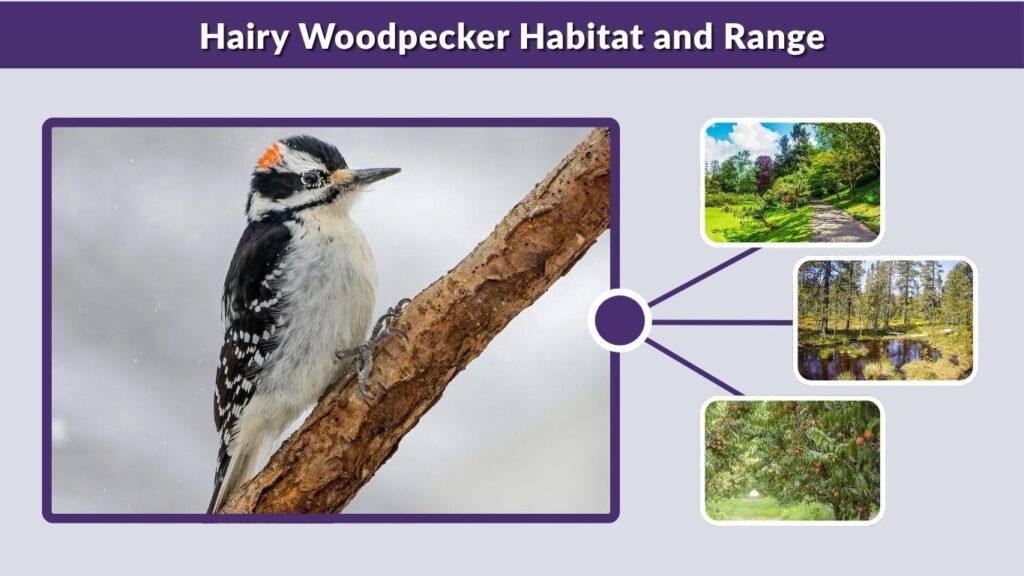
Hairy woodpeckers occupy an exceptionally broad variety of wooded environments. They generally favor habitats containing mature trees because larger trunks provide nesting cavities and abundant insects beneath bark. Although strongly associated with forests, they can adapt well to human-modified landscapes when adequate trees remain. Their wide geographic distribution makes them familiar birds across much of North America.
Hairy Woodpecker Habitat
Typical habitats include mature deciduous forest, coniferous woodland, mixed forest, wooded wetlands, burned forest, parks, orchards, and suburban neighborhoods.
They are especially attracted to areas containing dead or dying trees. These trees support wood-boring insects and provide softer wood for excavating nesting cavities.
Burned forests can also become productive feeding areas because dead trees frequently contain large populations of insects.
Hairy Woodpecker Range
Hairy woodpeckers occur through much of the United States and Canada and extend into parts of Mexico and Central America.
They can be found from Alaska and Canada southward through many regions of the continental United States, including Ohio, Colorado, Florida, and other states.
Most populations remain within their general home range throughout the year rather than making long-distance seasonal migrations.
Common Hairy Woodpecker Behaviors
Hairy woodpeckers frequently:
- Climb vertical tree trunks
- Examine bark for insects
- Hammer into dead wood
- Remove bark to expose larvae
- Drum to advertise territory
- Visit backyard suet feeders
- Move between large branches and trunks
- Use stiff tail feathers for support
Their powerful movements and substantial bill often make them appear more robust than downy woodpeckers.
What Does a Hairy Woodpecker Eat?
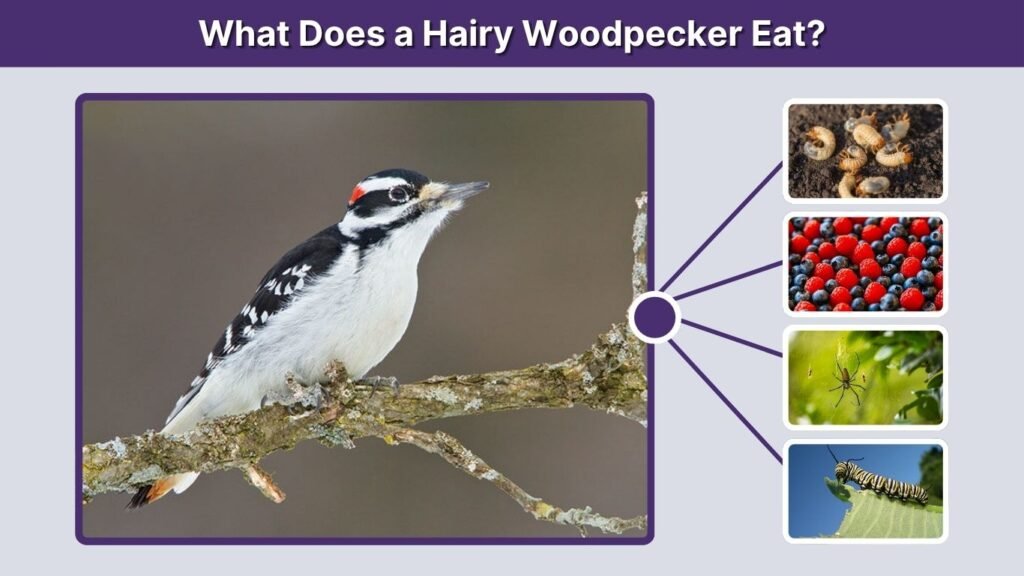
Hairy woodpeckers are primarily insect eaters and spend considerable time investigating trunks, branches, and dead wood. Their long, powerful bills allow them to reach prey hidden deeper inside bark than many smaller birds can access. Natural food changes through the seasons, and hairy woodpeckers may supplement insects with seeds, nuts, and foods available at backyard feeders.
Hairy Woodpecker Diet
Their diet can include:
- Beetle larvae
- Wood-boring beetles
- Ants
- Caterpillars
- Spiders
- Other insects
- Seeds
- Nuts
- Berries
- Suet
Wood-boring insects are particularly important. Hairy woodpeckers may chip away considerable amounts of bark and wood to reach larvae hidden underneath.
Hairy Woodpeckers at Bird Feeders
Hairy woodpeckers readily visit feeders, particularly during colder months when insects are harder to locate.
Suet is one of the most effective foods for attracting them. They may also eat peanuts and sunflower seeds.
A feeder positioned near mature trees usually provides a more natural setting where the bird can quickly retreat to a trunk after feeding.
Hairy Woodpecker Call, Sound and Drumming
Hairy woodpeckers are often detected by sound before they are seen. Their vocalizations include sharp contact calls as well as rattling sequences, while their rapid drumming carries through wooded areas. Learning these sounds can also help separate hairy woodpeckers from the visually similar downy woodpecker, particularly when the bird is high in a tree.
What Does a Hairy Woodpecker Sound Like?
One of the most familiar calls is a sharp, strong “peek” note.
Hairy woodpeckers also produce a rapid series of notes sometimes described as a whinny or rattle. The sound tends to remain fairly even or strong toward the end rather than dropping dramatically in pitch.
Calls may be used between mates, during territorial interactions, or when birds become alarmed.
Hairy Woodpecker Drumming
Drumming consists of rapid strikes against a resonant surface.
It is primarily communication rather than an attempt to excavate food. Birds use drumming to establish territory and communicate during the breeding season.
Hairy woodpeckers may drum on dead branches, hollow trees, utility poles, or occasionally buildings that produce a particularly loud sound.
Downy vs Hairy Woodpecker
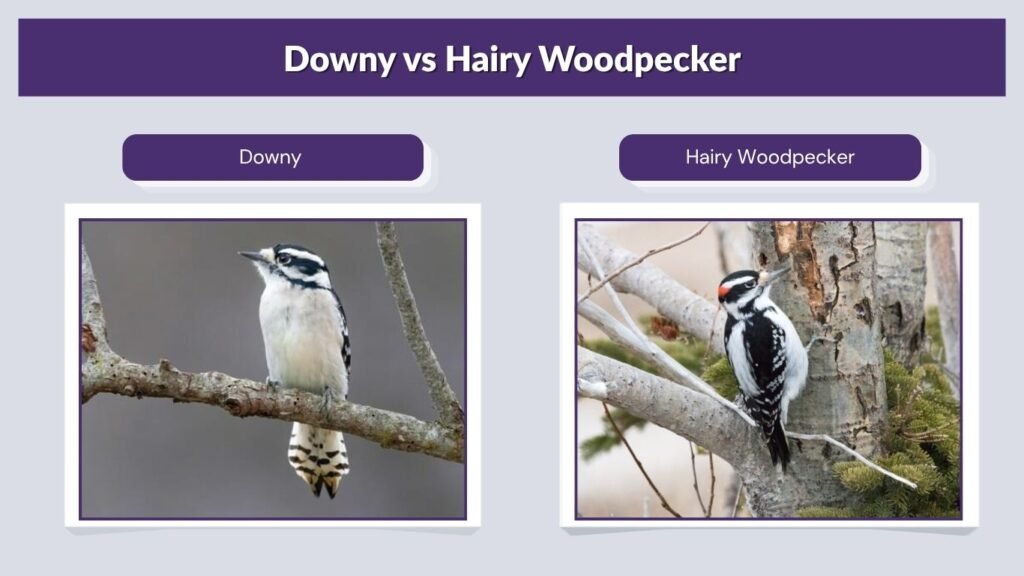
The downy and hairy woodpecker are among the most commonly confused North American birds. Their black-and-white patterns are remarkably similar, and both males possess a red patch on the back of the head. Size, bill proportions, outer tail markings, voice, and overall structure provide the most dependable clues when deciding whether a bird is a downy or hairy woodpecker.
Downy vs Hairy Woodpecker Differences
The main differences include:
- Size: Hairy woodpeckers are noticeably larger.
- Bill: Hairy woodpeckers have a long, substantial bill.
- Downy bill: Much shorter and smaller relative to the head.
- Outer tail: Hairy woodpeckers usually have cleaner white outer tail feathers.
- Downy tail: Often shows small dark spots or bars.
- Build: Hairy woodpeckers appear stronger and more robust.
- Voice: Hairy calls generally sound sharper and stronger.
Bill length is usually the easiest clue when both birds cannot be compared side by side.
Female Downy vs Female Hairy Woodpecker
Both females lack the red head patch found on adult males, making their overall patterns even more similar.
A female hairy woodpecker is larger and has a bill nearly as long as her head. A female downy has a much shorter, delicate-looking bill.
Checking the white outer tail feathers can provide another clue when the bird’s bill is difficult to see.
Downy vs Hairy Woodpecker Calls
Hairy woodpeckers generally produce stronger, sharper calls.
Both species can make rattling vocalizations, but the downy’s whinny commonly descends toward the end, whereas the hairy woodpecker’s comparable call tends to remain more level.
Their drumming patterns can also differ, although visual characteristics are usually easier for beginners to use.
Hairy Woodpecker Nesting and Young

Hairy woodpeckers are cavity nesters that generally excavate their own nesting chambers. Dead trees and dead portions of living trees provide particularly useful nesting sites because the wood is easier to remove. Both members of a pair participate in breeding activities. Nest cavities also provide protection for eggs and vulnerable nestlings from weather and many potential predators.
Hairy Woodpecker Nest
A nest is usually excavated in:
- Dead trees
- Dead branches
- Softened sections of living trees
- Broken tree stubs
- Large standing snags
The entrance leads into a deeper chamber where the eggs rest directly on wood chips rather than on a conventional nest made from grasses or twigs.
Eggs and Fledglings
Females generally lay several plain white eggs. Both parents participate in incubation.
After hatching, the nestlings remain inside the cavity while their parents deliver insects repeatedly throughout the day.
As fledging approaches, young birds may become noisy around the entrance. After leaving the cavity, fledglings continue depending on their parents while developing stronger flight and independent foraging skills.
FAQs
Hairy woodpeckers raise many identification questions because they so closely resemble downy woodpeckers. Bill size, body length, head markings, calls, and tail patterns are particularly useful when identifying them. Their willingness to visit backyard feeders also gives birdwatchers excellent opportunities to observe these characteristics and compare males, females, and juvenile birds at relatively close range.
How Big Is a Hairy Woodpecker?
Hairy woodpeckers are generally about 7–10 inches long with a wingspan of approximately 13–17 inches.
How Can You Tell a Male From a Female Hairy Woodpecker?
Adult males have a small red patch on the back of the head. Adult females lack this red patch.
What Is the Difference Between a Downy and Hairy Woodpecker?
Hairy woodpeckers are larger and have much longer bills. Downy woodpeckers have short bills and often show dark spots on their white outer tail feathers.
What Do Hairy Woodpeckers Eat?
They primarily eat insects and larvae but may also consume seeds, nuts, berries, peanuts, and suet.
Do Hairy Woodpeckers Visit Bird Feeders?
Yes. Hairy woodpeckers commonly visit backyard feeders, particularly those containing suet, peanuts, or sunflower seeds.
