

The harpy eagle (Harpia harpyja) is one of the most impressive birds of prey on Earth. Known for its enormous talons, muscular build, and remarkable hunting abilities, this eagle dominates the tropical rainforests of Central and South America. Although not the bird with the largest wingspan, it is often considered the strongest eagle in the world. Its ability to capture large prey from dense forest canopies has earned it a reputation as one of nature’s most formidable aerial predators.
What Is a Harpy Eagle?
The harpy eagle is a massive raptor native to the rainforests of the Americas. As the national bird of Panama and an important predator in tropical ecosystems, it plays a crucial role in maintaining ecological balance. Its striking appearance, featuring a distinctive double crest and powerful legs, makes it one of the most recognizable eagles in the world.
Scientific Classification
The harpy eagle belongs to the Accipitridae family, which includes hawks, eagles, and kites. Its scientific name, Harpia harpyja, comes from the harpies of Greek mythology, mythical creatures known for their strength and fierce nature. The species is the only living member of its genus, making it a unique and fascinating bird among modern raptors.
Why Is It Called the Harpy Eagle?
The name “harpy” originates from ancient Greek mythology. Harpies were winged creatures with extraordinary power and intimidating appearances. Early naturalists believed the eagle’s large size, fierce facial features, and hunting prowess reflected these mythical beings, leading to the name that remains in use today.
How Big Is a Harpy Eagle?
The harpy eagle is among the largest and heaviest eagles in the world. While several eagle species may have longer wingspans, few can match the harpy eagle’s combination of weight, strength, and body size. Female harpy eagles are significantly larger than males, a common trait among birds of prey.
Harpy Eagle Size and Weight
Adult females typically weigh between 13 and 20 pounds (6–9 kilograms), while males usually weigh between 9 and 13 pounds (4–6 kilograms). The body length of an adult harpy eagle ranges from 34 to 42 inches (86–107 centimeters), making it one of the most imposing raptors on the planet.
Harpy Eagle Wingspan
Unlike eagles that soar over open landscapes, harpy eagles live in dense forests. Their wingspan is shorter than many people expect, ranging from approximately 6.5 to 7.5 feet (2–2.3 meters). This adaptation allows them to maneuver efficiently between trees while pursuing prey.
Harpy Eagle Size Compared to Humans
When standing beside a person, a harpy eagle appears remarkably large. Its powerful legs can be nearly as thick as a human wrist, and its talons are comparable in size to a grizzly bear’s claws. Images showing a harpy eagle next to a human often surprise viewers because the bird appears much larger than most expect.
Physical Characteristics of the Harpy Eagle
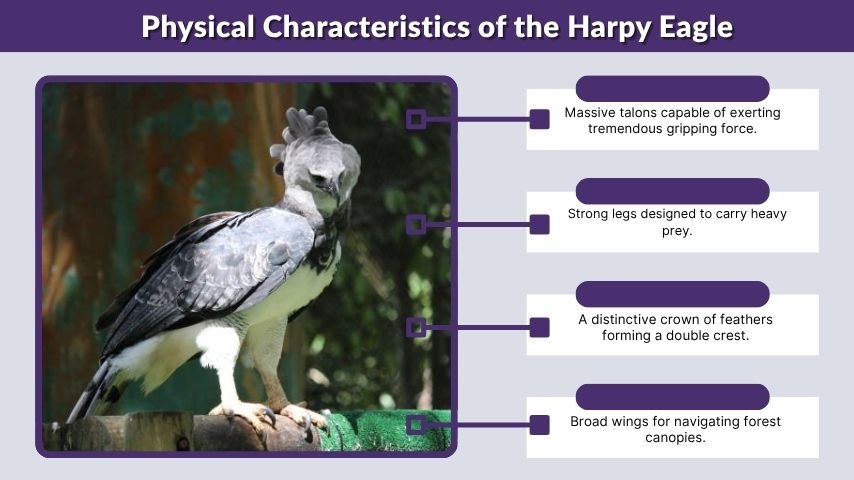
The harpy eagle possesses several specialized features that make it a highly effective predator. Every aspect of its body, from its talons to its feathers, has evolved to help it hunt in dense rainforest environments. These adaptations allow it to dominate the forest canopy and capture prey that many other raptors could not handle.
Notable Physical Features
- Massive talons capable of exerting tremendous gripping force.
- Strong legs designed to carry heavy prey.
- A distinctive crown of feathers forming a double crest.
- Broad wings for navigating forest canopies.
- Sharp eyesight for spotting movement from great distances.
Talons and Grip Strength
The harpy eagle’s talons are among the largest of any living eagle. Individual claws can reach lengths of up to 5 inches (13 centimeters). These formidable weapons enable the bird to seize and immobilize prey instantly. Scientists often compare the talon size of a harpy eagle to that of a large bear.
Feathers and Coloration
Adult harpy eagles display a striking combination of gray, black, and white plumage. Their heads are pale gray, while the chest and underparts are predominantly white. Dark feathers on the wings and back provide camouflage among the shadows of the rainforest canopy.
Where Do Harpy Eagles Live?

Harpy eagles inhabit tropical rainforests across a broad geographic range. They require extensive areas of mature forest to find sufficient food and nesting sites. Because they depend on large, undisturbed habitats, the species is often considered an indicator of rainforest health and biodiversity.
Geographic Distribution
Harpy eagles can be found throughout portions of Central and South America. Their range stretches from southern Mexico through countries such as Panama, Colombia, Ecuador, Peru, Venezuela, and Brazil. The Amazon Basin remains one of the species’ most important strongholds.
Preferred Habitat
These birds thrive in lowland tropical rainforests where tall trees provide ideal nesting locations. Dense forest canopies also support the diverse prey species that harpy eagles rely upon for survival. Areas with minimal human disturbance offer the best conditions for maintaining healthy populations.
Countries Where Harpy Eagles Are Common
Some of the countries most closely associated with harpy eagle populations include:
- Brazil
- Panama
- Colombia
- Peru
- Ecuador
- Venezuela
Large protected rainforest reserves in these nations provide essential habitat for the species and support ongoing conservation efforts.
What Do Harpy Eagles Eat?

As apex predators of the rainforest canopy, harpy eagles consume a variety of medium-sized animals. Their hunting strategy focuses on ambushing prey from concealed perches before launching a rapid attack. Unlike many other eagles that hunt in open terrain, harpy eagles are perfectly adapted to pursuing prey through dense vegetation and thick forest cover.
Main Components of Their Diet
The harpy eagle primarily feeds on tree-dwelling mammals and birds. Common prey species include:
- Sloths
- Howler monkeys
- Capuchin monkeys
- Opossums
- Large birds
- Iguanas
- Tree porcupines
Their preference for arboreal animals reflects their specialization as rainforest hunters.
Hunting Techniques
Harpy eagles rely on exceptional eyesight and patience. They often perch silently for long periods while scanning the canopy for movement. Once a target is identified, the eagle swoops down with remarkable speed and precision. Its powerful talons allow it to seize prey instantly, often killing it on impact.
Importance as a Top Predator
By controlling populations of monkeys, sloths, and other animals, harpy eagles help maintain ecological balance within rainforest ecosystems. Their presence indicates a healthy food chain and a well-preserved habitat.
Harpy Eagle Life Cycle

The life cycle of a harpy eagle is unusually slow compared to many birds. These eagles invest significant time and energy into raising their young, which contributes to their low reproductive rate. Because each breeding attempt requires considerable parental care, population recovery can be slow when numbers decline.
Nest Construction
Harpy eagles build enormous nests high in emergent rainforest trees. These nests may reach several feet in diameter and are often reused and expanded over many years. Large tree species provide the stability needed to support both the nest and growing chicks.
Harpy Eagle Chick Development
Females typically lay one or two eggs, although usually only one chick survives to adulthood. Young harpy eagles remain dependent on their parents for an extended period and may stay near the nest for many months while learning essential hunting skills.
Lifespan
In the wild, harpy eagles can live for 25 to 35 years under favorable conditions. Birds living in protected habitats with abundant prey often enjoy longer lifespans than those facing habitat loss or human disturbance.
Female vs Male Harpy Eagle
Like many birds of prey, harpy eagles display sexual dimorphism, meaning males and females differ noticeably in size. These differences influence hunting behavior, breeding responsibilities, and parental care throughout the species’ life cycle.
Size Differences
Female harpy eagles are significantly larger than males. This size advantage allows females to capture larger prey and defend nesting territories more effectively. Males, being lighter and more agile, often perform frequent hunting trips during the breeding season.
Division of Responsibilities
During nesting periods, both parents contribute to raising offspring. Typical roles include:
- Females guarding the nest and young chicks.
- Males deliver food to the nest.
- Both parents protect territory from threats.
- Adults teaching juveniles survival skills.
This cooperative parenting strategy increases the chances of successful chick development.
Why Larger Females Benefit the Species
A larger female can defend the nest, incubate eggs effectively, and handle bigger prey items. Meanwhile, the smaller male can hunt more efficiently through dense forest environments, creating a highly effective partnership.
Harpy Eagle Predators and Conservation Status

Adult harpy eagles have very few natural predators due to their immense size and strength. However, human activities pose significant threats to their long-term survival. Conservation organizations throughout the Americas continue working to protect remaining populations and preserve critical habitat.
Natural Predators
Healthy adult harpy eagles sit at the top of the rainforest food chain. Potential threats are generally limited to:
- Large predators targeting eggs or chicks.
- Rival raptors competing for territory.
- Severe environmental conditions.
Adult birds rarely face predation in the wild.
Human-Caused Threats
The greatest dangers to harpy eagles stem from human activity. Major threats include deforestation, agricultural expansion, illegal hunting, and habitat fragmentation. As rainforest habitats shrink, suitable nesting sites become increasingly scarce.
Are Harpy Eagles Endangered?
The harpy eagle is currently classified as Near Threatened by conservation organizations. While populations remain stable in some protected regions, significant declines have occurred in areas where forests have been extensively cleared.
Amazing Harpy Eagle Facts
The harpy eagle possesses numerous characteristics that make it one of the most fascinating birds on Earth. From its extraordinary strength to its unique adaptations, the species continues to captivate bird enthusiasts and researchers alike.
Fascinating Facts About Harpy Eagles
- They have some of the largest talons of any eagle species.
- Females can be nearly twice as heavy as males.
- Their grip strength is powerful enough to crush large prey.
- They can live for more than three decades.
- They build some of the largest nests among birds of prey.
- They are the national bird of Panama.
- Their crest feathers rise when the bird becomes alert.
- They are considered among the strongest eagles in the world.
FAQs
How big is a harpy eagle?
Adult harpy eagles can reach lengths of up to 42 inches (107 centimeters) and weigh as much as 20 pounds (9 kilograms), making them one of the world’s largest eagles.
What do harpy eagles eat?
Their diet consists primarily of sloths, monkeys, large birds, iguanas, and other tree-dwelling animals found in tropical rainforests.
Where do harpy eagles live?
Harpy eagles inhabit tropical forests throughout Central and South America, with significant populations found in the Amazon Basin.
Are harpy eagles dangerous to humans?
Harpy eagles generally avoid humans and do not view people as prey. They may become defensive if their nests are threatened.
How strong are harpy eagle talons?
Their talons are among the largest and most powerful of any eagle species, capable of exerting enough force to quickly subdue large prey animals.
