
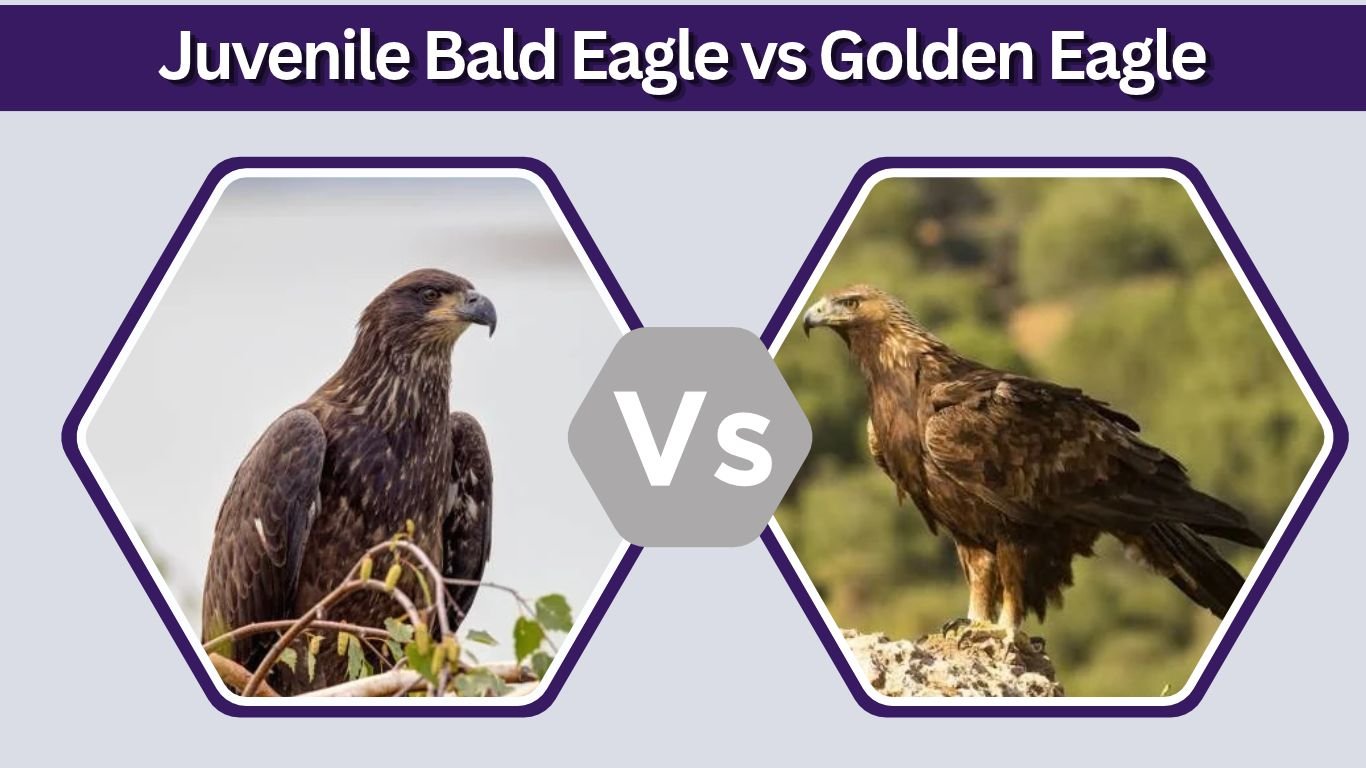
Distinguishing a juvenile bald eagle vs golden eagle can be challenging because both birds have dark brown feathers, powerful beaks, and impressive wingspans. Unlike adult bald eagles, juveniles do not have white heads or tails, making them resemble golden eagles at first glance. However, differences in head shape, feather patterns, wing structure, and flight behavior help identify each species. Understanding these characteristics also makes it easier to distinguish juvenile bald eagles from ospreys, red-tailed hawks, turkey vultures, and other large birds of prey.
Juvenile Bald Eagle vs Golden Eagle: Main Differences
Juvenile bald eagles (Haliaeetus leucocephalus) and golden eagles (Aquila chrysaetos) are among North America’s largest birds of prey. Although they share similar brown coloring, their physical characteristics differ significantly. Juvenile bald eagles generally have larger-looking heads, heavier beaks, and broader tails. Golden eagles typically have smaller-looking heads, longer tails, and golden-brown feathers around their necks.
| Feature | Juvenile Bald Eagle | Golden Eagle |
| Head | Large, dark brown | Smaller-looking, golden nape |
| Beak | Heavy and prominent | Relatively smaller |
| Body | Brown with variable white mottling | Mostly dark brown |
| Wings | Broad, relatively straight | Long, sometimes slightly raised |
| Tail | Broad, often mottled | Relatively longer |
| Legs | Bare lower legs above feet | Feathered down to feet |
| Habitat | Lakes, rivers, coastlines | Mountains, grasslands, open country |
| Diet | Fish, birds, mammals, carrion | Mammals, birds, carrion |
The most reliable identification comes from combining several characteristics rather than relying on a single feature.
How to Tell a Golden Eagle From a Juvenile Bald Eagle
Recognizing the difference between a golden eagle and juvenile bald eagle requires careful observation of their physical appearance. Both species may appear uniformly brown from a distance, but their head proportions, feather distribution, and leg structure provide useful clues. These differences become particularly noticeable when the birds are perched or photographed at close range.
Head Shape and Beak Size
A juvenile bald eagle has a noticeably large head and a substantial hooked beak. Its head projects prominently beyond the wings during flight.
Golden eagles generally have proportionally smaller heads and beaks. Their golden-brown nape feathers also help distinguish them from bald eagles.
Feather Color and Patterns
Juvenile bald eagles initially have predominantly brown plumage. As they mature, irregular white markings develop across their wings, chest, belly, and tail.
Golden eagles have more consistent dark brown body feathers. Young golden eagles often display sharply defined white patches near the bases of their primary feathers and a white tail base with a dark terminal band.
Legs and Talons
One of the clearest differences is leg feathering. Golden eagles have feathers extending down their legs to the feet.
Juvenile bald eagles have unfeathered lower legs above their yellow feet. This distinction is especially useful when identifying perched birds.
Golden Eagle vs Juvenile Bald Eagle in Flight
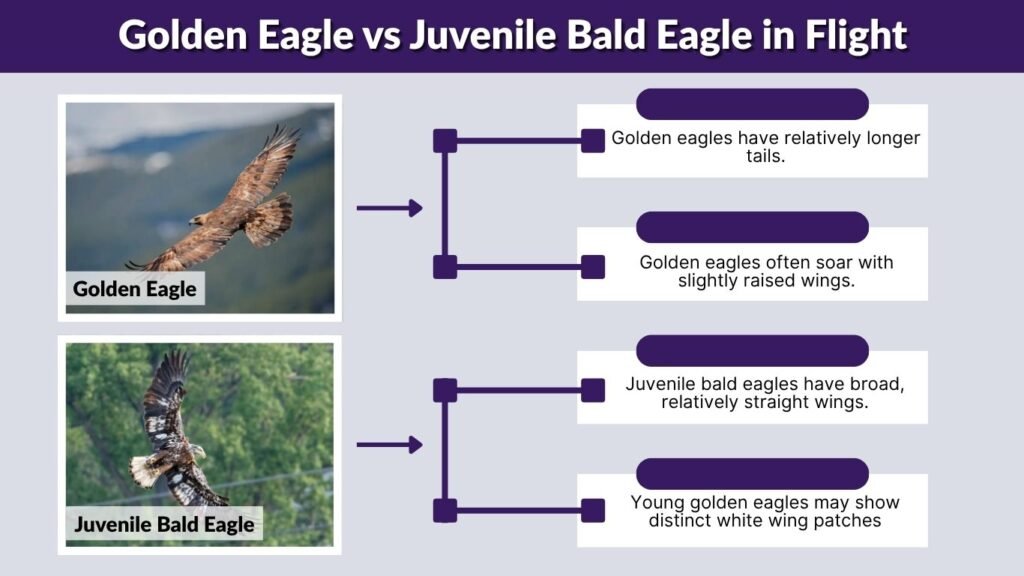
Flight identification is often easier when observers focus on wing proportions, tail length, and head projection rather than feather color alone. A juvenile bald eagle typically soars with its broad wings held nearly horizontal. Golden eagles frequently hold their wings in a shallow V, although wing posture can change with wind and flight conditions.
Key Flight Identification Features
- Wing shape: Juvenile bald eagles have broad, relatively straight wings.
- Head projection: Bald eagles show a more prominent head extending forward.
- Tail length: Golden eagles have relatively longer tails.
- Wing posture: Golden eagles often soar with slightly raised wings.
- White markings: Young golden eagles may show distinct white wing patches, while immature bald eagles often show irregular mottling.
- Silhouette: Bald eagles appear heavy-headed, while golden eagles look comparatively long-tailed.
Eagle, Osprey, and Hawk Wingspan Comparison
| Bird | Approximate wingspan |
| Juvenile Bald Eagle | Around 6–7.5 feet |
| Golden Eagle | 6–7.2 feet |
| Osprey | 4.9–5.9 feet |
| Red-Tailed Hawk | 3.7–4.4 feet |
| Turkey Vulture | Around 5.3–6 feet |
Because wingspan ranges overlap, size alone cannot reliably distinguish a golden eagle from a juvenile bald eagle.
Juvenile Golden Eagle vs Juvenile Bald Eagle
Comparing two juvenile eagles can be especially difficult because neither bird has the fully developed appearance of an adult. However, their first-year plumage patterns are often distinctive. Juvenile golden eagles generally show more organized white markings, while juvenile bald eagles have predominantly brown feathers with variable pale areas that change as they mature.
First-Year Plumage Differences
A first-year juvenile golden eagle commonly has a dark chocolate-brown body, golden feathers around its nape, white patches near the bases of its primary feathers, and a largely white tail base with a broad dark tip.
A first-year bald eagle has a mostly brown head and body, a heavy dark beak, and a tail with brown and white mottling. Its white markings are usually less sharply defined.
Juvenile Bald Eagle vs Adult Bald Eagle
Bald eagles undergo several plumage changes before developing their familiar white heads and tails.
| Feature | Juvenile Bald Eagle | Adult Bald Eagle |
| Head | Brown | White |
| Tail | Brown or mottled | White |
| Beak | Dark, gradually lightening | Yellow |
| Eyes | Brown | Pale yellow |
| Body | Brown with age-dependent mottling | Dark brown |
| Age | Young or immature | Typically 4–5 years and older |
The transformation happens gradually, and individual birds develop adult plumage at slightly different ages.
Juvenile Bald Eagle vs Osprey
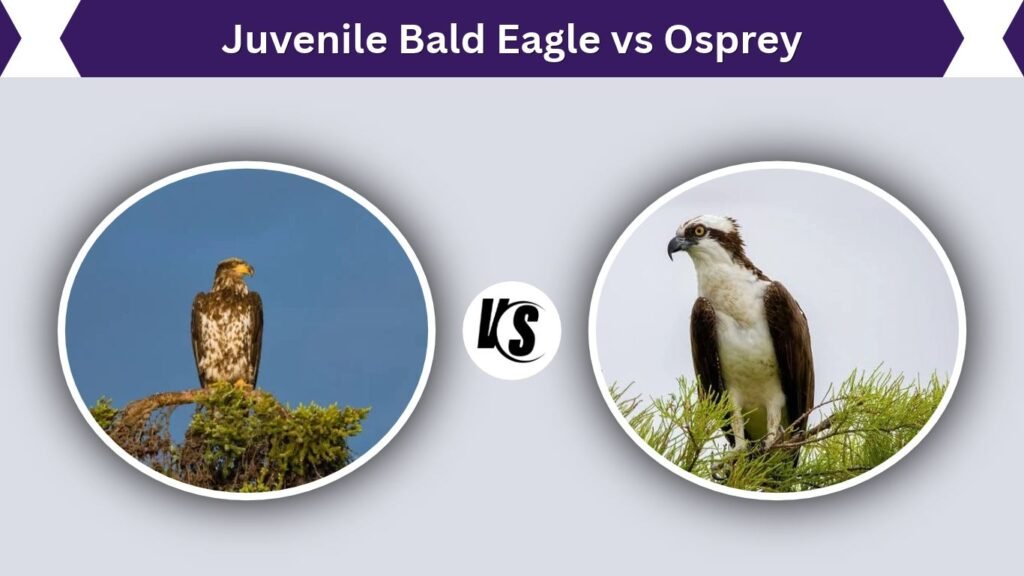
A juvenile bald eagle and an osprey (Pandion haliaetus) are frequently confused because both are large birds of prey commonly seen around water. Both species catch fish and perch near lakes, rivers, or coastal habitats. However, ospreys are smaller, slimmer, and generally much whiter underneath than juvenile bald eagles.
Identification Differences
- Head: Ospreys have mostly white heads with dark eye stripes, while juvenile bald eagles have mostly brown heads.
- Body: Ospreys show white underparts; juvenile bald eagles are predominantly brown or mottled.
- Wings: Ospreys have narrower wings with a noticeable bend at the wrists.
- Size: Juvenile bald eagles are generally larger and heavier.
- Flight: Ospreys may hover over water before diving feet-first to catch fish.
An osprey’s distinctive M-shaped wing profile is particularly helpful for identification.
Juvenile Bald Eagle vs Hawk: How to Identify Them
Juvenile bald eagles sometimes resemble large hawks, particularly when viewed from a distance. Their brown feathers, hooked beaks, and broad wings can create confusion. However, bald eagles generally have much larger bodies, longer wingspans, and heavier bills than most North American hawks. Comparing overall proportions is more reliable than judging feather color.
Juvenile Bald Eagle vs Red-Tailed Hawk
The red-tailed hawk (Buteo jamaicensis) is one of the most common birds mistaken for a juvenile bald eagle.
Important differences include:
- Size: Juvenile bald eagles are substantially larger.
- Head: Bald eagles have heavier heads and more prominent beaks.
- Wings: Red-tailed hawks have comparatively shorter, broad, rounded wings.
- Tail: Adult red-tailed hawks usually have reddish tails, while young hawks have brown, barred tails.
- Underparts: Many red-tailed hawks display pale underparts with a darker belly band.
Dark-morph red-tailed hawks may be almost entirely brown, making wing shape and size especially important.
Juvenile Bald Eagle vs Other Hawks
Other large hawks can occasionally resemble young bald eagles. However, their smaller bills, lighter body structures, and different wing proportions usually distinguish them.
A bald eagle typically looks considerably bulkier when perched, especially when its head and large feet are visible.
Juvenile Bald Eagle vs Turkey Vulture
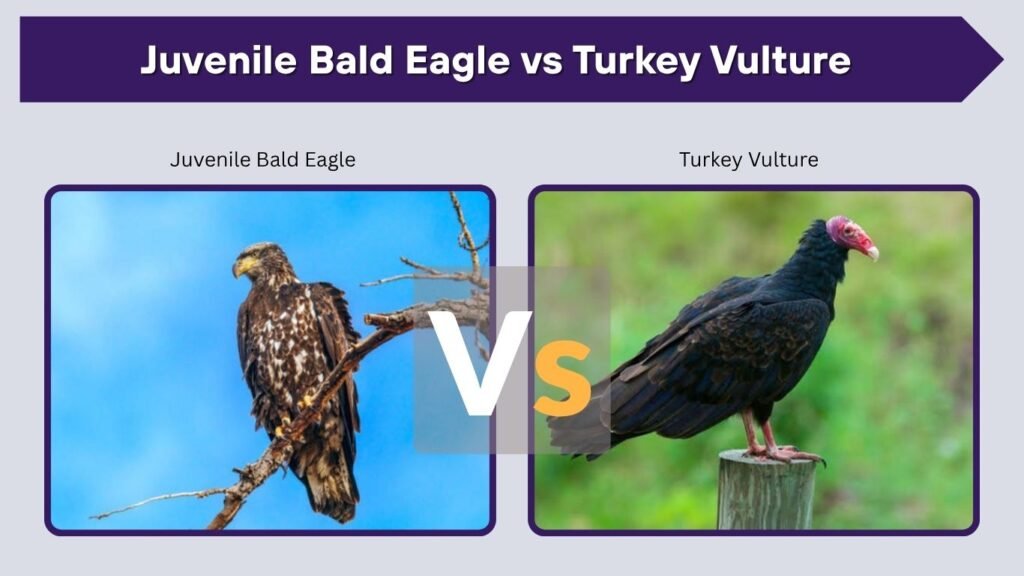
Turkey vultures (Cathartes aura) are another species commonly mistaken for juvenile bald eagles. Both have large wingspans and dark bodies, and both frequently soar high above open landscapes. Nevertheless, their flight behavior, head structure, and underwing coloration reveal several differences that make identification easier.
Main Identification Features
- Turkey vultures have small, bare heads, while juvenile bald eagles have large feathered heads.
- Vultures usually hold their wings in a shallow V while soaring.
- Juvenile bald eagles typically hold their wings flatter.
- Turkey vultures display noticeably lighter flight feathers underneath their wings.
- Vultures frequently rock or tilt from side to side while gliding.
- Bald eagles have much larger hooked bills and powerful-looking heads.
The turkey vulture’s rocking flight pattern is one of the most useful identification clues.
Juvenile vs Immature Bald Eagle vs Eaglet
The terms eaglet, juvenile, and immature bald eagle describe different developmental stages. Although people sometimes use these words interchangeably, birdwatchers often distinguish them by age and independence. Understanding the terminology also helps when comparing photographs of young bald eagles with adult birds or juvenile golden eagles.
An eaglet is a young eagle, particularly one still developing in the nest. A fledgling has grown flight feathers and begun leaving the nest but may still depend on its parents.
A juvenile bald eagle generally refers to a first-year bird wearing its initial flight plumage. An immature bald eagle is a broader term covering young birds that have not yet developed complete adult plumage.
Most bald eagles acquire their familiar adult appearance around four to five years of age.
FAQs
1. How Can You Tell a Golden Eagle From a Juvenile Bald Eagle?
Golden eagles have proportionally smaller heads, longer tails, and golden-brown nape feathers. Juvenile bald eagles have larger-looking heads, heavier beaks, and more irregular white mottling. Golden eagles also have feathered lower legs, unlike bald eagles.
2. Is a Juvenile Bald Eagle Bigger Than a Golden Eagle?
Juvenile bald eagles and golden eagles have overlapping wingspans and body sizes. Female bald eagles can be particularly large, but neither species is consistently bigger in every measurement. Individual size varies according to sex, age, and geographic population.
3. Do Juvenile Golden Eagles Have White Feathers?
Yes, juvenile golden eagles often display white patches near the bases of their primary wing feathers and a white tail base with a broad dark tip. These markings typically become less noticeable as the eagle develops adult plumage.
4. What Is the Difference Between a Juvenile Bald Eagle and a Red-Tailed Hawk?
A juvenile bald eagle is substantially larger, with a heavier beak, more prominent head, and longer wingspan. Red-tailed hawks usually have shorter, rounded wings and comparatively small bills. Juvenile red-tailed hawks also display barred rather than reddish tails.
5. How Can You Identify a Juvenile Bald Eagle From Below?
Look for broad wings held relatively flat, a large projecting head, and a heavy body. The underside is predominantly brown with variable white mottling. Unlike a turkey vulture, a juvenile bald eagle generally lacks a strongly two-toned underwing pattern.