
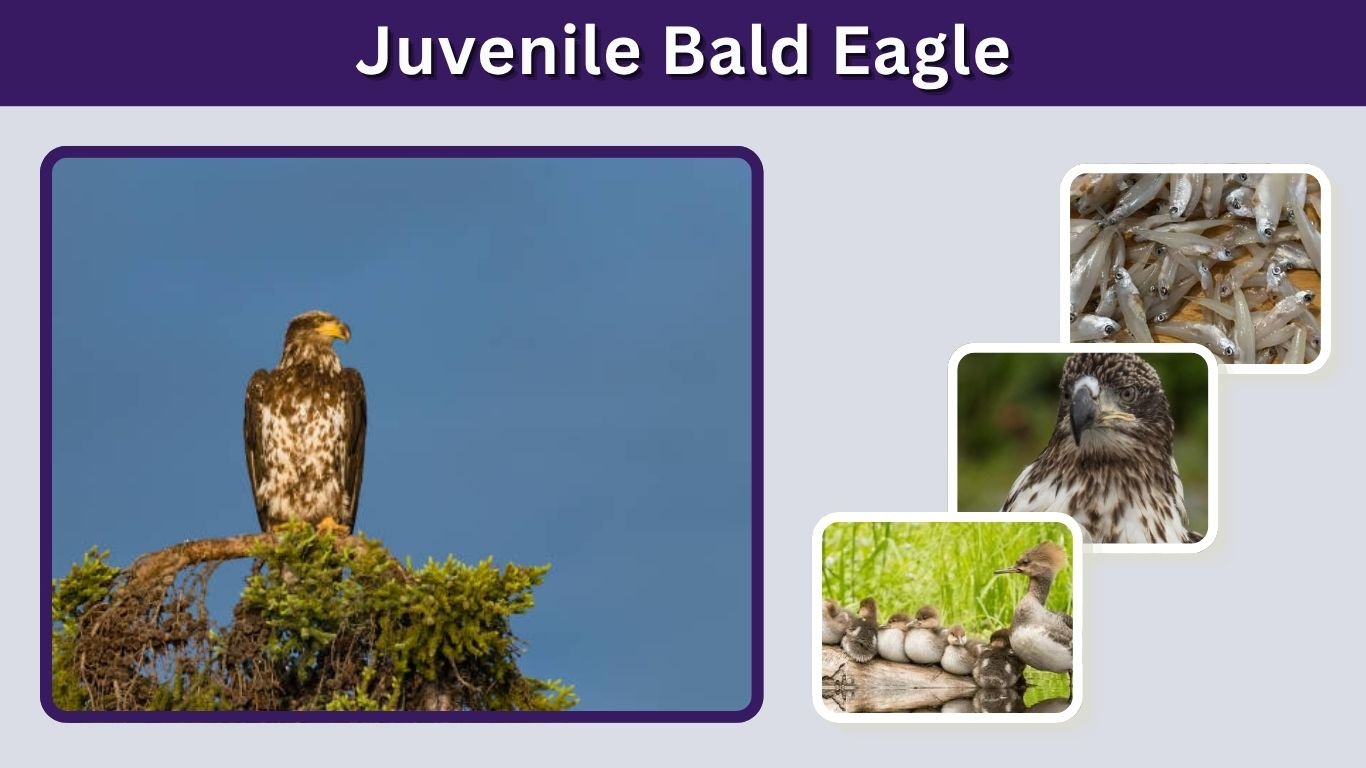
A juvenile bald eagle looks surprisingly different from the familiar adult bald eagle with its white head and tail. Young bald eagles have mostly dark brown feathers, dark beaks, and brown eyes, making them easy to confuse with golden eagles and other large birds of prey. Their appearance changes gradually as they mature, usually taking about four to five years to develop their distinctive adult plumage. Understanding juvenile bald eagle identification, size, wingspan, flight patterns, and feather development can help birdwatchers recognize these impressive North American raptors.
What Does a Juvenile Bald Eagle Look Like?
A juvenile bald eagle (Haliaeetus leucocephalus) is a large bird of prey with a predominantly dark brown body, broad wings, and a powerful hooked beak. Unlike adults, young bald eagles lack the recognizable white head and tail. Their feathers gradually develop different amounts of white as they grow, creating several distinctive appearances before adulthood.
Juvenile Bald Eagle Identification
Important identification features include:
- Head: Mostly dark brown, occasionally showing lighter feather markings.
- Beak: Large, strongly hooked, and initially dark gray or blackish.
- Eyes: Dark brown in young birds, becoming lighter with age.
- Body: Predominantly brown, with variable pale or white mottling.
- Wings: Long, broad, and relatively straight when soaring.
- Tail: Broad and rounded, usually dark brown during the first year.
- Legs: Yellow, with powerful feet and sharp black talons.
Juvenile Bald Eagle Head and Feathers
The juvenile bald eagle’s head is generally brown without the striking white coloring seen in adults. Its large beak and substantial head help distinguish it from a golden eagle.
Young birds initially have dark plumage, but successive molts introduce lighter feathers across their wings, chest, belly, and tail. The amount of white varies considerably between individuals.
Juvenile Bald Eagle Size and Wingspan
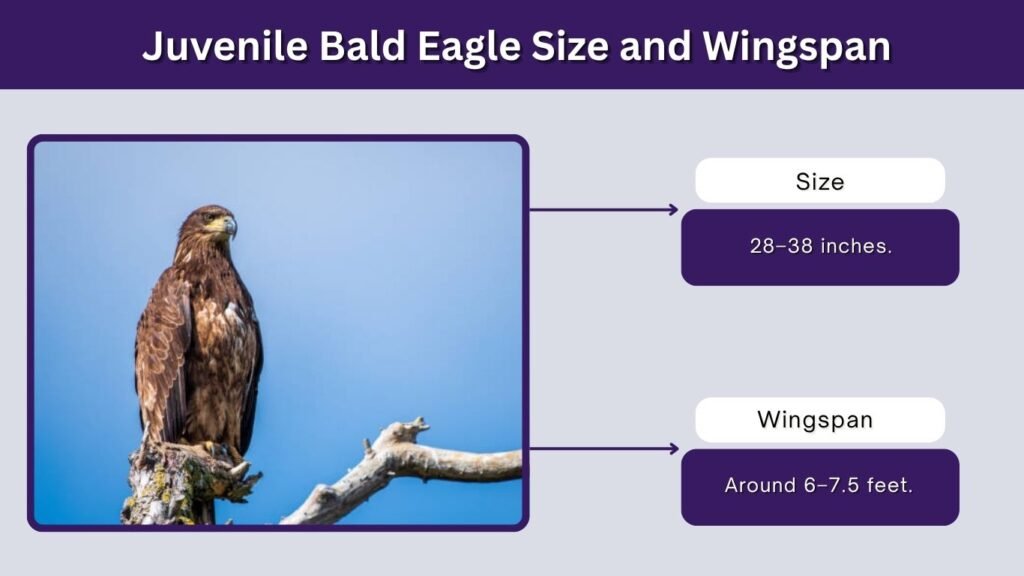
Juvenile bald eagles are nearly adult-sized when they leave the nest. Their substantial bodies, broad wings, and strong talons allow them to begin flying and developing hunting skills shortly after fledging.
Their approximate physical measurements are:
| Feature | Typical measurement |
| Body length | 28–38 inches |
| Wingspan | Around 6–7.5 feet |
| Weight | Approximately 6.5–14 pounds |
| Female size | Generally larger than males |
| Adult plumage | Around 4–5 years |
Female juvenile bald eagles are generally heavier and larger than males. Interestingly, young eagles can appear slightly larger than adults because their first flight feathers may be longer.
However, they are not necessarily heavier or physically bigger than fully grown birds.
Juvenile Bald Eagle vs Golden Eagle: Key Differences
Distinguishing a juvenile bald eagle from a golden eagle can be challenging because both species have dark brown feathers, powerful beaks, and impressive wingspans. However, several physical characteristics make identification easier.
Golden eagles generally have smaller-looking heads, longer tails, and golden-brown feathers around the back of the neck. Juvenile bald eagles have more substantial head projections and often develop irregular white feather patterns.
Juvenile Bald Eagle vs Golden Eagle Comparison
| Feature | Juvenile Bald Eagle | Golden Eagle |
| Head | Large, dark brown | Smaller-looking, golden nape |
| Beak | Large and heavy | Comparatively smaller |
| Body feathers | Brown with variable mottling | Mostly dark brown |
| Tail | Broad with irregular pale markings | Juveniles show white base and dark tip |
| Wings | Broad, usually held flat | Often slightly raised |
| Lower legs | Unfeathered | Feathered to the feet |
| Habitat | Frequently near water | Often open country and mountains |
How to Tell Them Apart in Flight
Look for these distinguishing characteristics:
- Juvenile bald eagles have broader-looking heads and heavier bills.
- Golden eagles typically show longer tails relative to their heads.
- Immature golden eagles may display distinct white patches near the bases of their flight feathers.
- Juvenile bald eagles often show irregular pale markings rather than sharply defined patches.
Observing several characteristics together provides more reliable identification than relying on color alone.
How to Identify a Juvenile Bald Eagle in Flight
A juvenile bald eagle in flight displays a powerful silhouette with wide wings, finger-like primary feathers, and a relatively short, broad tail. Its flight style resembles that of an adult bald eagle, although young birds may appear less experienced when maneuvering or landing.
Juvenile Bald Eagle From Below
When identifying a juvenile bald eagle from underneath, look for:
- Broad, rectangular-looking wings with spread primary feathers.
- Dark brown underwings with variable pale mottling.
- A substantial head extending forward.
- A broad, rounded tail.
- Slow, deep wingbeats alternating with extended gliding.
The underside may show noticeable white markings, particularly in immature birds beyond their first year.
Juvenile Bald Eagle Perched
When perched, juvenile bald eagles appear bulky and upright, with large hooked beaks and powerful yellow feet.
They commonly rest in tall trees, along shorelines, or near rivers and lakes. Their considerable size and heavy bills are particularly useful for distinguishing them from hawks.
Juvenile Bald Eagle Feathers and Plumage by Age
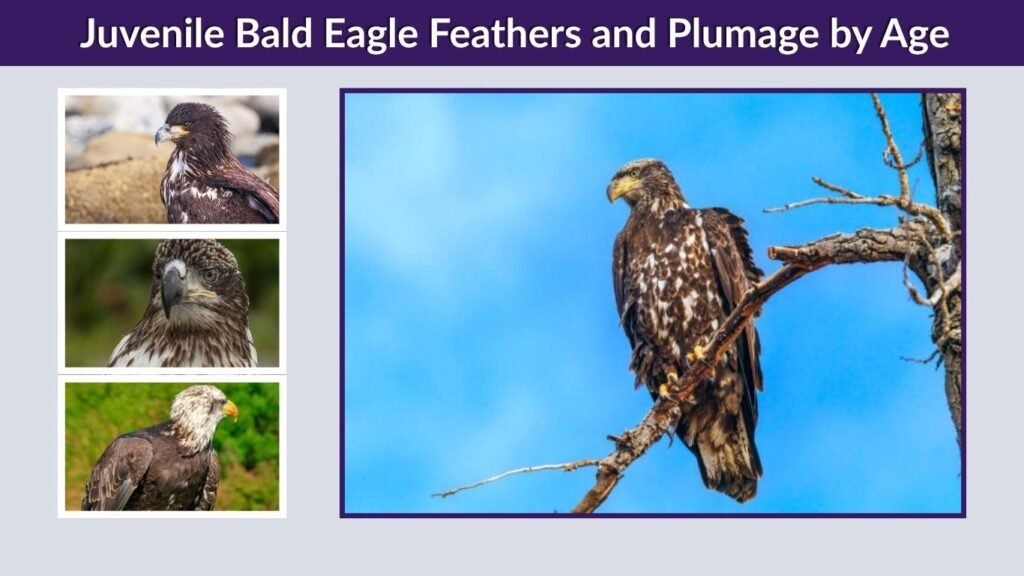
The most noticeable transformation in a bald eagle’s development is its changing feather coloration. Young bald eagles pass through several plumage stages before gaining the white head and tail associated with mature adults.
First-Year Juvenile Bald Eagle
During the first year, the eagle generally has dark brown feathers covering most of its body. Its head, tail, and wings remain predominantly brown, although some lighter markings may be present.
Its eyes and beak are relatively dark, and the bird lacks the sharp adult color contrast.
Second-Year Juvenile Bald Eagle
During the second year, white or pale feathers become more noticeable across the belly, wings, and other body areas.
These irregular markings can produce a strongly mottled appearance. The beak and eyes may also begin gradually lightening.
Third- and Fourth-Year Bald Eagle
During the third and fourth years, the eagle increasingly develops white feathers around its head and tail.
Some individuals display a whitish head with a dark eye stripe. By approximately five years old, most have acquired the characteristic adult appearance, although the timing varies.
Juvenile Bald Eagle vs Osprey, Hawk, and Turkey Vulture
Juvenile bald eagles can also resemble several other large birds, particularly when observed from a distance.
Their size, wing shape, flight behavior, and feather patterns provide useful identification clues.
- Juvenile Bald Eagle vs Osprey: Ospreys are generally smaller, with white underparts, dark wrist patches, and long wings that often form an M-shaped silhouette.
- Juvenile Bald Eagle vs Red-Tailed Hawk: Red-tailed hawks are noticeably smaller, have shorter wingspans, and typically show a more compact head and bill.
- Juvenile Bald Eagle vs Turkey Vulture: Turkey vultures often soar with their wings raised in a shallow V and display a two-toned underside. Bald eagles usually hold their wings flatter.
Comparing multiple features is especially important when lighting conditions make feather colors difficult to distinguish.
Juvenile Bald Eagle Behavior, Diet, and Sounds
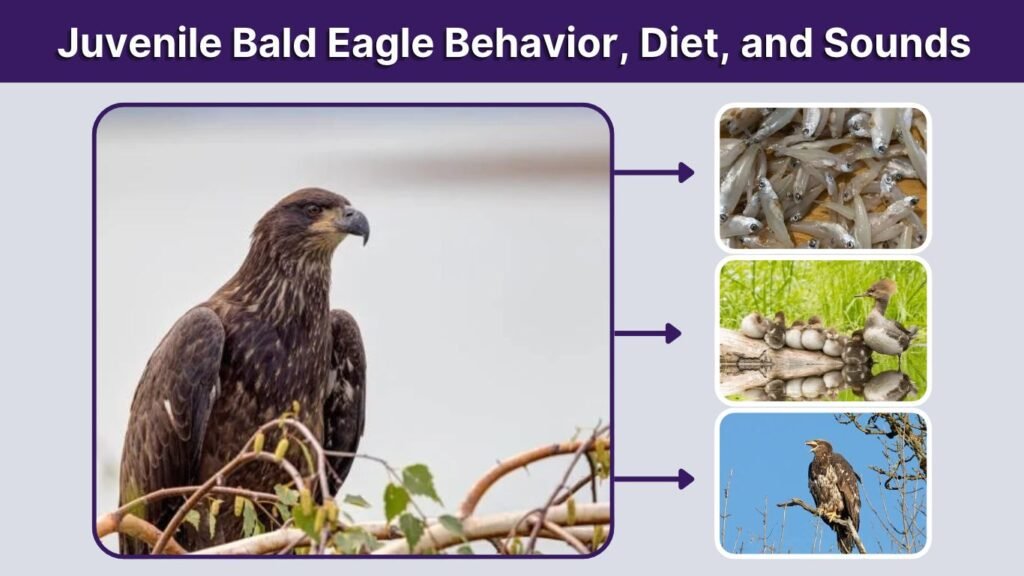
Young bald eagles gradually become independent after leaving the nest. They initially depend on their parents for food while strengthening their flight abilities and learning to find prey.
Juvenile bald eagles eat fish, waterfowl, small mammals, and carrion. They may also steal food from other birds. Scavenging provides valuable feeding opportunities while their hunting skills develop.
Their vocalizations include high-pitched whistles, piping calls, and repeated begging sounds. Juveniles commonly call around the nest when requesting food or interacting with their parents.
Young eagles typically make their first flights at approximately 10–14 weeks of age. They may remain near their nesting territory for several additional weeks before dispersing.
FAQs
1. Do Juvenile Bald Eagles Have White Heads?
No, juvenile bald eagles generally have dark brown heads during their first year. White feathers gradually appear as they mature. Most bald eagles develop their recognizable white heads and tails around four to five years of age.
2. Are Juvenile Bald Eagles Larger Than Adults?
Juvenile bald eagles are usually close to adult size when they begin flying. Their first flight feathers can be slightly longer, sometimes creating a larger-looking silhouette. However, juveniles are not consistently heavier or larger-bodied than mature bald eagles.
3. How Long Do Juvenile Bald Eagles Stay With Their Parents?
Young bald eagles usually remain near their parents for several weeks after their first flight. Many stay within the nesting territory for approximately four to twelve weeks, gradually becoming independent as they develop flying, feeding, and hunting abilities.
4. When Do Juvenile Bald Eagles Get White Heads?
Juvenile bald eagles gradually develop white head feathers over several years. Partial white coloring may appear during intermediate plumage stages, but the complete white head and tail associated with adult bald eagles usually develop around four to five years old.
5. What Does a Juvenile Bald Eagle Sound Like?
A juvenile bald eagle produces high-pitched whistles, squeaky calls, and repeated begging vocalizations. These sounds are particularly common near nesting areas when young birds request food. Their calls are generally less deep and powerful than people expect from such large birds.