
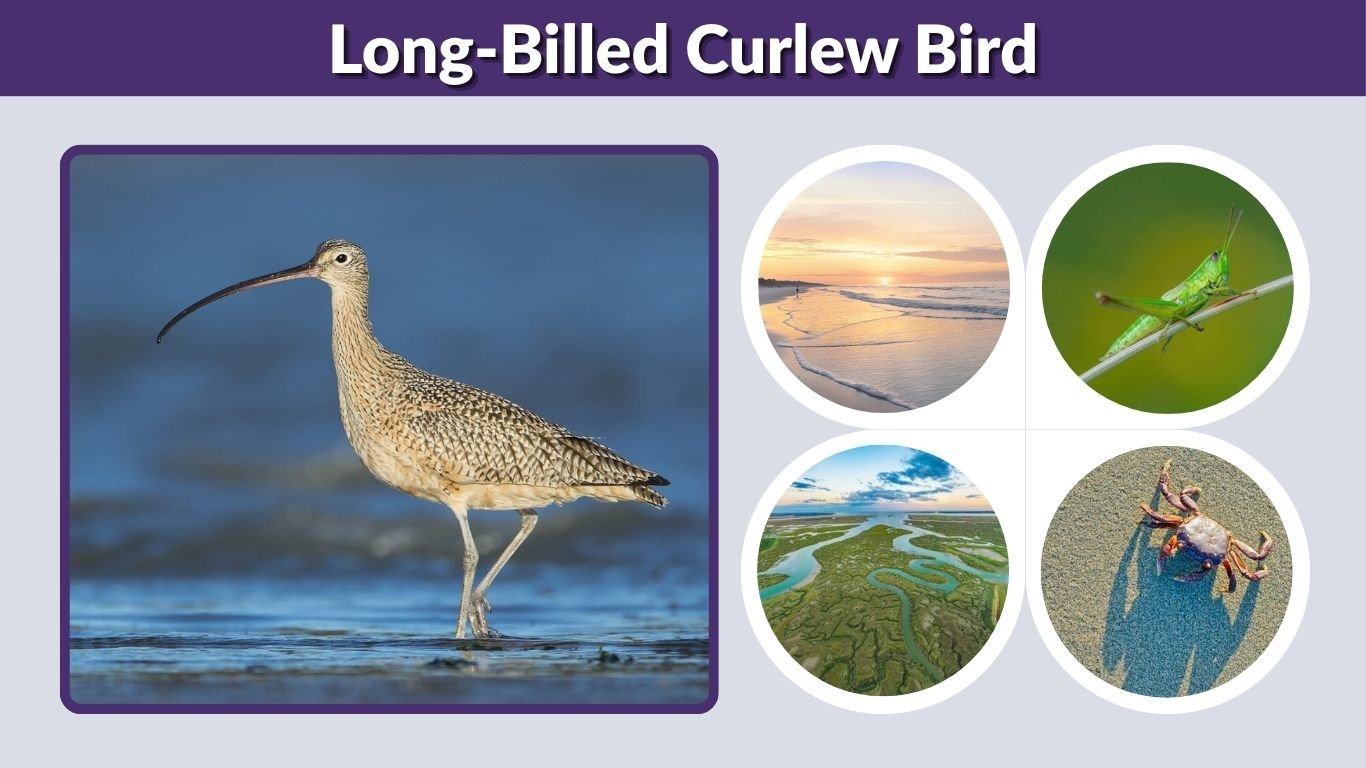
The Long-billed Curlew (Numenius americanus) is North America’s largest shorebird and one of its easiest waders to recognize. Its exceptionally long, downward-curving bill, cinnamon-colored underwings, long legs, and speckled brown body create a distinctive appearance. Although often associated with beaches and mudflats, these birds spend their breeding season mainly in western grasslands. Their specialized bill helps them capture insects, worms, crabs, and other hidden prey. Here is everything you need to know about their identification, range, habitat, migration, diet, nesting, calls, and behavior.
Long-Billed Curlew Identification
The Long-billed Curlew is a large, long-legged member of the sandpiper family, Scolopacidae. Its scientific name is Numenius americanus. While several North American shorebirds possess elongated bills, few approach the remarkable proportions of this species. Its warm coloration and enormous curved bill usually make identification straightforward when the bird is observed clearly.
Key Identification Features
Look for these characteristics when identifying a Long-billed Curlew:
- Bill: Extremely long, thin, and curved downward
- Body: Large and relatively heavy for a shorebird
- Plumage: Mottled brown, buff, and cinnamon
- Underparts: Pale with a noticeable cinnamon wash
- Underwings: Bright rusty or cinnamon coloration
- Legs: Long and grayish
- Head: Fairly plain without bold crown stripes
- Neck: Long and slender
- Flight: Broad wings with visible rusty coloration underneath
Its combination of body size and bill length makes the silhouette especially recognizable.
Long-Billed Curlew Beak Size and Adaptation
The enormous bill is the bird’s most impressive adaptation. Females generally have longer bills with more strongly curved tips than males. This difference may allow males and females to reach prey at somewhat different depths and locations.
The bill is not simply decorative. Curlews insert it deep into soft ground, sand, and mud to locate hidden invertebrates. Along coastal areas, they can probe into burrows for crabs and shrimp that shorter-billed birds may be unable to reach.
Long-Billed Curlew Range and Habitat
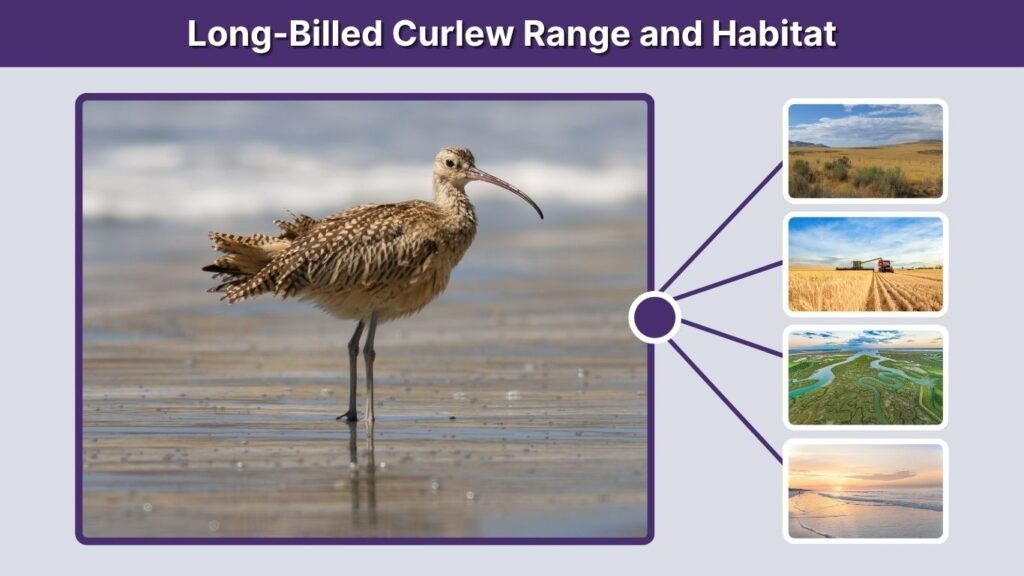
Despite being classified as a shorebird, the Long-billed Curlew spends much of its breeding season far from the ocean. It is strongly associated with the open landscapes of western North America. Habitat changes throughout the year, with birds moving between grassland breeding territories and wetlands, beaches, agricultural areas, and coastal environments during migration and winter.
Where Does the Long-Billed Curlew Live?
Important habitats and regions include:
- Shortgrass and mixed-grass prairies
- Open rangelands
- Sagebrush grasslands
- Agricultural fields
- Wet meadows and pastures
- Salt marshes
- Tidal estuaries
- Coastal mudflats
- Beaches
- Shallow flooded fields
- Western Canada
- Western and central United States
- California and the Pacific Coast
- Southern United States
- Mexico
Breeding populations occur across parts of the Great Plains, Great Basin, western United States, and western Canada.
Long-Billed Curlew Migration
Long-billed Curlews leave many northern breeding areas after nesting and move toward wintering grounds. Coastal California, the southwestern United States, and Mexico provide particularly important nonbreeding habitat.
During migration, individuals may stop at grasslands, agricultural fields, lakes, estuaries, and wetlands. Some curlews travel in small groups and may forage alongside Marbled Godwits, Willets, and other large shorebirds.
What Does a Long-Billed Curlew Eat?

The Long-billed Curlew is an opportunistic feeder whose menu changes depending on its surroundings. Birds living on breeding grasslands consume many terrestrial insects, while wintering birds around coastal mudflats exploit aquatic invertebrates. Their combination of long legs and an extraordinarily long bill allows them to forage across shallow water, soft mud, sand, and dry grasslands.
Long-Billed Curlew Diet
Long-billed Curlews may consume:
- Grasshoppers
- Beetles
- Caterpillars
- Earthworms
- Spiders
- Crabs
- Shrimp
- Crayfish
- Marine worms
- Mollusks
- Other aquatic invertebrates
- Berries
- Occasionally eggs or very small vertebrate prey
In grasslands, insects can make up an important portion of their food. On coastal mudflats, crabs, shrimp, worms, and similar animals become more important.
How the Long Bill Helps With Feeding
A feeding curlew often walks steadily while examining the ground. It may pick visible insects from vegetation or push its bill deeply into soft sediment.
The downward curve is particularly useful for reaching into burrows. A bird can insert the bill while keeping most of its head above the mud or water. This remarkable feeding specialization explains why the Long-billed Curlew can successfully use both grassland and coastal environments.
Long-Billed Curlew Nesting and Chicks
Breeding occurs in open grasslands, where curlews require enough visibility to detect approaching danger. The nest itself is surprisingly simple compared with the bird’s striking appearance. Long-billed Curlews nest directly on the ground, and both parents participate in incubation and caring for their young during the first stages of the nesting season.
Nest, Eggs, and Baby Curlews
Typical breeding characteristics include:
- Nest location: Open grassland or prairie
- Nest type: Shallow scrape in the ground
- Lining: Small amounts of grass or other vegetation
- Typical clutch: About four eggs
- Egg color: Buff to olive with darker markings
- Incubation: Performed by both parents
- Incubation period: Roughly 27–30 days
- Chicks: Down-covered and able to leave the nest shortly after hatching
Young Long-billed Curlews can feed themselves, although their parents continue guarding and guiding them.
Long-Billed Curlew Call and Behavior
Their calls are loud and carrying, which is useful across open prairie. The species produces ringing, whistled vocalizations, including calls that can sound like repeated “curlee” notes.
Males perform impressive breeding displays. A male may rise into the air with fluttering wingbeats before descending while calling. On the ground, curlews can become highly defensive around nests and chicks, giving alarm calls and reacting strongly when potential predators approach.
Long-Billed Curlew vs Whimbrel
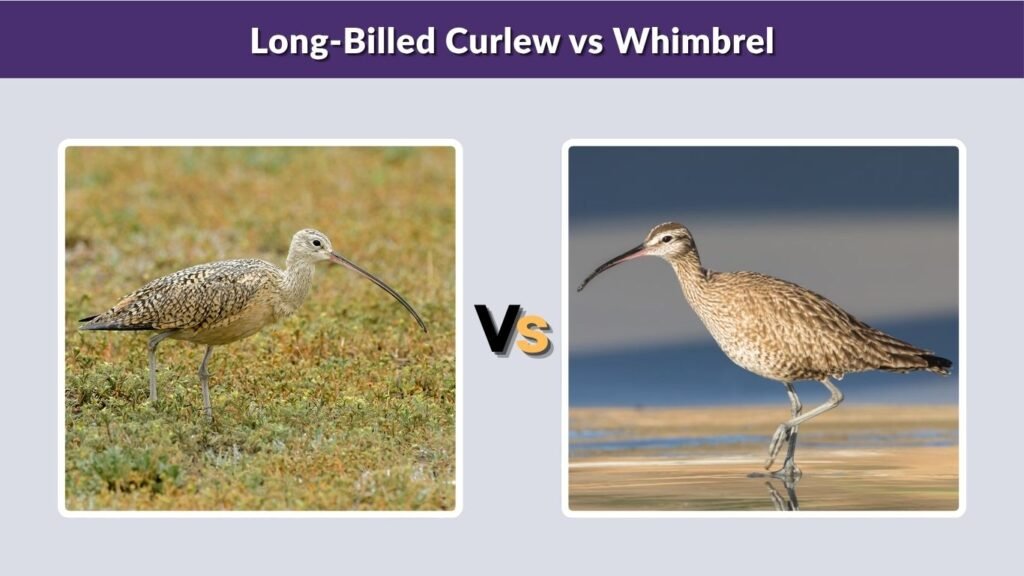
The Whimbrel is the species most likely to create identification confusion. Both are brown-patterned members of the genus Numenius, possess downward-curved bills, and may occur in similar wetland environments. However, differences in bill length, body size, head pattern, and coloration usually separate them when observers have a reasonably clear view.
Difference Between Whimbrel and Long-Billed Curlew
A Long-billed Curlew is larger and stands noticeably taller. Its bill is dramatically longer than a Whimbrel’s and can appear almost disproportionate to the body.
Whimbrels typically have conspicuous dark crown stripes and a contrasting pale stripe along the center of the head. Long-billed Curlews have much plainer heads. The curlew’s warm cinnamon underwings are another useful feature, especially when the bird takes flight.
Long-Billed Curlew Conservation and Facts
Long-billed Curlews remain widely distributed across western North America, but their historical range was substantially larger. Market hunting contributed to major declines during the nineteenth century, and conversion of native grasslands later eliminated populations from several former breeding areas. Today, preserving grasslands, wetlands, and coastal feeding areas remains important for maintaining healthy populations.
Interesting Long-Billed Curlew Facts
- It is considered North America’s largest shorebird.
- Its scientific name is Numenius americanus.
- Females generally have longer bills than males.
- The species breeds primarily in open western grasslands.
- Both parents participate in incubating eggs.
- Chicks leave the nest soon after hatching.
- Birds use their bills to reach deeply buried prey.
- Cinnamon-colored underwings are conspicuous during flight.
- Curlews may return to previous breeding areas in later years.
- Long-billed Curlews are currently considered a species of Least Concern globally, although habitat loss remains an important conservation issue.
Audubon and the Long-Billed Curlew
The bird also has an important place in ornithological art. John James Audubon illustrated the Long-billed Curlew in his famous Birds of America. The work is known as Plate 231 (CCXXXI) and depicts the species with the exaggeratedly elegant bill that makes it so recognizable.
Historical artwork such as Audubon’s also provides a reminder that the species was once found more widely across North America than it is today.
FAQs
The unusual proportions of this species generate plenty of questions, particularly about its enormous bill and where such a seemingly coastal bird lives. Long-billed Curlews are actually closely connected with both inland grasslands and coastal wetlands, switching environments seasonally. Understanding those movements makes their behavior, diet, and physical adaptations much easier to explain.
1. What is the scientific name of the Long-billed Curlew?
The scientific name of the Long-billed Curlew is Numenius americanus. It belongs to the sandpiper family, Scolopacidae.
2. How long is a Long-billed Curlew’s beak?
The bill can be remarkably long, with females generally possessing longer and more strongly curved bills than males. It is proportionally one of the most impressive bills among North American shorebirds.
3. Is the Long-billed Curlew endangered?
No. It is currently classified globally as Least Concern, but habitat loss and conversion of native grasslands remain conservation concerns.
4. Where is the best place to see a Long-billed Curlew?
During breeding season, western North American grasslands provide good opportunities. In fall and winter, look around Pacific Coast estuaries, tidal flats, wetlands, agricultural fields, and suitable habitats in the southwestern United States and Mexico.
5. What is the main difference between a Whimbrel and Long-billed Curlew?
Long-billed Curlews are larger, have dramatically longer bills, plainer heads, and warm cinnamon underwings. Whimbrels have shorter curved bills and much more obvious striped crown patterns.