
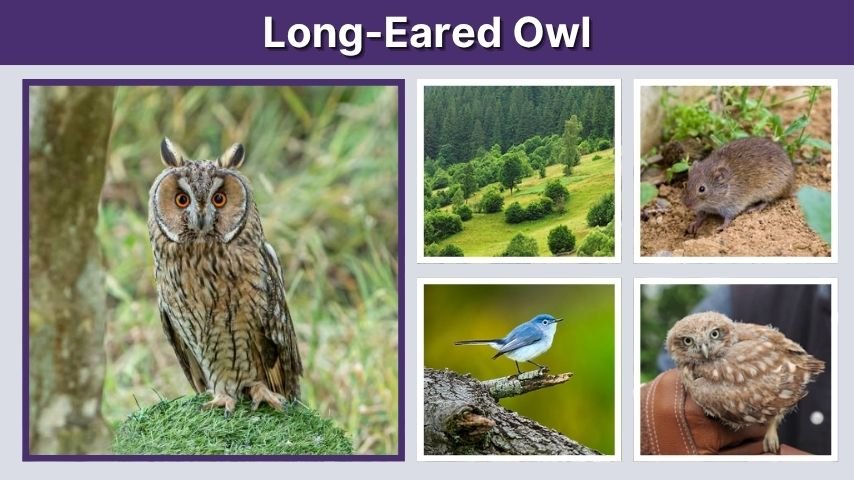
The long-eared owl is a secretive nighttime bird known for its tall ear tufts, slim body, orange facial discs, and excellent camouflage. Although its “ears” are actually feathers, they give the owl a sharp and alert look. Long-eared owls hide in dense trees during the day and hunt mostly after dark. They are often difficult to find, but their soft calls, pellets, roosting habits, and striking appearance make them fascinating birds for owl lovers and bird watchers.
What Is a Long-Eared Owl?
The long-eared owl is a medium-sized owl with long feather tufts on its head, a narrow body, and bark-like coloring. It is mostly active at night and usually rests quietly in thick trees during the day. This owl is known for being shy, well-camouflaged, and harder to spot than many larger owl species.
Long-Eared Owl Scientific Name
The scientific name of the long-eared owl is Asio otus. It belongs to the family Strigidae, which includes many typical owls. The common name comes from the long feather tufts on its head. These tufts look like ears, but the owl’s real ears are hidden under feathers on the sides of the head.
Long Ear Owl vs Long-Eared Owl
“Long ear owl,” “long-eared owl,” and “long eared owl” usually refer to the same bird. The correct common spelling is long-eared owl, but many people search using shorter or misspelled versions. Names like “long earred owl” or “longed eared owl” are spelling mistakes, not different owl species.
Long-Eared Owl Characteristics
Long-eared owls have a slim shape, long ear tufts, orange-brown facial discs, dark vertical streaks, and mottled brown feathers. Their body pattern helps them blend into tree bark and branches. When resting, they often stretch tall and narrow, making themselves look like part of the tree.
Long-Eared Owl Appearance and Size
Long-eared owls are elegant, slender birds that can look taller because of their raised ear tufts. Their feathers are brown, buff, gray, and black, with heavy streaking across the body. They are smaller than great horned owls but larger than many small woodland owls. Their long wings help them fly quietly through the night.
What Does a Long-Eared Owl Look Like?
A long-eared owl has a narrow body, long feather tufts, orange facial discs, and dark markings around the eyes. Its feathers are strongly patterned, giving it a tree-bark appearance. When perched upright, it can be very hard to notice, especially in dense conifers or tangled branches.
Long-Eared Owl Size
The long-eared owl is a medium-sized owl. It is not as bulky as the great horned owl, but it is larger than many small owls. Its slim body, long wings, and upright posture can make it appear taller than it really is.
| Feature | Long-Eared Owl Description |
| Scientific name | Asio otus |
| Body type | Slim and medium-sized |
| Key feature | Long feather ear tufts |
| Face | Orange-brown facial discs |
| Main activity time | Night |
| Common habitat | Dense trees near open hunting areas |
Male vs Female Long-Eared Owl
Male and female long-eared owls look very similar. In many owl species, females are slightly larger than males, and this can also be true for long-eared owls. However, the size difference is often hard to see in the field unless both birds are close together.
Long-Eared Owl Call and Sounds
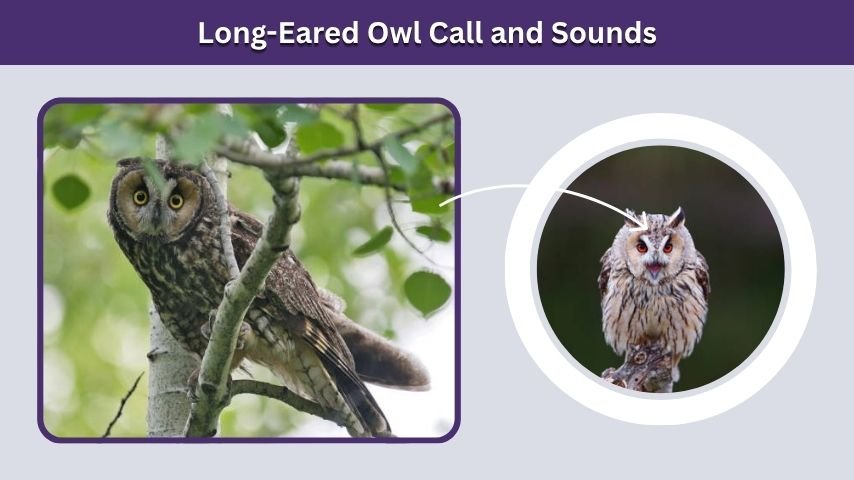
The long-eared owl is often easier to hear than to see, especially during breeding season. Its sounds are usually softer and less powerful than the deep hoots of a great horned owl. Adults may give repeated hoots, while young owls can make high, begging calls near the nest or roosting area.
Long-Eared Owl Call
The male long-eared owl often gives a low, repeated hooting call. This call may be heard at night during courtship and breeding. It is usually steady and simple, not as loud or dramatic as the call of larger owls. Listening carefully at night can help birders detect this hidden species.
Long-Eared Owl Sound at Night
Long-eared owls are most vocal after dark. Night calls may include hoots, alarm notes, and contact sounds. During the breeding season, calling becomes more noticeable as pairs communicate and defend nesting areas. Their calls can travel through quiet woodland edges and open fields.
Juvenile Long-Eared Owl Call
Young long-eared owls often make begging calls when they want food. These calls may sound thin, high, squeaky, or repeated. Juvenile calls are commonly heard near nests after the young leave the nest but still depend on their parents for food.
Where Do Long-Eared Owls Live?
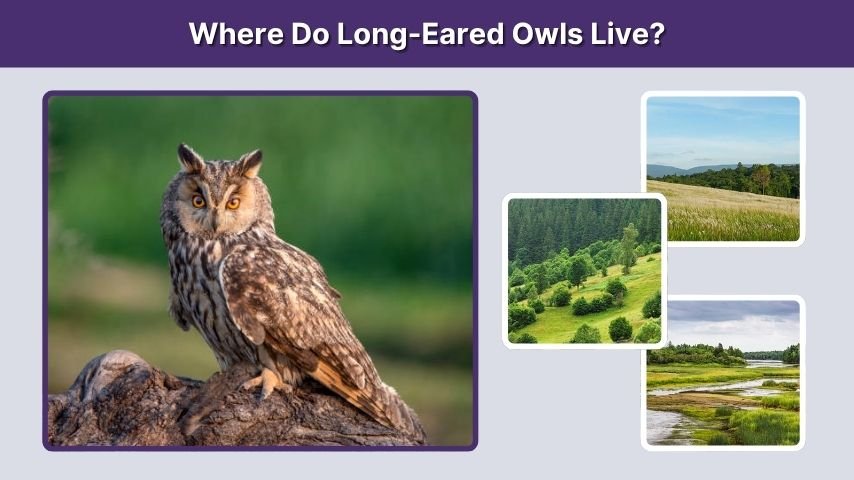
Long-eared owls live across parts of North America, Europe, Asia, and northern Africa. They prefer habitats that provide both dense cover and open hunting areas. During the day, they hide in thick trees, especially conifers. At night, they hunt over fields, grasslands, marsh edges, farmland, and other open spaces where small mammals are active.
Long-Eared Owl Habitat
Long-eared owls often use habitats such as:
- Dense conifer groves
- Woodlots and shelterbelts
- Forest edges
- Grasslands and meadows
- Marshes and wetlands
- Farmland with nearby trees
- Shrubby areas near open fields
They need trees for roosting and open areas for hunting, so mixed landscapes are especially useful.
Long-Eared Owl Range
The long-eared owl has a wide range across the Northern Hemisphere. It is found in many parts of Europe, Asia, North America, and parts of northern Africa. However, it is not always easy to find within that range because it is quiet, nocturnal, and extremely well camouflaged.
European, British, Irish, and Canadian Long-Eared Owls
In Europe and the UK, long-eared owls may be seen in woodland edges, conifer stands, and winter roosts. In Ireland, they are also associated with suitable wooded and open habitats. In Canada, they occur in various provinces where trees and hunting areas are available, including prairie shelterbelts and wooded edges.
What Do Long-Eared Owls Eat?
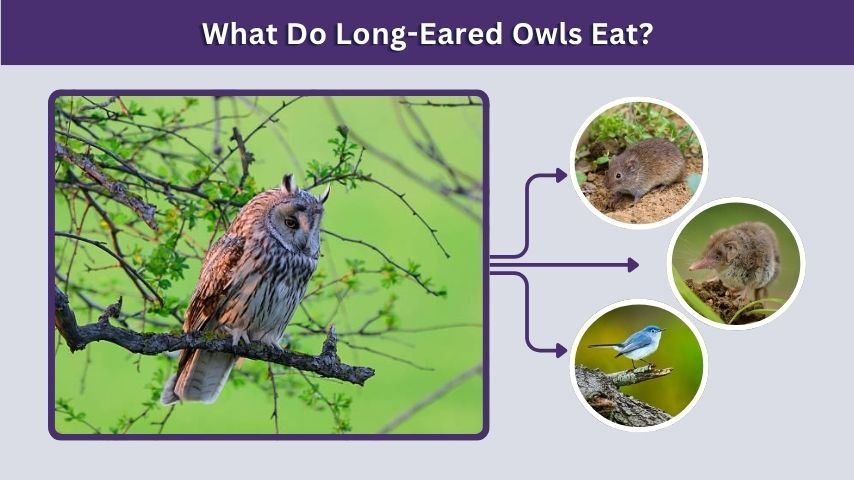
Long-eared owls are nighttime hunters that mainly eat small mammals. Their diet changes depending on location, season, and prey availability. In many places, voles and mice are especially important. These owls hunt quietly over open land and use sharp hearing, silent flight, and quick talons to catch prey.
Long-Eared Owl Diet
A long-eared owl may eat:
- Voles
- Mice
- Shrews
- Small rats
- Small birds
- Bats
- Frogs
- Lizards
- Large insects
Small mammals usually make up the largest part of the diet, especially in grassland and farmland habitats.
Long-Eared Owl Hunting
Long-eared owls usually hunt at night by flying low over fields and open areas. Their soft feathers help reduce sound, allowing them to approach prey quietly. They also use excellent hearing to detect small animals moving in grass or leaves. Once prey is located, the owl drops quickly and grabs it with sharp talons.
What Do Long-Eared Owls Eat in Winter?
In winter, long-eared owls still rely heavily on small mammals, especially voles and mice. Snow, cold weather, and prey movement can affect hunting success. In some areas, they may shift feeding locations or gather near good hunting grounds where prey remains available.
Long-Eared Owl Flight and Adaptations
Long-eared owls have several adaptations that help them survive as quiet nighttime hunters. Their soft wing feathers allow nearly silent flight, while their facial discs help direct sound toward the ears. Their camouflage keeps them hidden during the day. These features work together to help the owl hunt, hide, and avoid danger.
Long-Eared Owl in Flight
In flight, the long-eared owl looks slim, light, and graceful. Its wings are long and rounded, giving it smooth, quiet movement. It may fly low over fields while hunting or move silently between roosting and feeding areas. Because it is mostly nocturnal, people often see it only at dusk or after dark.
Long-Eared Owl Adaptations
Important adaptations include:
- Silent flight feathers
- Strong night vision
- Excellent hearing
- Facial discs that focus sound
- Camouflaged plumage
- Sharp talons
- Long wings for quiet movement
- Upright posture for hiding in trees
These adaptations make the long-eared owl a skilled but secretive predator.
Long-Eared Owl Camouflage
Camouflage is one of the long-eared owl’s strongest defenses. Its streaked brown feathers look similar to bark, twigs, and shadows. When the owl stretches its body and raises its ear tufts, it can resemble a broken branch. This helps it avoid predators and stay hidden from people during the day.
Roosting, Breeding, and Life Cycle
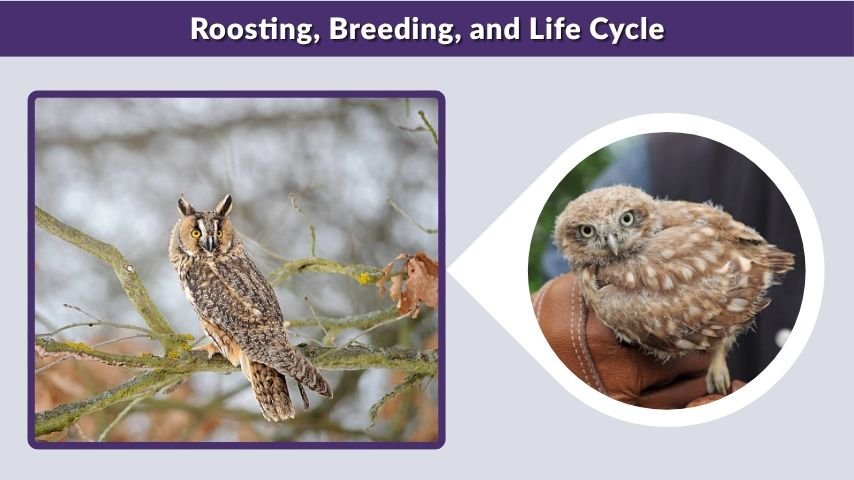
Long-eared owls are known for quiet daytime roosting and secretive nesting behavior. In winter, they may gather in communal roosts, sometimes using the same trees repeatedly. During the breeding season, they often use old stick nests built by other birds. They do not usually build their own nests from scratch.
Long-Eared Owl Roost
A long-eared owl roost is usually hidden in dense trees or thick vegetation. Conifers are often used because they provide cover all year. In winter, several owls may roost together in the same area. These roosts should not be disturbed, because repeated disturbance can cause owls to leave a safe resting place.
Long-Eared Owl Breeding Season
Breeding often begins in spring, although timing depends on region and prey supply. Males may call more often during courtship. Long-eared owls usually nest in old nests made by crows, magpies, hawks, or other large birds. The female incubates the eggs while the male brings food.
Long-Eared Owl Chicks and Fledglings
Young long-eared owls hatch helpless and depend on their parents for warmth and food. As they grow, they develop down, feathers, and stronger movement. Fledglings may leave the nest before they can fly well and spend time climbing or perching nearby while still begging for food.
Long-Eared Owl vs Great Horned Owl
Long-eared owls and great horned owls are often confused because both have ear tufts. However, they are very different in size, shape, sound, and behavior. The great horned owl is much larger and more powerful, while the long-eared owl is slimmer, more delicate, and more secretive.
Size and Shape Difference
The great horned owl is heavier, broader, and stronger than the long-eared owl. It has a powerful body and large feet. The long-eared owl is thinner, lighter, and more narrow-looking. Its ear tufts stand close together, while the great horned owl’s tufts look wider and more horn-like.
Sound Difference
The great horned owl has a deep, strong hooting voice that many people recognize. The long-eared owl has softer, repeated hoots and thinner juvenile begging calls. If the call sounds deep and powerful, it is more likely from a great horned owl. If it is softer and more hidden, it may be a long-eared owl.
Habitat Difference
Great horned owls use many habitats, including forests, deserts, wetlands, suburbs, and open country. Long-eared owls are more closely linked to dense roosting trees near open hunting land. They are also more secretive and harder to observe during the day.
Are Long-Eared Owls Rare or Endangered?
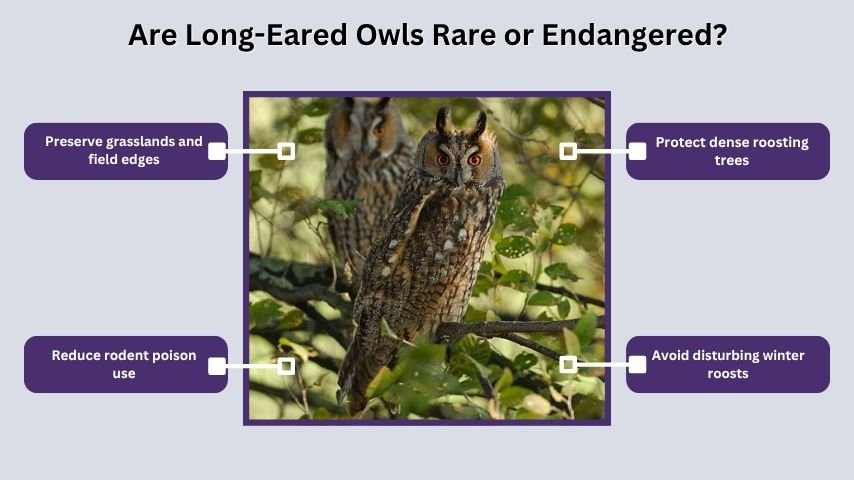
Long-eared owls can seem rare because they are quiet, nocturnal, and excellent at hiding. In some regions, they are uncommon or declining, while in others they may be present but overlooked. Their local status depends on habitat quality, prey supply, nesting sites, winter roost protection, and human disturbance.
Are Long-Eared Owls Rare?
Long-eared owls are often difficult to find, even where they occur. Their daytime roosting habits and camouflage make them easy to miss. They may be locally uncommon in some areas, but in other regions they are regular winter or breeding birds. Birders often find them by locating roost signs rather than seeing them in flight.
Are Long-Eared Owls Endangered?
The long-eared owl is not equally threatened everywhere. In some areas, it may be listed as a species of concern because of habitat loss, disturbance, or population declines. In other places, it may not be considered endangered. Local conservation status should always be checked by region.
How to Protect Long-Eared Owls
Ways to help long-eared owls include:
- Protect dense roosting trees
- Avoid disturbing winter roosts
- Preserve grasslands and field edges
- Reduce rodent poison use
- Support natural prey habitat
- Keep distance from nests and fledglings
- Report sightings responsibly
Interesting Long-Eared Owl Facts
Long-eared owls are fascinating because they combine mystery, camouflage, quiet movement, and unusual appearance. Their ear tufts, orange facial discs, and secret roosting habits make them a favorite bird for careful observers. Although they may not be as famous as larger owls, they have many unique traits worth knowing.
Fun Facts About Long-Eared Owls
- Their ear tufts are feathers, not real ears.
- They often roost in dense trees during the day.
- They may gather in winter communal roosts.
- They mainly eat small mammals.
- Their camouflage makes them hard to spot.
- Young owls can make loud begging calls.
- They often use old nests made by other birds.
- They are slimmer than great horned owls.
- They hunt mostly at night.
- Their scientific name is Asio otus.
FAQs
What does a long-eared owl sound like?
A long-eared owl often makes low, repeated hoots, especially during the breeding season. Young owls may give high, repeated begging calls near the nest. Their sounds are usually softer and less powerful than the deep hoots of a great horned owl.
What do long-eared owls eat?
Long-eared owls mainly eat small mammals such as voles, mice, shrews, and small rats. They may also eat small birds, bats, frogs, lizards, and large insects when available. Their diet depends on habitat, season, and prey supply.
Where do long-eared owls live?
Long-eared owls live in parts of North America, Europe, Asia, and northern Africa. They prefer dense trees for daytime roosting and nearby open areas for hunting. Good habitats include conifer groves, woodlots, shelterbelts, grasslands, wetlands, and farmland edges.
Are long-eared owls rare?
Long-eared owls can seem rare because they are secretive, nocturnal, and well camouflaged. In some regions, they are uncommon or declining, while in others they are present but overlooked. Their local abundance depends on habitat, prey, and disturbance levels.
What is the difference between a long-eared owl and a great horned owl?
A great horned owl is much larger, heavier, and stronger than a long-eared owl. Long-eared owls are slimmer, more secretive, and have closer upright ear tufts. Great horned owls also have deeper hoots and can live in a wider range of habitats.
