
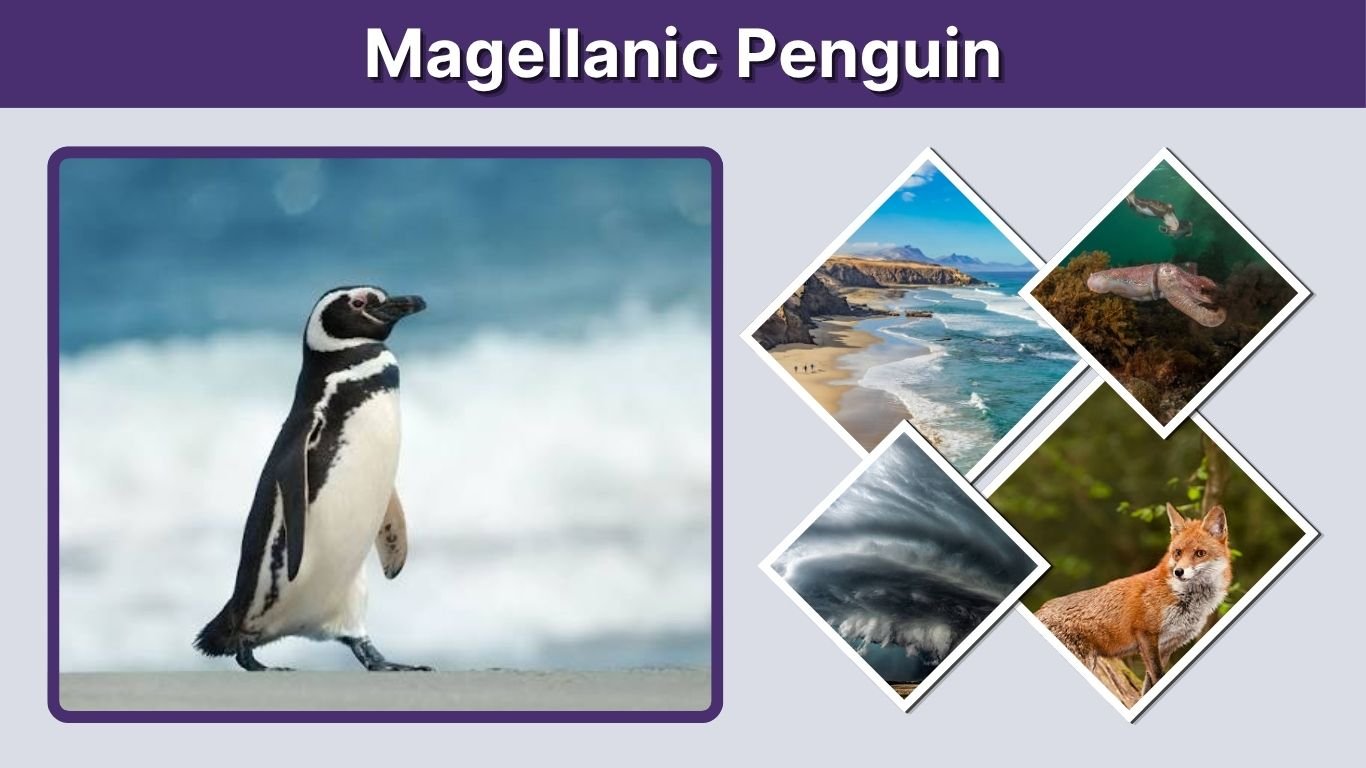
The Magellanic penguin (Spheniscus magellanicus) is a medium-sized penguin native to southern South America. Recognizable by the two dark bands across its white chest and the white stripe curving around its face, this species spends much of the year at sea but returns to coastal colonies to breed. Magellanic penguins live along Argentina, Chile, and the Falkland Islands, feeding mainly on fish and squid. Their burrowing nests, long seasonal migrations, distinctive calls, and ability to handle relatively warm climates make them fascinating seabirds.
What Is a Magellanic Penguin?
The Magellanic penguin belongs to the genus Spheniscus, a group of banded penguins that also includes African, Humboldt, and Galápagos penguins. Its name is connected with explorer Ferdinand Magellan’s 1520 voyage around southern South America. These birds are highly adapted to marine life but depend on land for nesting, raising chicks, resting, and completing their annual molt.
Scientific Name and Classification
The scientific name of the Magellanic penguin is Spheniscus magellanicus. It belongs to the family Spheniscidae and order Sphenisciformes.
Its common name reflects its association with the region explored during Magellan’s historic expedition. The species is one of the best-known penguins of Patagonia and forms enormous breeding colonies along suitable sections of the South American coastline.
What Does a Magellanic Penguin Look Like?
Adults have a black back, white underside, dark bill, and a distinctive white band running from above each eye around the side of the head.
The chest usually shows two dark bands, helping distinguish this species from some closely related penguins. Juveniles lack the fully developed adult facial and chest markings.
Magellanic Penguin Size and Characteristics
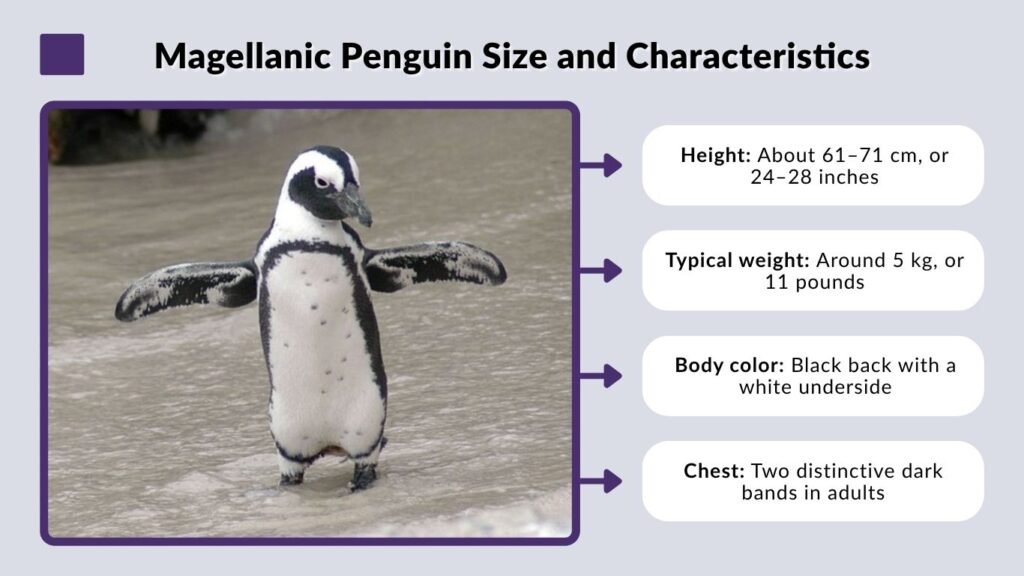
Magellanic penguins are considerably larger than little or fairy penguins but smaller than giants such as emperor penguins. Males and females look similar, although males tend to be somewhat larger. Their compact shape, powerful flippers, webbed feet, and streamlined feathers make them highly efficient swimmers, while their distinctive facial and chest patterns are useful for identification.
Magellanic Penguin Size
Typical physical characteristics include:
- Height: About 61–71 cm, or 24–28 inches
- Typical weight: Around 5 kg, or 11 pounds
- Body color: Black back with a white underside
- Chest: Two distinctive dark bands in adults
- Bill: Strong, dark bill
- Feet: Webbed and adapted for swimming
- Sex difference: Males are generally somewhat larger
Body weight changes during the year because penguins gain considerable reserves before periods such as molting.
How Does the Plumage Help?
The black back and white belly provide countershading. When viewed from above, the penguin’s dark back blends with deeper ocean water. From below, its pale belly is less obvious against the brighter surface.
Its dense feathers also provide insulation and create a waterproof outer layer, allowing the bird to spend long periods foraging in cold seawater.
Where Does the Magellanic Penguin Live?

The Magellanic penguin habitat is centered on the temperate coastlines and offshore waters of southern South America. Breeding colonies occur in Argentina, Chile, and the Falkland Islands, while birds spend much of the non-breeding season at sea. Their nesting habitat must provide access to productive ocean waters as well as suitable soil, vegetation, or sheltered sites for nests.
Breeding Habitat
During breeding season, Magellanic penguins use coastal grasslands, shrub-covered shorelines, cliff areas, and places where they can construct burrows.
Many pairs dig nests underground, while others nest beneath bushes or within naturally protected spaces. Their burrows provide shade and shelter against weather conditions and can help protect eggs and chicks.
Magellanic Penguins in Patagonia
Patagonia supports some of the species’ most famous colonies. Punta Tombo in Argentina is especially well known for large numbers of breeding penguins.
These colonies become extremely busy during breeding season, when adults return from the ocean to reclaim nesting territories, locate partners, incubate eggs, and raise chicks.
What Does a Magellanic Penguin Eat?
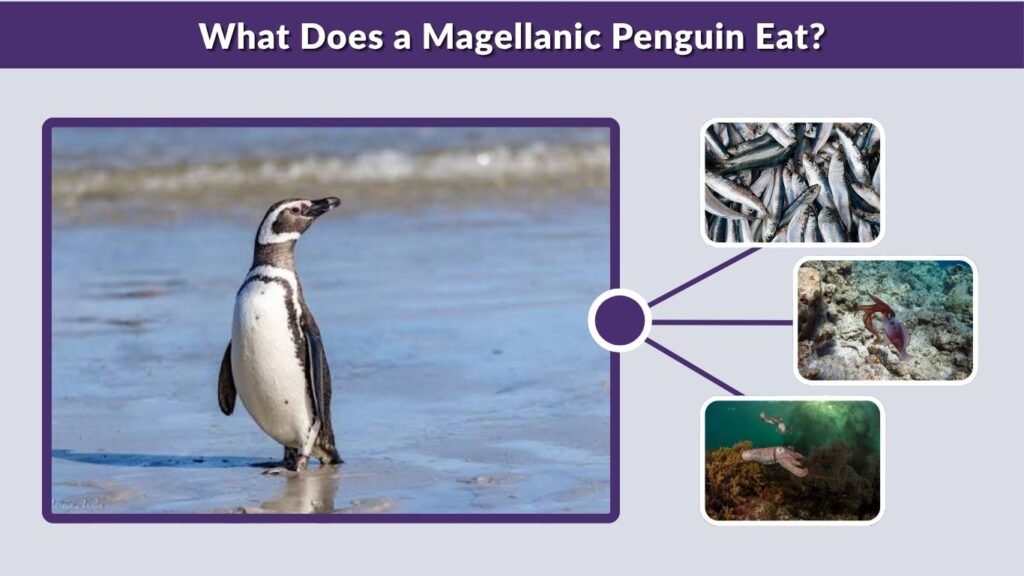
Magellanic penguins are marine predators whose diet changes according to location and available prey. Fish make up an important part of their food, but squid and other marine animals are also taken. Their streamlined bodies and strong flippers allow them to chase prey underwater efficiently, and recorded dives can exceed 76 meters while the birds search for food.
Magellanic Penguin Diet
Common foods include:
- Anchovies
- Small pelagic fish
- Sprats
- Squid
- Cuttlefish
- Other locally abundant marine prey
Northern colonies may depend heavily on anchovies, while birds from southern colonies can consume more squid and other fishes.
How Do They Hunt?
A Magellanic penguin uses its flippers almost like underwater wings. Instead of flying through air, it propels itself rapidly through water while using its feet and body to maneuver.
Excellent underwater vision helps it locate moving prey. Penguins may travel substantial distances from their breeding colonies when nearby waters do not provide enough food.
Magellanic Penguin Life Cycle and Chicks
Breeding is closely synchronized with seasonal conditions. Adults return to breeding colonies, establish or reclaim nests, pair, and share incubation responsibilities. Magellanic penguins commonly maintain pair bonds across multiple breeding seasons. Raising chicks is demanding because parents must balance protecting the nest with repeated feeding trips to sea.
Eggs and Incubation
A female commonly lays two eggs. Incubation lasts approximately 40–42 days, with both parents participating.
The adults alternate between guarding the eggs and feeding at sea. Burrows or covered nests help shield eggs from sun, wind, predators, and temperature extremes.
Magellanic Penguin Chicks
After hatching, chicks remain dependent on their parents for warmth and food. Adults feed them by regurgitating prey collected at sea.
The young are closely brooded during their earliest weeks. Later, parents make longer feeding trips as chicks grow. Fledging normally occurs at roughly 40–70 days, after which young birds enter the ocean and become increasingly independent.
Magellanic Penguin Migration and Behavior
Magellanic penguins are highly migratory. Their annual schedule alternates between a breeding period on land and months spent almost entirely at sea. Once breeding and molting are complete, adults and juveniles move north with productive ocean currents. Some individuals travel hundreds of kilometers offshore while searching for food during the non-breeding season.
Seasonal Migration
After leaving breeding grounds, birds generally migrate northward along the South American coastline.
Some Atlantic populations can reach waters much farther north than their nesting colonies. During this marine phase, they live a largely pelagic lifestyle and may forage 100–1,000 km offshore.
Calls and Colony Behavior
Magellanic penguins are vocal birds. Their calls have sometimes been compared with donkey-like braying.
Calls help adults communicate with mates and neighboring birds in densely populated colonies. Males may also become territorial around their nests and engage in confrontations with rivals.
Predators, Adaptations and Threats
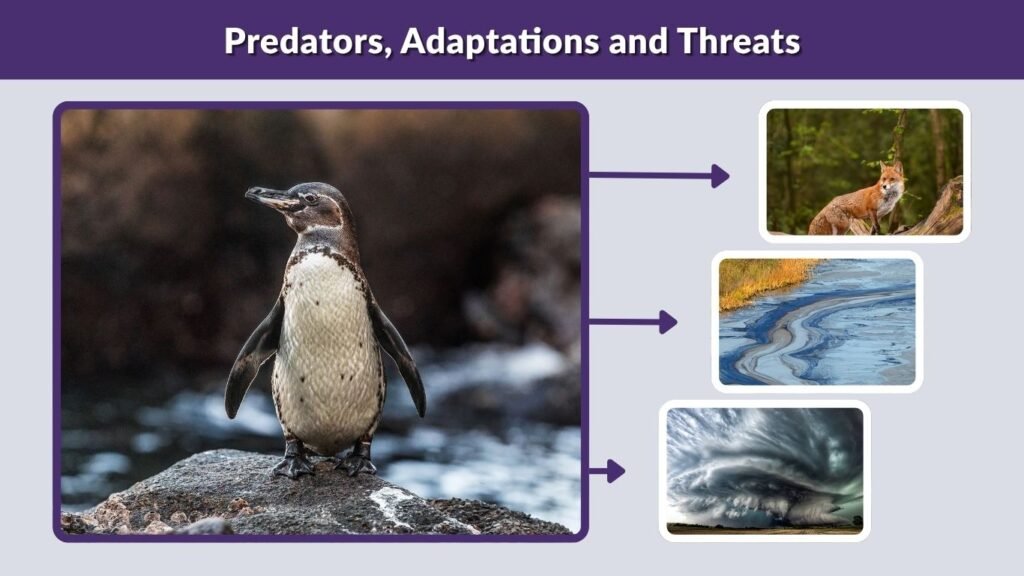
Life presents very different dangers on land and at sea. Eggs and chicks are vulnerable to terrestrial and aerial predators, while adults may be hunted by large marine animals. Magellanic penguins also face human-related pressures such as fishing interactions and marine pollution. Several physical and behavioral adaptations help them survive in their challenging coastal and ocean environment.
Predators and Threats
Known predators and risks include:
- Kelp gulls that take eggs and small chicks
- Foxes that prey on penguins on land
- Giant petrels
- South American sea lions
- Orcas
- Accidental capture in fishing gear
- Oil pollution
- Changes in food availability
- Climate and weather extremes
Different predators affect penguins at different stages of their lives.
Adaptations for Warmer Conditions
Unlike penguins that spend their lives in extreme Antarctic cold, Magellanic penguins breed in temperate environments and can experience surprisingly warm weather.
When overheated, they may raise or extend their flippers to expose more surface area to moving air, helping release body heat. Burrows also offer valuable protection from high temperatures.
Magellanic Penguin Lifespan and Conservation
Magellanic penguins can survive for decades, although young birds face considerable mortality during their first ocean migrations. Their long lifespan helps support established breeding pairs that may return repeatedly to familiar colonies. Despite large numbers overall, the species continues to face pressures from fisheries, pollution, climate variation, and changing ocean conditions.
How Long Does a Magellanic Penguin Live?
Estimates vary among references. Animal Diversity Web reports a typical wild lifespan of approximately 25–30 years, while SeaWorld gives a general lifespan of about 15–20 years. Differences reflect the difficulty of following wild individuals throughout their lives and variation between populations.
Is the Magellanic Penguin Endangered?
The species is currently classified as Near Threatened, rather than Endangered, in BirdLife International’s penguin species listing.
This means conservation remains important. Bycatch in fishing operations, pollution, changes in prey distribution, and climate-related environmental changes can affect colonies even when the global population remains comparatively large.
FAQs
Magellanic penguins are among South America’s most recognizable seabirds, yet their migration, appearance, lifespan, and nesting habits often cause questions. Their distinctive chest bands and burrowing behavior separate them from many other penguins, while their long-distance movements make them especially interesting to researchers studying how marine birds respond to changing ocean conditions.
1. Where does the Magellanic penguin live?
Magellanic penguins breed primarily along the coasts of Argentina and Chile and on the Falkland Islands. Outside the breeding season, they migrate through coastal and offshore waters of South America.
2. What does a Magellanic penguin eat?
Its diet consists mainly of small fish along with squid and other marine prey. The exact diet varies according to the location of the colony and seasonal food availability.
3. How tall is a Magellanic penguin?
An adult is generally about 61–71 cm (24–28 inches) tall and commonly weighs around 5 kg or 11 pounds.
4. Why is it called a Magellanic penguin?
The name is associated with Ferdinand Magellan’s expedition, during which European accounts of these South American penguins were recorded in 1520.
5. What is the Magellanic penguin’s conservation status?
BirdLife International currently lists the Magellanic penguin as Near Threatened. Conservation concerns include fishing-related mortality, pollution, environmental variation, and changes affecting marine food resources.