
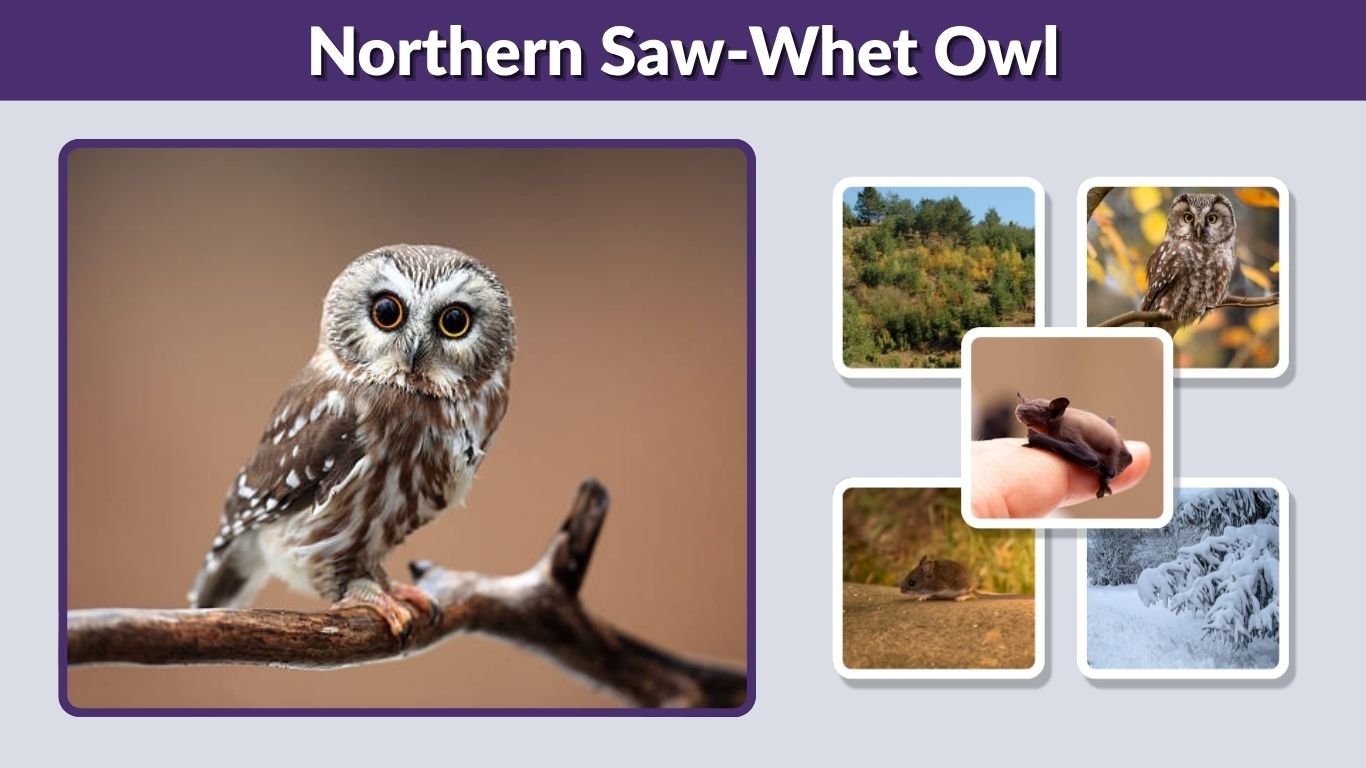
The Northern Saw-whet Owl is one of North America’s smallest and most secretive owls. Its oversized yellow eyes, rounded head, spotted brown feathers, and catlike face give it a distinctive appearance. Although these owls are widespread, they are difficult to observe because they hunt at night and hide inside thick vegetation during the day. Their scientific name is Aegolius acadicus.
Northern Saw-Whet Owl Quick Facts
Northern Saw-whet Owls are compact forest birds about the size of a robin. Their small bodies allow them to move easily through dense branches while searching for mice and other prey.
| Feature | Northern Saw-Whet Owl |
| Scientific name | Aegolius acadicus |
| Family | Strigidae |
| Length | 7.1–8.3 inches |
| Weight | 2.3–5.3 ounces |
| Wingspan | 16.5–18.9 inches |
| Eye color | Yellow |
| Active period | Primarily nighttime |
| Main food | Mice, voles and shrews |
| Clutch size | 4–7 eggs |
| Conservation status | Least Concern |
Northern Saw-whet Owls measure approximately 7.1–8.3 inches long, weigh 2.3–5.3 ounces, and have a wingspan of 16.5–18.9 inches. Females are usually larger and heavier than males.
Northern Saw-Whet Owl Identification
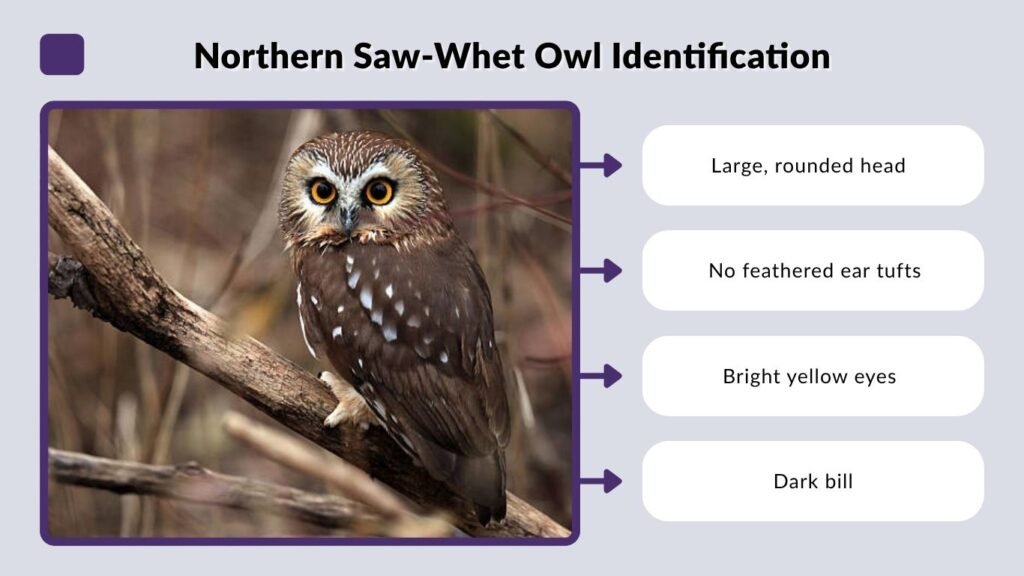
The owl’s small size and lack of visible ear tufts help distinguish it from many other species. However, its brown-and-white plumage provides excellent camouflage against tree bark and evergreen branches.
Physical Characteristics
- Large, rounded head
- No feathered ear tufts
- Bright yellow eyes
- Dark bill
- Whitish facial disc
- White eyebrows forming a Y-shaped pattern
- Brown upperparts with white spots
- White chest with reddish-brown streaks
- Short tail
- Feather-covered legs and feet
Adults have finely streaked crowns and white-spotted wings and backs. Their pale facial discs are bordered by brown feathers, creating an alert, wide-eyed expression.
Juvenile Northern Saw-Whet Owl
Juveniles look noticeably different from adults. A young Northern Saw-whet Owl has a dark chocolate-brown head and back with a cinnamon, creamy yellow, or orange-buff chest. It has pale eyebrows but lacks the extensive head streaking and back spotting of an adult.
As the juvenile molts, it gradually develops the spotted brown upperparts and vertically streaked white underparts associated with mature birds.
How Big Is a Northern Saw-Whet Owl?
A Northern Saw-whet Owl is approximately robin-sized, although it appears rounder because of its thick feathers and large head. It is smaller than an Eastern Screech-Owl and generally smaller than a Boreal Owl.
| Measurement | Typical Range |
| Body length | 7.1–8.3 inches |
| Weight | 2.3–5.3 ounces |
| Wingspan | 16.5–18.9 inches |
| Metric length | 18–21 centimeters |
| Metric wingspan | 42–48 centimeters |
Females may be large enough to be distinguished from males through a combination of weight and wing measurements. However, birds with intermediate measurements can be difficult to sex accurately without detailed examination.
Northern Saw-Whet Owl Call and Sounds
The Northern Saw-whet Owl is often detected by its voice long before it is seen. Males become particularly vocal during the late winter and spring breeding season.
Main Whistling Call
The best-known Northern Saw-whet Owl call is a steady series of high, whistled “too-too-too” notes. The notes remain at roughly the same pitch and are delivered at approximately two notes per second.
A territorial male may repeat this whistle for long periods, and the sound can carry up to half a mile under favorable conditions. Females produce a version of the song during courtship.
Other Northern Saw-Whet Owl Sounds
Northern Saw-whet Owls also make:
- High-pitched barks
- Squeaks
- Whining calls
- Guttural notes
- Sharp “tssst” calls
- Bill-snapping sounds
The sharp “tssst” call is often associated with communication between females and males during courtship. An owl that feels threatened may snap its bill as a warning.
The species may have received its name because one of its calls reminded early listeners of a saw being sharpened on a whetstone, although there is no complete agreement about which sound inspired the name.
Northern Saw-Whet Owl Habitat and Range
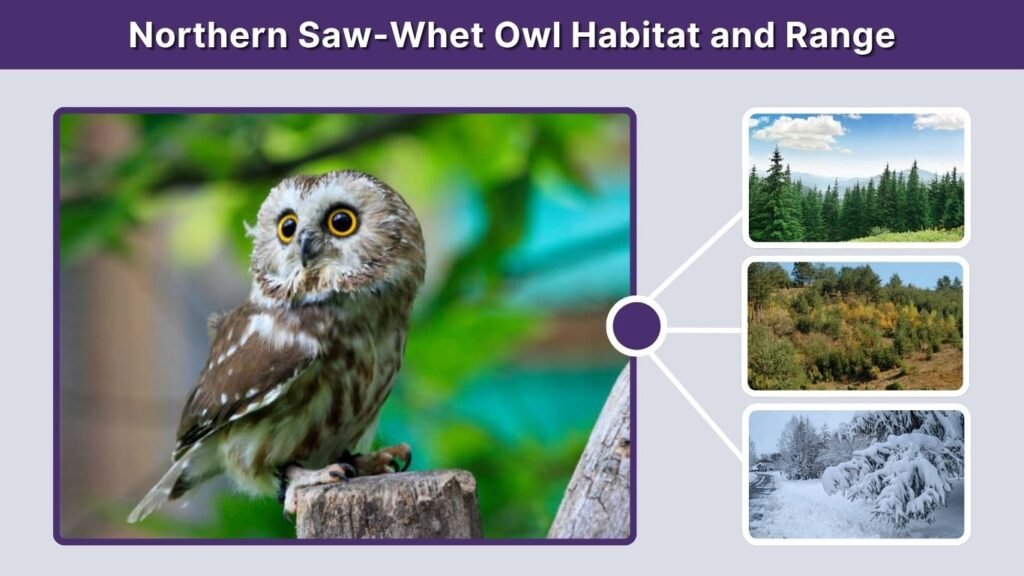
Northern Saw-whet Owls are woodland birds that need sheltered daytime roosts, suitable nesting cavities, and open spaces where they can hunt.
Where Do Northern Saw-Whet Owls Live?
Their breeding range covers much of southern Canada and the northern and western United States, extending south through mountainous areas into central Mexico. Some populations remain in the same general region throughout the year, while others move south for winter.
Suitable habitats include:
- Spruce and fir forests
- Pine woodlands
- Cedar swamps
- Mixed deciduous-coniferous forests
- Riverside woods
- Aspen groves
- Shrub-steppe with nesting trees
- Dense suburban conifers
They appear to benefit from mature forests containing open understories for hunting, deciduous trees or dead snags for nesting, and dense evergreens for daytime shelter.
Daytime Roosting
During daylight, Northern Saw-whet Owls sit quietly inside thick conifers or tangled vegetation. They often perch close to the trunk and may roost only a short distance above eye level. Their small size and motionless posture make them extremely difficult to notice.
Northern Saw-Whet Owl Migration
Northern Saw-whet Owls can be permanent residents, short-distance migrants, or long-distance migrants. Many move southward or descend from mountains during autumn, while others remain near their breeding territories throughout winter. Migration takes place mainly at night.
Approximately every four years, unusually large numbers may move south in an event called an irruption. These movements are thought to be connected to breeding success and changing prey availability in northern forests. Migrating individuals can cross large bodies of water, including parts of the Great Lakes.
Banding stations capture, measure, mark, and release migrating saw-whets, helping researchers understand their routes, ages, population cycles, and differences between male and female migration.
What Do Northern Saw-Whet Owls Eat?
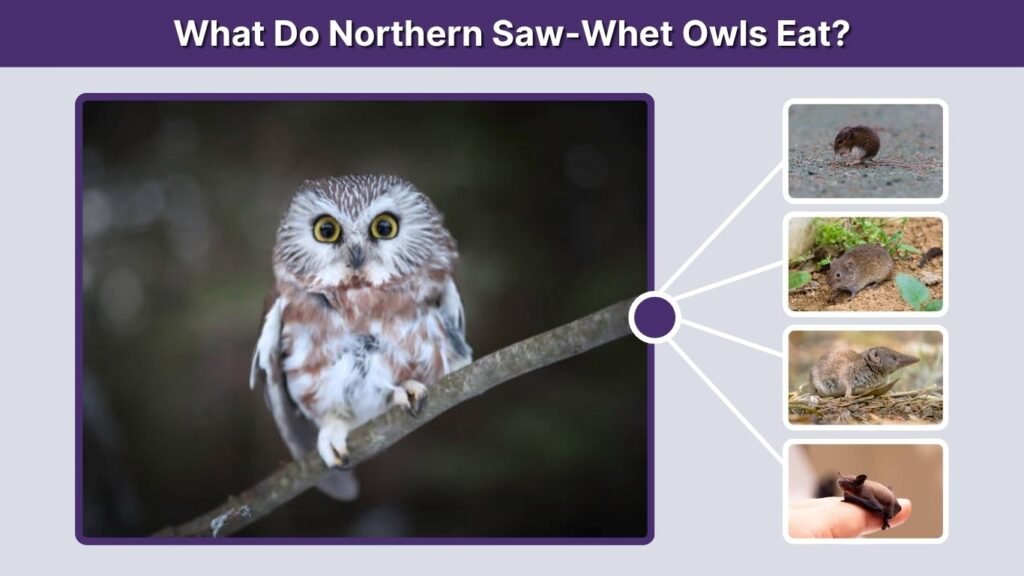
Northern Saw-whet Owls mainly eat small mammals. They hunt from low perches at night, listening and watching for movement before flying down to seize prey with their talons.
Common Foods
- Deer mice
- White-footed mice
- Voles
- Shrews
- Harvest mice
- Jumping mice
- Small bats
- Young squirrels and chipmunks
- Small songbirds
- Beetles, moths and grasshoppers
Mice are among their most important foods. During migration, the owls may take more birds, including chickadees, sparrows, kinglets, juncos, wrens, warblers and thrushes. Coastal individuals sometimes consume small intertidal invertebrates.
Northern Saw-Whet Owl Nesting and Life Cycle
Northern Saw-whet Owls do not excavate their own nesting holes or construct conventional nests. Instead, they use natural tree hollows, abandoned woodpecker cavities, and properly designed nest boxes.
Nest, Eggs and Young
Females probably make the final nest-site selection. Common sites include former Northern Flicker and Pileated Woodpecker holes in dead or damaged trees. Eggs are laid directly on existing wood chips, moss, hair, bones, or other debris inside the cavity.
A typical clutch contains four to seven smooth white eggs. Incubation lasts approximately 26–29 days, and the young remain in the nest for about 27–34 days. Newly hatched owlets have closed eyes and are covered with white down.
Nest boxes may help where natural cavities are scarce, but they should be installed in suitable wooded habitat using species-appropriate measurements.
Northern Saw-Whet Owl Adaptations and Behavior
Several adaptations allow this tiny owl to hunt efficiently in dark, densely wooded habitats.
Adaptations for Survival
- Facial disc: Channels faint sounds toward the ears.
- Sensitive hearing: Helps locate prey in darkness and thick vegetation.
- Large eyes: Improve vision under low-light conditions.
- Soft flight feathers: Reduce wing noise when approaching prey.
- Camouflaged plumage: Conceals the owl against bark and foliage.
- Feathered feet: Provide warmth and help protect the legs.
- Compact body: Makes movement through dense forest easier.
Northern Saw-whet Owls are mostly solitary outside the breeding period. They may remain remarkably still when approached, but this behavior should not be mistaken for tameness. Wild owls need space and should not be disturbed at their daytime roosts.
Northern Saw-Whet Owl vs Similar Owls
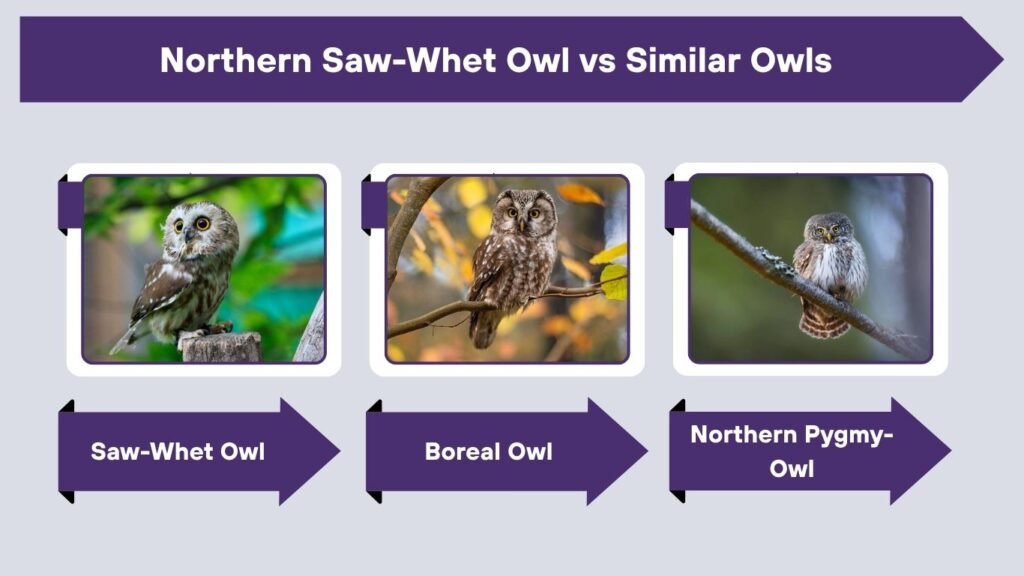
| Feature | Saw-Whet Owl | Boreal Owl | Northern Pygmy-Owl |
| Length | 7.1–8.3 inches | 8.3–11 inches | 6.3–7.1 inches |
| Head | Rounded | Large and square | Round with longer tail |
| Bill | Dark | Yellowish | Yellow |
| Facial border | Soft brown pattern | Bold dark outline | No strong facial disc |
| Activity | Mainly nocturnal | Mainly nocturnal | Often hunts by day |
| Main call | Repeated even whistles | Short accelerating hoots | Series of hollow toots |
The Boreal Owl is larger, grayer, and more heavily outlined around the face. The Northern Pygmy-Owl has a longer tail, yellow bill, dark false eyespots behind its head, and regularly hunts during daylight.
Predators and Conservation
Larger owls and hawks prey on Northern Saw-whet Owls. Known predators include Great Horned Owls, Eastern Screech-Owls, Spotted Owls, Cooper’s Hawks, Broad-winged Hawks, and Peregrine Falcons.
The species is classified as Least Concern and remains widespread, although its nocturnal and secretive behavior makes population trends difficult to measure. Protecting mature woodland, dense roosting cover, and cavity-bearing trees helps preserve essential habitat.
FAQs
How long do Northern Saw-Whet Owls live?
Many young owls do not survive their first years, but individuals can live much longer. The U.S. Bird Banding Laboratory lists a female that was at least 14 years and 5 months old when recaptured alive in Pennsylvania.
Do Northern Saw-Whet Owls come out during the day?
They normally hunt at night and rest during daylight. A person may occasionally see one during the day, especially when songbirds discover and mob an owl hidden inside a conifer. Daytime activity may also occur when an owl is disturbed.
Are Northern Saw-Whet Owls endangered?
The Northern Saw-whet Owl is not currently considered globally endangered and is classified as Least Concern. However, protecting forest habitat, nesting cavities, and migration stopovers remains important because its secretive nature makes long-term population changes difficult to track.
Can Northern Saw-Whet Owls be kept as pets?
Northern Saw-whet Owls are wild raptors rather than domestic pets. Their specialized diet, nocturnal behavior, need for flight, and legal protection make private ownership inappropriate and generally unlawful without the required wildlife permits.
Why do Northern Saw-Whet Owls whistle at night?
Males whistle repeatedly to advertise territories and attract females during the breeding season. The familiar call consists of evenly spaced “too-too-too” notes. Other males may answer with a softer and faster version, while females also vocalize during courtship.