
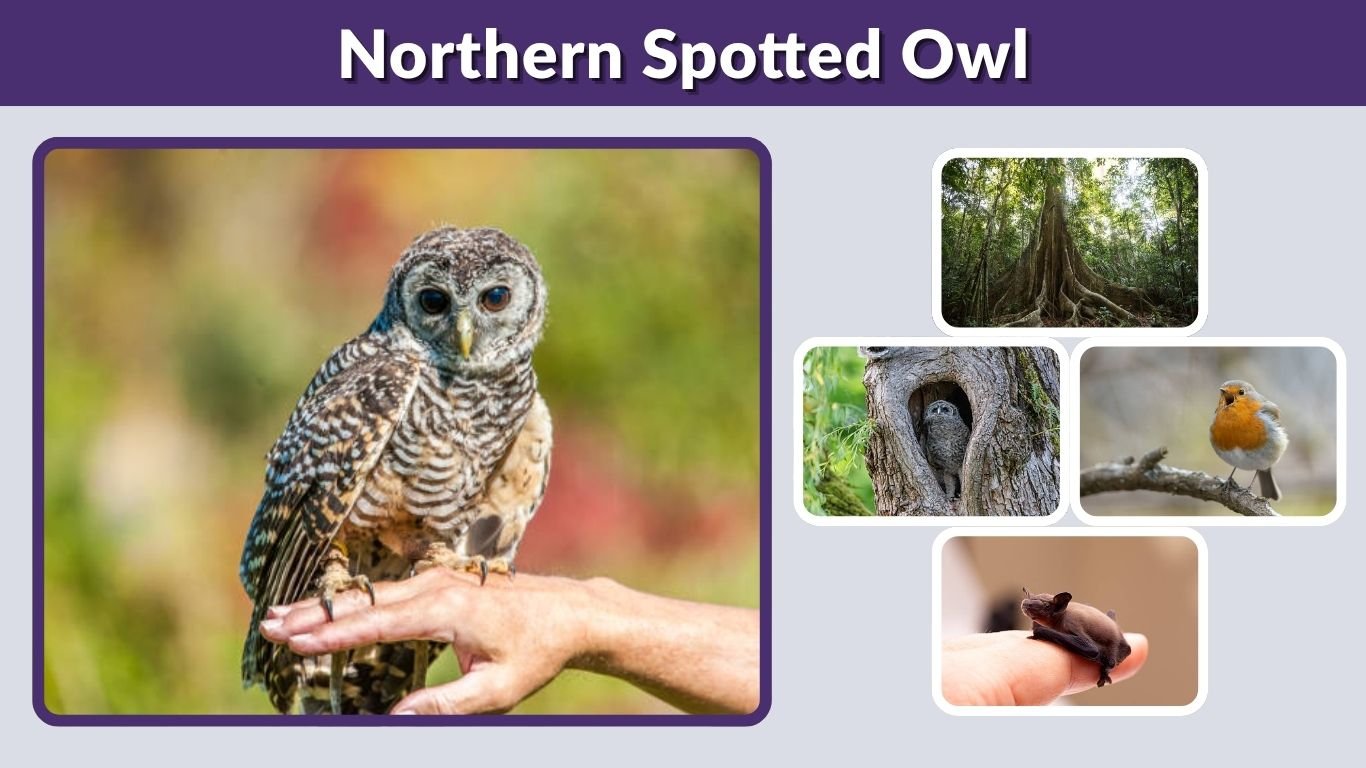
The northern spotted owl is a rare forest owl of the Pacific Northwest. Known for its dark eyes, chocolate-brown feathers and white spots, it depends heavily on mature forests with large trees and complex vegetation. Although it remains federally classified as threatened in the United States, its population continues to decline because of habitat loss and competition from invasive barred owls.
Northern Spotted Owl Quick Facts
The northern spotted owl is the largest of the three recognized spotted owl subspecies. It is a long-lived bird with high adult survival, slow reproduction and strong parental care. These traits make population recovery difficult when adult numbers decline.
| Feature | Information |
| Common name | Northern spotted owl |
| Scientific name | Strix occidentalis caurina |
| Family | Strigidae |
| Length | About 18.5–18.9 inches |
| Wingspan | About 39.8 inches |
| Weight | Around 17.6–24.7 ounces |
| Main diet | Flying squirrels, woodrats, mice and voles |
| Habitat | Mature and old-growth forests |
| Range | British Columbia to northern California |
| U.S. federal status | Threatened |
The measurements above refer to spotted owls generally and can vary by sex and regional population. Females are usually heavier than males, even though both sexes have similar plumage.
Northern Spotted Owl Identification
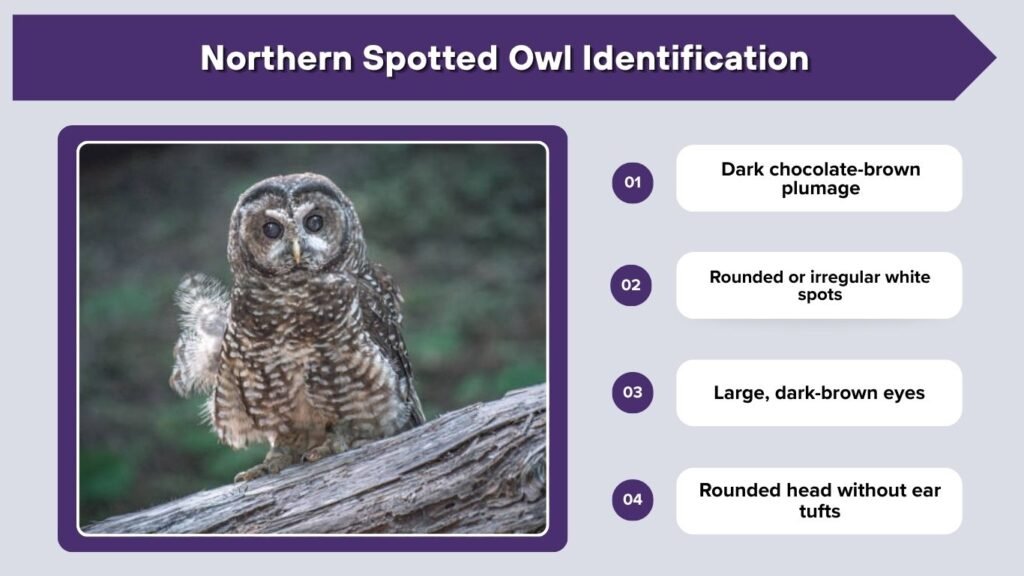
Northern spotted owls are medium-to-large owls with rounded heads, broad wings and short tails. They lack the pointed feather tufts seen on great horned and long-eared owls.
Key Characteristics
- Dark chocolate-brown plumage
- Rounded or irregular white spots
- Large, dark-brown eyes
- Rounded head without ear tufts
- Pale markings around the facial disc
- White spotting across the chest and belly
- Brown-and-white barred tail
- Broad, rounded wings
Northern spotted owls are generally darker than the California and Mexican spotted owl subspecies. Their dark feathers provide effective camouflage among shadows, moss, bark and dense forest vegetation.
Northern Spotted Owl Size
An adult spotted owl measures approximately 18.5 to 18.9 inches long, weighs around 17.6 to 24.7 ounces and has a wingspan close to 40 inches. It is slightly larger than an American crow but somewhat smaller than a barred owl.
Where Do Northern Spotted Owls Live?
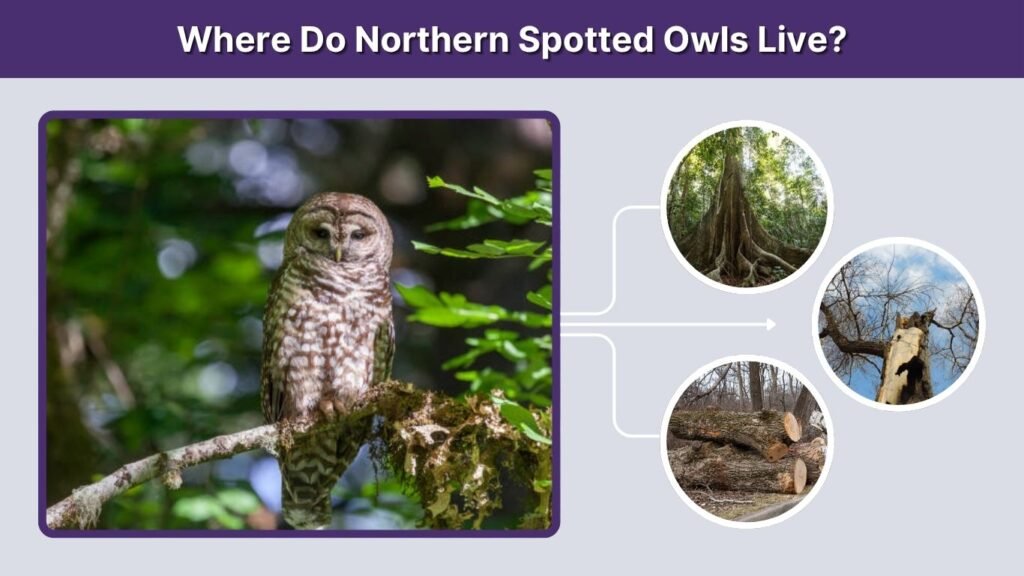
Northern spotted owls occur along the Pacific Coast of North America. Their range extends from southwestern British Columbia through western Washington and Oregon into northern California. They do not normally migrate long distances, although young owls may disperse while searching for unoccupied territory.
Preferred Habitat
The species is strongly associated with extensive mature and old-growth forests. Suitable habitat typically contains:
- Large, old trees
- Broken tree tops and natural cavities
- Standing dead trees
- Fallen logs and woody debris
- Dense, multilayered canopies
- Open spaces beneath the canopy for hunting
- Healthy populations of small mammals
At Mount Rainier, typical habitat includes forests dominated by old Douglas fir, western hemlock and western red cedar. Some stands used by the owls contain trees more than 200 years old.
Northern spotted owls may hunt in some previously logged forests when enough large trees and canopy cover remain. However, they usually avoid extensive clear-cuts, recently logged land and large areas of low brush.
What Do Northern Spotted Owls Eat?
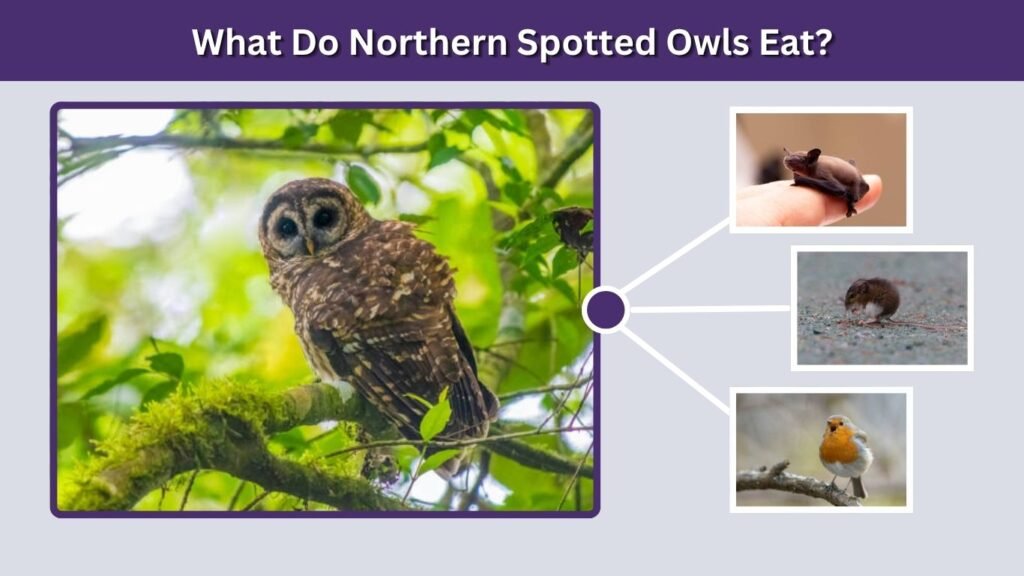
Northern spotted owls are nocturnal predators that primarily eat small forest mammals. The most important prey animals vary across their range according to elevation, forest type and local availability.
Common Foods
Their diet includes:
- Northern flying squirrels
- Dusky-footed woodrats
- Deer mice
- Voles
- Pocket gophers
- Shrews
- Small rabbits
- Bats
- Small birds
- Insects and reptiles
Flying squirrels are especially important in northern forests, while woodrats often dominate the diet in parts of Oregon and California. In Marin County, studies found that woodrats, brush rabbits, mice, voles and pocket gophers accounted for most recorded prey.
Hunting Behavior
The owl normally waits quietly on a branch and listens for movement below. After detecting an animal, it swoops from its perch and captures the prey with its talons. It can also fly slowly through the forest while searching for food.
Northern spotted owls occasionally store uneaten prey beneath logs, among rocks or on moss-covered branches. This behavior allows them to return to the food later, especially when hunting is successful.
What Does a Northern Spotted Owl Sound Like?
The northern spotted owl produces several hoots, whistles and barking calls. Its best-known territorial call consists of four clear hooted notes, with the middle two notes delivered close together.
Both males and females use this call to defend territory and communicate. Male calls are generally deeper, while female calls are slightly higher. Pairs may also make rising whistles, and young owls produce high-pitched begging calls when requesting food.
Nesting and Life Cycle
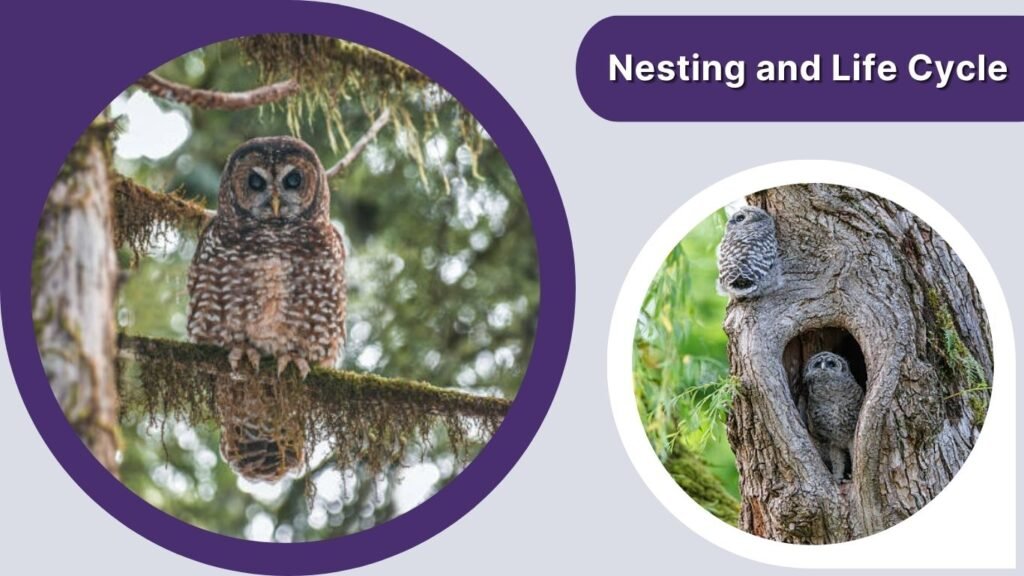
Northern spotted owls do not construct traditional stick nests. They usually nest in large tree cavities, broken tree tops, abandoned raptor nests or natural platforms formed by accumulated debris.
The female generally lays one to four eggs. She performs most of the incubation while the male hunts and delivers food. Young owls may leave the nest and climb onto nearby branches before they can fly properly, a behavior known as branching.
Spotted owls may not reproduce every year. Breeding success depends partly on food availability, weather, habitat quality and disturbance. Their low reproductive rate means populations cannot quickly replace adults that die or disappear.
Why Is the Northern Spotted Owl Endangered?
The northern spotted owl is currently listed as threatened, rather than endangered, under the U.S. Endangered Species Act. It received federal protection in 1990. In 2020, the U.S. Fish and Wildlife Service determined that changing its status to endangered was scientifically warranted but prevented at that time by other higher-priority listing actions.
Loss of Old-Growth Forest
Logging, development and other land changes have removed or fragmented much of the owl’s mature forest habitat. Habitat fragmentation can separate nesting areas, reduce prey populations and force owls to cross open land they normally avoid.
Competition With Barred Owls
Barred owls expanded into the Pacific Northwest from eastern North America. They are larger, more aggressive and more adaptable than northern spotted owls. They also use a wider range of habitats and foods.
Barred owls compete for nesting territories and prey, disrupt spotted owl reproduction and sometimes kill or interbreed with spotted owls. They now outnumber northern spotted owls in many parts of the spotted owl’s range.
Declining Population
A range-wide study using 26 years of information from 11 study areas found annual population declines of approximately 2% to 9%. In seven study areas, no more than 35% of the populations recorded in 1995 remained.
There is no dependable single count showing exactly how many northern spotted owls remain across their entire range. Researchers instead monitor occupied territories, survival, reproduction and detections over time. The available results show a severe continuing decline.
Northern Spotted Owl vs. Barred Owl
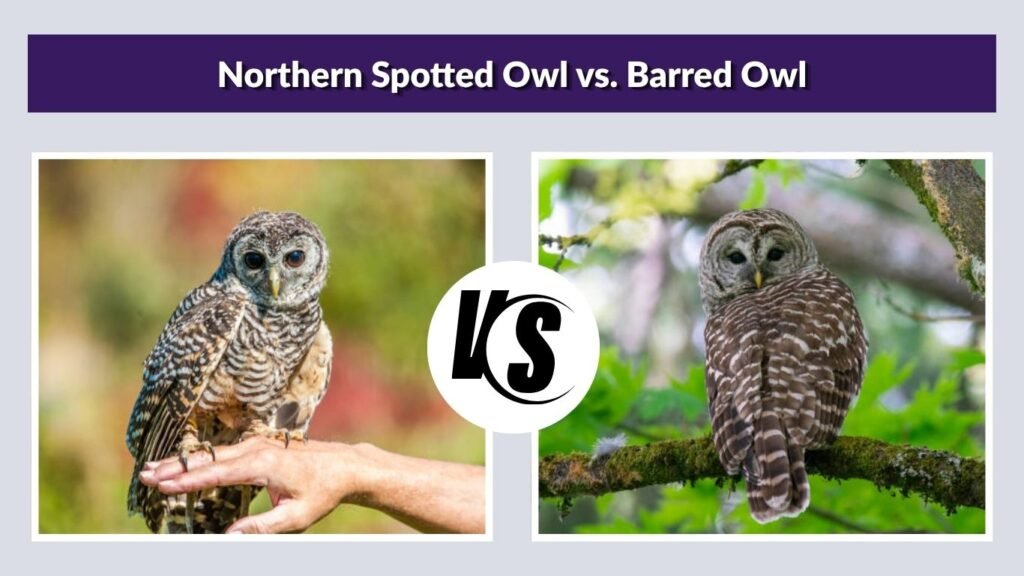
These two forest owls can appear similar, but several features help distinguish them.
| Feature | Northern Spotted Owl | Barred Owl |
| Eyes | Dark brown | Dark brown |
| Plumage | White spots on brown feathers | Vertical and horizontal barring |
| Size | Slightly smaller | Slightly larger |
| Main call | Four-note territorial hoot | Repeated rhythmic hooting |
| Habitat | Strongly associated with mature forests | Uses a wider variety of forests |
| Behavior | Less aggressive | More adaptable and aggressive |
The spotted owl usually has obvious rounded white spots, while the barred owl shows stronger streaks and bars. Location alone is becoming less reliable because barred owls now occupy much of the northern spotted owl’s historic range.
Northern Spotted Owl Conservation
Conservation efforts include protecting mature forests, restoring habitat, monitoring owl territories and limiting disturbances near active nests. The U.S. Fish and Wildlife Service adopted a barred owl management strategy in 2024 after experiments showed that reducing barred owl numbers could improve northern spotted owl survival and stabilize local populations.
Successful recovery will likely require both long-term forest protection and targeted management of barred owls. Addressing only one threat may not be enough to reverse population declines throughout the owl’s range.
FAQs
Is the northern spotted owl endangered?
The northern spotted owl is federally listed as threatened in the United States. However, wildlife officials previously determined that endangered status was warranted because of continuing population declines, habitat loss and pressure from barred owls.
How many northern spotted owls are left?
Scientists do not have a precise range-wide count. The owls live in remote forests and are difficult to survey consistently. Long-term monitoring shows substantial declines, with some study populations losing more than half their earlier numbers.
What is the northern spotted owl’s scientific name?
Its scientific name is Strix occidentalis caurina. It is one of three spotted owl subspecies, alongside the California spotted owl and Mexican spotted owl.
What animals prey on northern spotted owls?
Great horned owls and barred owls may kill spotted owls, while eggs and young can be vulnerable to forest predators. Habitat fragmentation can increase risk by forcing young or displaced owls into unfamiliar and less-protected areas.
Why is the northern spotted owl important?
The owl is considered an indicator of mature forest conditions because it depends on large trees, complex canopies and healthy forest food webs. Protecting its habitat can also conserve many other plants and animals that depend on older Pacific Northwest forests.
