
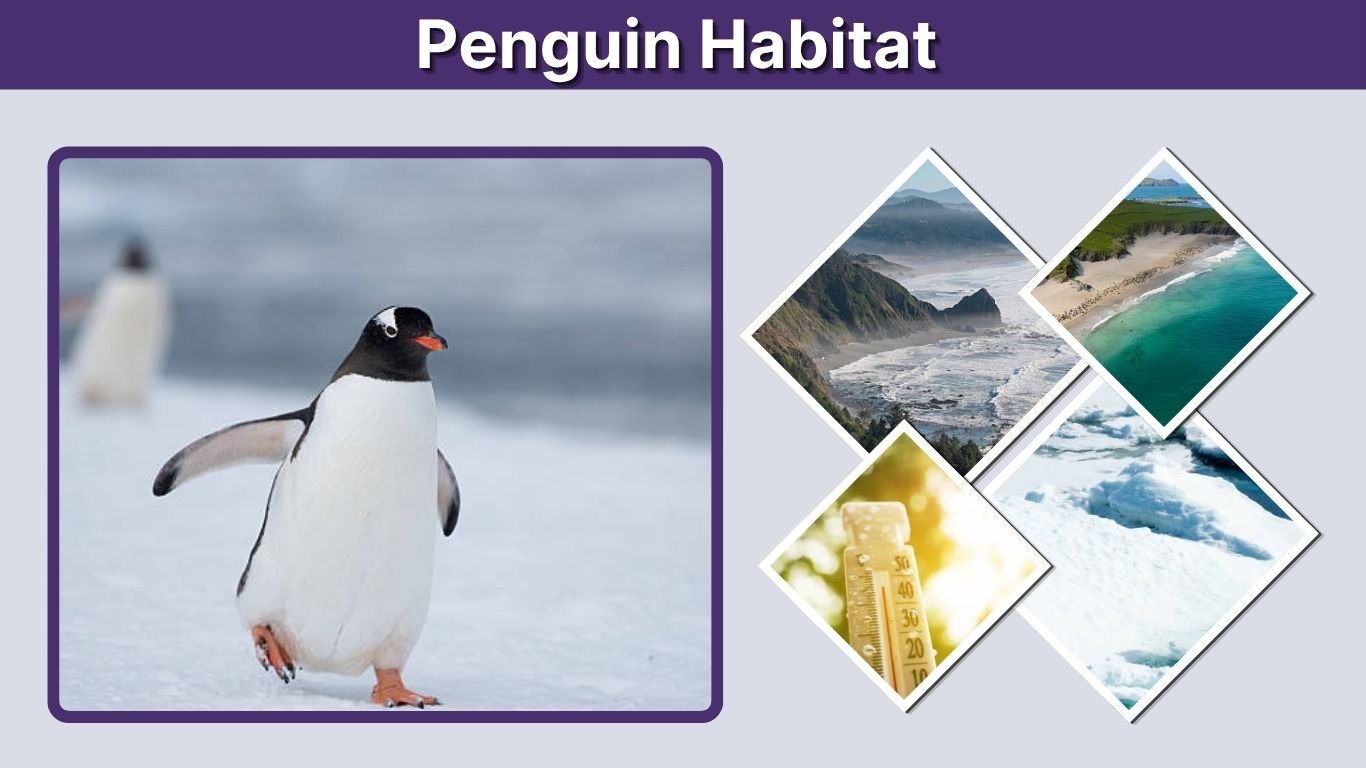
A penguin habitat can range from frozen Antarctic sea ice to rocky islands, sandy African beaches, coastal forests, and even the volcanic Galápagos Islands. Penguins are found naturally in the Southern Hemisphere, with different species adapted to very different climates. Some depend heavily on sea ice, while others live in temperate or relatively warm coastal regions. Understanding where penguins live, how their habitats differ, and which environmental features they need helps explain their remarkable adaptations, feeding behavior, breeding strategies, and conservation challenges.
Where Do Penguins Live?
Penguins occur naturally throughout much of the Southern Hemisphere. Although Antarctica contains some of the most famous species, penguins also inhabit sub-Antarctic islands, South America, southern Africa, Australia, New Zealand, and the Galápagos Islands. Most species depend on productive marine waters for feeding and use nearby coastlines, islands, rocks, beaches, or ice for breeding and resting.
Main Penguin Habitat Locations
Important penguin regions include:
- Antarctica
- Antarctic Peninsula
- Sub-Antarctic islands
- Southern South America
- Peru and Chile
- Southern Africa
- Australia
- New Zealand
- Galápagos Islands
- Southern Atlantic and Indian Ocean islands
The greatest concentrations occur around Antarctic and sub-Antarctic environments, but the penguin family occupies a much wider range than icy landscapes alone suggest.
Do Penguins Live in the Arctic?
No wild penguin species naturally lives in the Arctic.
Penguins evolved in the Southern Hemisphere, while polar bears, Arctic foxes, walruses, and many northern seabirds belong to northern polar ecosystems.
This means wild polar bears and penguins do not naturally share the same habitat, despite often appearing together in cartoons and decorations.
What Does a Penguin Habitat Look Like?
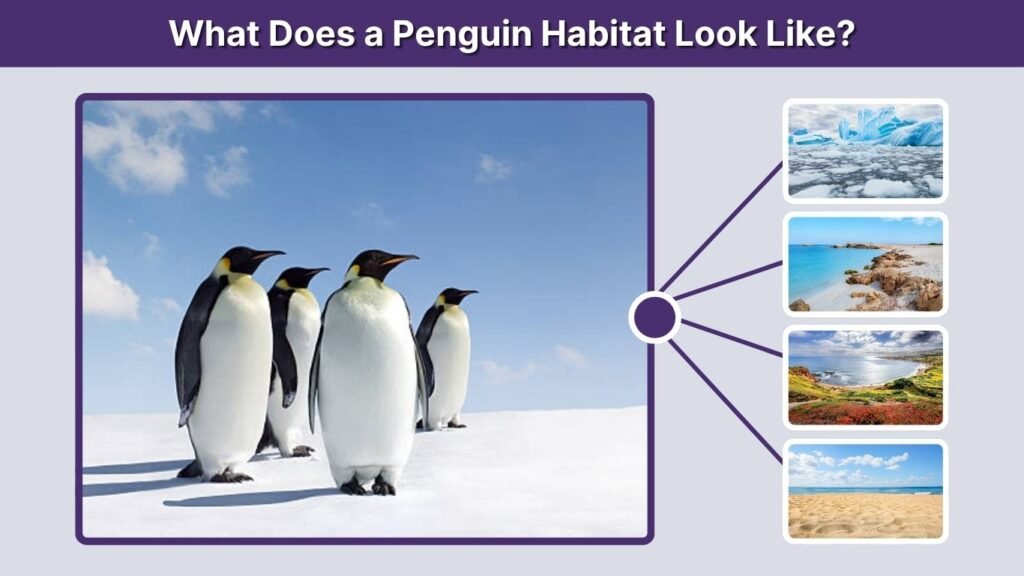
A suitable penguin habitat must provide access to marine food and a safe place for resting, molting, and breeding. The exact environment varies dramatically by species. Some penguins nest on exposed rock, while others use burrows, vegetation, beaches, or sea ice. The ocean is equally important because penguins spend much of their lives swimming and searching for prey.
Important Habitat Features
Depending on the species, penguin habitats may contain:
- Sea ice
- Open ocean
- Rocky coastlines
- Pebble beaches
- Cliffs and caves
- Burrows
- Coastal grassland
- Temperate forest
- Sandy beaches
- Offshore islands
- Nutrient-rich feeding waters
Ocean Habitat
Penguins are highly adapted marine birds rather than purely land animals.
Their streamlined bodies, stiff flippers, waterproof feathers, and insulating fat enable them to spend substantial periods in the ocean. Penguins generally feed on fish, krill, squid, and other marine prey, making productive ocean habitats essential to their survival.
Emperor Penguin Habitat
The emperor penguin inhabits Antarctica and is among the species most strongly associated with sea ice. Unlike most birds, emperor penguins breed during the Antarctic winter, enduring exceptionally low temperatures and powerful winds. Stable coastal fast ice is especially important because breeding colonies need ice that remains intact long enough for chicks to develop before entering the ocean.
Where Emperor Penguins Live
Emperor penguin colonies occur around the Antarctic coastline.
During breeding, adults often gather on fast ice attached to the coastline or grounded ice features. Their feeding grounds are in surrounding Southern Ocean waters.
Because their life cycle depends so strongly on sea-ice timing, changes in ice conditions can directly affect breeding success.
Adélie, Chinstrap and Gentoo Penguin Habitats
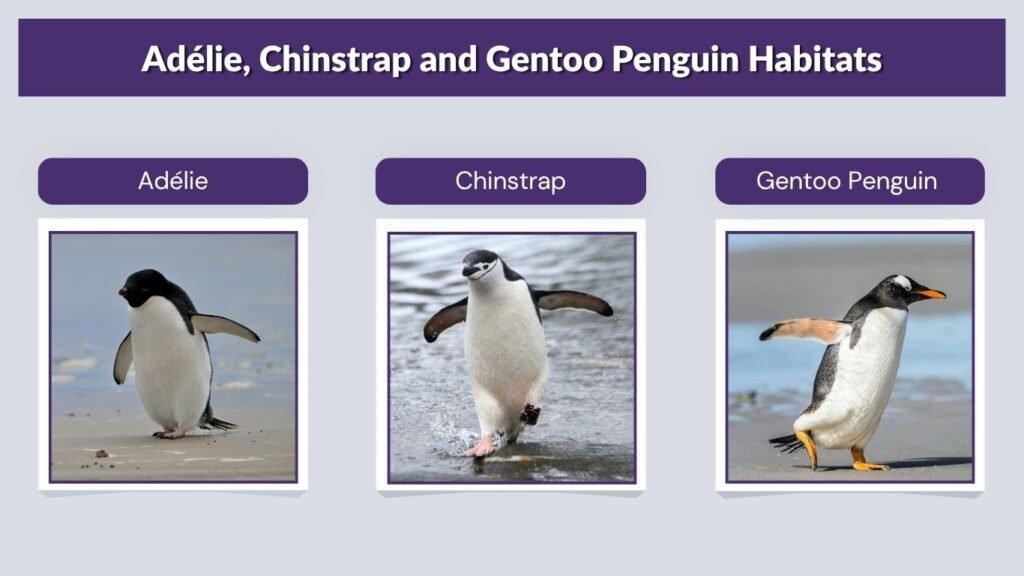
Several familiar penguin species inhabit Antarctic and sub-Antarctic regions but use somewhat different environments. Adélie penguins are strongly associated with Antarctica, while chinstrap and gentoo penguins are particularly common around the Antarctic Peninsula and nearby islands. Access to ice-free breeding ground during summer is important for many colonies.
Adélie Penguin Habitat
Adélie penguins breed around the Antarctic coast and on nearby islands where exposed rock is available.
During winter they spend considerable time at sea among pack ice. Some individuals travel more than 1,000 kilometers from their breeding locations while moving through their marine habitat.
Gentoo Penguin Habitat
Gentoo penguins occupy many sub-Antarctic islands as well as the Antarctic Peninsula.
Unlike some highly migratory species, many gentoo populations remain relatively close to their breeding islands throughout the year. They generally breed on ice-free rocky or gravelly ground near the coast.
Chinstrap Penguin Habitat
Chinstrap penguins typically breed on rocky, ice-free coasts and islands around the Antarctic Peninsula and surrounding Southern Ocean.
Their colonies are often located close to productive marine feeding areas, allowing adults to make repeated trips between nesting sites and the sea while raising chicks.
African Penguin Habitat
African penguins demonstrate clearly that penguins do not need snow and ice. They inhabit coastal southern Africa, particularly South Africa and Namibia. Their environment can include rocky islands, sandy beaches, and warm coastal areas where birds require access to shade and cool ocean water.
Life on African Beaches
African penguins commonly nest in sheltered coastal locations, including burrows, vegetation, and protected depressions.
The surrounding ocean supplies fish, while land provides breeding areas.
Their distribution historically extended along the southwestern African coastline, although populations have experienced severe declines associated with food availability, habitat pressures, and other threats.
Galápagos Penguin Habitat
The Galápagos penguin is unusual because it lives near the equator. Its existence there is possible largely because cool, nutrient-rich ocean currents create productive feeding conditions around the Galápagos Islands. Rather than dealing primarily with snow, these penguins must manage intense tropical sunlight and high air temperatures.
How Penguins Survive Near the Equator
Galápagos penguins spend considerable time in cool water and use shaded coastal areas, cracks, and caves when on land.
They may hold their flippers away from the body and use other behavioral mechanisms to release excess heat.
Their habitat demonstrates how strongly penguin distribution depends on ocean conditions, not simply latitude.
Humboldt and Magellanic Penguin Habitats
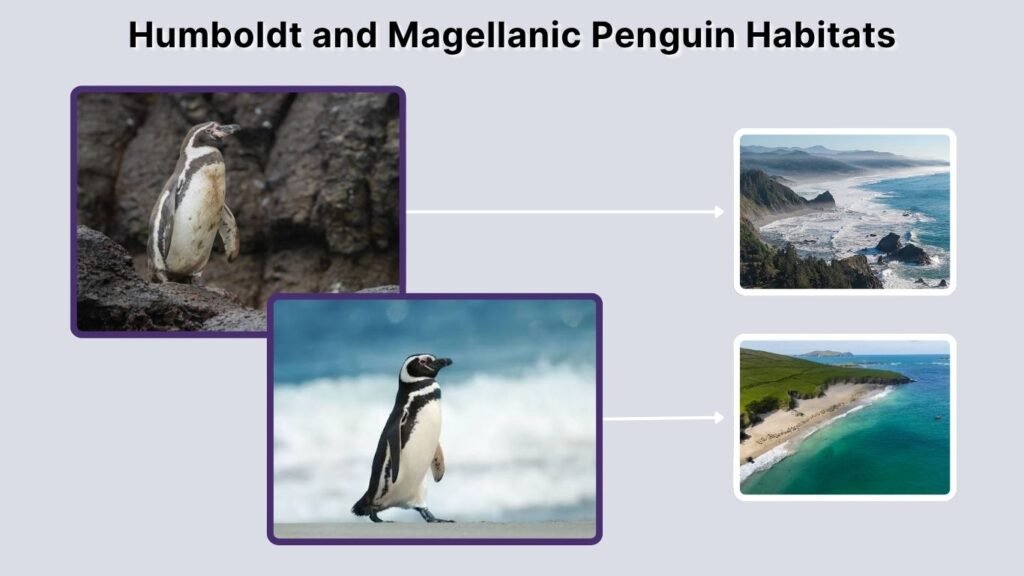
Humboldt and Magellanic penguins live along parts of South America’s coastline. Their habitats include rocky shores, islands, deserts, beaches, and burrows. Both species rely on productive marine ecosystems but occupy environments dramatically different from the frozen world associated with Antarctic penguins.
Humboldt Penguin Habitat
Humboldt penguins occur mainly along the Pacific coasts of Peru and Chile.
Cold, nutrient-rich waters of the Humboldt Current support abundant fish populations. On land, the birds may nest in rocky crevices, caves, or burrows, including sites along extremely dry desert coastlines.
Magellanic Penguin Habitat
Magellanic penguins occur around southern South America, particularly Argentina and Chile.
They often breed in large coastal colonies, nesting in burrows or beneath vegetation. After breeding, many travel long distances through surrounding marine waters while following food resources.
King and Macaroni Penguin Habitats
Many penguins occupy remote sub-Antarctic islands positioned between Antarctica and more temperate southern regions. King and macaroni penguins are prominent examples. Their colonies may contain thousands of birds and are usually situated near rich Southern Ocean feeding grounds.
King Penguin Habitat
King penguins breed mainly on sub-Antarctic islands.
They generally favor beaches, valleys, and relatively open coastal ground because, unlike many smaller species, they do not build conventional nests. Instead, parents carry their single egg on their feet beneath a brood pouch.
Macaroni Penguin Habitat
Macaroni penguins have a broad circumpolar distribution on sub-Antarctic islands.
They frequently breed on steep, rocky slopes and rugged coastal terrain. Large colonies can develop near areas where the surrounding ocean provides krill, fish, and other prey.
Little Blue and Yellow-Eyed Penguin Habitats
Not every penguin habitat is open rock or ice. Penguins found around Australia and New Zealand can occupy beaches, dunes, grasslands, coastal scrub, and even forested environments. These smaller species often nest in burrows or sheltered natural cavities.
Little Blue Penguin Habitat
Little penguins, also called little blue or fairy penguins, live around parts of southern Australia and New Zealand.
They typically feed at sea during the day and return to land after dark. Nesting sites may occur in burrows, rock crevices, dunes, vegetation, or artificial nesting boxes.
Yellow-Eyed Penguin Habitat
Yellow-eyed penguins are associated with New Zealand and nearby southern islands.
They can nest in coastal forest and dense vegetation, making their habitat very different from crowded Antarctic colonies.
Vegetation provides shade and nesting cover while nearby marine waters supply food.
How Penguins Adapt to Their Habitats
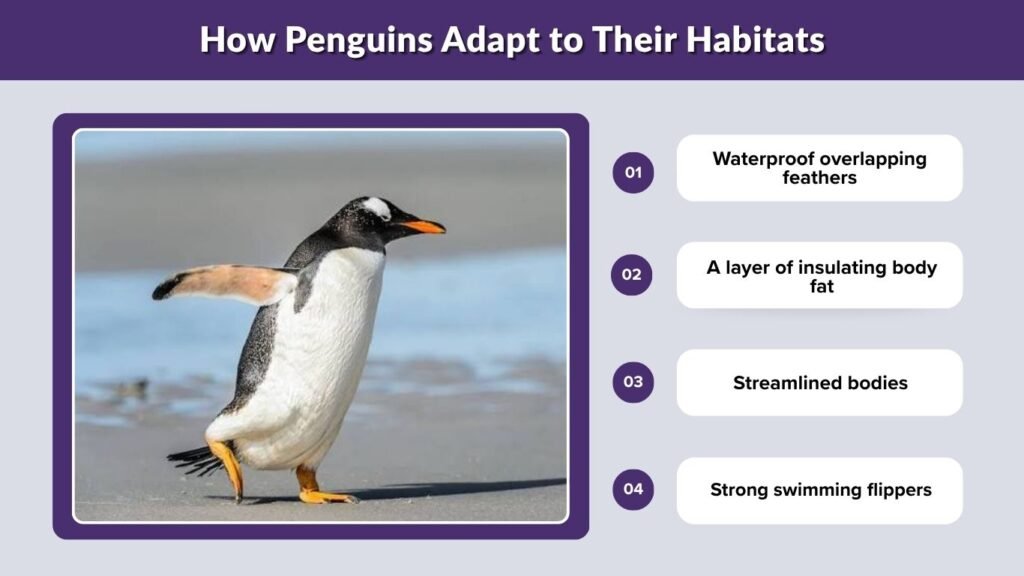
Penguin species experience everything from severe Antarctic cold to temperate sunshine. Despite these environmental differences, they share several physical features that make them excellent marine predators. Species living in especially cold or warm habitats also have additional behavioral and physiological adaptations.
Key Penguin Adaptations
Penguins survive through adaptations such as:
- Waterproof overlapping feathers
- A layer of insulating body fat
- Streamlined bodies
- Strong swimming flippers
- Webbed feet
- Countershading coloration
- Huddling in cold conditions
- Burrowing or seeking shade in warm regions
- Specialized heat-conservation systems
- Efficient diving abilities
Emperor penguins are particularly well adapted to cold conditions, while warm-climate species rely more heavily on shade and heat-loss behaviors.
Penguin Habitat Temperature
There is no single ideal penguin habitat temperature because different species occupy dramatically different climates. Emperor penguins endure the Antarctic winter, whereas African and Galápagos penguins encounter much warmer air temperatures. The common requirement is access to marine environments that provide sufficient food.
Cold vs Warm Penguin Habitats
Cold-adapted species depend on dense insulation, waterproof plumage, and behavioral strategies such as huddling.
Warm-climate penguins must avoid overheating. They may seek shade, spend more time in cool water, expose bare skin, or adjust their activity according to temperature.
This variation explains why defining penguins simply as “cold-weather birds” is inaccurate.
Threats to Penguin Habitats
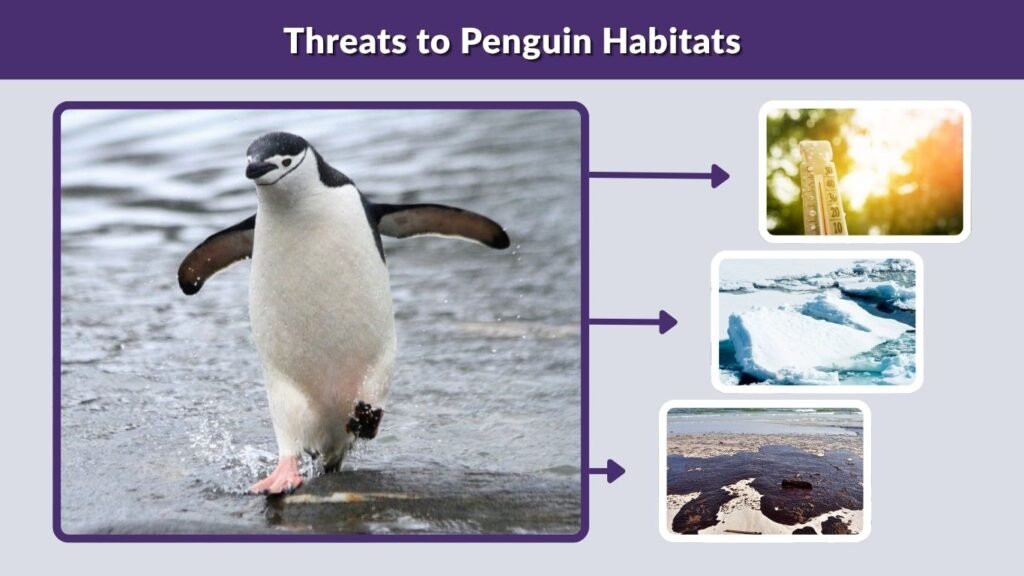
Penguin habitats are affected by both regional and global environmental pressures. The importance of each threat differs by species, but habitat loss, changing food supplies, pollution, disease, fishing activity, introduced predators, and climate change can all influence penguin populations. BirdLife reports that many penguin species are experiencing population declines.
Major Habitat Threats
Important threats include:
- Climate change
- Sea-ice loss
- Reduced prey availability
- Commercial fishing pressure
- Oil and marine pollution
- Coastal development
- Human disturbance
- Introduced predators
- Disease
- Loss of nesting areas
Emperor penguins are particularly vulnerable to declining and unstable Antarctic fast ice. In 2026, the IUCN classified the emperor penguin as Endangered, citing climate-driven sea-ice changes as the principal threat.
FAQs
1. What is the natural habitat of a penguin?
Penguins live in marine and coastal habitats throughout the Southern Hemisphere, including Antarctica, sub-Antarctic islands, South America, Africa, Australia, New Zealand, and the Galápagos Islands.
2. Do all penguins live in Antarctica?
No. Only some species live in Antarctica. Others inhabit beaches, deserts, rocky islands, grasslands, and coastal forests in warmer parts of the Southern Hemisphere.
3. What is the emperor penguin habitat?
Emperor penguins live around Antarctica and depend heavily on coastal sea ice for breeding, molting, and access to surrounding marine feeding areas.
4. Can penguins live in warm habitats?
Yes. African, Humboldt, little, and Galápagos penguins live in comparatively warm environments. They use behavioral and physical adaptations to regulate body temperature.
5. Why is the ocean important to penguin habitat?
Penguins obtain almost all of their food from the ocean. They are specialized swimmers that hunt fish, krill, squid, and other marine animals, making healthy marine ecosystems essential for their survival.