

The pileated woodpecker is one of the largest and most recognizable woodpeckers in North America. With its black body, bold white facial stripes, and brilliant red crest, this forest bird is difficult to mistake once seen clearly. People are especially curious about the pileated woodpecker’s size, loud call, differences between males and females, tree holes, nesting habits, diet, and range. Its powerful bill also makes it an important part of forest ecosystems by creating cavities that other wildlife may later use.
What Is a Pileated Woodpecker?
The pileated woodpecker (Dryocopus pileatus) is a large North American woodpecker in the family Picidae. It spends much of its time climbing tree trunks and searching dead or decaying wood for insects.
Its name comes from the Latin word referring to a cap or crest, describing the prominent red feathers on top of its head.
Pileated Woodpecker Identification
Look for these characteristics:
- Mostly black plumage
- Bright red crest
- Bold white stripe along the face and neck
- Long, heavy, dark bill
- White patches visible under the wings during flight
- Long neck and relatively long tail
- Strong feet adapted for gripping tree bark
- Large, rectangular feeding holes in trees
Pileated woodpeckers are much larger than common backyard species such as downy or hairy woodpeckers.
Pileated Woodpecker Size

Size is one of the easiest ways to identify this species.
How Big Is a Pileated Woodpecker?
Adults are generally around 40–49 cm (16–19 inches) long, with a wingspan of approximately 66–75 cm (26–30 inches).
They can appear nearly crow-sized when seen flying through the forest.
Their large size allows them to excavate deeply into dead trees and fallen logs while searching for insects.
Pileated Woodpecker Call and Sound
The pileated woodpecker produces some of the loudest and most distinctive woodpecker sounds in North American forests.
What Does a Pileated Woodpecker Sound Like?
Its best-known call is a loud series of ringing notes often described as:
“kuk-kuk-kuk-kuk-kuk.”
The call may rise and fall in intensity and can carry over a considerable distance.
Pileated woodpeckers also drum loudly on trees, dead branches, utility poles, or other resonant surfaces.
Why Do Pileated Woodpeckers Drum?
Drumming is primarily a form of communication rather than feeding.
Birds use it to:
- Advertise territory
- Communicate with a mate
- Warn competing woodpeckers
- Attract a potential mate
When searching for insects, they produce more irregular chopping and hammering sounds.
Male vs Female Pileated Woodpecker
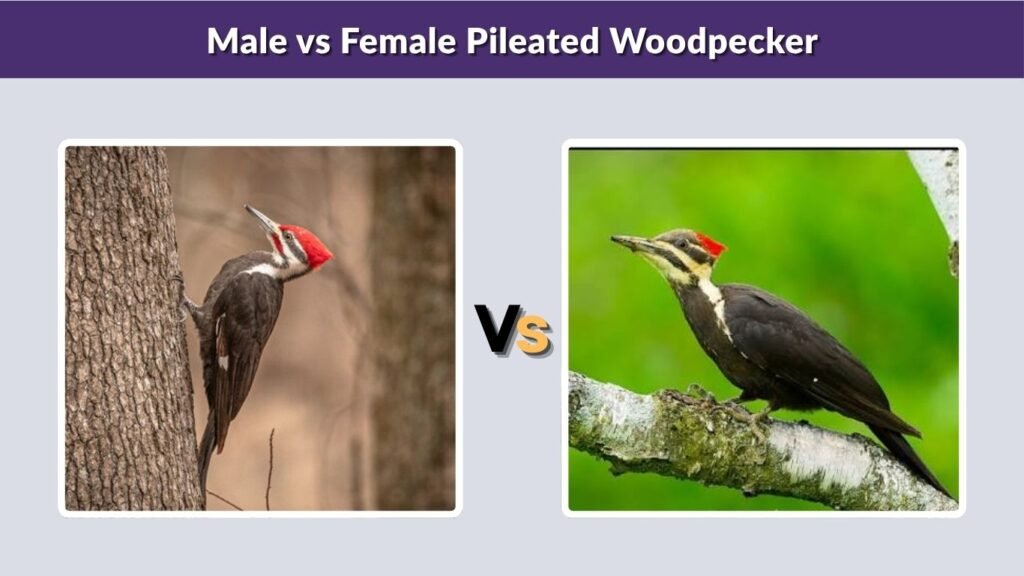
Male and female pileated woodpeckers look very similar, but the head provides several useful clues.
Male Pileated Woodpecker
The male has:
- A red crest extending toward the bill
- A red stripe along the cheek, often called a mustache or malar stripe
- Black-and-white facial markings
Female Pileated Woodpecker
The female also has a bright red crest, but the forehead is generally darker, and her cheek stripe is black rather than red.
From a distance, sex can be difficult to determine. A close view of the face is usually needed.
Juvenile Pileated Woodpecker
Young pileated woodpeckers resemble adults soon after leaving the nest.
Their plumage may appear slightly duller, and their crests may be shorter or less neatly shaped. Juveniles can sometimes be seen following adults while learning where and how to find food.
Parents continue feeding young birds for a period after they leave the nest.
Pileated Woodpecker Habitat
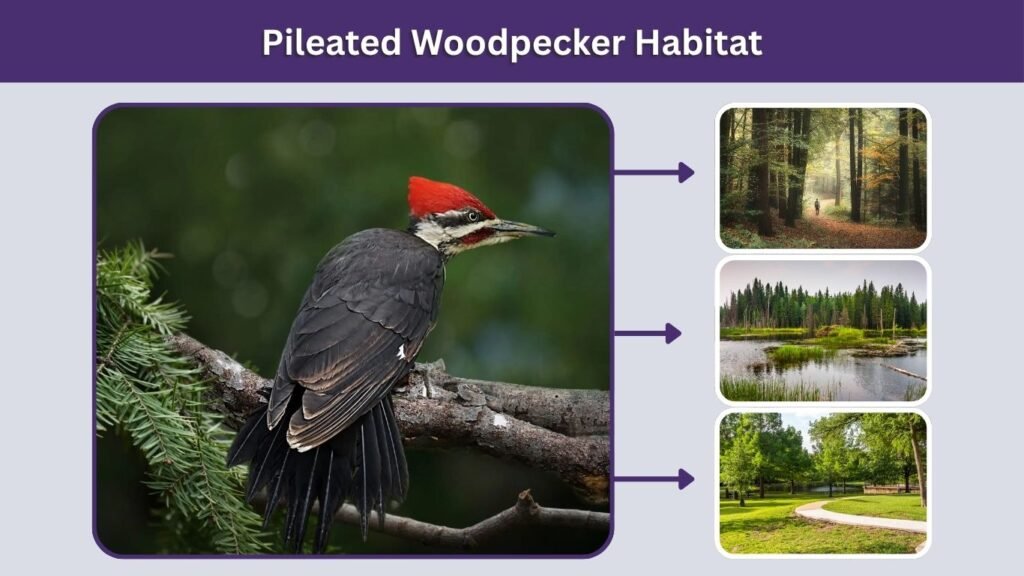
Pileated woodpeckers are strongly associated with wooded habitats containing large mature trees and dead wood.
Where Do Pileated Woodpeckers Live?
Common habitats include:
- Mature deciduous forest
- Mixed forest
- Wooded swamps
- Forest edges
- Large suburban woodlots
- Parks with mature trees
- Areas containing standing dead trees
Dead and decaying wood is especially valuable because it supports ants and beetle larvae while also providing nesting and roosting sites.
Pileated Woodpecker Range
Pileated woodpeckers occur across much of eastern North America, southern Canada, parts of the northern United States, and portions of the Pacific Northwest.
They can be found in states such as Florida, Michigan, and Ohio as long as appropriate forest habitat remains.
Unlike migratory birds, pileated woodpeckers generally remain within their territories throughout the year.
What Do Pileated Woodpeckers Eat?
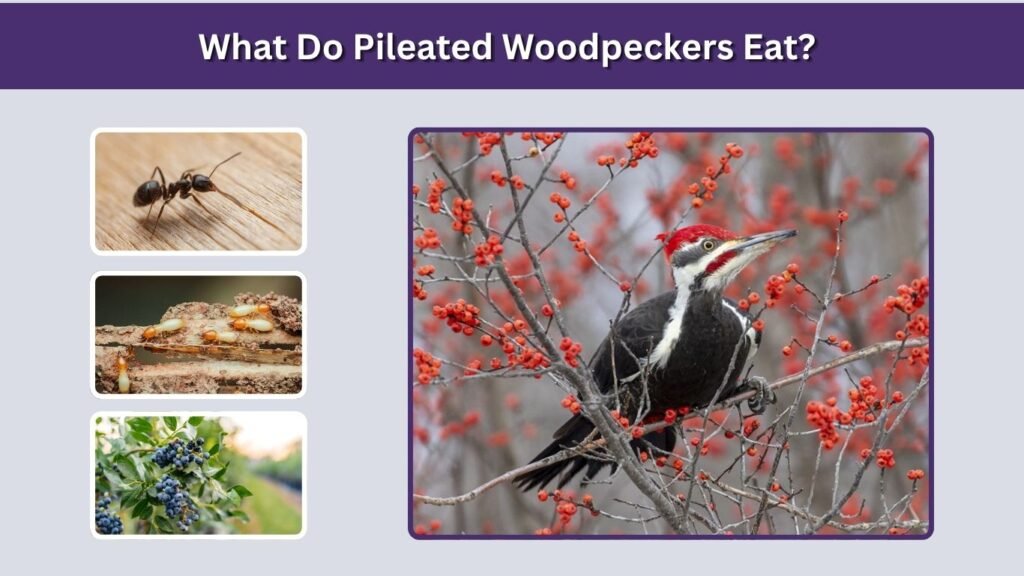
Pileated woodpeckers are primarily insect eaters, although they also consume fruits and other foods.
Pileated Woodpecker Diet
Their diet can include:
- Carpenter ants
- Other ants
- Beetle larvae
- Wood-boring insects
- Termites
- Caterpillars
- Berries
- Wild fruits
- Nuts
Carpenter ants are one of their most important foods.
A woodpecker may tear deeply into decaying wood and then use its long tongue to remove insects from tunnels and cracks.
Pileated Woodpecker Tongue
The tongue is a specialized feeding tool.
It is long and can extend far beyond the tip of the bill. Its surface helps the woodpecker reach insects hidden deep inside wood.
The bird first excavates the tree using its powerful bill and then probes the exposed tunnels with its tongue.
This combination makes it highly effective at reaching prey inaccessible to many other birds.
Pileated Woodpecker Holes in Trees

One of the most obvious signs of a pileated woodpecker is a large excavation in a dead or declining tree.
What Do Pileated Woodpecker Holes Look Like?
Feeding holes are commonly:
- Large
- Deep
- Roughly rectangular
- Surrounded by fresh wood chips
This rectangular shape is particularly characteristic.
The holes may look destructive, but woodpeckers are often targeting trees or sections of wood already weakened by decay and insect activity.
Do Pileated Woodpeckers Damage Trees?
They can create substantial holes, but healthy trees are not usually their primary target.
A pileated woodpecker repeatedly excavating one section of a tree may indicate insects or internal decay.
For homeowners, this can actually serve as a warning that the tree should be inspected for structural problems.
Pileated Woodpecker Nest
Pileated woodpeckers nest inside cavities they excavate themselves.
Nesting Behavior
Both members of a pair help create the nest cavity, usually in a dead tree or a dead section of a living tree.
The entrance is typically relatively large and may be round or somewhat elongated.
The female usually lays several white eggs. Both parents participate in incubation and feeding the chicks.
After the woodpeckers abandon a cavity, it can become valuable shelter for other wildlife, including smaller birds, squirrels, and some mammals.
Pileated Woodpecker in Flight
A flying pileated woodpecker is impressive because of its large size and contrasting markings.
White areas become particularly noticeable beneath the wings during flight.
Like many woodpeckers, its flight often consists of several strong wingbeats followed by a brief glide, producing an undulating flight pattern.
Its loud calls can sometimes alert observers before the bird itself becomes visible.
Pileated Woodpecker Feeder and Suet
Although pileated woodpeckers obtain most food naturally from trees and logs, they sometimes visit backyard feeders.
How to Attract Pileated Woodpeckers
Helpful features include:
- Large suet feeders
- Suet cakes
- Mature trees
- Standing dead trees when safe
- Fallen logs
- Natural wooded areas
- Berry-producing native plants
Because these birds are large, they need sturdy feeders with enough space to cling comfortably.
Avoid removing every dead tree from a property when it is safe to leave some standing, because dead wood can provide both food and nesting opportunities.
Pileated Woodpecker vs Ivory-Billed Woodpecker

The pileated woodpecker is frequently confused with the extremely rare or possibly extinct ivory-billed woodpecker.
Pileated woodpeckers are smaller and have different white wing patterns.
In a perched pileated woodpecker, most of the back appears black. The ivory-billed woodpecker historically showed much more white across the folded wings and lower back.
The pileated woodpecker also remains widespread and regularly observed across suitable North American forests.
How Do You Pronounce Pileated Woodpecker?
Two pronunciations are commonly heard:
“PIE-lee-ay-tid”
and
“PILL-ee-ay-tid.”
Both have long been used in English, so hearing either pronunciation is common among birdwatchers.
Interesting Pileated Woodpecker Facts
- Its scientific name is Dryocopus pileatus.
- It is one of North America’s largest woodpeckers.
- Carpenter ants make up an important part of its diet.
- Both males and females have red crests.
- Males have a red cheek stripe that females lack.
- They excavate large rectangular feeding holes.
- Their calls can carry long distances through forests.
- They remain in much of their range throughout the year.
- Old nest cavities provide homes for other wildlife.
- Their white underwing markings become obvious in flight.
FAQs
How Big Is a Pileated Woodpecker?
A pileated woodpecker is usually around 16–19 inches long with a wingspan reaching roughly 26–30 inches, making it similar in overall size to a crow.
What Does a Pileated Woodpecker Sound Like?
Its best-known call is a loud, ringing series of repeated “kuk” notes. It also produces powerful drumming sounds on trees and other resonant surfaces.
How Can You Tell a Male From a Female Pileated Woodpecker?
Males have a red cheek or mustache stripe, while females have a dark stripe in the same area. Both sexes have prominent red crests.
What Do Pileated Woodpeckers Eat?
They primarily eat ants and beetle larvae, especially carpenter ants, but they may also consume termites, other insects, berries, fruits, and nuts.
Are Pileated Woodpeckers Rare?
They are not generally considered rare across their overall North American range, although sightings depend heavily on the availability of mature wooded habitat with large trees and dead wood.
